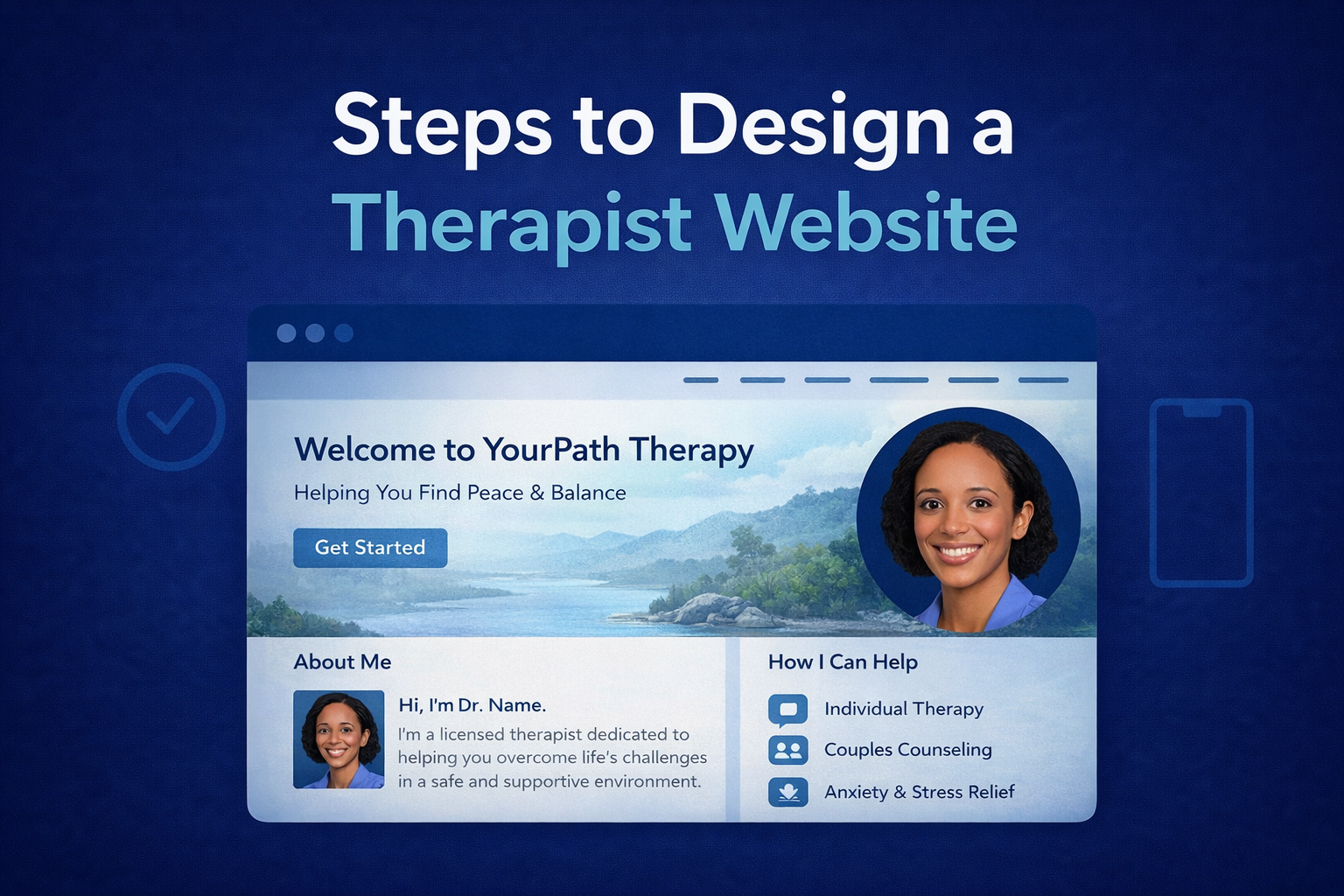
For most people, your website is the first place they decide whether you feel safe, credible, and aligned with their needs. It’s your digital office open 24/7, shaping trust before a single word is spoken.
If you want to design a therapist website that attracts the right clients, your site must do more than look professional. It must communicate clarity, emotional safety, and purpose while guiding visitors gently toward the next step.
This guide shows you exactly how to design a website for a private therapy practice that ranks in search, builds trust, and supports real growth.
Decide Between Hiring a Website Designer or Building Your Own Site
Before you move into design and structure, you need to make one strategic decision: Will you build the website yourself, or hire a therapist-focused professional?
This choice affects your time, compliance, visibility in search, and the quality of clients you attract. The right path depends on your stage of practice, budget, and growth goals.
| Aspect | Build It Yourself | Hire a Therapist Website Designer |
|---|---|---|
| Upfront Cost | Low | Higher initial investment |
| Time Required | High – weeks or months of learning and setup | Low – handled for you |
| Design Quality | Template-based, often generic | Custom, aligned with clinical tone |
| SEO Foundation | Limited or incorrect | Built for search visibility |
| HIPAA Awareness | Easy to overlook | Implemented correctly |
| Conversion Strategy | Guesswork | Intent-driven structure |
| Scalability | Difficult to expand later | Built for growth |
| Best For | New practices with tight budgets | Practices focused on growth and credibility |
Most therapists only realize what’s possible once they see it. If you want to understand what a high-converting, ethically designed therapy website actually looks like in practice, explore real examples built for mental-health professionals.
The 10 Steps to Design a Therapist Website
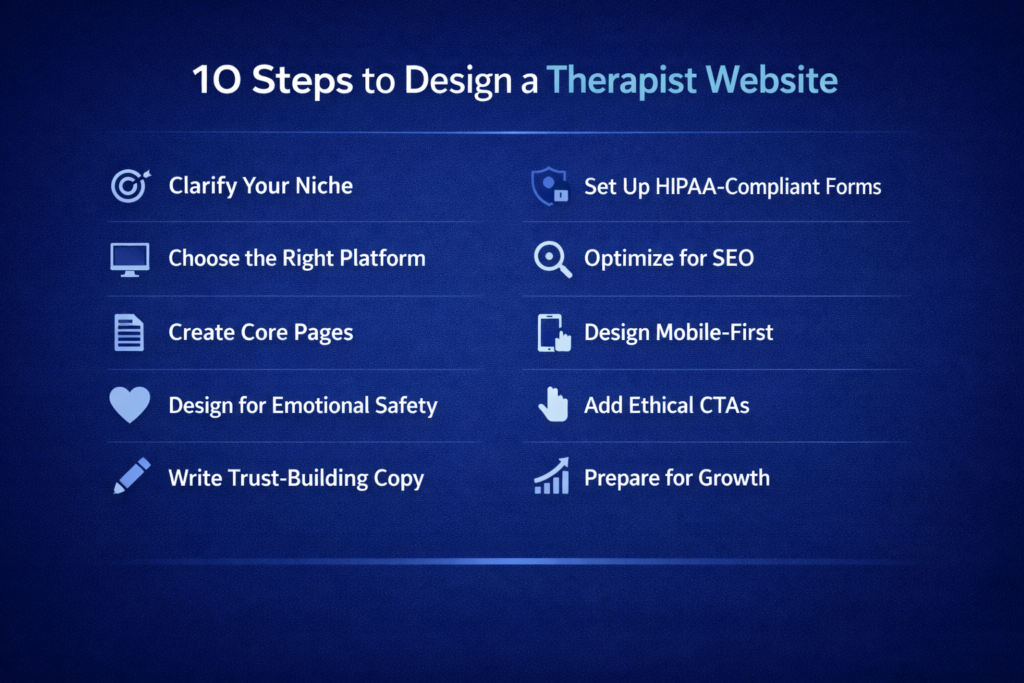
Step 1: Clarify Who You Serve and Why
A therapist website that tries to speak to “everyone” rarely resonates with anyone.
When you clearly define who you serve, couples, trauma survivors, neurodivergent adults, and high-achieving professionals, your website becomes instantly more relevant. This improves both user trust and search visibility.
Search engines reward clarity. A focused site is easier to rank because your content aligns with real search behavior such as “EMDR therapist for trauma” or “couples counselor in Austin.”
Your goal is simple:
Make the right client feel seen in the first 10 seconds.
Step 2: Choose a Platform Built for Growth
Your platform determines how flexible, visible, and scalable your website can be.
- WordPress – Best for long-term growth, SEO control, and ownership
- Wix/Squarespace – Easy to start, limited to scale
If your practice is serious about growth, WordPress provides the foundation you need.
For deeper guidance, explore: Which Is The Best Website Builder For Therapists
Step 3: Create the Best Website Structure for Therapists
Structure turns a collection of pages into a guided experience.
An effective therapy website follows this emotional flow:
- Safety and clarity (Home)
- Connection and credibility (About)
- Relevance and fit (Services)
- Practical reassurance (Fees / Insurance)
- Gentle action (Contact / Book)
- Trust and compliance (Privacy & Policies)
This mirrors how anxious visitors think. It reduces cognitive load and subtly guides them toward a next step without pressure. Search engines also rely on this hierarchy to understand your services and location.
Seeing this structure in action makes it much easier to understand how flow, trust, and clarity come together.
Step 4: Design for Emotional Safety
Design is emotional before it is visual.
Use:
- Calming colors
- Clean spacing
- Human typography
- Simple navigation
Avoid corporate or medical aesthetics. Your site should feel grounded and welcoming never overwhelming.
Step 5: Write Trust-First Copy
Therapy website copy is not sales copy.
Your words should:
- Normalize hesitation
- Reflect emotional intelligence
- Clarify your therapeutic style
- Set expectations gently
Avoid buzzwords and promises. Write the way you speak in session clear, grounded, human.
Strong copy answers the questions clients are afraid to ask:
- “Will I be judged?”
- “Is this right for me?”
- “What actually happens in therapy?”
When your site answers these, trust forms before contact.
Step 6: Build HIPAA-Aware Contact Paths
Trust is built in the details.
- Use secure forms
- Avoid collecting PHI in basic tools
- Choose BAA-compliant platforms
- Display privacy language clearly
Your contact process should feel safe, simple, and respectful.
Step 7: Optimize for Ethical SEO
To design a therapist website that search engines understand, you must balance visibility with integrity.
Focus on:
- Local and service-based pages
- Clear titles and meta descriptions
- Content that answers real questions
Learn more here: SEO For Therapists 2026 Guide
Ethical SEO ensures your practice is found by people actively seeking help without sounding commercial.
Step 8: Design Mobile-First
Most therapy searches happen on phones, often in moments of vulnerability.
Your mobile design must:
- Load in under 3 seconds
- Show key information immediately
- Use tap-friendly buttons
- Keep forms short
If it’s hard to use, it feels unsafe. Mobile usability directly impacts both rankings and inquiries.
Step 9: Add Ethical Conversion Elements
Conversions don’t have to feel commercial.
Use:
- “Request a Consultation”
- “Ask a Question”
- “See If We’re a Fit”
Support them with:
- Credentials
- Professional affiliations
- Gentle reassurance near forms
Your goal is not urgency it’s permission.
Step 10: Prepare for Growth
Your site should support:
- New services
- Group practice expansion
- Educational resources
- Long-term scalability
A future-ready structure protects your investment and allows your practice to evolve without rebuilding from scratch.
FAQ’s
-
Which is the best platform to design a therapist website?
For most therapists, WordPress is the best choice. It offers full ownership, advanced SEO control, and the flexibility to grow with your practice.
-
How much does it cost to design a therapist website?
Costs range from a few hundred dollars (DIY) to several thousand for a professional build. A well-built site pays for itself through consistent inquiries.
-
Do therapist websites need to be HIPAA compliant?
Yes. Any site that collects client information should use secure, HIPAA-aware tools. Using the wrong forms or email systems can expose sensitive data.
-
How long does it take to design a therapy website?
DIY sites may take months. A professional, therapist-focused website typically launches in 3–6 weeks.
-
Can a therapist website really bring in new clients?
Yes. When structured correctly, your website becomes your primary referral engine—ranking in local searches and guiding high-intent visitors toward contact.
Conclusion – Your Website Should Work as Hard as You Do
Your website is not just a marketing asset; it is the digital extension of your clinical presence.
When you design a therapist website with intention, you are not “selling” therapy. You are creating a space that helps people feel seen, understood, and safe enough to take a first step. Every element structure, language, design, and flow either builds trust or creates friction.
A well-designed therapy website works quietly in the background. It answers questions before they’re asked. It filters the right clients. It prepares people emotionally for reaching out. And it supports your practice even when you’re fully booked.
Whether you build it yourself or partner with a specialist, what matters is this: Your website should reflect the same care, clarity, and professionalism you bring to every session.
Design it with purpose, and it will work for you, long after the screen goes dark.