
If you’re a therapist, psychologist, counselor, or group practice owner, you may be wondering whether ADA compliance is something you should consider or something you must do. Many mental health professionals assume accessibility laws apply only to large hospitals or government organizations. In reality, therapist websites are increasingly subject to ADA scrutiny, and accessibility is no longer optional.
Your website is often the first interaction a potential client has with your practice. If that experience excludes people with disabilities, visual, auditory, cognitive, or motor, it can create legal exposure, ethical concerns, and lost client opportunities. This guide explains how ADA compliance applies to therapists, what risks exist, and how to move forward responsibly.
So yes. If you’re a therapist with a public-facing website, ADA accessibility applies to you regardless of practice size.
The ADA Requires Therapist Websites to Be Accessible (Here’s Why)
The Americans with Disabilities Act (ADA) was designed to prevent discrimination against individuals with disabilities in places of public accommodation. While the law predates modern websites, courts now routinely interpret websites as extensions of public-facing healthcare services.
Therapy practices qualify as places of public accommodation because they:
- Provide healthcare services
- Accept online inquiries
- Offer intake forms, scheduling, or teletherapy access
- Market services to the public
Courts increasingly view inaccessible websites as a barrier to care. For therapists, this means your website is not just marketing, it is part of your clinical access pathway.
Are There Any Mandatory ADA Guidelines for Websites?
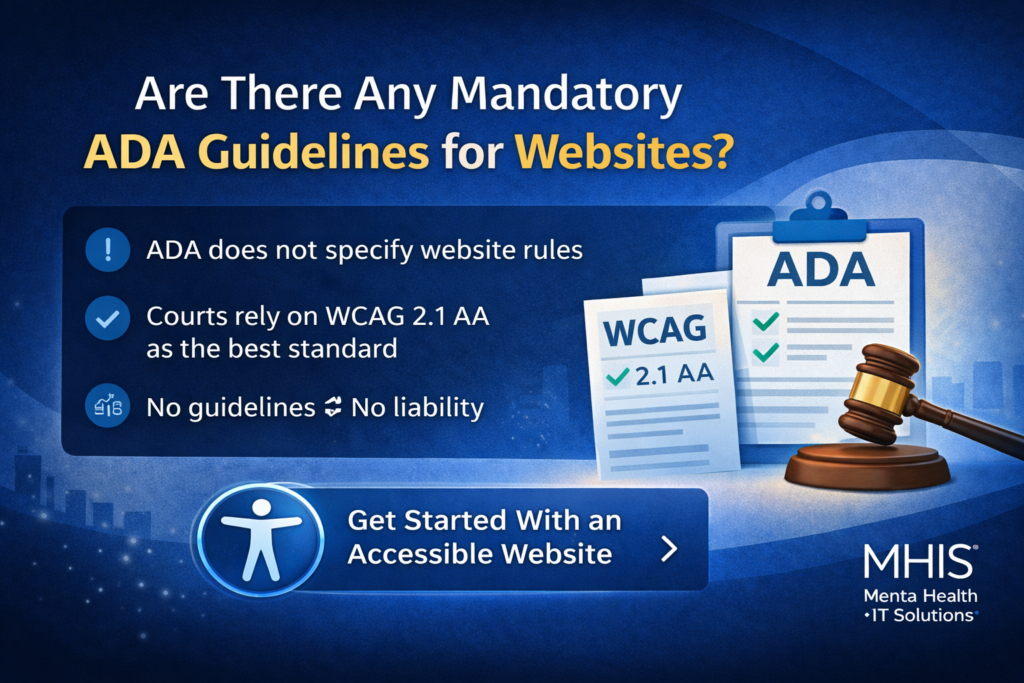
One of the most common misconceptions is that “ADA doesn’t specify website rules, so compliance isn’t required.” This assumption has led many therapists into preventable legal trouble.
While the ADA does not list technical website requirements, enforcement bodies and courts rely on the Web Content Accessibility Guidelines (WCAG) to determine compliance. Most rulings reference WCAG 2.1 Level AA as the accepted standard.
In practice:
- ADA establishes the obligation
- WCAG defines the technical benchmark
- Ignoring WCAG does not reduce liability
Healthcare websites, including therapist sites, are often held to higher standards due to the vulnerable populations they serve.
Understanding ADA Compliance for Therapist Websites
Why Do Therapist Websites Need to Be Accessible?
Accessibility affects more clients than many therapists realize. Your website may be used by:
- Individuals with visual impairments using screen readers
- Clients with ADHD or cognitive processing challenges
- Trauma survivors are sensitive to cluttered or confusing layouts
- Older adults navigating without advanced technical skills
- Users relying on keyboard-only navigation
If your site creates friction or confusion, potential clients may leave without contacting you often without explanation. Accessibility supports clarity, safety, and trust, all core values in mental healthcare.
What Is WCAG (and Why Therapists Should Care)?
WCAG (Web Content Accessibility Guidelines) is a global standard developed by the World Wide Web Consortium (W3C). It outlines how websites can be made accessible to people with disabilities.
WCAG is built on four principles:
- Perceivable – Content must be readable by assistive technologies
- Operable – Navigation must work without a mouse
- Understandable – Layout and content must be predictable
- Robust – Compatible with assistive tools and devices
For therapists, WCAG impacts:
- Page structure and headings
- Color contrast and font size
- Intake and contact forms
- Videos, audio, and downloadable files
- Mobile and tablet usability
Most ADA-related website cases reference WCAG 2.1 AA as the compliance threshold.
What Types of Therapy Practices Must Comply With the ADA?
ADA obligations are not limited to large clinics. Practices that should prioritize accessibility include:
- Solo private practices
- Group practices and clinics
- Teletherapy providers
- Therapists using online intake or booking
- Practices advertising services online
Even a small, home-based practice can be affected if its website is publicly accessible.
ADA vs Section 508 Compliance: What’s the Difference?
- ADA (Title III): Applies to private businesses and healthcare providers
- Section 508: Applies to federal agencies and federally funded entities
Most therapists fall under ADA, not Section 508. However, both rely on WCAG standards, which is why WCAG compliance is widely adopted.
Common Examples of Poor Web Accessibility on Therapist Websites
Many therapist websites unintentionally create barriers, including:
- Intake forms without screen-reader labels
- Low-contrast color palettes
- Images without alt text
- Videos without captions
- Mouse-only navigation
- Inaccessible PDFs
- Pop-ups that trap keyboard focus
These issues not only increase legal risk but also reduce inquiry rates and trust.
What’s the Risk of Non-Compliance for Therapists?
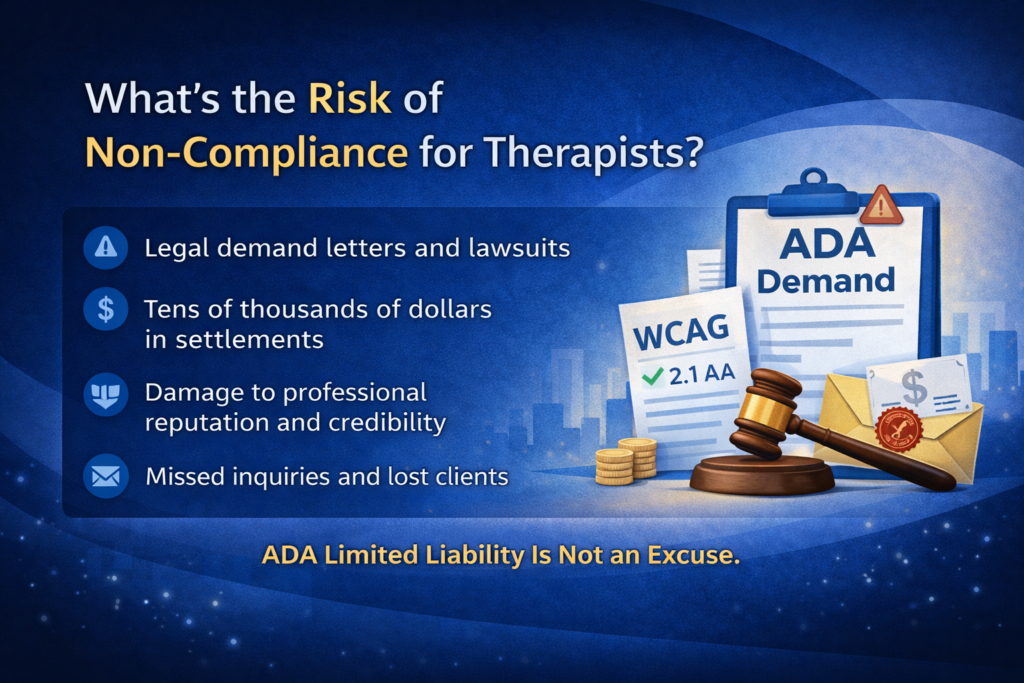
Ignoring accessibility can lead to serious consequences, even for well-intentioned therapists.
Risks include:
- ADA demand letters and lawsuits
- Settlement costs often range from thousands to tens of thousands of dollars
- Forced remediation under legal deadlines
- Damage to professional credibility
- Loss of trust from potential clients
- Missed inquiries from users who cannot access your site
From both a legal and ethical standpoint, accessibility is part of responsible care.
Is Your Therapy Website Putting You at Risk?
Many therapists don’t realize accessibility issues exist until a client can’t use their website—or a legal notice arrives.
A professional accessibility review can uncover compliance gaps before they become costly problems.
Request an ADA Accessibility Review
How Can Therapists Make Their Websites ADA-Compliant?
ADA compliance is not achieved through a single plugin or overlay. It requires accessible design, proper structure, and ongoing evaluation.
For a deeper breakdown of how accessibility applies specifically to mental health practices, review this detailed guide: ADA Compliant Therapist Website
ADA-Compliant Web Accessibility Checklist for Therapists
A compliant therapist website typically includes:
- WCAG 2.1 AA–aligned layout
- Proper heading hierarchy
- Screen-reader friendly navigation
- Keyboard accessibility
- High-contrast, readable typography
- Accessible contact and intake forms
- Captions for videos and audio
- Alt text for images
- Mobile accessibility
- Accessible PDFs
- Ongoing accessibility audits
Need Help Making Your Website ADA-Compliant?
ADA compliance isn’t about installing a tool—it’s about building accessibility into your website’s foundation.
Mental Health IT Solutions specializes in therapist websites aligned with WCAG 2.1 AA, healthcare usability standards, and ethical best practices.
Talk to an ADA-Compliance Specialist
Automated Tools vs Real ADA Compliance
Accessibility widgets and overlays can assist with detection, but do not guarantee compliance. Courts have repeatedly ruled that overlays alone are insufficient.
True compliance requires:
- Manual accessibility audits
- Accessible design and development
- Ongoing testing and updates
For therapists, accessibility should be part of long-term website care—not a quick fix.
How Mental Health IT Solutions Builds ADA-Compliant Therapist Websites
MHIS builds accessibility into every stage of therapist website development, including:
- WCAG 2.1 AA–aligned design
- Trauma-informed UX
- Accessible intake forms
- Keyboard and screen-reader optimization
- HIPAA-secure infrastructure
- Ongoing accessibility monitoring
This approach protects your practice while improving client experience.
FAQs
-
Do therapist websites legally have to be ADA-compliant?
Yes. While the ADA does not explicitly list website rules, courts increasingly treat therapist websites as places of public accommodation. Because therapists provide healthcare services to the public, their websites are expected to be accessible to individuals with disabilities.
-
Is ADA compliance required for solo private practice therapists?
Yes. ADA requirements are not limited to large clinics or hospitals. Solo therapists with public-facing websites, online intake forms, or booking tools can still be held responsible for accessibility barriers.
-
What accessibility standard do courts use for websites?
Most courts rely on WCAG 2.1 Level AA as the accepted standard for website accessibility. Even though WCAG is not written into the ADA itself, it is widely used to measure compliance during legal disputes.
-
Can I avoid ADA issues by installing an accessibility plugin or overlay?
No. Accessibility widgets and overlays do not guarantee compliance. Courts have ruled that overlays alone do not fix underlying accessibility issues. True compliance requires proper website structure, accessible design, and manual remediation.
-
What are the biggest ADA compliance risks for therapists?
Risks include legal demand letters, costly settlements, forced website remediation, reputational damage, and lost client inquiries. Non-compliance can also conflict with ethical obligations to provide inclusive access to care.
Conclusion
ADA compliance for therapist websites is no longer a gray area. It’s a legal safeguard, an ethical responsibility, and a client care issue. An accessible website protects your practice and ensures your services are available to everyone who needs them.
Need Help Making Your Website ADA-Compliant?
ADA compliance isn’t about installing a tool it’s about building accessibility into your website’s foundation.
Mental Health IT Solutions specializes in therapist websites aligned with WCAG 2.1 AA, healthcare usability standards, and ethical best practices.