

Choosing the right website builder is one of the most important decisions you will make for your therapy practice. Your website is where potential clients decide whether you feel safe, professional, and trustworthy enough to contact. When someone searches for “therapist near me” or “online counseling,” the platform behind your site determines how quickly you load, how easily you are found on Google, and how confidently visitors move toward booking.
In today’s search-driven landscape, most clients discover therapists online before any referral ever happens. That means your website is not just informational; it is the backbone of your visibility and growth. A strong therapist website must be HIPAA-aware, SEO-ready, mobile-friendly, and built in a way that can evolve as your practice grows from solo to group, from local to telehealth.
Not all website builders are created with these needs in mind. Some prioritize ease but limit long-term flexibility. Others offer beautiful design but fall short on SEO or compliance. The right platform should support ethical marketing, protect client data, and give you full control over your digital presence.
What Therapists Should Look for in a Website Builder?
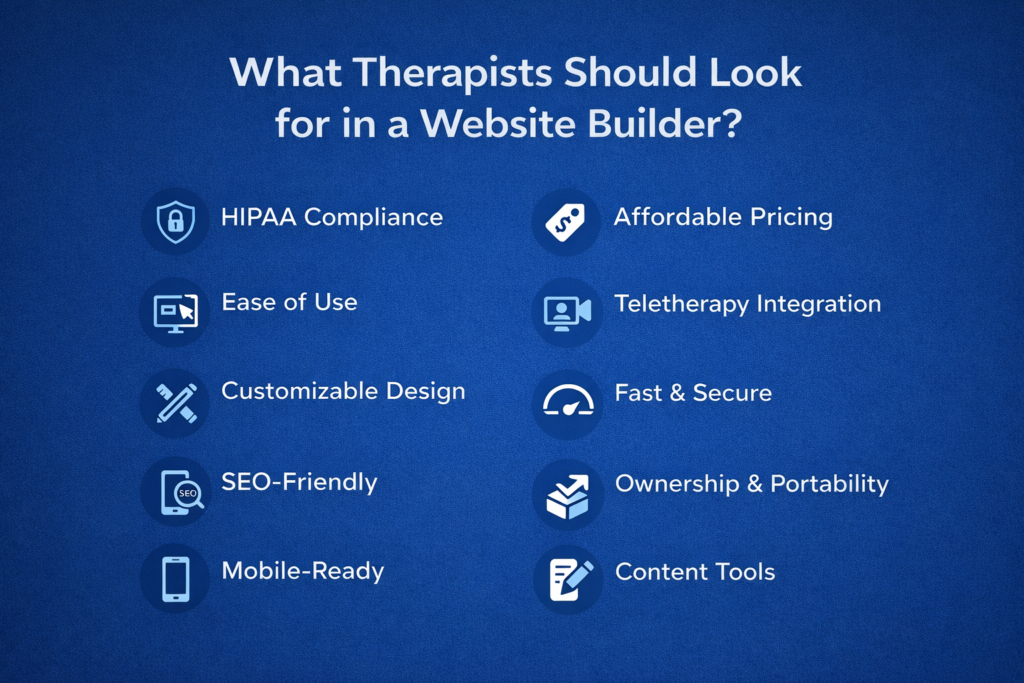
Not all website builders are created equal. As a therapist, your site has unique needs, privacy, empathy-driven design, and integration with telehealth or scheduling tools.
Here’s what to prioritize:
1. HIPAA Compliance Capabilities
Your website may handle sensitive client information through contact or intake forms. Ensure the platform supports secure hosting, SSL encryption, and HIPAA-compliant form tools.
For deeper insight, see HIPAA-Compliant Web Design for Mental Health Therapists.
2. Ease of Use
If you’re not tech-savvy, opt for a platform with drag-and-drop editing. It should allow you to add pages, blogs, and service updates easily.
3. Customizability & Branding
Therapy is personal. Your website should reflect your tone and values — colors, logo, fonts, and imagery should align with your brand.
4. SEO Features
Ranking locally for search terms like “trauma therapist in Austin” or “couples counseling San Diego” requires on-page SEO tools. A builder that supports title tags, schema markup, and blog optimization is essential. For deep insights visit – SEO for Therapists.
5. Mobile-Friendly Templates
Over 70% of users browse therapy sites from mobile devices. Responsive design ensures seamless browsing across all screens.
6. Teletherapy Integrations
Choose a platform that allows embedding or integration with Zoom, doxy.me, SimplePractice, or TherapyNotes.
7. Speed & Performance
Fast websites improve SEO and user experience. Aim for platforms that provide CDN support and lightweight templates.
8. Affordability & Scalability
Start small, but ensure your builder supports growth new locations, more team members, or advanced automation later.
9. Content Tools
Blogging and educational resources build trust and improve rankings. Check if your builder includes easy-to-use content tools.
10. Ownership & Portability
Some “all-in-one” platforms don’t give you full ownership. Always check if you can export or move your site freely.
Overview of Popular Website Builders for Therapists
Let’s explore the most widely used platforms among mental-health professionals:
- WordPress – Most flexible and scalable option
- Wix – Easiest for beginners
- Squarespace – Best for visually aesthetic brands
- Webflow – Best for advanced custom designs
- Shopify – Ideal for selling courses, books, or wellness products
Each platform has strengths, but your choice depends on whether you value control, HIPAA security, or convenience most.
WordPress – The Best Overall Website Builder for Therapists
Why Therapists Prefer WordPress
WordPress powers over 40% of the web, including thousands of therapist websites. It offers unmatched flexibility, ownership, and SEO performance.
- Full control over every aspect of your website
- Integration with HIPAA-secure form plugins like FormDr, JotForm HIPAA, or Hushmail
- Seamless connection with EHRs, calendars, and payment tools
- Superior SEO tools via RankMath or Yoast
- Long-term scalability for growing practices
Pros
- HIPAA-ready hosting available (through platforms like Atlantic.Net or LuxSci)
- Elementor and Divi builders make drag-and-drop editing simple
- Thousands of healthcare-specific templates
- Easy to integrate telehealth booking and contact forms
- Supports comprehensive blog systems for content marketing
Cons
- Requires developer support for setup and maintenance
- Needs ongoing security and plugin updates
Best Use Case – Therapists seeking full customization, control, SEO growth, and HIPAA readiness.
Wix – Best for Simple, DIY Therapist Websites
Pros
- Intuitive drag-and-drop interface
- Hundreds of ready-made templates for wellness and healthcare
- Built-in appointment scheduler
- Affordable monthly plans
Cons
- Limited SEO flexibility
- Not HIPAA-compliant
- Hard to migrate later
Best Use Case – Solo practitioners who need a professional site quickly without technical complexity or large budgets.
Squarespace – Best for Aesthetics & Branding
Squarespace stands out for its minimalist, modern designs and ease of content management.
Pros
- Clean, design-centric templates
- Built-in blogging platform
- Consistent mobile responsiveness
Cons
- Weak for competitive SEO
- No HIPAA-compliant hosting
- Limited third-party integrations
Best Use Case – Therapists prioritize brand identity and aesthetic appeal over deep customization or advanced technical control.
Webflow – Best for Premium, Modern Designs
Webflow allows agency-level design with dynamic animations and custom layouts.
Pros
- Pixel-perfect design freedom
- High-performance hosting
- Great for brand-driven practices
Cons
- Learning curve for non-designers
- Requires developer support
- No HIPAA compliance out of the box
Best Use Case – Clinics or group practices that need high-end custom visuals or interactive storytelling sites.
Shopify – Best for Selling Therapy Resources, Courses & Digital Products
Shopify is not designed for traditional therapy practice websites, but it excels when your goal is to sell digital or physical products such as courses, workbooks, guided journals, group programs, or wellness resources under your professional brand.
It’s widely used by creators, educators, and clinicians who want to monetize expertise beyond 1:1 sessions.
Pros
- Purpose-built for selling digital and physical products
- Secure checkout and payment processing
- Easy setup for courses, downloads, and memberships
- Scales well for high-volume sales
- Reliable hosting and performance
Cons
- Not built for therapy practice websites
- No HIPAA-compliant form handling
- Limited SEO flexibility compared to WordPress
- Not ideal for service-based booking workflows
Best Use Case – Therapists creating and selling online courses, workbooks, group programs, or wellness products rather than promoting a clinical practice or booking therapy sessions.
Side-by-Side Comparison Table
| Platform | HIPAA Readiness | SEO Strength | Customization | Ease of Use | Integrations | Ownership | Ideal For |
|---|---|---|---|---|---|---|---|
| WordPress | ✅ Yes (with HIPAA hosting) | ⭐⭐⭐⭐⭐ | ⭐⭐⭐⭐⭐ | ⭐⭐⭐ | ✅ Extensive | ✅ Full | Scalable private practices |
| Wix | ❌ No | ⭐⭐ | ⭐⭐ | ⭐⭐⭐⭐ | ⚙️ Limited | ❌ Partial | Solo therapists, startups |
| Squarespace | ❌ No | ⭐⭐⭐ | ⭐⭐⭐ | ⭐⭐⭐⭐ | ⚙️ Moderate | ❌ Partial | Brand-focused therapists |
| Webflow | ❌ No | ⭐⭐⭐⭐ | ⭐⭐⭐⭐⭐ | ⭐⭐ | ⚙️ Advanced | ✅ Yes | Premium design seekers |
| Shopify | ❌ No | ⭐⭐⭐ | ⭐⭐ | ⭐⭐⭐ | ✅ E-commerce | ✅ Full | Therapists selling digital products |
HIPAA Considerations for Therapist Websites
HIPAA compliance isn’t optional for therapy sites that collect client data. Violations can result in heavy fines or reputational damage.
Key Points
- Avoid collecting PHI via standard contact forms unless encrypted.
- Always use SSL (HTTPS) and secure hosting.
- Only work with vendors offering BAA (Business Associate Agreements).
- Recommended tools: FormDr, JotForm HIPAA, Google Workspace BAA, or Hushmail.
WordPress with HIPAA-compliant hosting remains the best route for private practices handling client data.
For a broader understanding, check HIPAA-Compliant Website Development.
Website Builders to Avoid for Therapists
Avoid platforms that:
- Lack HTTPS security
- Restrict SEO customization
- Don’t allow export or migration
- Offer suspiciously cheap hosting or templates
- Store data outside U.S. servers
These risks lead to poor rankings, security issues, and long-term vendor lock-in.
FAQ – Common Questions Therapists Ask
1. Which website builder is best for therapists?
WordPress is the best overall choice for therapists because it offers full ownership, strong SEO capabilities, and flexible integrations when paired with HIPAA-aware hosting and tools.
2. Are Wix or Squarespace HIPAA-compliant?
No. Wix and Squarespace do not support HIPAA compliance or Business Associate Agreements (BAAs), making them unsuitable for sites that collect protected health information.
3. Can I use Shopify for my therapy practice?
Shopify is ideal for selling digital products like courses and workbooks, but it is not built for clinical appointment booking or HIPAA-compliant client intake.
4. Do I need technical support to manage a WordPress site?
Initial setup and compliance configuration are best handled by a developer or specialist, but many therapists can manage content updates and SEO tasks independently afterward.
5. What’s the biggest mistake therapists make when choosing a platform?
Choosing a website builder based solely on ease or price without considering SEO visibility, compliance, and long-term scalability can lead to costly rebuilds later.
Conclusion: Which Website Builder Is Best for Therapists?
Choosing the right website builder is not just a technical choice it defines how your practice is discovered, trusted, and experienced online. While platforms like Wix, Squarespace, Shopify, and Webflow each serve specific purposes, they all come with limitations for long-term growth, compliance, and visibility in the mental health space.
For most therapists, WordPress stands out as the best overall website builder. It offers full ownership, unmatched SEO performance, and the flexibility to create a HIPAA-aware, growth-ready digital presence. With the right hosting and tools, WordPress supports everything a modern therapy practice needs from secure forms and telehealth integrations to local search dominance and scalable content marketing.
Your website should evolve with your practice. WordPress gives you that freedom without locking you into a platform that outgrows you. It’s not just a website builder; it’s a foundation for sustainable, ethical growth.