

For many therapists, accepting insurance feels like a necessary trade-off. It provides a steady flow of clients but often at the cost of autonomy, income stability, and long-term sustainability. Low reimbursement rates, administrative burden, delayed payments, and limited clinical flexibility push many clinicians toward burnout.
At the same time, demand for private-pay therapy is growing. Clients increasingly seek specialized, personalized, and high-quality mental health care, and they are willing to pay for it.
The question is no longer “Is private-pay therapy possible?”
It’s “How do I consistently attract the right clients without relying on insurance?”
This guide walks you through ethical, proven, and sustainable strategies to grow a private-pay therapy practice without racing to the bottom on price or volume.
Why More Therapists Are Moving Away From Insurance Panels

Insurance-based practices often rely on high session volume to remain profitable. Over time, this model creates strain on both clinicians and clients.
Common challenges include:
- Stagnant reimbursement rates despite rising costs
- Extensive documentation and utilization reviews
- Delayed or denied payments
- Limited session flexibility
- Reduced time for deep clinical work
Private-pay practices, by contrast, allow therapists to:
- Set their own fees
- Control caseload size
- Focus on outcomes instead of quotas
- Specialize clinically without restrictions
Importantly, private-pay does not mean serving only wealthy clients. It means working with clients who value therapy, prioritize mental health, and seek a specific type of care not just coverage.
Feeling stuck with insurance-driven volume instead of aligned clients?
Explore why your current marketing may be attracting the wrong inquiries.
The Mindset Shift: From “General Therapist” to Clear Specialist
One of the biggest barriers to attracting private-pay clients is unclear positioning.
Many therapists market themselves as helping “everyone with everything.” While inclusive, this approach makes it difficult for a potential client to recognize why you are the right fit especially when they are paying out of pocket.
Why Niches Matter for Private-Pay Growth
Private-pay clients are not shopping for the cheapest option. They are searching for someone who understands their specific experience.
Examples of high-demand private-pay niches include:
- Trauma, EMDR, and somatic therapy
- Couples therapy and relationship intensives
- Anxiety, OCD, and panic disorders
- ADHD and executive functioning
- Burnout, high-achievers, and professionals
- Identity, life transitions, and complex grief
A clear niche allows you to:
- Speak directly to the client’s lived experience
- Reduce price resistance
- Increase trust and perceived value
- Convert fewer inquiries into more aligned clients
Niche clarity is the foundation of every successful private-pay strategy that follows.
Your Website Is the Core of Private-Pay Client Acquisition
For insurance-free growth, your website must function as more than an online brochure. It is your primary conversion system.
Private-pay clients usually visit your website before contacting you. They are evaluating:
- Do you understand my problem?
- Do I feel safe here?
- Is this worth the investment?
If your website cannot answer those questions clearly, visitors will leave even if you are clinically excellent.
What a Private-Pay Therapist Website Must Do
A high-performing private-pay website should:
- Clearly state who you help and how
- Lead with outcomes and transformation, not credentials alone
- Explain your approach in human, accessible language
- Normalize private-pay therapy without defensiveness
- Guide visitors toward a clear next step
Key elements include:
- Strong above-the-fold messaging
- Service-specific pages for each specialty
- Thoughtful pricing language (without listing fees if you prefer)
- Trust signals: licensure, experience, values, approach
- Simple, secure contact forms
A generic website attracts price shoppers. A positioned website attracts aligned clients.
Your website should attract private-pay clients—not price shoppers.
Build a private-pay therapy website designed to convert the right inquiries.
Using SEO to Attract Private-Pay Clients (Not Low-Intent Traffic)

Search engine optimization is one of the most effective long-term strategies for private-pay growth when done correctly.
The mistake many therapists make is targeting keywords that attract insurance-focused or price-sensitive searches.
Private-Pay SEO Is About Intent, Not Volume
Instead of broad terms like “therapist near me,” private-pay SEO focuses on high-intent, niche-specific searches, such as:
- “Trauma therapist for professionals”
- “Private couples therapy near me”
- “EMDR therapist for complex trauma”
- “Anxiety therapist for high-functioning adults”
These searches come from people actively looking for specialized care and willing to invest.
What Private-Pay SEO Includes
- Dedicated service pages for each specialty
- Location-based optimization without sounding generic
- Educational content that builds trust and authority
- Internal linking that supports topical relevance
- Clear, ethical messaging around private-pay care
SEO works best when combined with a strong website experience. Traffic without clarity does not convert.
Google Business Profile: Still Powerful for Private-Pay Therapists
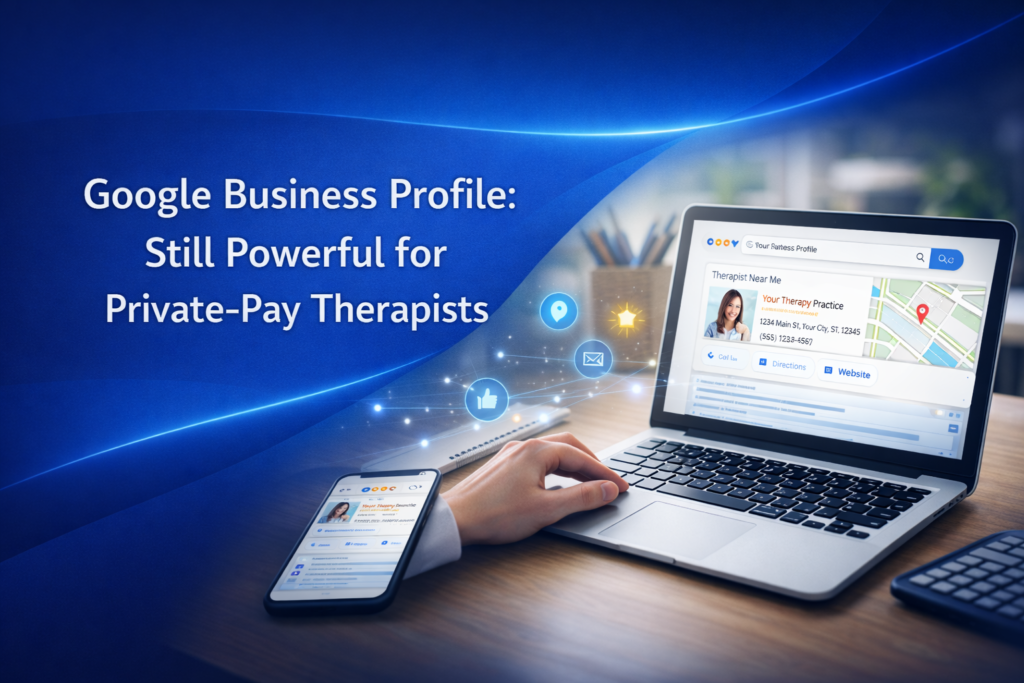
Many therapists assume Google Business Profile (GBP) only works for insurance-based practices. That is not true.
Private-pay clients still use Google to find local therapists they just evaluate them differently.
How Private-Pay Therapists Should Use GBP
Your profile should emphasize:
- Specialty services, not insurance acceptance
- Professional tone and trust-building language
- Clear practice focus and population served
Client reviews are especially powerful. At the same time, you cannot solicit specific content, reviews that mention feeling understood, supported, and respected carry more weight than those referencing cost.
GBP works best when aligned with your website and content strategy, not in isolation.
Reframing Private-Pay as a Premium and Ethical Choice
One of the most important shifts in private-pay marketing is how you talk about it.
Private-pay should not be framed as a limitation or apology. It should be positioned as an intentional model that supports better care.
What Private-Pay Allows You to Offer
- Longer or more flexible sessions
- Deeper therapeutic work
- Faster access and shorter wait times
- Greater privacy and discretion
- Tailored treatment plans
Your website copy should reflect confidence not defensiveness.
Clients do not need to be convinced that insurance is bad. They need to understand why your care is different.
Content That Pre-Qualifies Clients Before They Contact You
Private-pay practices benefit enormously from content that educates clients before they reach out.
Well-written content reduces mismatched inquiries and increases alignment.
Content Ideas That Support Private-Pay Growth
- “Is private therapy worth it?”
- “Who benefits most from private-pay therapy?”
- “What to expect from a specialized therapy practice”
- “Why some therapists don’t accept insurance”
These articles:
- Address common concerns upfront
- Build trust without pressure
- Filter out clients who are not a good fit
Pre-qualified inquiries save time, reduce emotional labor, and improve clinical satisfaction.
Building Trust Without Competing on Price
Private-pay clients are not comparing therapists like products but they are evaluating trustworthiness.
Trust signals matter.
Key Trust Signals for Private-Pay Websites
- Professional, modern design
- Clear navigation and readability
- Thoughtful tone and language
- Secure, HIPAA-aware forms
- Accessibility-conscious design
A cluttered, outdated, or confusing website raises doubts even if your clinical skills are strong.
Trust is often built silently, before any conversation happens.
Why Directories Alone Aren’t Enough for Private-Pay Growth
Directories can support visibility, but they are not a growth strategy on their own.
Challenges with relying solely on directories include:
- Limited control over messaging
- Price comparison behavior
- Platform dependency
- Algorithm changes outside your control
Your website, content, and SEO create owned visibility assets that compound over time.
The most sustainable practices use directories as a supplement, not a foundation.
Common Mistakes That Keep Therapists Stuck in Insurance Dependence
Many therapists want to move away from insurance but unknowingly block their own progress.
Common mistakes include:
- Trying to appeal to everyone
- Generic website copy that lacks clarity
- Avoiding conversations about value
- Targeting low-intent SEO keywords
- Weak or unclear calls to action
Private-pay growth is not about working harder. It’s about working with intention.
How Mental Health IT Solutions Helps Therapists Grow Without Insurance
Mental Health IT Solutions specializes in helping therapists transition to and scale private-pay practices—ethically and sustainably.
We support therapists with:
- Private-pay positioning strategy
- Conversion-focused website design
- SEO built for high-value client searches
- HIPAA-secure, ADA-aware development
- Ongoing optimization for long-term growth
Everything is designed specifically for mental health professionals not generic businesses.
Frequently Asked Questions
Yes. Thousands of therapists operate fully private-pay practices by focusing on specialization, clarity, and value-driven marketing.
Most therapists see meaningful progress within 6–12 months with a structured strategy. Timelines vary based on niche, location, and consistency.
Yes. They use more specific, problem-focused searches and spend more time evaluating websites before contacting a therapist.
There is no one-size-fits-all answer. Many private-pay therapists choose to explain their pricing philosophy rather than list exact fees.
SEO creates long-term, owned visibility. Directories can support short-term exposure but should not replace a strong website and content strategy.
Conclusion:
Leaving insurance is not about rejecting accessibility it’s about creating a practice that is sustainable for both therapist and client.
With clear positioning, a strong website, ethical SEO, and trust-driven messaging, private-pay growth becomes predictable, not risky.
You do not need more clients.
You need the right clients.
And that starts with clarity, confidence, and control over your digital presence.