
As a therapist, your website is not just an online brochure; it is your primary digital office, your first impression, your credibility anchor, and one of the most important drivers of client inquiries. Whether you’re a solo practitioner, an LMFT running a private practice, or a psychologist expanding into group practice, your site must support SEO, branding, HIPAA-aware functionality, and long-term scalability.
Platforms like Wix make it easy to get started quickly. Many clinicians choose Wix because of its drag-and-drop builder, pre-made templates, and low upfront cost. For therapists in the early stages of private practice, Wix feels sufficient. But as your practice grows and the competition intensifies, especially in major cities, these benefits quickly turn into limitations.
Therapists today need a website that loads fast, ranks in Google search, supports advanced service pages, integrates HIPAA-aligned tools, and builds authority in a way that resonates with their niche. Your site must help you attract more inquiries, establish trust, and convert visitors into clients. And this requires a platform with depth and flexibility.
To give you a deeper context, we’ll evaluate both platforms, outline real-world limitations, break down the migration process, and show how therapists benefit from making the switch.
Mental Health IT Solutions has migrated dozens of therapist websites from Wix to WordPress without ranking loss and with measurable improvements in visibility, speed, conversions, and design authority. As you read this guide, you’ll clearly understand whether now is the right time for your practice to make the shift.
To further support your decision-making, you can explore common challenges therapists face in attracting clients here: Why Am I Not Getting Enough Clients for My Therapy Practice?
1. Why Many Therapists Start With Wix
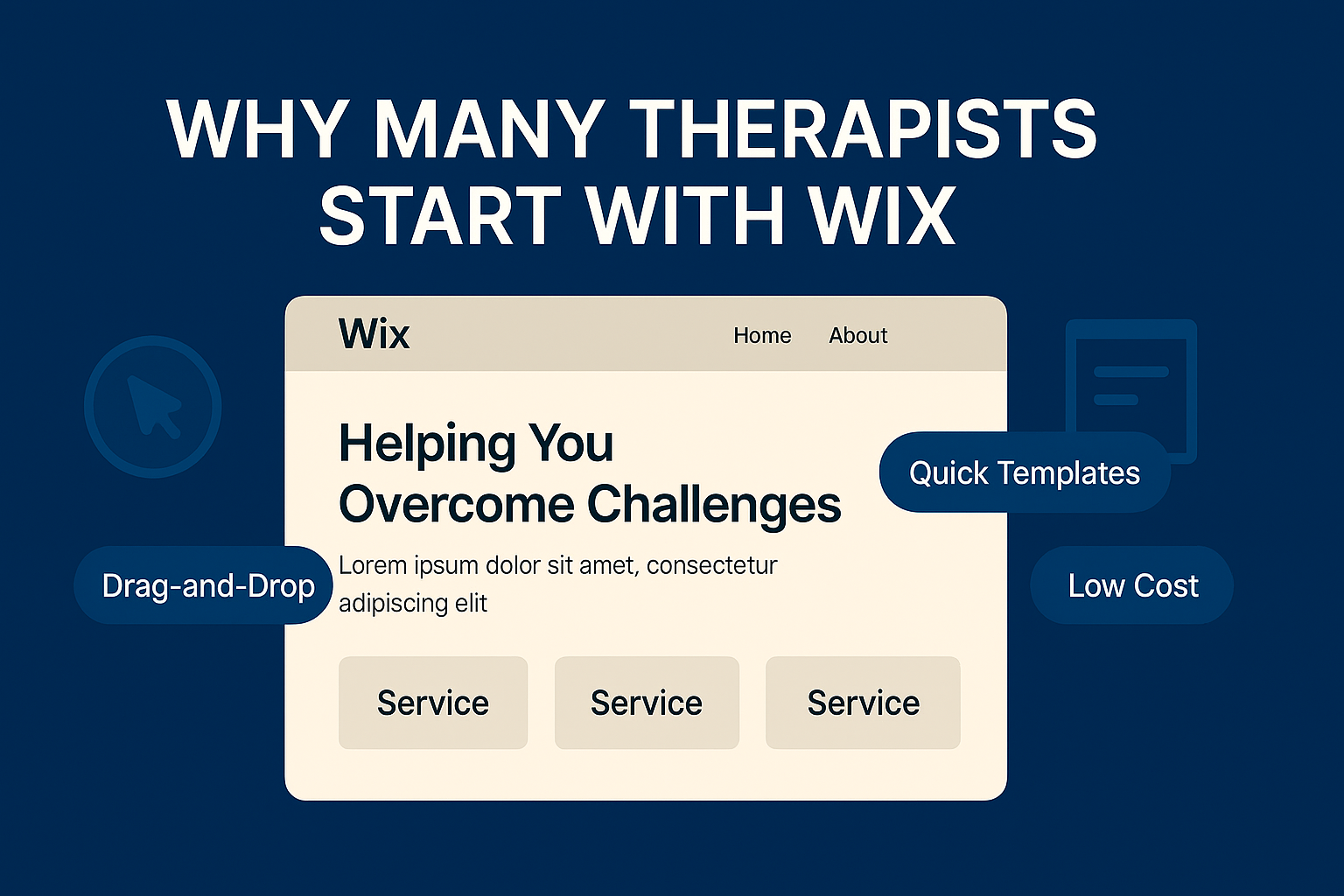
The Initial Appeal
Wix is one of the most user-friendly website builders available, especially for non-technical users. Many therapists choose it because:
- It offers drag-and-drop editing
- Templates make setup quick
- It requires minimal technical effort
- The cost is low, especially when starting out
- It makes DIY website creation feel approachable
For clinicians launching their first private practice, this convenience is appealing. If the goal is simply to “have a website,” Wix checks that box.
But When Practices Grow, Limitations Appear
Over time, however, therapists notice that the very features that made Wix appealing begin to hold them back:
- Templates feel restrictive and generic
- Custom design becomes almost impossible
- SEO control is limited
- Adding niche-specific service pages (EMDR, DBT, trauma therapy, OCD treatment, couples counseling) becomes frustrating
- Integrations are shallow or unavailable
- Scaling beyond a basic website is difficult
This is especially true for therapists in competitive cities where ranking for local keywords is essential.
To understand how website quality directly impacts client acquisition, review: Therapist Website Development
2. Key Limitations of Wix for Therapists
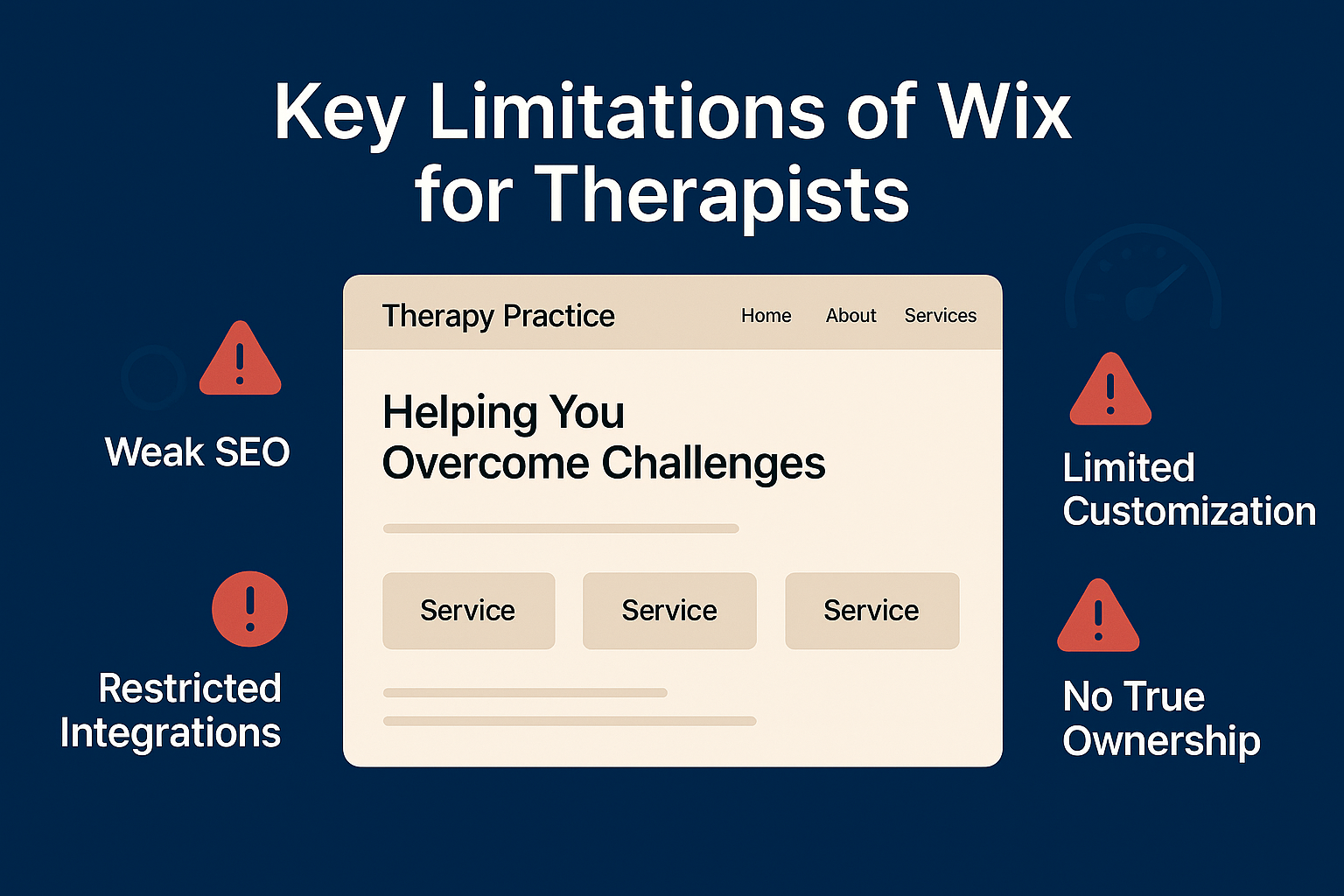
Wix is a beginner-friendly platform but therapy practices that want visibility, scalability, and professionalism often outgrow it quickly. Here are the core limitations.
Weak SEO Structure
Therapists repeatedly report difficulty ranking on Wix. The reasons are structural:
- Restricted URL structure
- Limited control over metadata
- Slower page load speeds
- Weak schema markup
- Less efficient crawling
- Poor local SEO capability
If you want to appear on page one for “therapist near me” or “LMFT in [city],” Wix often can’t support that goal.
To understand why SEO is essential for therapist visibility, explore: SEO for Therapist
Limited Customization for Service Pages
Therapy websites must communicate trust and clinical expertise. But Wix templates limit how deeply you can customize service pages:
- Hard to build comprehensive EMDR or trauma-specific layouts
- Difficult to showcase niche-specialized frameworks
- Limited ability to create long-form, authority-driven content
- Many Wix layouts look identical across therapist sites, reducing credibility
Restricted Integrations
Wix is not designed for the level of professional functionality therapists require:
- Limited HIPAA-aware form options
- Weak EHR integration support
- Basic scheduling widgets
- No advanced intake systems
- Limited ability to embed secure telehealth workflows
Limited Ownership
One of the biggest issues with Wix is ownership:
- You do not fully own your website
- You cannot move your site elsewhere
- You are permanently locked into Wix’s ecosystem
- Scaling becomes impossible without redesigning everything
As your practice grows, this becomes a silent but significant limitation.
3. Why WordPress Is Preferred by High-Performing Therapy Practices
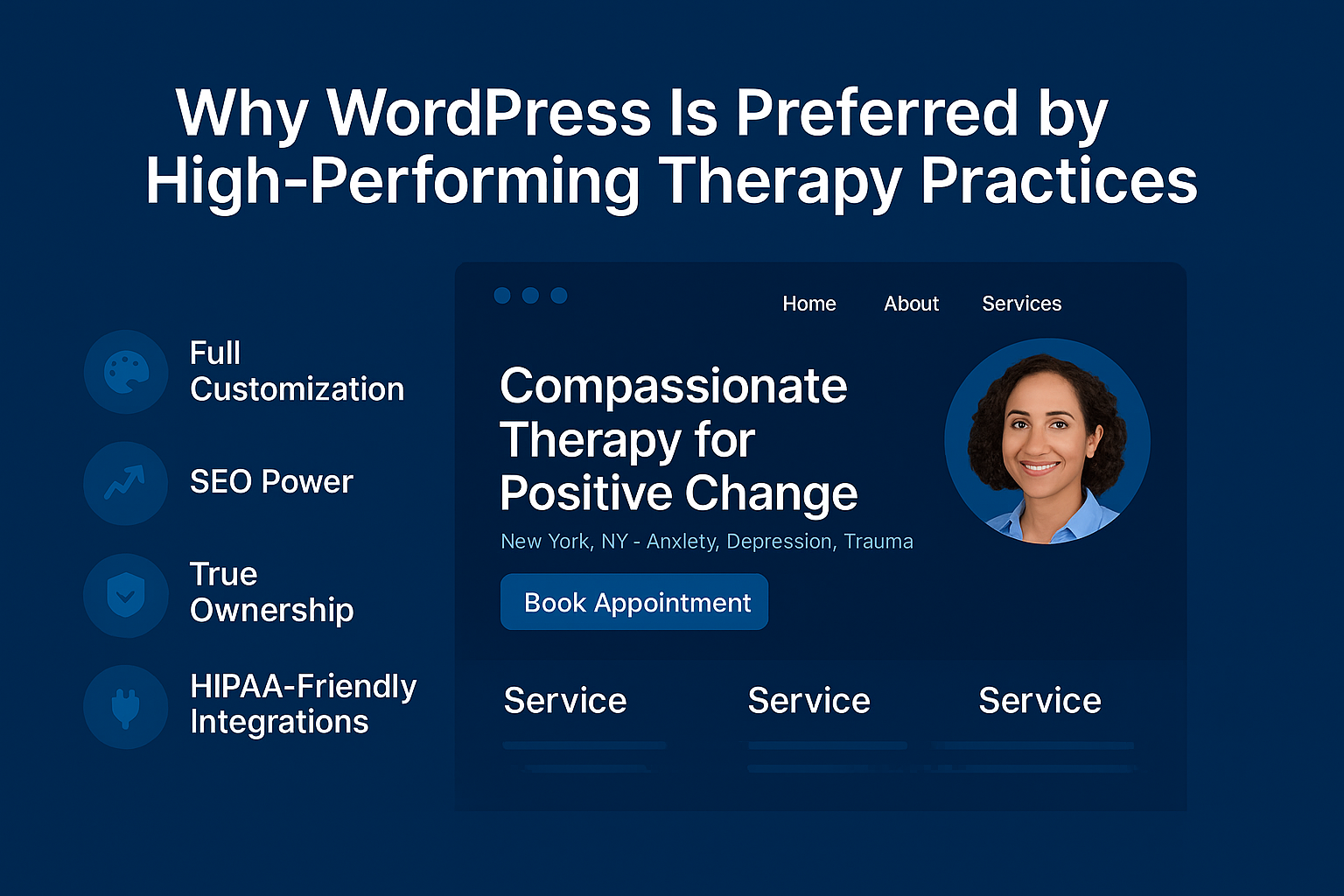
WordPress is the world’s most widely used website platform and for good reason. It delivers the flexibility, SEO structure, and professional capabilities that modern therapy practices require.
Full Customization
With WordPress, every part of the design can be tailored:
- Custom layouts for trauma, EMDR, CBT, DBT, or couples therapy
- Authority-driven section designs
- Warm, empathetic, clinical tone
- Brand-aligned colors and typography
- Fully custom user experience
This level of control helps therapists present themselves as credible, trustworthy experts.
SEO Power
WordPress is significantly superior to Wix in SEO because:
- URLs are fully customizable
- Metadata control is unlimited
- Schema markup can be deeply implemented
- Load speeds are much faster
- Google crawls WordPress far more efficiently
- Local SEO plugins boost visibility
This matters especially in a niche where 70–90% of clients begin their search online.
To see how local visibility improves client flow, read: Local SEO for Therapists
True Ownership & Portability
Unlike Wix:
- You own your entire website
- Hosting is independent
- You can switch platforms anytime
- Your content, database, and design remain yours
- Your site can scale infinitely
Therapists planning long-term growth need this level of control.
Add-Ons Built for Therapists
WordPress supports:
- HIPAA-aware form systems
- Psychology-specific templates
- Secure scheduling integrations
- Blogging systems optimized for psychoeducation
This makes it far more aligned with the needs of therapy practices.
4. Wix vs WordPress for Therapists: Quick Comparison Table
| Feature | Wix | WordPress |
|---|---|---|
| SEO Performance | Basic | Advanced + full control |
| Design Flexibility | Limited | Unlimited |
| HIPAA Options | Very limited | Multiple secure solutions |
| Speed Optimization | Template-dependent | Fully optimizable |
| Ownership | Locked | Full ownership |
| Integrations | Limited | Extensive |
| Scalability | Low | Very High |
5. What Happens When Therapists Move From Wix to WordPress?
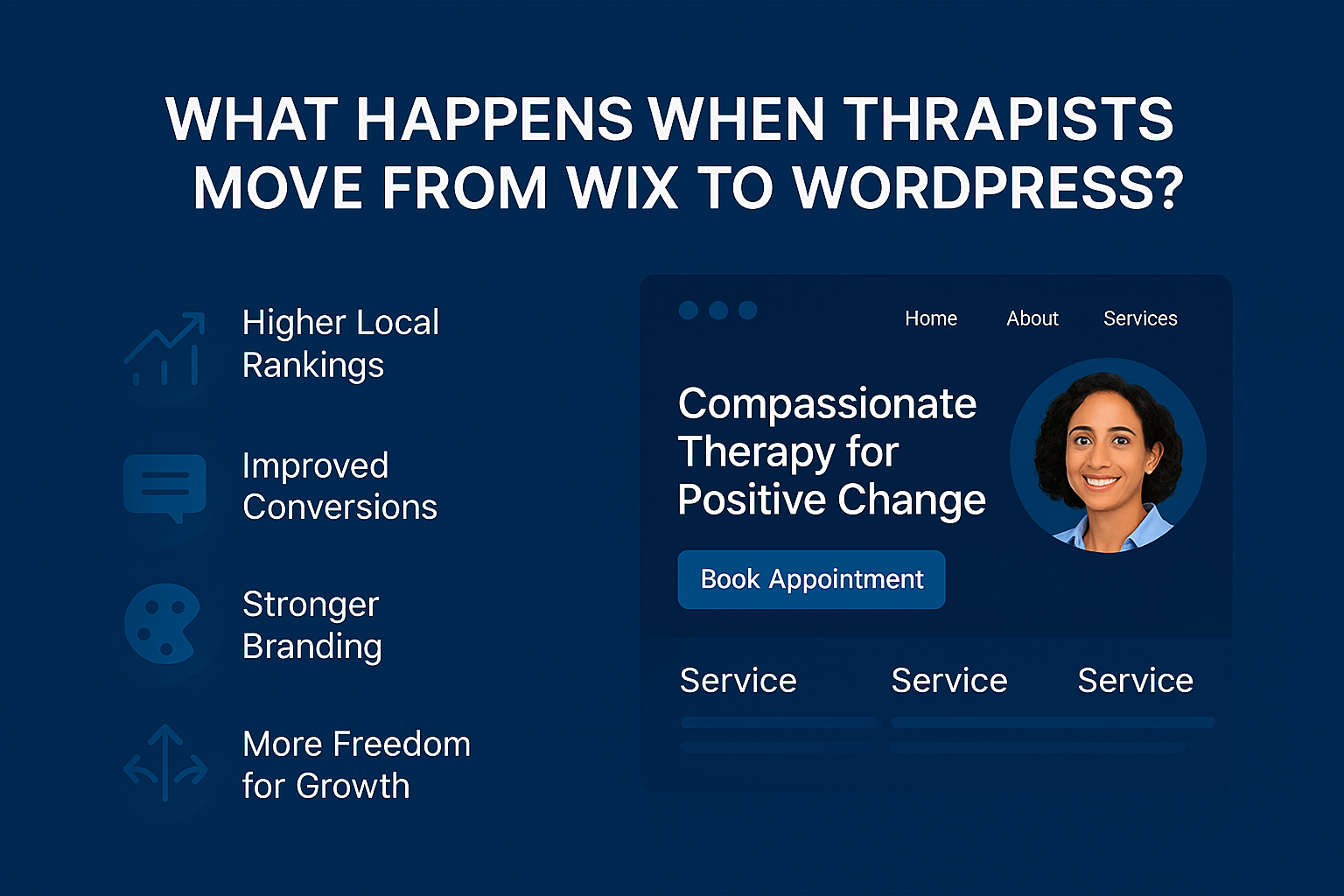
Based on real migrations completed by MHIS, here’s what therapists experience after switching.
Higher Local Rankings
WordPress dramatically improves visibility for phrases such as:
- “therapist near me”
- “trauma therapist in [city]”
- “LMFT in [city]”
- “online therapist [state]”
Because of WordPress’ SEO strength, therapists begin receiving more organic inquiries within weeks.
Improved Conversions
A professionally built WordPress site converts better because:
- CTAs are placed strategically
- Intake pathways are optimized
- UX is cleaner and more intuitive
- Mobile experience improves dramatically
- Trust signals are integrated throughout
Stronger Professional Branding
WordPress enables premium, clinical-grade branding:
- Deep-blue themes
- Minimalist, high-authority layouts
- Professional fonts
- Strong imagery and hierarchy
Therapists immediately appear more credible and trustworthy.
More Freedom for Growth
WordPress supports expansion through:
- Additional service pages
- Multi-location structures
- Group practice pages
- Advanced integrations
- Blog expansion
This matters highly for therapists who want to grow sustainably.
To understand how website improvements directly impact lead generation, see: How Can I Get More Clients for My Therapy Practice?
6. How MHIS Handles a Smooth Migration from Wix to WordPress
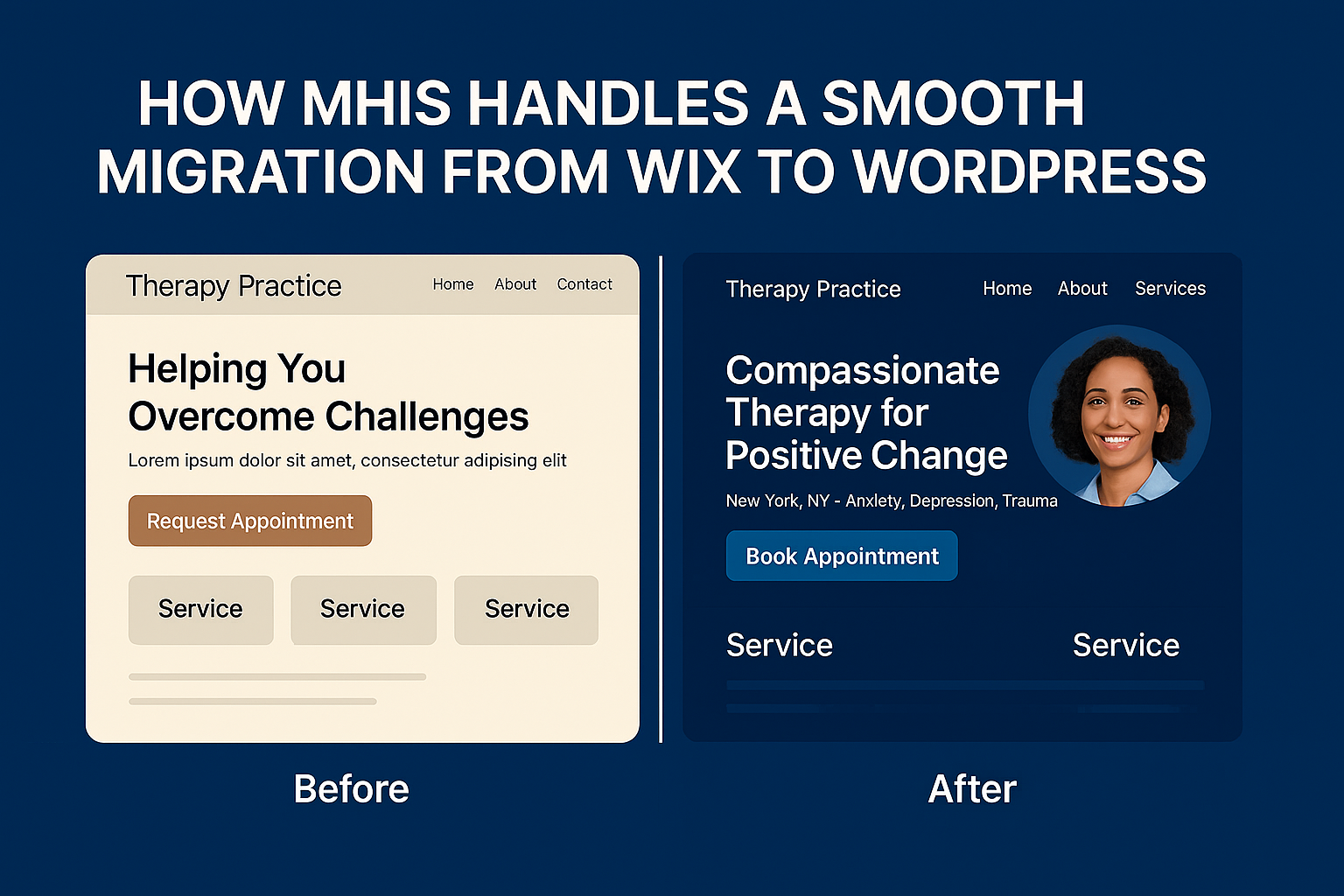
Migrating from Wix to WordPress must be done carefully to avoid ranking loss, broken pages, or structural issues. MHIS has perfected a four-phase methodology tailored for therapists.
Phase 1 — Strategy & Website Planning
- Comprehensive audit of your existing Wix site
- Mapping of all current URLs
- Identification of missing SEO opportunities
- New website structure planning
- Identifying HIPAA-aware integrations
- Planning new service-page frameworks
This ensures your new WordPress site is built with clarity and strategic intent, not just design.
Phase 2 — Custom WordPress Design
MHIS creates a fully custom, premium-level design:
- Deep-blue MHIS theme
- Clinical-grade UI with a warm, empathetic feel
- Professional section layouts
- High-authority typography
- Strong CTAs
- Dedicated niche pages (anxiety therapy, trauma therapy, EMDR, DBT, couples therapy)
Phase 3 — Migration & SEO Setup
We ensure a smooth transition without losing ranking:
- Full content migration
- 301 redirect setup
- Technical SEO configuration
- Speed optimization
- On-page SEO for all services
- Local SEO setup (NAP structure, metadata, internal linking)
This phase protects your SEO and prepares the site for growth.
Phase 4 — Launch & Support
Right before launch, MHIS completes:
- Full mobile optimization
- Cross-browser testing
- ADA accessibility basics
- Google Search Console setup
- Google Analytics setup
- Security configuration
- Firewall + backups
- Optional yearly support
This ensures your new site performs flawlessly from day one.
7. Signs You Should Move From Wix to WordPress
You should consider switching platforms if any of the following apply:
- You want higher SEO rankings
- Your site feels generic
- You need HIPAA-aware forms
- Your practice is expanding
- You want faster load speed
- You’re planning to publish blogs
- You want stronger branding
- You’re not getting enough inquiries
If any of these resonate, the switch is not just beneficial, it’s necessary.
8. Common Fears Therapists Have About Switching (and the Reality)
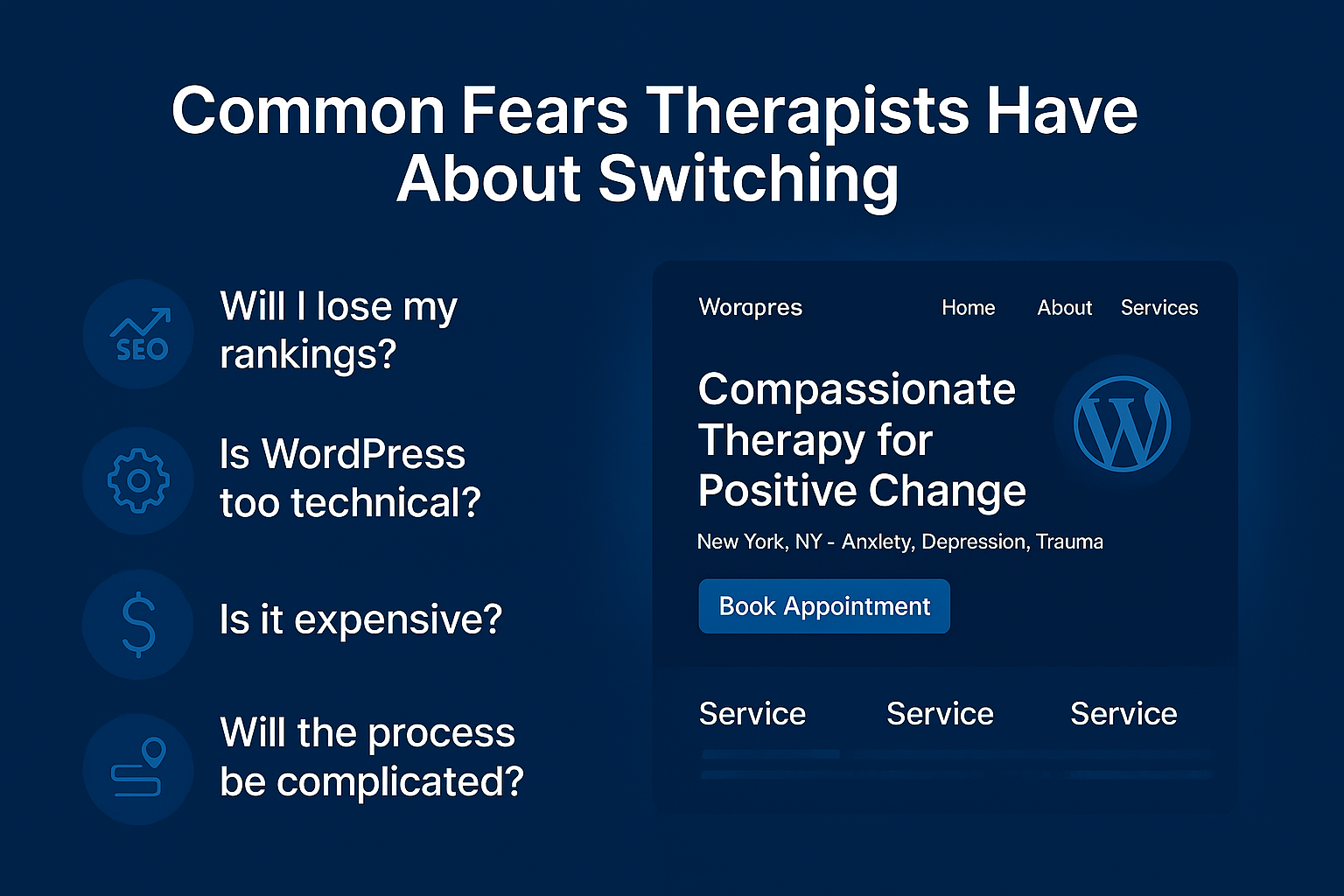
Mental Health IT Solutions has handled dozens of migrations, and we consistently hear the same concerns.
“Will I lose my rankings?”
No, if redirects and technical SEO are handled correctly. Every migration we’ve completed has resulted in ranking improvement, not loss.
“Will WordPress be too technical for me?”
MHIS handles hosting, maintenance, updates, backups, and security. You never touch the technical side.
“Is WordPress expensive?”
WordPress offers long-term ROI and eliminates the need for repeated redesigns. It is an investment that pays back through visibility and inquiries.
“Will the transition be complicated?”
Not with a structured migration plan. We handle everything from planning to launch.
For deeper understanding of what impacts client flow, revisit: Why Am I Not Getting Enough Clients for My Therapy Practice?
FAQs
A properly managed migration will not hurt your rankings. When redirects, URL mapping, and technical SEO are handled correctly, therapists often see improved visibility on WordPress due to a stronger SEO architecture.
On its own, WordPress requires maintenance, but with MHIS managing hosting, updates, backups, and security, it becomes as simple as using Wix. You focus on your practice, and MHIS handles the technical side.
WordPress offers full control over metadata, schema, URLs, site speed, and content structure. This makes it far superior for ranking for keywords like “therapist near me,” niche service pages, and local SEO across competitive cities.
While initial setup may be higher than Wix, WordPress eliminates recurring redesigns, expands as your practice grows, and improves organic traffic delivering a stronger long-term ROI for therapy practices.
MHIS uses a structured four-phase migration: strategy & mapping, custom WordPress design, full content/SEO migration, and launch optimization. This prevents ranking loss and ensures your new site is faster, more secure, and clinically aligned.
Final Verdict — Should Therapists Move to WordPress?
If your goal is to build a high-performing therapy website that:
- ranks locally
- improves authority
- builds client trust
- supports HIPAA-aware tools
- scales with your practice
- loads fast
- and helps you grow consistently
Then WordPress is the clear choice.
Wix works only for early-stage clinicians who need a basic online presence. But if you want a professional, scalable, SEO-ready platform that supports your practice long-term, WordPress is the gold standard.
When handled by experts, migration is smooth, secure, and structured and results in a powerful improvement in both branding and SEO.
Ready to Upgrade Your Therapy Website?
Explore recent therapist website projects built by Mental Health IT Solutions: Website design & development Portfolio