
When comparing Psychology Today vs therapist website, the real question is where clients actually convert. Mental health professionals today are investing in visibility, but visibility alone doesn’t guarantee clients. The real question is: where do potential clients actually convert? Is it through directories like Psychology Today, or through your own private practice website?
Many therapists rely heavily on directory listings because they’re easy to set up and promise exposure. Others invest in SEO-driven websites, expecting long-term growth and higher-quality leads. But when it comes to actual client conversions, booked sessions, inquiries, and long-term retention, the difference between these channels becomes critical.
This article breaks down where conversions truly happen, what influences client decisions, and how you can strategically use both platforms to maximize ROI.
Want more therapy clients without relying solely on directories?
Understanding the Role of Psychology Today
Psychology Today is one of the most widely used directories for therapists globally. It acts as a marketplace where potential clients browse, compare, and shortlist professionals.
Why Therapists Use Psychology Today
- High domain authority (ranks easily on Google)
- Built-in traffic from people actively searching for therapists
- Easy setup with minimal technical effort
- Filters for specialties, insurance, and location
Where It Works Well
Psychology Today performs best at the discovery stage. Clients who:
- Don’t have a specific therapist in mind
- Are exploring options
- Want to compare multiple professionals quickly
Where It Falls Short
Despite high visibility, conversion rates often remain limited due to:
- High competition: Your profile appears alongside dozens of others
- Limited personalization: Restricted formatting and branding
- No ownership: You don’t control platform changes or visibility
- Low differentiation: Many profiles sound similar
Key Insight: Psychology Today is a lead source, not a conversion engine.
The Power of Your Website in Conversions
Your website is your owned digital asset and more importantly, your highest-converting channel when optimized correctly.
Unlike directories, your website allows you to:
- Control messaging and positioning
- Build trust through content
- Guide users toward action (booking, contact forms)
- Rank for high-intent keywords via SEO
A well-structured website isn’t just about looking professional it directly impacts how many visitors turn into clients. From layout to call-to-action placement, every element plays a role in conversion. If your website isn’t designed with this in mind, you could be losing high-intent traffic.
Learn what makes a high-converting therapy website: Therapist Website Development Tips
Why Websites Convert Better
- Trust Building Through Content
Blogs, FAQs, and service pages answer client concerns before they even reach out. - Clear Conversion Paths
Strategic CTAs, booking integrations, and contact forms reduce friction. - Brand Authority
A well-designed site positions you as a specialist not just another listing. - SEO-Driven Intent Traffic
Visitors landing on your site via Google are often further along in the decision-making process.
Conversion Behavior: Directory vs Website
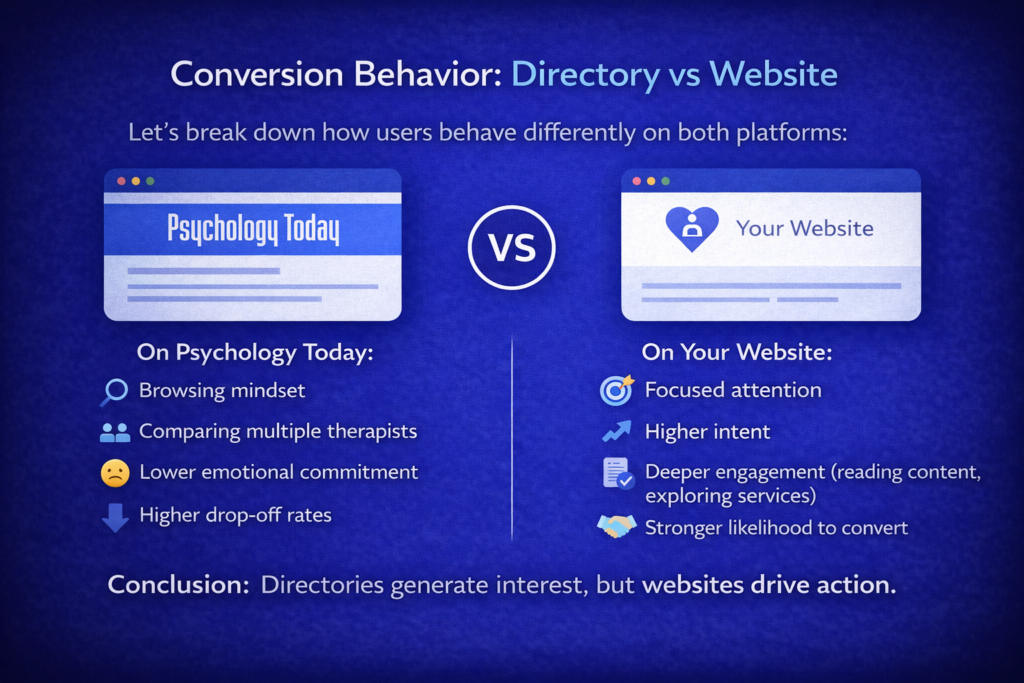
Let’s break down how users behave differently on both platforms:
On Psychology Today:
- Browsing mindset
- Comparing multiple therapists
- Lower emotional commitment
- Higher drop-off rates
On Your Website:
- Focused attention
- Higher intent
- Deeper engagement (reading content, exploring services)
- Stronger likelihood to convert
Conclusion:
Directories generate interest, but websites drive action.
The Client Journey: What Actually Happens
In reality, conversions rarely happen in a single step.
A typical journey looks like this:
- Client searches for a therapist
- Finds you on Psychology Today
- Clicks your website link
- Evaluates your credibility
- Reads blogs or service pages
- Decides to contact or book
This means your website plays a decisive role, even if the initial discovery happens elsewhere.
Getting traffic but no inquiries? Your website might be the problem.
Why Many Therapists Struggle to Convert
Even with both platforms in place, many therapists fail to convert leads due to:
1. Weak Website Structure
- No clear CTA
- Confusing navigation
- Poor mobile experience
2. Lack of SEO Strategy
Without proper keyword targeting, your website won’t attract high-intent traffic.
3. Generic Messaging
If your content sounds like everyone else, clients won’t feel a connection.
4. No Trust Signals
Missing:
- Testimonials
- Credentials
- Case-specific expertise
EEAT: The Real Conversion Driver
Google prioritizes Experience, Expertise, Authoritativeness, and Trustworthiness (EEAT) and so do clients.
How EEAT Impacts Conversions
- Experience: Real insights into client struggles
- Expertise: Clear specialization (e.g., trauma, anxiety, couples therapy)
- Authority: Published blogs, consistent branding
- Trust: Professional design, clear policies, secure contact forms
Your website is the only place where you can fully demonstrate all four.
SEO vs Directory Traffic: Quality Comparison
Directory Traffic:
- High volume
- Low intent
- Shared attention
SEO Traffic:
- Lower volume
- High intent
- Exclusive attention
Example:
A user searching “therapist near me” vs
“How to manage panic attacks: therapy techniques.”
The second user is far more likely to convert, and they land on your website, not just a directory.
The Hybrid Strategy That Works
Instead of choosing one, smart therapists use both strategically.
Step 1: Use Psychology Today for Visibility
- Optimize your profile
- Use niche-specific keywords
- Add a compelling bio
Step 2: Use Your Website for Conversion
- Build high-quality landing pages
- Add strong CTAs
- Create educational blog content
Step 3: Connect Both
- Link your website in your directory profile
- Ensure brand consistency
- Guide users toward your website
What High-Converting Therapy Websites Include
To outperform directories, your website must include:
1. Clear Positioning
Who you help + how you help them
2. Conversion-Focused Design
- Simple layout
- Mobile optimization
- Fast loading speed
3. Strategic CTAs
- “Book a Session”
- “Schedule a Free Consultation”
- “Contact Now”
4. Content That Answers Questions
- Blog posts
- FAQs
- Service-specific pages
5. Trust Elements
- Credentials
- Certifications
- Testimonials
Common Mistake: Over-Relying on Directories
Many therapists treat Psychology Today as their primary marketing channel.
This creates risk:
- Rising competition
- Increasing costs
- Lack of control
- Dependency on third-party platforms
Long-term growth requires ownership and that comes from your website.
Real Conversion Insight
Across multiple therapy practices, the pattern is clear:
- Directories generate visibility
- Websites generate clients
Therapists who invest in SEO and website optimization consistently report:
- Higher-quality inquiries
- Better client-fit
- Increased session bookings
- Reduced reliance on paid listings
FAQs
1. Do clients book directly through Psychology Today?
Some do, but many use it to discover therapists and then visit their websites before making a decision.
2. Is having a website necessary if I’m on Psychology Today?
Yes. A website builds trust, improves conversions, and gives you full control over your marketing.
3. Which platform is better for long-term growth?
Your website. It’s a scalable, owned asset that generates organic traffic over time.
4. How can I improve conversion rates on my website?
Focus on clear messaging, strong CTAs, SEO optimization, and trust-building elements.
5. Should I invest in SEO or directories first?
Start with directories for quick visibility, but invest in SEO for sustainable growth and better conversions.
Final Verdict: Where Do Clients Actually Convert?
If we break it down:
- Psychology Today → Discovery
- Your Website → Conversion
The real winner isn’t one or the other it’s how well you use both together.
But if your goal is consistent, scalable client acquisition, your website is the asset that drives long-term results.
Ready to turn your website into a client-generating machine?