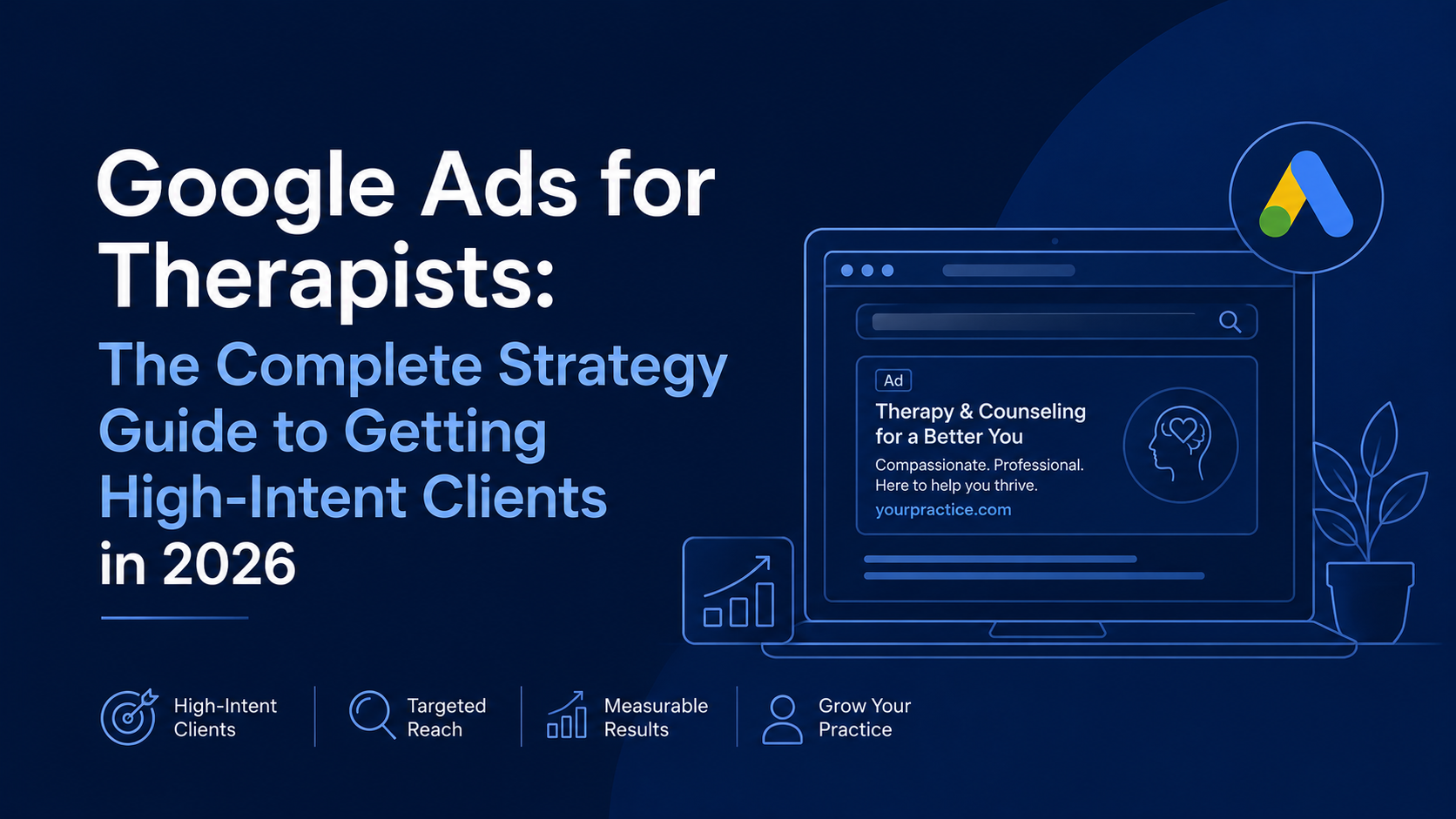
When a potential client types “anxiety therapist near me” into Google, they are not browsing casually. They are ready to make a decision. That level of intent is rare in digital marketing, and it is exactly why Google Ads for therapists is one of the most powerful client acquisition tools available to private practices today.
The challenge is execution. Most therapists who try Google Ads either run campaigns that are too broad, send traffic to the wrong pages, or lack the tracking setup needed to measure what is actually working. The result is wasted budget and the false conclusion that “Google Ads don’t work for therapists.”
They absolutely do work when built correctly.
At Mental Health IT Solutions (MHIS), we have managed Google Ads campaigns for therapy practices across the United States and Canada, including highly competitive markets like Los Angeles, New York, the Bay Area, Chicago, and Toronto. This guide covers everything a therapist or group practice needs to know to run profitable campaigns in 2026, from keyword strategy and budget planning to HIPAA-conscious tracking, landing page optimization, and bidding strategy.
What Are Google Ads for Therapists?
Google Ads is a pay-per-click (PPC) advertising platform where therapists pay to appear at the top of Google search results for specific keywords. You only pay when someone clicks your ad. There is no charge for impressions.
When someone searches “trauma therapist in Chicago” or “online couples counseling,” Google shows paid ads at the top of the page before any organic results. These placements are won through a real-time auction that factors in your bid amount, your ad’s relevance, and the quality of your landing page.
The core advantage for therapists is intent alignment. People clicking these ads are not passively scrolling social media. They are actively searching for a therapist, often in a moment of emotional urgency. That distinction drives significantly higher conversion rates compared to any other paid advertising channel.
Why Google Ads Work So Well for Therapists
High-Intent Traffic at the Right Moment
Search-based advertising responds to what people are actively seeking. A therapist running Google Ads is visible at the exact moment a potential client decides to look for help. No other paid channel replicates this timing or this quality of intent.
Immediate Visibility While SEO Builds
SEO for therapists is a long-term strategy that compounds over time. Google Ads delivers page-one visibility from day one. For practices that need clients now, or that are launching in a new market, paid search fills the gap while organic rankings develop.
Precise Budget and Geographic Control
Therapists can set an exact daily budget, define a service radius, and target specific cities or zip codes. A practice in Pasadena does not need to pay for clicks coming from San Francisco. This geographic precision significantly reduces wasted spend.
Measurable, Accountable Results
Every click, phone call, and form submission can be tracked. That data lets you see exactly which keywords are generating consultations and which are burning budget. Unlike a Psychology Today listing or a printed directory, Google Ads gives you full visibility into what is working and what is not.
Google Ads vs. SEO vs. Psychology Today: Choosing the Right Channel
This is one of the most common questions therapists ask. The honest answer is that these channels serve different functions, and the strongest practices use a combination of all three.
| Channel | Speed to Results | Cost Model | Sustainable Without Ongoing Investment |
|---|---|---|---|
| Google Ads | Immediate | Pay per click | No, stops when budget stops |
| SEO | 3 to 12 months | Content and technical investment | No, stops when the budget stops |
| Psychology Today | Immediate | Monthly subscription | No |
Google Ads is the fastest path to new client inquiries. SEO builds long-term authority and free organic traffic. Psychology Today captures clients searching that specific platform, but builds no brand equity and sends no traffic to your website.
For a deeper breakdown of when to prioritize each, read: Google Ads vs. SEO for Therapists
How Much Should Therapists Spend on Google Ads?
Budget is one of the most misunderstood variables in therapist Google Ads campaigns. The right spend depends on your market, your specialty, and whether you offer in-person, telehealth, or hybrid services.
General Benchmarks by Market Type
| Market | Estimated Monthly Budget for Consistent Results |
|---|---|
| Small to mid-size city | $500 – $900/month |
| Mid-size metro (Denver, Austin, Seattle) | $900 – $1,500/month |
| High-competition metro (NYC, LA, Bay Area, Chicago) | $1,500 – $3,000/month |
| Telehealth (state-wide targeting) | $1,000 – $2,500/month |
Cost-Per-Click and Cost-Per-Lead Benchmarks
Cost per click in the therapy space typically ranges from $4 to $15 in smaller markets and $18 to $45 in major metros, particularly for high-demand specialties like couples counseling and trauma therapy.
Cost per lead, meaning a form submission or phone call, generally runs between $90 and $300, depending on market competition, landing page quality, and keyword targeting.
Conversion rates on a well-optimized therapy landing page run between 6% and 12%. Practices with weaker pages see 1% to 3%, which multiplies the effective cost per lead by a significant margin.
The Real Metric: Client Lifetime Value
If a private-pay therapy client stays for an average of 16 sessions at $150 per session, that client is worth $2,400 to your practice. Paying $200 to $300 to acquire that client through Google Ads is a strong return on investment.
For a more detailed budget planning resource, read: How Much Should Therapists Spend on Ads
HIPAA-Conscious Google Ads Setup for Therapists
This is the section most Google Ads guides written for therapists skip entirely. It is also one of the areas where MHIS operates differently from general marketing agencies.
Standard Google Ads tracking tools, including Google’s default remarketing pixel, can create HIPAA compliance concerns for mental health practices. When a potential client visits a therapy website after searching for “depression therapist” or “PTSD treatment,” that behavioral data is captured and can be used for audience building inside Google’s ecosystem. For healthcare providers, this can constitute sharing protected health information (PHI) without proper authorization.
What Therapists Need to Address in Their Tracking Setup
Remarketing audiences built from healthcare-related site visits may include implied health condition data. Google has restrictions on using sensitive health data for targeting, and therapists should review their remarketing configurations carefully before enabling any audience-based features.
Call tracking software that records calls or sends data to third-party servers may require a Business Associate Agreement (BAA) to remain compliant. Not all call tracking providers offer BAAs, which is a meaningful distinction for mental health practices.
Conversion tracking via Google Tag Manager should be configured to avoid passing identifiable user data into Google’s systems. The goal is to capture the performance metrics you need, calls, form submissions, and bookings, without creating compliance exposure in the process.
MHIS’s Approach
MHIS sets up conversion tracking for therapy practices in a way that delivers the performance data needed to optimize campaigns without transmitting sensitive user behavior into ad platforms in ways that create compliance risk. We review tracking configurations against current healthcare advertising guidelines and, where necessary, recommend HIPAA-compliant call tracking solutions that include BAAs.
This is not something a generalist agency typically addresses. It is a core part of how we build every campaign for mental health professionals.
Ready to run Google Ads that are both high-performing and HIPAA-conscious? Book a Free Google Ads Audit for Your Practice
Keyword Strategy for Therapists: How to Target the Right Searches
The Three Keyword Categories That Drive Results
Problem-based keywords target people by describing what they are experiencing. Examples include “help with anxiety,” “I feel depressed all the time,” and “how to stop panic attacks.” These indicate emotional distress, but not always readiness to book useful for top-of-funnel awareness but lower conversion intent than the next two categories.
Service-based keywords are more specific to the type of therapy offered. Examples include “EMDR therapist,” “CBT for OCD,” “somatic therapy,” and “couples counseling.” These signals indicate that the searcher already knows what kind of help they want, which increases conversion likelihood significantly.
Location-based keywords combine service intent with geographic specificity. Examples include “trauma therapist in Brooklyn,” “online LMFT in California,” and “anxiety counseling near me.” These are consistently the highest-converting keyword type for both in-person and telehealth practices.
Keyword Match Types: What They Mean and Which to Use
Broad match shows your ad for searches Google considers related to your keyword, which often includes irrelevant terms. Without an aggressive negative keyword list, broad match wastes budget for most therapy campaigns.
Phrase match triggers ads when the search includes your keyword phrase, with additional words before or after allowed. For example, a phrase match for “anxiety therapist” would also match “best anxiety therapist near me.”
An exact match shows your ad only when the search closely mirrors your keyword. It generates lower volume, but the most targeted traffic.
For most therapy practices, MHIS recommends starting with a mix of phrase match and exact match keywords, then expanding based on search term report data once there is enough volume to draw conclusions.
Negative Keywords: Your Budget’s Best Protection
A negative keyword list prevents your ad from showing for irrelevant or non-converting searches. Without one, your practice could receive clicks from people searching for “free therapy,” “therapy license exam prep,” “become a therapist,” or “therapy jobs near me.” None of those searches will ever convert into a client.
Essential negative keywords for most therapy campaigns:
- Free, cheap (if targeting private pay)
- License, certification, training, school
- Jobs, career, salary, internship
- Self-help, DIY (depending on your goals)
- Crisis hotline, emergency
MHIS builds and continuously refines negative keyword lists as a standard part of every campaign we manage. Unchecked broad-match clicks are one of the most common reasons therapy practices drain budget without results.
For a deeper look at keyword planning, read: Keyword Research for Mental Health Professionals
Writing Google Ads Copy That Converts
Your ad copy has one job: convince someone in emotional distress that you are the right therapist to contact. That requires clarity, specificity, and trust, not generic filler.
What High-Converting Therapy Ads Include
Strong therapy ads communicate the specialization clearly, address what the prospect is feeling or seeking, and reduce friction around taking the next step. They do not try to be everything to everyone.
Weak ad copy: “Therapy Services | Accepting New Clients | Call Today.”
Strong ad copy: “Anxiety Therapy in Austin | CBT Specialist | Confidential Consultation | Same-Week Availability”
The second version identifies location, modality, a trust signal, and a practical differentiator. It earns the click because it is specific.
Responsive Search Ads: How to Use Them Effectively
Google uses Responsive Search Ads (RSAs) as the default format. You provide up to 15 headlines and 4 descriptions, and Google tests combinations to find the best-performing arrangements.
Best practices for therapy RSAs:
- Write each headline so it can stand alone without relying on adjacent headlines for context
- Pin your primary specialization and location to positions 1 and 2 so they always appear
- Include at least one headline with a clear call to action
- Include at least one trust signal: “Licensed Therapist,” “HIPAA-Compliant,” “Confidential Sessions.”
Ad Assets: Free Tools That Expand Your Ad’s Presence
Ad Assets, formerly called Ad Extensions, are additional pieces of information that appear below your main ad text at no extra cost. They increase the visual footprint of your ad on the page, which improves visibility and click-through rates without increasing your cost per click.
The assets most relevant to therapy practices:
Sitelink Assets link to specific pages on your website. Useful sitelinks include your specializations page, your about page, an FAQ page, and your consultation booking page.
Callout Assets are short phrases that highlight differentiators: “Telehealth Available,” “Sliding Scale Options,” “LGBTQ+ Affirming,” “Accepting New Clients.”
Call Assets display your phone number directly in the ad, allowing mobile users to call without visiting your website first. Many therapy clients prefer to call before committing to an intake form.
Location Assets connect to your Google Business Profile and display your address and distance from the searcher. Essential for in-person practices.
MHIS configures all relevant assets for every campaign we build. Practices running ads without assets are leaving measurable click-through rate improvements unclaimed.
Understanding Quality Score: Why It Determines What You Pay
Quality Score is Google’s rating of the relevance and quality of your keywords, ads, and landing pages. It is scored from 1 to 10 and directly affects both your ad ranking and your cost per click.
A higher Quality Score means Google considers your ad genuinely useful to the searcher. As a result, you can achieve higher ad positions while paying less per click than a competitor with a lower score.
The three components:
Expected Click-Through Rate (CTR): How likely is someone to click your ad when it appears? Strong, specific ad copy improves this.
Ad Relevance: How closely does your ad copy match the intent of the keyword? An ad for “couples counseling” that specifically addresses couples therapy performs better than a generic practice ad targeting that same keyword.
Landing Page Experience: How relevant, fast, and user-friendly is the page someone reaches after clicking? A landing page built specifically for the keyword earns a higher score than a generic homepage.
Most therapists running their own campaigns have Quality Scores of 3 to 5 because they send all ad traffic to a homepage. MHIS-managed campaigns typically achieve scores of 7 to 9 by aligning keywords, ad copy, and landing pages into tightly focused campaign structures.
Smart Bidding vs. Manual CPC: Which Should Therapists Use?
Google offers automated bidding strategies collectively called Smart Bidding that use machine learning to optimize bids in real time. The most relevant options for therapy campaigns:
Target CPA (Cost Per Acquisition): You set a target cost per lead, and Google adjusts bids to hit that goal. Works well once a campaign has at least 30 to 50 tracked conversions, giving the algorithm enough data to make intelligent decisions.
Maximize Conversions: Google spends your budget to generate as many conversions as possible within your daily cap. Good for new campaigns building conversion history.
Manual CPC: You set individual bids per keyword. This gives maximum control but requires more active management and a deeper understanding of the platform.
For new therapy campaigns with limited conversion data, MHIS typically starts with Maximize Conversions under a capped budget, then transitions to Target CPA once sufficient data is collected. Running Smart Bidding without enough conversion history leads to erratic spending and poor optimization.
Performance Max Campaigns for Therapists: What You Need to Know
Performance Max (PMax) is Google’s fully automated, cross-channel campaign type. It runs ads across Search, Display, YouTube, Gmail, Maps, and Discover simultaneously from one campaign structure.
PMax can work well for therapy practices in certain situations, particularly for telehealth providers targeting broad geographic regions or group practices with multiple locations and specialties. However, it requires strong creative assets, a well-structured conversion tracking setup, and careful audience signal configuration to avoid wasted placements across irrelevant channels.
MHIS recommends that most single-location private practices start with standard Search campaigns and optimize them thoroughly before exploring PMax. The transparency of Search campaigns, where you can see exactly which queries triggered your ads, is invaluable during the early optimization phase when you are still learning what works in your market.
Building a High-Converting Landing Page for Therapy Ads
Sending Google Ads traffic to your homepage is one of the most common and most costly mistakes therapists make. A homepage is designed to introduce your practice broadly. A landing page is designed to convert one specific visitor with one specific need.
What a High-Performing Therapy Landing Page Requires
A headline that mirrors the keyword. If someone searched “trauma therapist in Denver,” the headline should confirm immediately that they have found exactly that. “Trauma Therapy in Denver | Confidential Consultations Available” removes any doubt and reduces bounce rate.
Clear specialization above the fold. Visitors should understand within three seconds who you help and how. If they have to scroll to find that information, many will leave.
Therapist credentials and a professional photo. Trust is foundational in therapy. A professional headshot combined with a brief credential summary significantly reduces the friction between clicking an ad and making contact.
A single, frictionless call to action. One clear next step: schedule a consultation, call the office, or fill out a short intake form. Multiple competing CTAs reduce conversion rates. Choose one and make it prominent.
Social proof. Anonymized testimonials, professional affiliations, or years of practice experience build credibility for visitors who are still deciding.
Fast load speed. A page that takes more than 3 seconds to load loses a significant percentage of mobile visitors. MHIS builds landing pages on WordPress with speed optimization as a non-negotiable requirement, not an afterthought.
For practices needing a conversion-focused website foundation, explore MHIS Website Development for Therapists.
Conversion Tracking: The Non-Negotiable Foundation
Without conversion tracking, your campaign is operating blind. You cannot optimize spend, you cannot identify what is working, and you cannot justify the budget.
The conversions every therapy practice should track:
- Phone calls initiated directly from ads
- Form submissions (contact forms, intake forms, consultation requests)
- Online appointment bookings, if applicable
Phone call tracking requires a tracking number that captures which ad, keyword, and campaign triggered the call. MHIS evaluates call tracking solutions for each practice to ensure the setup is effective and consistent with healthcare privacy standards.
Form submission tracking is set up through Google Tag Manager by firing a conversion event when a user reaches the confirmation page after form completion.
Verifying this setup before spending a dollar on ads is a standard part of every MHIS campaign audit. If your conversions are not being tracked accurately, your bidding strategy has nothing reliable to optimize toward.
Advanced Optimization for Established Campaigns
Once a campaign has been running for four to eight weeks and has meaningful conversion data, the real optimization work begins.
Campaign Segmentation by Specialty: Separate campaigns for anxiety therapy, couples counseling, and trauma therapy allow you to control budgets independently, write more targeted ad copy, and analyze performance by specialty. A couples counseling campaign often performs very differently from a depression therapy campaign in the same market.
Ad Scheduling: Running ads 24/7 and receiving inquiries at 2 am when no one can follow up, wastes budget and lowers the conversion rate on those leads. MHIS analyzes conversion data by hour and day of week to schedule ad delivery during the highest-intent, highest-response windows.
Geo-Performance Analysis: If you are targeting a metro area that spans multiple cities or zip codes, reviewing performance by location often reveals that certain areas convert at a far lower cost than others. Adjusting bids by location is one of the most direct ways to improve overall campaign efficiency.
Retargeting with Compliance Awareness: Retargeting visitors who did not contact you on their first visit can be effective, particularly for practices with a longer consideration window. However, as discussed in the HIPAA section, retargeting configurations for mental health practices require careful setup. Standard Google remarketing pixel configurations are not appropriate for therapy websites without modification.
Want MHIS to audit your current Google Ads setup and identify where budget is being wasted? Get a Free Google Ads Audit
Common Google Ads Mistakes Therapists Make
Running broad keywords without negative lists. Targeting “therapy” or “therapist” without qualification results in clicks from people searching for a career in therapy, therapy exercises, or services in a different state entirely.
Sending all traffic to the homepage. The homepage is not a landing page. Ad traffic needs intent-matched pages built to convert.
No conversion tracking. Without it, you are looking at click data, not lead data. You cannot optimize what you cannot measure.
Pausing campaigns too early. Google Ads campaigns need four to eight weeks to build conversion data and for Smart Bidding to calibrate. Therapists who stop campaigns after two weeks because initial results are slow never reach the optimization phase, where results actually improve.
Ignoring the search terms report. This report shows exactly what searches triggered your ads. Reviewing it weekly and adding irrelevant terms to your negative keyword list is one of the highest-ROI actions in ongoing campaign management.
Setting and forgetting. Google Ads is not a passive channel. Without active management, Quality Scores drift, bids go stale, and budget efficiency deteriorates. Campaigns that are not actively managed almost always underperform over time.
When Google Ads Deliver the Strongest Results for Therapists
Google Ads produces the best outcomes when:
The practice offers private-pay services. Insurance-dependent practices face a narrower client pool and more complex intake processes that reduce conversion rates from paid traffic.
The therapist has a defined specialty. Campaigns built around EMDR, OCD, couples therapy, or trauma consistently outperform generic “therapy” campaigns in the same market and budget.
The website or landing page is built for conversion, not just information. Strong messaging, fast load speed, a clear CTA, and a professional presentation all directly affect whether ad traffic becomes consultations.
The practice has the capacity to follow up within a few hours. Therapy clients who submit a form or call and do not hear back quickly often move on to the next result. Speed of response is a conversion factor.
When Google Ads May Not Be the Right Starting Point
If your website lacks clear messaging, does not have a fast mobile experience, or sends all visitors to a generic homepage, Google Ads will underperform regardless of how well the campaign is structured. In that situation, addressing the website foundation first produces significantly better ad results.
MHIS website development services for therapists are specifically designed to create that conversion-ready foundation before paid traffic is introduced. There is no point in driving highly targeted, paid traffic to a site that cannot convert it.
Why Therapists Work With MHIS for Google Ads
Mental health practices have specific needs that general digital marketing agencies are not equipped to address. MHIS works exclusively with therapists, psychologists, LMFTs, and group practices. That specialization directly affects campaign performance.
We understand the compliance landscape around healthcare advertising and configure tracking accordingly. We have built campaigns in the most competitive therapy markets in the United States and Canada, which means our benchmark data, keyword libraries, and landing page frameworks are built from real results across hundreds of campaigns — not generic marketing playbooks retrofitted for therapists.
We also do not treat Google Ads as an isolated tactic. The most successful therapy practices we work with combine paid search with SEO and a conversion-focused website, creating a system where each channel reinforces the others. That integrated approach is what drives consistent, scalable client acquisition, not one-off campaigns that stall when the budget runs out.
Mental Health IT Solutions manages Google Ads exclusively for therapists and mental health practices. Start a Conversation About Your Practice’s Growth
Frequently Asked Questions
Are Google Ads worth it for therapists?
Yes, when properly structured and actively managed. The high intent of search traffic combined with the strong lifetime value of a therapy client makes Google Ads one of the best-performing paid channels for private practices. Therapists who see poor results are almost always running campaigns with weak keyword targeting, no dedicated landing pages, or missing conversion tracking, not because the channel itself does not work.
How much should therapists spend on Google Ads per month?
Most private practices in small to mid-size markets see consistent results starting at $500 to $900 per month. Practices in competitive metros like New York, Los Angeles, or the Bay Area typically need $1,500 to $3,000 per month to achieve meaningful volume. Telehealth practices targeting broad geographic regions often require $1,000 to $2,500 per month. The right budget also depends on your specialty, your conversion rate, and how quickly you need new clients.
How long does it take for Google Ads to work for therapists?
Traffic starts immediately once a campaign goes live. However, meaningful optimization requires four to eight weeks of data collection. Smart Bidding strategies need a minimum of 30 to 50 tracked conversions to calibrate effectively. Therapists should plan for a 60 to 90-day ramp-up period before drawing firm conclusions about campaign performance.
What keywords should therapists use in Google Ads?
The most effective keyword strategy combines service-based terms (such as “EMDR therapist” or “CBT for anxiety”), location-based terms (such as “trauma therapist in Boston”), and problem-based terms (such as “help with panic attacks”). These should be structured with phrase or exact match types and supported by a comprehensive negative keyword list to prevent irrelevant clicks.
Do therapists need a dedicated landing page for Google Ads?
Yes, without exception. Sending ad traffic to a homepage significantly reduces conversion rates. A dedicated landing page matches the specific search intent of the visitor, communicates the therapist’s specialization immediately, and removes the navigation distractions that cause visitors to leave without making contact.
Can therapists run retargeting ads on Google?
Therapists can run retargeting campaigns, but this requires careful configuration to avoid HIPAA compliance issues. Standard Google remarketing pixels can capture sensitive behavioral data tied to mental health searches. MHIS configures retargeting for therapy practices in a HIPAA-conscious way that captures performance without creating compliance exposure.
How is Google Ads different from advertising on Psychology Today?
Psychology Today is a directory where clients browse profiles. Google Ads puts your practice directly in front of people actively searching on Google, which drives higher intent and higher conversion rates. Google Ads also sends traffic to your own website, building long-term brand equity and supporting your SEO. Psychology Today generates traffic to their platform, not yours. Many successful practices use both, but they serve fundamentally different functions.
Is Google Ads or SEO better for therapists?
They serve different purposes and work best in combination. Google Ads delivers immediate visibility and measurable leads from day one. SEO builds compounding organic traffic over 3 to 12 months. Practices that rely on ads alone face rising costs over time. Practices that invest in both create a system where SEO reduces their long-term dependence on paid traffic. The strongest therapy marketing setups we see at MHIS use ads to fill the calendar now while SEO builds the foundation for sustainable growth.
Conclusion
Google Ads for therapists is not a plug-and-play solution. It is a system that requires the right keyword structure, intent-matched landing pages, HIPAA-conscious tracking setup, and continuous optimization to generate a consistent, profitable flow of new client consultations.
When those elements are in place, no other paid channel delivers the same combination of immediacy, intent, and measurability for a private practice.
The therapists and group practices that see the strongest results are not necessarily spending the most. They are running campaigns built on a clear strategy, supported by a conversion-focused website, and actively managed by someone who understands both digital marketing and the specific context of the mental health industry.
That is exactly what Mental Health IT Solutions is built to do.
{ “@context”: “https://schema.org”, “@graph”: [ { “@type”: “BlogPosting”, “@id”: “https://mentalhealthitsolutions.com/blog/google-ads-for-therapists/#blogposting”, “mainEntityOfPage”: { “@type”: “WebPage”, “@id”: “https://mentalhealthitsolutions.com/blog/google-ads-for-therapists/” }, “headline”: “Google Ads for Therapists: The Complete Strategy Guide to Getting High-Intent Clients in 2026”, “description”: “MHIS breaks down exactly how therapists can run profitable Google Ads campaigns in 2026. Covers budgets, keywords, HIPAA-safe tracking, LSAs, Quality Score, and more.”, “image”: { “@type”: “ImageObject”, “url”: “https://mentalhealthitsolutions.com/wp-content/uploads/2026/04/Google-Ads-for-Therapists-2.png”, “width”: 1200, “height”: 630 }, “datePublished”: “2026-04-01”, “dateModified”: “2026-05-19”, “author”: { “@type”: “Organization”, “name”: “Mental Health IT Solutions”, “url”: “https://mentalhealthitsolutions.com”, “logo”: { “@type”: “ImageObject”, “url”: “https://mentalhealthitsolutions.com/wp-content/uploads/mhis-logo.png” } }, “publisher”: { “@type”: “Organization”, “name”: “Mental Health IT Solutions”, “url”: “https://mentalhealthitsolutions.com”, “logo”: { “@type”: “ImageObject”, “url”: “https://mentalhealthitsolutions.com/wp-content/uploads/mhis-logo.png” } }, “keywords”: [ “Google Ads for therapists”, “PPC for mental health practices”, “therapy practice Google Ads”, “HIPAA-conscious Google Ads”, “therapist paid advertising”, “Google Ads keywords for therapists”, “private practice lead generation”, “mental health PPC strategy”, “therapy landing page optimization”, “Google Ads budget for therapists” ], “articleSection”: “Digital Marketing for Therapists”, “inLanguage”: “en-US”, “about”: [ { “@type”: “Thing”, “name”: “Google Ads”, “sameAs”: “https://en.wikipedia.org/wiki/Google_Ads” }, { “@type”: “Thing”, “name”: “Pay-per-click advertising”, “sameAs”: “https://en.wikipedia.org/wiki/Pay-per-click” }, { “@type”: “Thing”, “name”: “Mental health”, “sameAs”: “https://en.wikipedia.org/wiki/Mental_health” } ], “mentions”: [ { “@type”: “Thing”, “name”: “HIPAA”, “sameAs”: “https://en.wikipedia.org/wiki/Health_Insurance_Portability_and_Accountability_Act” }, { “@type”: “Thing”, “name”: “Quality Score”, “description”: “Google Ads metric scoring keyword, ad, and landing page relevance on a scale of 1–10” }, { “@type”: “Thing”, “name”: “Performance Max Campaigns”, “description”: “Google’s automated cross-channel campaign type running across Search, Display, YouTube, Gmail, and Maps” } ], “speakable”: { “@type”: “SpeakableSpecification”, “cssSelector”: [“h1”, “h2”, “.article-intro”] } }, { “@type”: “WebPage”, “@id”: “https://mentalhealthitsolutions.com/blog/google-ads-for-therapists/”, “url”: “https://mentalhealthitsolutions.com/blog/google-ads-for-therapists/”, “name”: “Google Ads for Therapists: Complete Strategy Guide (2026)”, “description”: “MHIS breaks down exactly how therapists can run profitable Google Ads campaigns in 2026. Covers budgets, keywords, HIPAA-safe tracking, LSAs, Quality Score, and more.”, “isPartOf”: { “@type”: “WebSite”, “@id”: “https://mentalhealthitsolutions.com/#website”, “url”: “https://mentalhealthitsolutions.com”, “name”: “Mental Health IT Solutions”, “description”: “Digital marketing, SEO, and website development for therapists and mental health practices”, “publisher”: { “@type”: “Organization”, “name”: “Mental Health IT Solutions” }, “inLanguage”: “en-US” }, “primaryImageOfPage”: { “@type”: “ImageObject”, “url”: “https://mentalhealthitsolutions.com/wp-content/uploads/2026/04/Google-Ads-for-Therapists-2.png” }, “breadcrumb”: { “@id”: “https://mentalhealthitsolutions.com/blog/google-ads-for-therapists/#breadcrumb” }, “inLanguage”: “en-US”, “potentialAction”: { “@type”: “ReadAction”, “target”: “https://mentalhealthitsolutions.com/blog/google-ads-for-therapists/” } }, { “@type”: “BreadcrumbList”, “@id”: “https://mentalhealthitsolutions.com/blog/google-ads-for-therapists/#breadcrumb”, “itemListElement”: [ { “@type”: “ListItem”, “position”: 1, “name”: “Home”, “item”: “https://mentalhealthitsolutions.com/” }, { “@type”: “ListItem”, “position”: 2, “name”: “Blog”, “item”: “https://mentalhealthitsolutions.com/blog/” }, { “@type”: “ListItem”, “position”: 3, “name”: “Google Ads for Therapists: Complete Strategy Guide (2026)”, “item”: “https://mentalhealthitsolutions.com/blog/google-ads-for-therapists/” } ] }, { “@type”: “Organization”, “@id”: “https://mentalhealthitsolutions.com/#organization”, “name”: “Mental Health IT Solutions”, “url”: “https://mentalhealthitsolutions.com”, “description”: “Specialized digital marketing, SEO, website development, and Google Ads management for therapists and mental health practices across the United States and Canada.”, “logo”: { “@type”: “ImageObject”, “url”: “https://mentalhealthitsolutions.com/wp-content/uploads/mhis-logo.png” }, “areaServed”: [ { “@type”: “Country”, “name”: “United States” }, { “@type”: “Country”, “name”: “Canada” } ], “knowsAbout”: [ “Google Ads for therapists”, “SEO for mental health practices”, “HIPAA-conscious digital marketing”, “Website development for therapists”, “Private practice growth” ], “sameAs”: [ “https://www.linkedin.com/company/mental-health-it-solutions” ] } ] }