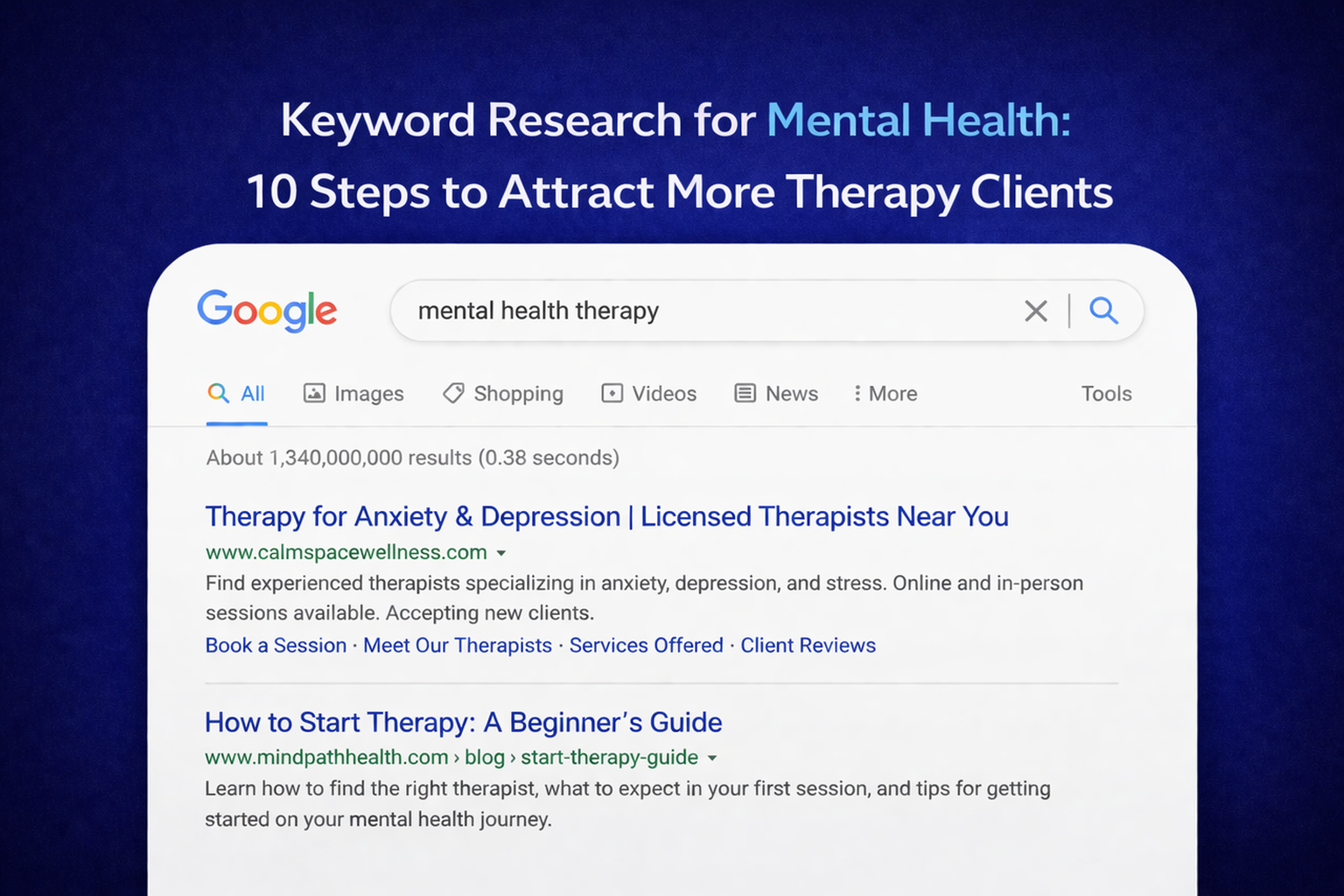
Most therapists approach SEO the same way they pick a few obvious keywords like “therapy near me” or “anxiety therapist” and expect results.
That approach no longer works.
Search behavior has evolved. Competition has increased. And more importantly, Google now prioritizes experience, expertise, authority, and trust (E-E-A-T), especially in mental health.
If your keyword strategy isn’t aligned with search intent + clinical relevance + real user behavior, you’ll struggle to rank and even if you do rank, you won’t convert.
If you’re currently relying on guesswork for your keywords, you’re likely missing high-intent opportunities.
We help therapists identify exactly what their ideal clients are searching for—and build a strategy around it.
Book a consultation with Mental Health IT Solutions to uncover your highest-converting keywords.
Why Keyword Research Matters More in Mental Health
Unlike other industries, mental health searches are:
- Emotion-driven
- Highly specific
- Often urgent
- Location-sensitive
A search like “why do I feel emotionally numb after a breakup” reflects a completely different stage compared to “trauma therapist near me.”
Both matter but require different content strategies.
Step 1: Understand Search Intent (Before You Pick Keywords)
Every keyword falls into one of four intent categories:
Informational
“Why do I overthink everything?”
Navigational
“Dr. Smith therapist NYC”
Transactional
“online therapy for anxiety”
Commercial Investigation
“CBT vs DBT therapy”
Key Insight:
High-performing therapist websites don’t just target one type they cover the full journey.
Step 2: Build Your Core Keyword Buckets
Structure your keyword research into:
- Condition-based (anxiety, trauma, depression)
- Audience-based (teens, couples, professionals)
- Modality-based (CBT, EMDR, somatic)
- Location-based (therapist in [city])
- Problem-based long-tail queries
For local strategy, check – Local SEO for Therapists
Step 3: Use the Right Tools (Without Overcomplicating)
Focus on:
- Google Autocomplete
- People Also Ask
- Ahrefs / SEMrush / Ubersuggest
Step 4: Focus on Long-Tail Keywords
Instead of chasing broad keywords, prioritize:
- “why do I feel anxious at night”
- “therapy for burnout in professionals”
- “online couples counseling cost”
These are:
- Easier to rank
- More intent-driven
- Higher converting
Step 5: Map Keywords to Pages (Critical Step)
Structure matters:
- Homepage → primary local keyword
- Service pages → specific therapy types
- Blogs → informational queries
Most therapists already have content, but it’s not structured around intent.
We audit your existing website, identify missed keyword opportunities, and restructure your content to improve rankings and conversions.
Step 6: Optimize for “Near Me” Searches
Ranking for “therapist near me” requires:
- Google Business Profile optimization
- Local citations
- Location pages
- Reviews and authority signals
Full breakdown here: Why Am I Not Ranking for “Therapist Near Me”?
Step 7: Build Topic Clusters (Authority Strategy)
Instead of random blogs, create clusters.
Example: Anxiety
- Main page: Anxiety Therapy
- Blogs:
- why do I feel anxious all the time
- CBT techniques for anxiety
- panic attack symptoms
Supporting strategy: SEO for Therapists
Step 8: Add E-E-A-T Signals
To rank in mental health, your content must demonstrate:
- Clinical expertise
- Real-world experience
- Author credibility
- Trust signals (privacy, testimonials)
Step 9: Competitor Analysis (Smart, Not Copying)
Look at:
- What’s ranking
- Content depth
- Keyword targeting
Then:
- Identify gaps
- Create better content
Step 10: Track & Improve
Use:
- Google Search Console
- Google Analytics
Monitor:
- Rankings
- Traffic
- Conversions
Common Mistakes to Avoid
- Targeting only high-volume keywords
- Ignoring intent
- Weak or generic content
- Poor page structure
- No local SEO strategy
FAQ’s
1. How do therapists do keyword research for their website?
Therapists can start keyword research by identifying their core services (e.g., anxiety therapy, couples counseling), then expanding into long-tail search queries using tools like Google Autocomplete and SEO platforms. The key is to focus on search intent, what potential clients are actually typing when looking for help, and map those keywords to specific pages on the website.
2. What are the best keywords for mental health websites?
The best keywords combine service + location + intent, such as “anxiety therapist in [city]” or “online couples counseling.” High-performing websites also target long-tail keywords like “why do I feel anxious at night,” which attract users earlier in their decision-making journey.
3. Why is keyword research important for therapists?
Keyword research helps therapists understand how potential clients search for support online. Without it, websites may rank for irrelevant terms or not rank at all. A strong keyword strategy ensures your website attracts qualified traffic that converts into inquiries.
4. How do I find low-competition keywords for therapy SEO?
Focus on long-tail keywords and specific client problems rather than broad terms. For example, instead of “therapy,” target phrases like “therapy for burnout in professionals.” Tools like Google’s “People Also Ask” and keyword research platforms can help identify low-competition, high-intent opportunities.
5. How many keywords should a therapist target on one page?
Each page should focus on one primary keyword and a few closely related secondary keywords. Trying to target too many unrelated keywords on a single page can confuse search engines and reduce ranking potential.
Final Thought
Keyword research isn’t about traffic.
It’s about attracting the right clients at the right stage of their journey.
When done correctly, your website becomes a consistent source of qualified inquiries & not just visitors.
If your website isn’t generating consistent leads, your keyword strategy is likely the gap.
At Mental Health IT Solutions, we specialize in:
- SEO strategies tailored for therapists
- Keyword research focused on real client intent
- Website structures that convert traffic into inquiries