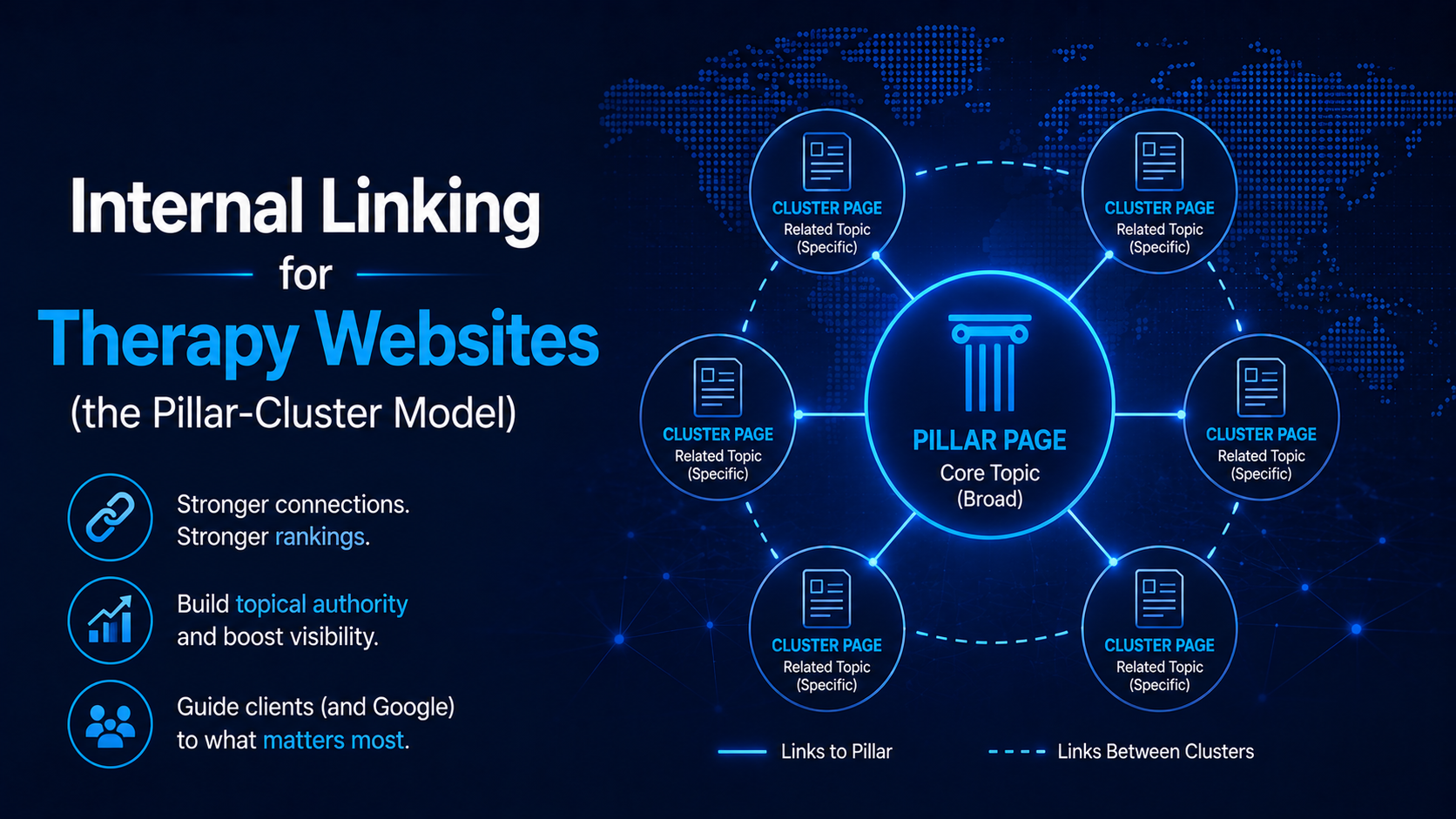
Internal linking for therapy websites is the practice of connecting your pages to each other with deliberate, descriptive links so search engines and AI systems can understand what your site covers and how deeply you cover it. The strongest structure for this is the pillar-cluster model: one broad pillar page anchors a topic, focused supporting pages cover its subtopics, and links flow both up to the pillar and sideways between related pages.
This is not a formatting detail. Internal links are how Google discovers new pages, how it decides which pages on your site matter most, and how it judges whether you have genuine depth on a topic or a scattered collection of unrelated posts. The same signals now shape how AI systems like ChatGPT and Perplexity decide what to cite, since a well-linked cluster reads as a coherent, authoritative source rather than a single isolated page.
This guide explains how the pillar-cluster model works, how to build one on a therapy website, and the linking rules that keep it effective as your content library grows. It is written for practice owners and the people who manage their marketing, not for therapy clients.
In short: build one pillar page per core service, link every supporting article up to that pillar with descriptive anchor text, link sideways to two or three genuinely related siblings, and never link to a page that is not actually relevant. Structure, not volume, is what makes internal linking work.
The mechanism is well established in SEO. Google’s own crawlers rely on internal links to find and prioritize pages, and pages that are well-linked from relevant content consistently outperform orphaned pages with identical content quality. For a therapy website with dozens or hundreds of published articles, internal linking is often the highest-leverage, lowest-cost improvement available, because it requires no new content, only better connections between what already exists.
What is the pillar-cluster model?
The pillar-cluster model organizes a website around topics instead of individual pages. A pillar page covers a core topic broadly, for example, SEO for therapists as a whole. Supporting pages, the cluster, each cover one specific piece of that topic in depth, such as local SEO, internal linking, or a specific keyword strategy. Every supporting page links back up to the pillar, and the pillar links down to its supporting pages.
You can see the model in action on this site. SEO for therapists is the pillar for this entire cluster, and an article like local SEO for therapists is one of its supporting pieces. This article you are reading is another. Each one links back to the pillar and connects sideways to its closest siblings, rather than existing in isolation.
Why does internal linking matter for therapy websites specifically?
Three reasons make this especially important for mental health practices. First, therapy is a Your Money or Your Life topic, and Google leans harder on trust and authority signals in YMYL niches. A well-linked cluster signals depth and genuine expertise on a subject, which a single standalone article cannot do alone.
Second, most therapy practices publish content unevenly over time, a post here, a service page there, often with no plan connecting them. Without deliberate internal linking, a site can accumulate hundreds of pages that never reinforce each other, wasting most of the SEO value each individual page could contribute.
Third, AI search systems increasingly retrieve and synthesize answers from clusters of related content rather than a single page, a pattern often called query fan-out. A site with a clear pillar and well-linked supporting pages is easier for these systems to parse and more likely to be pulled into an AI-generated answer than a page with no surrounding context.
How do you build a pillar-cluster structure?
Start with your core services, not your existing content. Each major service or specialty area, SEO, website development, a specific clinical approach, a location, becomes a candidate pillar. From there, list every subtopic a client or referral source might search for related to that pillar.
| Step | What to do | Example |
|---|---|---|
| 1. Identify the pillar | Pick a broad, core topic tied to a service you offer | SEO for therapists |
| 2. Map the subtopics | List the specific questions and searches under that topic | Local SEO, internal linking, keyword strategy, core update news |
| 3. Build or assign supporting pages | Write new content or tag existing posts to the cluster | This article, the local SEO guide |
| 4. Link up | Every supporting page links to the pillar with descriptive text | “SEO for therapists” links to the pillar |
| 5. Link sideways | Each supporting page links to 2 to 3 genuinely related siblings | This article links to the local SEO guide |
| 6. Link down from the pillar | The pillar links out to its strongest supporting pages | The pillar page lists and links its cluster |
Repeat this for each core service. A therapy website with SEO, website development, Google Ads, and practice growth as service lines should have four or more distinct pillars, each with its own cluster, rather than one giant undifferentiated blog.
Mapping a website into pillars and clusters, and fixing the linking between them, is core to the work our SEO team does for mental health practices.
What makes a good internal link?
Not every link is equally useful, and adding links carelessly can dilute the model instead of strengthening it. A good internal link meets four conditions: it points to a genuinely relevant page, it uses descriptive anchor text that tells both the reader and Google what the linked page covers, it appears naturally within the content rather than being forced in, and it exists because it helps the reader, not just because it helps a metric.
Anchor text matters more than most practices realize. A link that says “click here” tells Google nothing about the destination page. A link that says “local SEO for therapists” tells Google exactly what that page is about and reinforces the keyword relevance of both pages involved.
How many internal links should each page have?
There is no fixed number, but a useful working rule for a supporting article is one link up to its pillar and two to three links sideways to closely related siblings in the same cluster. Fewer than that under-connects the page. More than that, especially links to unrelated topics, dilutes the signal and can read as manipulative rather than helpful.
Pillar pages work differently. A strong pillar page links out to most or all of its supporting content, since its job is to be the hub the reader and the search engine both use to navigate the full topic.
What are the most common internal linking mistakes?
The most damaging mistake is linking only for the sake of adding links, connecting pages that have no genuine relevance to each other. This confuses both readers and search engines and weakens the topical clarity the pillar-cluster model is meant to build.
The second mistake is the orphan page: content published with no links pointing to it from anywhere else on the site. An orphan page is far harder for Google to find, crawl regularly, or trust, no matter how well it is written. The third is inconsistent anchor text, using vague phrases like “read more” instead of descriptive text that reinforces the linked page’s topic. The fourth is treating internal linking as a one-time task rather than an ongoing discipline; every new article should be linked into its cluster the day it publishes, not months later.
How does this connect to AI search visibility?
A well-structured pillar-cluster model does more than help Google crawl a site. It shapes how large language models understand what a website actually knows. When AI systems retrieve information to answer a question, they are more likely to pull from and cite a source that clearly demonstrates depth on a topic through a connected set of pages, rather than a single article with no surrounding context.
This means the internal linking work that has always mattered for traditional SEO is now doing double duty. The same clear pillar, the same well-linked cluster, the same descriptive anchor text, all increase both your Google rankings and your odds of being cited in an AI-generated answer.
If your site’s content is not structured into clear pillars and clusters yet, our mental health SEO services team can build that architecture and fix the linking.
Frequently asked questions
What is the difference between a pillar page and a supporting page?
A pillar page covers a core topic broadly and links out to the full cluster of related content. A supporting page covers one specific subtopic in depth and links back up to the pillar, plus sideways to a few closely related siblings.
How many supporting pages does a pillar need?
There is no fixed minimum, but a pillar with at least six to eight well-linked supporting pages demonstrates real topical depth. Keep adding supporting content as new subtopics and questions emerge within that service area.
Should every blog post link to a pillar page?
Every post should link to the pillar it most closely relates to. A post with no clear pillar connection is a signal that it may belong to a cluster you have not built yet, or that it strays outside your core topics.
Can too many internal links hurt SEO?
Yes, if the links are irrelevant or excessive. A page stuffed with links to unrelated content dilutes the topical signal and can appear manipulative. Link with intent: only to pages that are genuinely relevant to the reader.
Do I need to restructure my whole site to use this model?
No. Start by identifying your core service pillars, then audit existing content and slot each piece into the right cluster, adding the missing links. New content should be planned within the structure from the start.
The bottom line
Internal linking for therapy websites is not a finishing touch; it is the structure that determines whether Google and AI search systems see your site as a scattered collection of pages or a coherent, authoritative source on the topics you serve. Build pillars around your core services, connect every supporting page up and sideways with descriptive, relevant links, and keep the structure current as you publish. The practices that do this consistently outrank sites with equal or better individual content but no underlying architecture.
If your content library needs a pillar-cluster structure built or repaired, talk to our team and we will map your existing content into clusters and fix the linking that connects them.