Every day, people in your city open Google and type “anxiety therapist near me” or “trauma counselor in [city].” They are not browsing. They are ready to reach out often in the middle of a difficult moment, and they will contact the first credible practice that shows up.
If your website is not on page one, that client goes to someone else.
A 2024 study found that 77% of patients use search engines as their first step when finding a healthcare provider. Referrals still matter, but Google is now the front door of most private practices. Therapists who invest in SEO build a system that generates consistent, qualified inquiries without depending on paid ads, directories, or social media algorithms.
This guide covers everything you need to know about SEO for therapists in 2026: local optimization, keyword strategy, technical foundations, AI search visibility, common mistakes, and how to turn your website into your most reliable growth asset.
Table of Content
- Why SEO Matters More Than Ever for Therapists in 2026
- How Therapist SEO Differs from Other Industries (YMYL & E-E-A-T)
- The 4 Core Pillars of Therapist SEO
- Keyword Research for Therapists: 30+ High-Intent Keywords
- On-Page SEO for Therapy Websites
- Local SEO for Therapists: Ranking in Your City
- Technical SEO for Therapist Websites
- Off-Page SEO: Building Authority Outside Your Website
- Voice Search Optimization for Therapists
- AEO: Optimizing for AI Search (ChatGPT, Perplexity, Google AI Overviews)
- SEO vs. Paid Ads for Therapists: What’s Worth Your Money?
- Psychology Today and SEO: Does It Help or Hurt Your Rankings?
- Common SEO Mistakes Therapists Make
- How AI Tools Support Therapist SEO in 2026
- How MHIS Helps Therapists Improve SEO
- FAQs
- Conclusion
Why SEO Matters More Than Ever for Therapists in 2026
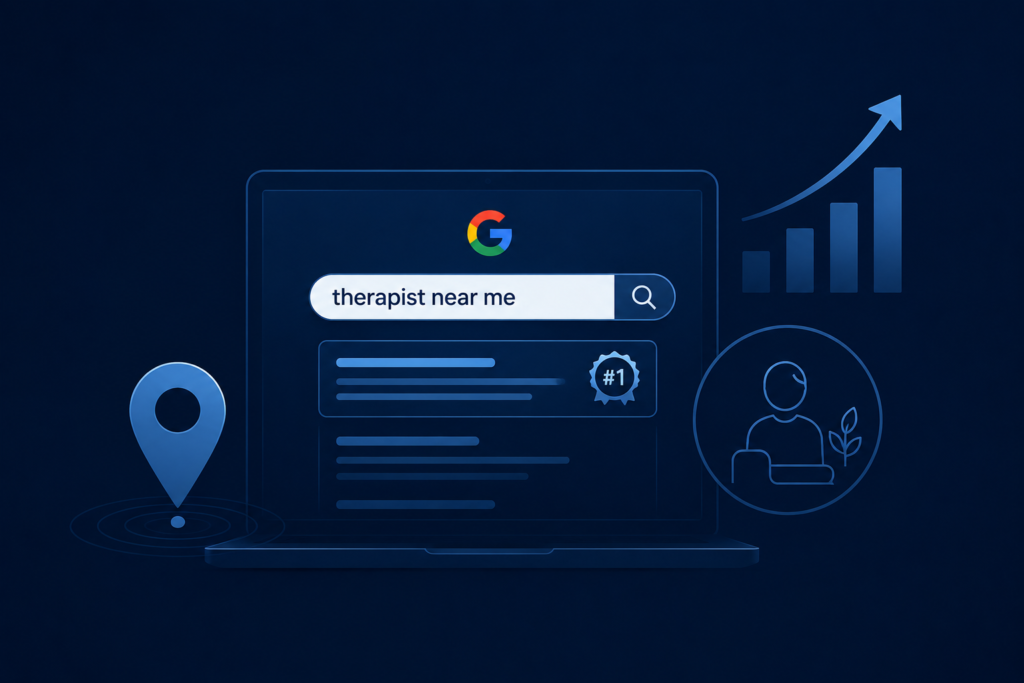
Every day, thousands of people search Google for phrases like “anxiety therapist near me,” “trauma counselor in [city],” or “online therapy for depression.” These are not casual browsers. These are people who are ready to reach out, often sitting in pain, uncertainty, or crisis, and looking for the first credible provider who shows up.
If your practice is not on page one of those results, you are invisible to them.
A 2024 study found that 77% of patients use search engines as their first step when looking for a healthcare provider. The mental health space is no different. Referrals still matter, but they are no longer the primary entry point for most new clients. Today, Google is the front door of your practice.
SEO search engine optimization is the ongoing process of making your website more visible to the right people at the right moment. For therapists, that means appearing when someone in your area is actively searching for the exact type of care you provide.
Done correctly, therapist SEO creates a system that works in the background while you focus on your clients. Each well-optimized page becomes a permanent entry point into your practice, one that generates inquiries month after month without relying on paid ads or social media algorithms.
This guide covers everything mental health professionals need to know about SEO in 2026, including local optimization, keyword strategy, technical foundations, AI search visibility, and the most common mistakes that keep therapy practices stuck on page two.
How Therapist SEO Differs from Other Industries: YMYL and E-E-A-T
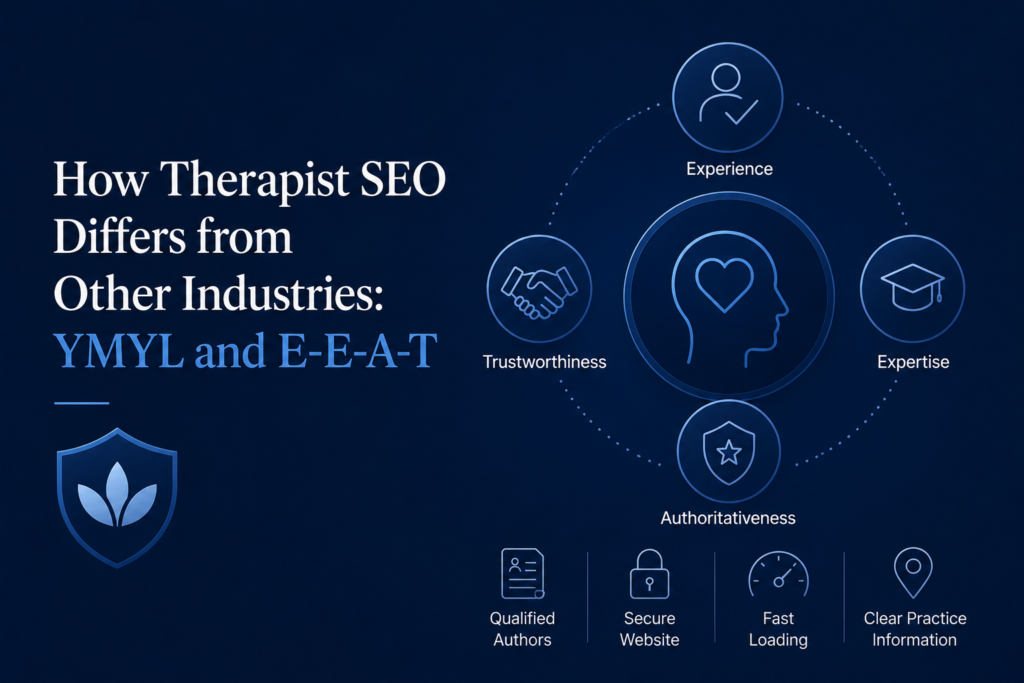
Mental health SEO is not the same as SEO for a restaurant or a retail brand. Google treats mental health content under a category called YMYL, Your Money or Your Life.
YMYL content covers topics that can significantly impact a person’s health, financial stability, or safety. Therapy falls squarely in this category. Because a potential client is making a high-stakes, deeply personal decision about who they trust with their mental health, Google holds therapy websites to a higher standard of quality, accuracy, and credibility.
This is where E-E-A-T becomes critical:
- Experience — Has the author or practice had direct, real-world experience with the topic?
- Expertise — Does the content reflect professional knowledge and clinical accuracy?
- Authoritativeness — Is the website recognized as a trusted source in the mental health space?
- Trustworthiness — Is the site secure, accurate, transparent, and honest about who is behind it?
Practically, this means:
- Your content must be written or reviewed by qualified mental health professionals or credible marketing experts in the space.
- Author bios matter. Anonymous content signals low credibility.
- Citing reputable sources (professional associations, research studies, Google’s own documentation) strengthens trust signals.
- Your website must be secure (HTTPS), load fast, and display clear practice information, including name, location, license, and contact details.
A therapy website that scores poorly on E-E-A-T will struggle to rank consistently, regardless of how well-written its content is. Building trust into your SEO foundation is not optional in this industry.
The 4 Core Pillars of Therapist SEO
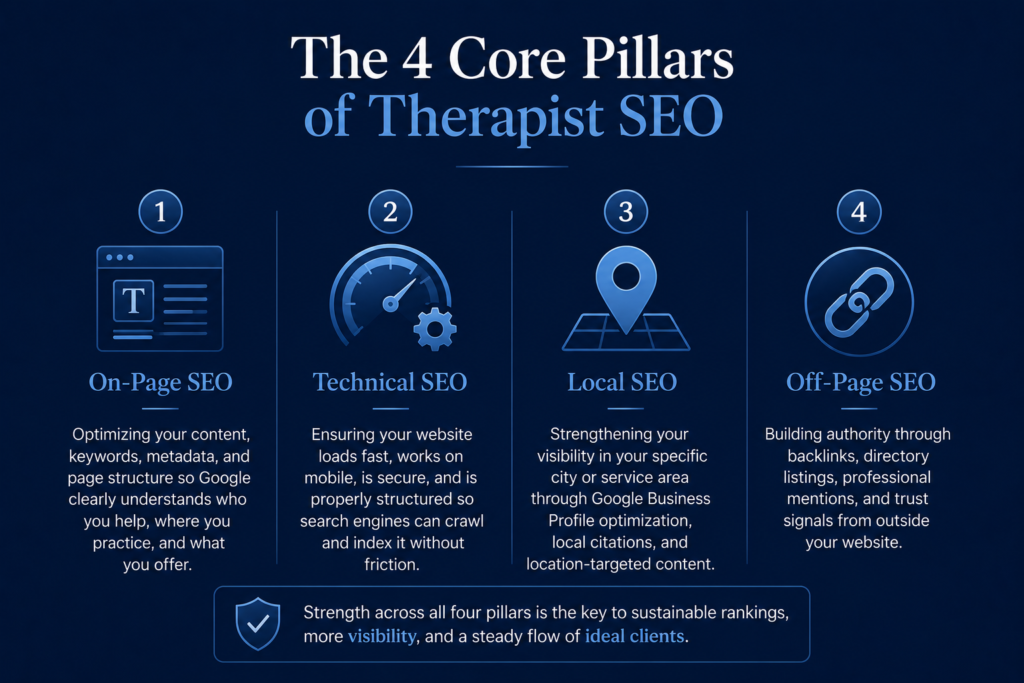
Strong therapist SEO is built on four pillars that work together. Weakness in any one area limits the results of the others.
1. On-Page SEO — Optimizing your content, keywords, metadata, and page structure so Google clearly understands who you help, where you practice, and what you offer.
2. Technical SEO — Ensuring your website loads fast, works on mobile, is secure, and is properly structured so search engines can crawl and index it without friction.
3. Local SEO — Strengthening your visibility in your specific city or service area through Google Business Profile optimization, local citations, and location-targeted content.
4. Off-Page SEO — Building authority through backlinks, directory listings, professional mentions, and trust signals from outside your website.
Each pillar supports the others. A technically perfect site with no local signals will not rank locally. A well-optimized site with no authority will struggle against competitors with established backlink profiles. The goal is strength across all four.
Keyword Research for Therapists: 30+ High-Intent Keywords
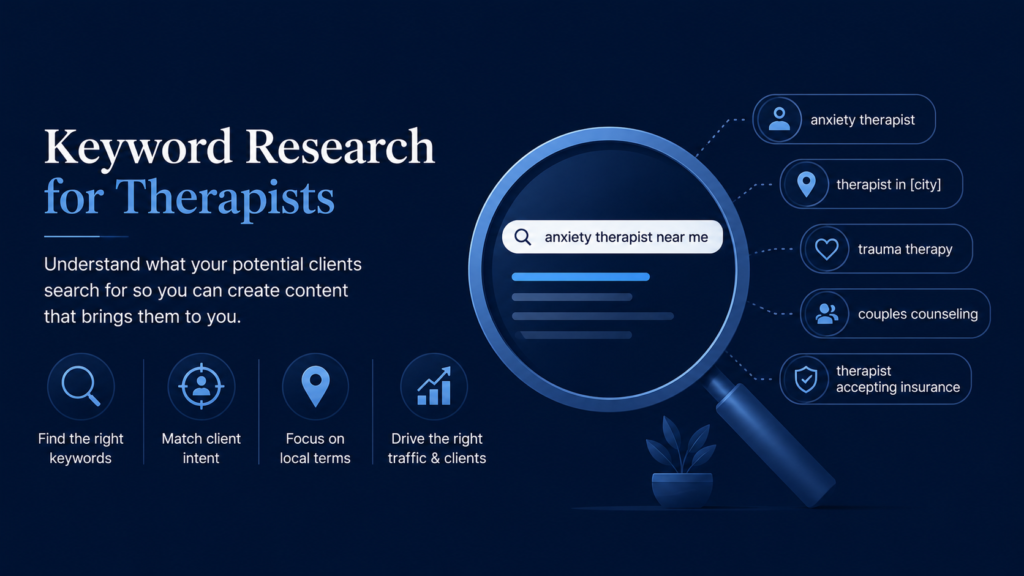
Keyword research for Therapists is the foundation of any effective therapist SEO strategy. It tells you exactly what language your potential clients use when searching for care, and those are the phrases your website needs to reflect.
Types of Keywords to Target
Service Keywords — These describe what you do:
- anxiety therapist
- trauma therapist
- couples counseling
- EMDR therapy
- CBT therapist
- depression therapy
- grief counseling
- teen therapist
- family therapy
Condition-Based Keywords — These match what clients are experiencing:
- help for panic attacks
- therapy for PTSD
- therapist for intrusive thoughts
- counseling for relationship anxiety
- therapy after divorce
Local Keywords — These combine service with geography:
- therapist in [city]
- anxiety counselor in [city]
- online therapist in [state]
- trauma therapy near me
- couples counselor [neighborhood]
Insurance and Access Keywords — Often overlooked but high-intent:
- therapist accepting Blue Cross Blue Shield
- Medicaid therapist in [city]
- sliding scale therapist near me
- therapist accepting new patients
Long-Tail and Conversational Keywords — These match how people actually speak:
- how do I know if I need therapy
- what to expect in a first therapy session
- how to find a trauma-informed therapist online
- best therapist for OCD near me
- is online therapy as effective as in-person
30 High-Impact Therapist Keywords for 2026
| How long does therapy take | Intent Type | Best Used On |
|---|---|---|
| anxiety therapist near me | Local + Service | Service page, homepage |
| therapist for depression | Condition | Service page |
| EMDR therapy [city] | Local + Modality | Location service page |
| online therapy for trauma | Modality + Access | Telehealth page |
| CBT therapist near me | Local + Modality | Service page |
| couples counseling [city] | Local + Service | Couples page |
| trauma-informed therapist | Specialty | About page, service page |
| therapist accepting insurance | Access | FAQ, homepage |
| grief therapist near me | Local + Condition | Service page |
| teen therapist [city] | Local + Specialty | Specialty page |
| how to find a therapist | Informational | Blog post |
| what is EMDR therapy | Informational | Blog, FAQ |
| sliding scale therapy near me | Access | FAQ, homepage |
| family therapist [city] | Local + Service | Service page |
| therapist for anxiety and depression | Condition | Service page |
| somatic therapist near me | Modality + Local | Service page |
| telehealth therapist [state] | Access + Local | Telehealth page |
| therapist for first responders | Specialty | Specialty page |
| postpartum therapist near me | Specialty + Local | Service page |
| psychologist vs therapist | Informational | Blog post |
| how long does therapy take | Informational | FAQ, blog |
| trauma therapy for adults | Condition + Service | Service page |
| LGBTQ+ therapist near me | Specialty + Local | Specialty page |
| therapist for relationship issues | Condition | Service page |
| anxiety therapy online | Modality + Condition | Telehealth page |
| private pay therapist [city] | Access + Local | FAQ, homepage |
| best therapist near me | Local Intent | Homepage, GBP |
| child therapist near me | Specialty + Local | Service page |
| mindfulness-based therapist | Modality | Service page |
| how to prepare for therapy | Informational | Blog post |
Pro tip: Do not try to target all of these at once. Build dedicated pages around your top 5–8 primary keywords, then use blogs and FAQs to capture long-tail and informational searches over time.
On-Page SEO for Therapy Websites
On-page SEO ensures that every page on your website clearly communicates your services, specialties, and location to both Google and your potential clients.
Page Titles and Meta Descriptions
Every service page and location page needs a unique, keyword-rich title tag and meta description. Titles should be 50–60 characters and include your primary keyword and city name where relevant.
Strong examples:
- “Anxiety Therapist in Denver | Jane Smith, LCSW.”
- “Online Trauma Therapy in California | Virtual EMDR Sessions”
- “Couples Counseling in Chicago | Book a Free Consultation.”
Meta descriptions (150–160 characters) should describe the value you offer and invite the click. They do not directly affect rankings but heavily influence click-through rate, which does.
Heading Structure (H1–H4)
Every page should have one H1 that includes your primary keyword. Use H2s to organize service descriptions, benefits, and specialties. Use H3s and H4s for subsections, FAQs, and specific topics.
This structure makes pages easier to read and helps Google understand what each section covers.
Intent-Based Content
Write each service page for one specific type of client. A page for “anxiety therapy” should speak directly to someone struggling with anxiety, what it feels like, what therapy involves, and what they can expect. This specificity increases relevance and improves both rankings and conversions.
Avoid generic language like “I help adults with a wide range of issues.” Be precise.
Internal Linking
Connect service pages to related blogs, FAQs to service pages, and location pages to specialty pages. A strong internal linking structure distributes ranking power across your site and helps Google understand the relationship between your topics.
Aim for 3–5 natural internal links per major service page and blog post.
Clear Calls to Action
Every page should guide a clear next step: “Book a Free Consultation,” “Schedule Your First Session,” or “Get in Touch.” Make it easy for someone who is ready to act to take that action without friction.
Local SEO for Therapists: Ranking in Your City
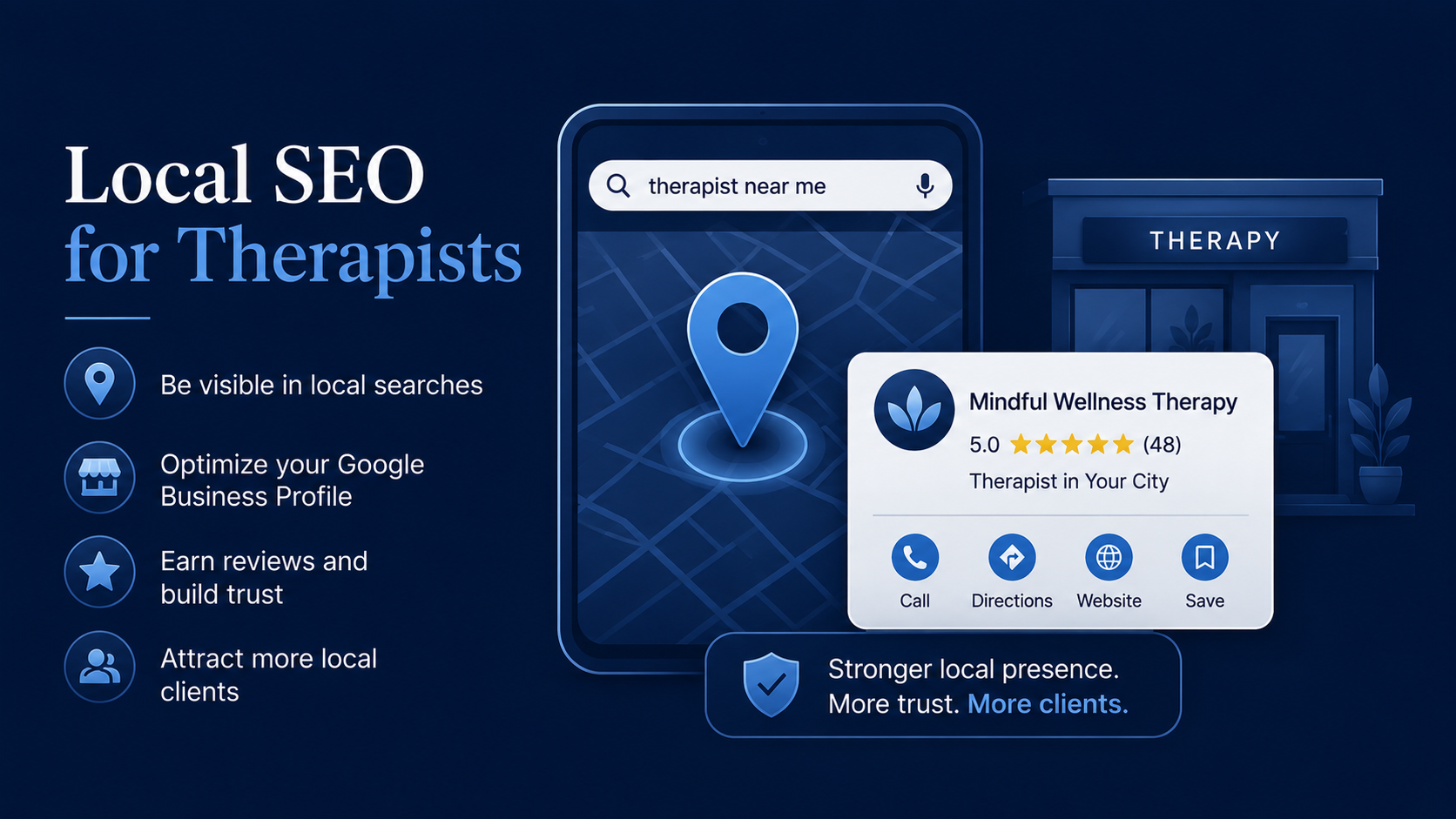
Local SEO for therapists determines whether your practice appears when someone searches “therapist near me” or “anxiety counselor in [city].” These are the highest-intent searches in private practice marketing. The person searching is not browsing; they are ready to reach out.
Google Business Profile (GBP)
Your Google Business Profile is the single most important local SEO asset you have. It controls how your practice appears in Google Maps and the local 3-pack, the top three results shown for local searches.
To optimize your GBP:
- Complete every field: business name, categories (use “Therapist” as the primary category), address, phone number, website, hours, and service areas.
- Write a keyword-rich business description that includes your specialties and city.
- Add high-quality photos of your office, profile photo, and team.
- List every service you offer directly in the Services section.
- Post updates regularly (resources, announcements, or practice news) to signal an active profile.
- Respond to all reviews professionally and promptly.
NAP Consistency
Your Name, Address, and Phone number must be identical across every platform where your practice appears your website, Google Business Profile, Psychology Today, TherapyDen, GoodTherapy, Yelp, and local directories. Inconsistencies confuse Google and weaken local trust signals.
Location-Specific Service Pages
If you serve multiple cities or neighborhoods, create individual landing pages for each. A page titled “Anxiety Therapist in Austin” with localized content will rank far better for Austin searches than a generic homepage.
Each location page should include the city name in the title, H1, meta description, and naturally throughout the content. Embed a Google Map on your contact or location page.
Building Ethical Reviews
Reviews are one of the strongest local ranking signals Google uses. More authentic, positive reviews from real clients directly improve your visibility in local results.
Because of ethical guidelines around client confidentiality, therapists cannot solicit reviews from current clients in most contexts. However, you can encourage reviews from colleagues, supervisees, or people who have attended your workshops or training. You can also include a gentle, compliant mention in session closure discussions.
Technical SEO for Therapist Websites
Technical SEO removes every obstacle between your website and Google’s ability to rank it. Even the best content will underperform on a slow, poorly structured site.
Page Speed
Google uses page speed as a direct ranking factor. Slow sites lose both rankings and visitors; most users abandon a page that takes more than 3 seconds to load.
To improve speed:
- Compress all images before uploading
- Use a lightweight, fast WordPress theme
- Minimize the use of page builder plugins
- Enable browser caching and use a CDN
- Use Google PageSpeed Insights to monitor performance
Mobile Optimization
The majority of therapy searches happen on smartphones. Your website must work perfectly on mobile, with readable text, easy-to-tap buttons, simple navigation, and no elements that overflow off-screen.
Google uses mobile-first indexing, meaning it evaluates your mobile site to determine your rankings. A poor mobile experience is a direct ranking penalty.
HTTPS and Security
Every therapy website must have a valid SSL certificate, which enables the HTTPS protocol and displays the padlock in the browser. This is both a Google ranking factor and a basic trust signal potential therapy clients will notice if your site is marked “Not Secure.”
Site Structure and Crawlability
A clear, logical site structure helps Google understand what your site is about and how your pages relate to each other.
- Your homepage should clearly identify your specialty and location
- Service pages should be accessible within one or two clicks from the homepage
- An XML sitemap should be submitted to Google Search Console
- A properly configured robots.txt file should prevent Google from indexing irrelevant pages (like thank-you pages or admin URLs)
Schema Markup
Schema markup is structured data that tells Google exactly what your content represents. For therapists, the most important schema types are:
- LocalBusiness schema — Identifies your practice location, services, and contact details
- FAQPage schema — Marks up your FAQ section so answers can appear directly in search results (featured snippets)
- Article schema — Identifies blog posts as editorial content
- BreadcrumbList schema — Improves how your site’s navigation appears in search results
Implementing the FAQ schema on this page specifically increases the chance of appearing in position zero for long-tail queries.
Core Web Vitals
Google’s Core Web Vitals measure three aspects of user experience: loading performance (LCP), interactivity (INP), and visual stability (CLS). Scores for all three are visible in Google Search Console. Failing these metrics can suppress rankings even when other signals are strong.
Off-Page SEO: Building Authority Outside Your Website
Off-page SEO tells Google that other credible sources recognize your practice as trustworthy and relevant. It is the difference between a site that Google ranks because it seems authoritative and one that Google ranks because others confirm it is.
Backlinks from Relevant Sources
A backlink is a link from another website to yours. Not all backlinks are equal. A link from a mental health directory, professional association, local news article, or respected health publication carries far more weight than a link from an unrelated or low-quality site.
High-value backlink sources for therapists:
- Psychology Today, TherapyDen, GoodTherapy, Zencare
- State and national mental health associations (APA, NASW, AAMFT)
- Local news outlets covering mental health topics
- Healthcare blogs and wellness publications
- University or hospital websites (if you teach, train, or collaborate)
- Local business directories and chamber of commerce sites
A handful of genuinely authoritative backlinks will outperform dozens of weak directory submissions.
Directory Listings
Beyond backlinks, your presence on reputable mental health directories strengthens both authority and local visibility. Ensure your profiles on Psychology Today, TherapyDen, GoodTherapy, and Zencare are complete, keyword-optimized, and consistent with your website’s NAP information.
Professional Online Presence
A well-maintained LinkedIn profile that references your specialties and links back to your website contributes to brand authority. Guest articles on mental health blogs, participation in podcasts, or being quoted in media pieces generate backlinks and reinforce expertise.
Voice Search Optimization for Therapists
Voice search is no longer emerging; it is mainstream. People use Siri, Google Assistant, and Alexa to ask full-question queries while driving, cooking, or multitasking. For therapists, this changes how you need to write content.
Voice searches are conversational and question-based. Instead of typing “anxiety therapist Denver,” someone might say, “Find me an anxiety therapist in Denver who offers online sessions.”
How to Optimize for Voice Search
- Write in natural, conversational language. Match the way people actually speak, not formal clinical terminology.
- Use question-and-answer formats. Structure content around the real questions clients ask: “What does a first therapy session look like?” “How do I choose the right therapist?” “Is online therapy as effective as in-person?”
- Create robust FAQ sections. Voice assistants frequently pull answers directly from FAQ sections on websites.
- Ensure fast load speed and mobile optimization. Voice search users expect immediate results.
- Optimize your Google Business Profile. Many voice searches have local intent and pull directly from GBP listings.
- Target long-tail keywords that mirror spoken queries. “Best trauma therapist near me who takes insurance” is a voice-friendly keyword that a traditional SEO approach might overlook.
AEO: Optimizing for AI Search in 2026
One of the most significant shifts in 2026 is the rise of AEO Answer Engine Optimization. While traditional SEO focuses on ranking in Google’s blue links, AEO focuses on being cited by AI-powered tools that summarize answers directly.
Tools like ChatGPT, Perplexity, and Google AI Overviews are now influencing how people find therapists. Someone may ask, “Who is the best trauma therapist in San Francisco?” and receive an AI-generated response that references specific practices — without ever clicking a traditional search result.
Research suggests that up to 25% of traditional search traffic may shift toward AI-assisted search experiences by the end of 2026. Therapists who optimize for AI visibility now will have a meaningful advantage.
How to Optimize for AI Search
Write clear, factual, authoritative content. AI tools favor content that directly answers questions without ambiguity. Hedged, fluffy, or vague content is unlikely to be cited.
Structure content with explicit question-and-answer formatting. AI models extract answers from well-structured content. Headers that are phrased as questions, followed by direct answers, are highly compatible with how AI systems retrieve and present information.
Establish E-E-A-T signals across your entire site. AI models prioritize sources that appear trustworthy and authoritative. Your author bio, credentials, external mentions, and backlink profile all influence whether AI tools treat your site as a credible source.
Get cited on authoritative platforms. Being mentioned or quoted on platforms like Psychology Today, major health publications, or professional association websites increases the chance that AI models will reference your practice.
Use consistent, specific information everywhere. Your practice name, location, specialties, and contact information should be identical across your website, GBP, directories, and any platform where you appear. AI tools cross-reference multiple sources to verify information.
AEO does not replace traditional SEO — it extends it. A strong SEO foundation makes AI citation more likely, not less.
SEO vs. Paid Ads for Therapists: What’s Worth Your Money?
Therapists frequently ask whether to invest in SEO, Google Ads, or both. Here is an honest comparison.
| Factor | SEO | Google Ads |
|---|---|---|
| Time to results | 3–6 months | Days |
| Cost over time | Decreases as authority builds | Continuous spend required |
| Traffic when you stop | Remains (momentum holds) | Stops immediately |
| Lead quality | High-intent, research-driven | High-intent, price-sensitive |
| Competition | Moderate to high | Can be very expensive in cities |
| Long-term ROI | Very high | Moderate to high |
| Best for | Established, growing practices | Immediate lead generation needs |
The bottom line: Google Ads is useful for short-term visibility or filling caseload quickly. SEO builds lasting infrastructure. For most private practice therapists, SEO provides far better long-term return on investment. The ideal approach is to use Ads in the short term while building SEO for sustainable, compounding growth.
Psychology Today and SEO: Does It Help or Hurt Your Rankings?
This is one of the questions therapists ask most often, and the answer is more nuanced than most marketing agencies admit.
However, Psychology Today has its own SEO interests. Its directory pages frequently outrank individual therapist websites for competitive search terms like “anxiety therapist in [city].” This means the directory can capture traffic that might otherwise reach your site directly.
Psychology Today does not hurt your rankings. It is a high-domain-authority website, and a link from your Psychology Today profile back to your website is a genuine, valuable backlink.
What this means for your strategy:
- Maintain and fully optimize your Psychology Today profile it contributes to your off-page authority and captures clients who use the directory’s internal search.
- Do not rely on Psychology Today as your primary SEO strategy. Directories can change their policies, algorithms, or pricing at any time.
- Invest in your own website’s SEO as a parallel, owned asset. When someone clicks your Psychology Today profile, they should also be able to find you on Google independently.
A well-optimized therapist website with strong local SEO will increasingly outrank or appear alongside Psychology Today for long-tail and specialty-specific searches, especially in smaller cities and niche specialties.
Common SEO Mistakes Therapists Make
Recognizing these mistakes is often the fastest way to diagnose why a therapy website is not ranking.
1. No dedicated service pages. A single “Services” page that lists everything you do is not SEO-effective. Each major specialty — anxiety, trauma, couples, EMDR, depression deserves its own dedicated page optimized for that specific search term.
2. Writing for the wrong audience. Content that explains clinical concepts to potential therapy clients (psychoeducation) is different from content that helps clients find you. SEO content should be written for people who are actively searching, not for people already in your care.
3. Ignoring the Google Business Profile. An incomplete or unverified GBP is the most common local SEO failure. A therapist without a claimed and optimized GBP is effectively invisible in map results.
4. Keyword stuffing. Forcing keywords into content unnaturally signals poor quality to Google. Write for people first; optimize secondarily.
5. No location signals on the website. If your city and state do not appear in your page titles, H1 tags, and content, Google has no clear signal about where you practice.
6. Slow website. Many therapy websites run on heavy themes with unoptimized images. A site that loads in 6 seconds will lose clients and rankings to one that loads in 1.5 seconds.
7. Using Wix or Squarespace for serious SEO. These platforms have improved but still carry significant SEO limitations — restricted technical control, slow performance, limited schema implementation, and weaker indexing compared to WordPress.
8. Publishing blogs without a keyword strategy. Writing about topics that have no search demand produces content that no one finds organically. Every blog post should be built around a real, researched keyword.
9. No FAQ section or schema. FAQ sections answer the real questions clients ask and, when properly marked up with FAQPage schema, can appear in featured snippets — one of the most prominent positions in Google search results.
10. No author attribution. Anonymous content on a mental health website is a direct E-E-A-T weakness. Name the author, include credentials, and link to a bio page.
How AI Tools Support Therapist SEO in 2026
AI tools have become a practical part of modern therapist SEO — not to replace clinical voice, but to amplify it.
Keyword and intent analysis. AI platforms can analyze how potential clients search for care, surfacing keyword opportunities and content gaps that manual research might miss.
Content drafting and expansion. AI tools can help draft FAQ sections, service page copy, or blog outlines — which a qualified writer then refines to ensure clinical accuracy and brand voice.
Google Business Profile optimization. AI can help craft keyword-rich service descriptions, suggest posting topics for GBP updates, and identify patterns in client inquiry language.
Competitive analysis. AI-powered SEO tools can audit competitor sites, identifying what content and keywords your competitors are ranking for so you can build strategically around or above them.
Voice and conversational content. AI is particularly useful for generating long-tail, question-based content that matches voice search patterns and AI search queries.
The key is using AI as a productivity tool within a human-led strategy. Content that sounds robotic, lacks clinical nuance, or ignores E-E-A-T standards will not rank well regardless of how it was produced.
How Mental Health IT Solutions Helps Therapists Improve SEO
Mental Health IT Solutions (MHIS) is built exclusively for the mental health industry. Every SEO strategy we develop is shaped by how real clients search for care, how Google evaluates YMYL healthcare content, and how therapists must communicate ethically online.
MHIS helps practices rank for high-intent searches — “anxiety therapist near me,” “EMDR therapy in [city],” “trauma counselor accepting insurance” by building location-specific service pages, optimizing Google Business Profiles, structuring websites for specialty recognition, and publishing authority-driven, voice-search and AI-optimized content.
Technical performance is strengthened through speed audits, Core Web Vitals improvements, schema implementation, and clean site architecture. Off-page authority is built through ethical directory optimization and a backlink strategy tailored to the mental health space.
The outcome is not just more traffic, it is better inquiries. Therapists attract people who are already searching for their exact specialties, in their exact locations. MHIS transforms a website from a passive digital brochure into a reliable, ethical client acquisition system.
FAQs
What is SEO for therapists?
SEO for therapists is the process of optimizing a therapy practice’s website so it appears higher in Google search results when potential clients search for mental health services. It includes keyword strategy, local optimization, technical improvements, content creation, and authority building, all designed to attract high-intent clients who are actively looking for care.
Why is SEO important for therapists?
SEO helps therapists appear in Google searches at the exact moment potential clients are looking for support. Because most people now begin their search for mental health care on Google before consulting directories, asking for referrals, or calling anyone, practices that do not rank are effectively invisible to a large portion of their potential client base.
How long does SEO take for therapists to see results?
Most therapists begin noticing improvements in visibility and website traffic within 2–3 months of consistent SEO effort. Meaningful ranking improvements for competitive keywords typically develop over 4–6 months. Full authority for highly competitive markets can take 9–12 months or more.
What keywords should therapists target?
Therapists should target a mix of service keywords (anxiety therapy, EMDR, couples counseling), local keywords (therapist in [city], therapist near me), condition-based keywords (therapy for PTSD, help with panic attacks), and long-tail conversational queries that match how clients actually search. Starting with 5–8 core keywords and expanding over time is the most effective approach.
Is local SEO necessary for teletherapy practices?
Absolutely. Even fully virtual practices are licensed in specific states, and clients search for telehealth therapists using location-based terms like u0022online therapist in Texasu0022 or u0022virtual anxiety therapy in California.u0022 Local SEO ensures you appear for those searches in every state where you are licensed.
What is the best website platform for therapist SEO?
WordPress is the best platform for therapist SEO. It offers full control over technical SEO settings, metadata, schema markup, site speed optimization, and content structure. Platforms like Wix and Squarespace have improved but remain limited in SEO flexibility compared to WordPress, particularly for therapists targeting competitive local markets.
Conclusion
Every day, people in your city search for exactly the kind of care you provide. They are not scrolling social media or waiting for a referral. They are on Google, right now, looking for a therapist who is credible, accessible, and relevant to what they are going through.
SEO determines whether you appear in that moment or whether someone else does.
The practices that consistently fill their caseloads in 2026 are not necessarily the most experienced therapists in their area. They are the practices that show up when it matters, communicate their value clearly, and give potential clients enough trust to take the next step.
Building that visibility takes time and strategy, but the results compound. Each optimized service page, each location signal, each well-structured blog post adds to a foundation that generates inquiries month after month without ads, without algorithms, and without constant promotion.
If your work has the power to change lives, invisibility is not a neutral outcome. It is the cost of not being found.