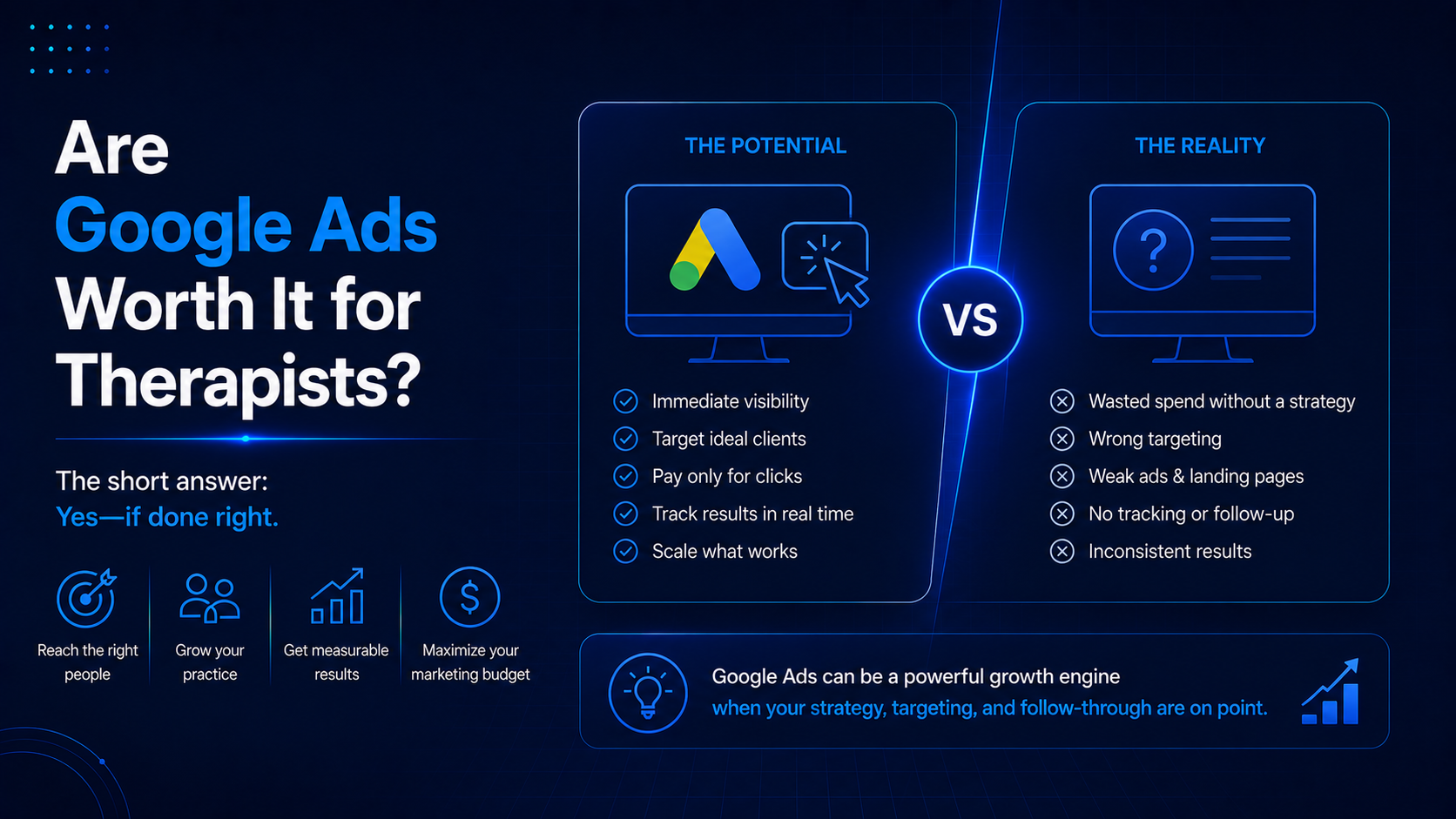
Ask around and you will hear both stories. One therapist says Google Ads were the best marketing decision they ever made and filled their calendar within weeks. Another says they poured money in for two months, got nothing, and swore off ads for good. Both are telling the truth. The difference is almost never the ads themselves. It is whether the practice was set up to make them work.
This guide gives you an honest answer to whether Google Ads are worth it for your practice, with the real numbers, the math behind the return, and a clear picture of who they fit and who should hold off.
Quick answer: Google Ads are worth it for therapy practices that have a conversion-ready website, a budget of at least a few hundred dollars a month, the capacity to take new clients, and the ability to respond to inquiries quickly. For practices missing those pieces, ads usually disappoint, not because the channel fails, but because the foundation is not ready.
Key Takeaways
- Google Ads are worth it for some practices and not others. The deciding factor is your setup, not the channel.
- They capture active demand. People searching for a therapist are ready to act, which makes the traffic higher intent than most other marketing.
- The math often works because of client value. One retained therapy client is usually worth far more than the cost to acquire them.
- They are not worth it without the foundation: a conversion-ready website, enough budget to gather data, capacity for clients, and fast follow-up.
- Most “ads did not work” stories are fixable setup problems, like sending traffic to a homepage or having no conversion tracking.
- Worth it is relative. Ads are fast and scalable, while local SEO compounds over time, so the strongest practices use both.
Not sure whether ads make sense for your practice? MHIS gives therapy practices an honest assessment of whether Google Ads would pay off for their specific situation, before they spend. Book a free consultation with MHIS.
What Google Ads Actually Offer a Therapy Practice
Google Ads place your practice at the top of search results the moment someone searches for a therapist, and you pay only when they click. For a therapy practice, the value is reaching people at the exact point they have decided to find help, faster than any other channel can.
The core benefits are straightforward. You appear in front of active searchers, you control who sees your ads by location and keyword, you set your own budget, and you can measure exactly what you get back. Unlike waiting months for SEO to build or hoping referrals come in, ads produce visibility on demand. For a fuller picture of how the channel works, see our guide to Google Ads for therapists.
The real question is not what ads offer, but whether that offer is worth the cost for your practice specifically. That comes down to the case for them, the math, and the situations where they do not pay off.
The Case for Google Ads
Google Ads are worth it when you need clients now, want control over who finds you, and can turn interested searchers into booked sessions. Their strengths line up well with how people actually look for a therapist.
Here is what makes them worth considering:
- They capture the highest-intent traffic. Someone typing “trauma therapist near me” has already decided they need help and is choosing where to go. That is a warmer prospect than a social media scroller or a general web visitor.
- They work fast. Ads can generate inquiries within days of launching, compared to the six to twelve months good SEO often takes to build momentum.
- You control and measure everything. You choose the keywords, the locations, and the budget, and you can see exactly which searches produce inquiries, so nothing is guesswork.
- They scale on demand. When ads work, you raise the budget to get more clients. Few other channels let you turn the dial like that.
- One client can be worth far more than the ad cost. This is the part most worth-it conversations skip, and it is where the real answer lives.
The Real Math: Do the Returns Justify the Cost?
Whether Google Ads are worth it comes down to one comparison: what it costs you to acquire a client versus what a client is worth to your practice. For most therapy practices, the lifetime value of a client is high enough that even a meaningful acquisition cost pays off.
Start with the costs. Therapy keywords typically run $3 to $15 per click, higher in major metros and competitive specialties, against an all-industry average around $5.42 per click in 2026 benchmarks. Most solo therapists spend $500 to $1,200 per month, and below roughly $300 to $400 per month, campaigns rarely gather enough data to perform. A common rule of thumb in the field is to budget around $200 per new client you want to attract. Healthcare also converts well on average, near 24% in recent benchmark data, so a strong landing page turns a healthy share of clicks into inquiries.
Now the value side, which is what tips the scales. Consider an illustrative example, with your own numbers plugged in:
- You spend $900 in a month, and your cost per inquiry is $45, giving you about 20 inquiries.
- Half are a good fit, and you book 4 as ongoing clients.
- Each client pays $150 per session and stays for an average of 12 sessions, which is $1,800 per client.
- That is $7,200 in revenue from $900 in ad spend.
Even if only two of those clients retain long-term, the spend is still well covered. The specific numbers will differ for your practice, but the structure is what matters: cost per client versus the lifetime value of a client. When a single retained client is worth well over a thousand dollars, an acquisition cost of $100 to $300 is usually a clear yes, especially for private-pay practices with healthy margins. To pin down realistic numbers for your market, see our guide on how much therapists should spend on ads.
The variables that decide your result are your cost per click, your conversion rate (driven by your landing page), your close rate on inquiries, and your client lifetime value. Improve any of those and the math gets better.
Wondering whether the numbers would work for your practice? MHIS builds and manages Google Ads for therapists, and pairs them with the conversion-focused websites and tracking that make the return real rather than theoretical. See how our Google Ads management for therapists works.
When Google Ads Are Not Worth It
Google Ads are not worth it, at least not yet, when the foundation is missing. Spending on traffic that has nowhere good to land, or that you cannot follow up on, wastes money regardless of how well the ads are built.
Hold off if any of these describe you:
- You do not have a conversion-ready website or landing page. Sending paid clicks to a slow or generic homepage is the single most common reason ads fail. Fix the destination first.
- Your budget is too small to gather data. Below a few hundred dollars a month, campaigns cannot learn what works, so they underperform and feel like a waste.
- You cannot respond to inquiries quickly. People reaching out for therapy often book with whoever answers first. If leads sit for days, you paid for them and lost them.
- You are already at capacity. If your caseload is full, spending on new client acquisition makes little sense until you have room.
- You expect to set it up once and never touch it. Ads reward ongoing management. Without it, budget drifts toward waste.
None of these mean ads will never work for you. They mean the smart move is to fix the missing piece first, then advertise. Otherwise you are testing the channel with a broken foundation and blaming the channel for the result.
Who Google Ads Are Worth It For
Google Ads are worth it for practices ready to convert and grow, and premature for those still missing the basics. The table below maps the two situations so you can place yourself.
| Google Ads are likely worth it if you | Reconsider or wait if you |
|---|---|
| Have a conversion-ready website or landing page | Send traffic to a generic, slow homepage |
| Can budget at least a few hundred dollars a month | Have almost no budget to test with |
| Have capacity for new clients | Are already at a full caseload |
| Can respond to inquiries quickly | Cannot follow up for days |
| Serve private-pay or higher-fee clients, or a clear niche | Rely on thin-margin, low-fee work with no room to invest |
| Are willing to manage or outsource optimization | Expect to set it up once and never touch it |
If you land mostly in the left column, ads are very likely worth testing. If you land mostly in the right, invest in the missing pieces first, then revisit.
Why Therapists Wrongly Conclude “Ads Aren’t Worth It”
Most therapists who decide Google Ads are a waste of money were not let down by the ads. They were let down by a fixable setup problem that quietly drained the budget. The channel took the blame for something else.
The usual culprits are familiar: sending clicks to a homepage instead of a focused landing page, bidding on broad symptom keywords that attract browsers rather than ready clients, running with no negative keywords so budget leaks on irrelevant searches, having no conversion tracking so there is no way to improve, and following up too slowly to convert the inquiries that do come in. Any one of these can make a perfectly viable channel look worthless.
The practical lesson is that before concluding ads do not work, it is worth checking whether the account and website were actually set up to succeed. In most underperforming cases, the fix is not abandoning Google Ads. It is repairing the leak. Our step-by-step guide on how to create a Google Ads campaign for a therapy practice covers building it correctly from the start.
Google Ads Worth It Compared to What?
Worth it is always relative to the alternative. Google Ads are fast, controllable, and scalable, but they carry an ongoing cost, so their value is best judged against the other ways therapists get clients.
- Versus Psychology Today: the directory is a low, fixed cost with a low ceiling. Ads cost more but capture higher intent and scale. Many practices use the directory as a baseline and ads for targeted growth.
- Versus local SEO: SEO takes months to build but then delivers visibility without ongoing media spend, making it a compounding asset. Ads deliver immediately but stop when you stop paying. The two work well together, and our guide on local SEO for therapists covers building that long-term visibility.
- Versus referrals: referrals are valuable but limited and unpredictable. Ads give you a lever you can actually control.
For most practices, the strongest answer is not ads instead of everything else, but ads as the fast, controllable piece of a broader mix. Judged that way, they are frequently worth it for the specific job of bringing in clients now.
A Simple “Is It Worth It for Me?” Test
Run through these questions. The more you answer yes, the more likely ads are worth it for you now:
- Do I have a fast, focused page to send ad traffic to, not just my homepage?
- Can I commit at least a few hundred dollars a month for long enough to gather data?
- Do I have room for new clients?
- Can I respond to inquiries within hours, not days?
- Is a new client worth significantly more to me than it would cost to acquire one?
- Am I willing to manage the account or have someone manage it?
Mostly yes means test them. Several nos means fix those first, and ads become worth it once the foundation is in place.
A Realistic Example
Consider a private-pay anxiety therapist with a full fee, a decent website, and room for four new clients a month.
She invests $800 per month in Google Ads targeting high-intent local keywords, sends clicks to a focused anxiety-therapy landing page, and responds to inquiries the same day. Her cost per inquiry lands around $50, giving her roughly 16 inquiries. She books three to four as ongoing clients. With each client worth well over a thousand dollars across their time in therapy, her return dwarfs the $800 spend, and because she has capacity and follows up fast, almost none of that budget is wasted.
Now change one variable. If she had sent that traffic to a generic homepage, her inquiries might have dropped by half or more, and the same $800 would have looked like a poor investment. Same market, same budget, opposite conclusion. That is the whole story of whether Google Ads are worth it: the channel is viable, and the setup decides the outcome.
Frequently Asked Questions
Are Google Ads worth it for therapists?
For many therapy practices, yes, but it depends on your setup rather than the channel itself. Google Ads are worth it when you have a conversion-ready website, a budget of at least a few hundred dollars a month, capacity for new clients, and the ability to respond to inquiries quickly. Under those conditions, they capture high-intent searchers and often pay off, because a retained therapy client is usually worth far more than the cost to acquire them. They are not worth it, at least not yet, if you are sending traffic to a generic homepage, cannot follow up fast, or have almost no budget to test with. In those cases, the smart move is to fix the missing piece first, then advertise.
How much do therapists need to spend for Google Ads to be worth it?
Most solo therapists need to budget $500 to $1,200 per month for ads to work consistently, with the right figure depending on your city and specialty. Below roughly $300 to $400 per month, campaigns usually cannot gather enough data to perform, so a very small budget often produces disappointing results that are not the channel’s fault. Just as important as the amount is focus: concentrating spend on a few high-intent, local keywords in your core service area outperforms spreading the same budget thinly. A useful rule of thumb is to expect to spend around $200 per new client, then weigh that against what a client is worth to you. Start at a level you can test properly, measure, and scale from there.
How do I calculate the ROI of Google Ads for my practice?
Compare what it costs to acquire a client against what a client is worth to you. Take your monthly ad spend and divide it by the number of clients it produces to get your cost per client. Then estimate a client’s lifetime value: their fee per session multiplied by the average number of sessions they stay. For example, a client at $150 per session for 12 sessions is worth $1,800. If your cost per client is $200 and each client is worth $1,800, the return is strongly positive. The key inputs are your cost per click, your conversion rate, your close rate on inquiries, and your client value. Track conversions so these numbers are real rather than guessed, and improve any input to improve the return.
Are Google Ads better than Psychology Today for getting clients?
They serve different purposes, so it is less about better and more about fit. Psychology Today is a low, fixed cost with a low ceiling, useful as a steady baseline, especially if you take insurance. Google Ads cost more but capture higher-intent searchers, give you control over targeting and messaging, and scale when they work. For a practice that wants to grow, target a specific niche, or reach private-pay clients, ads usually offer more upside. For a brand-new practice on a tight budget, the directory may be the better starting point. Many successful practices use both: the directory as an inexpensive baseline and Google Ads for targeted, scalable growth. The right choice depends on your goals, budget, and whether your website is ready to convert paid traffic.
Are Google Ads worth it if I take insurance?
They can be, but the math is tighter. Insurance reimbursement rates are often lower than private-pay fees, which reduces the lifetime value of each client and therefore how much you can profitably spend to acquire one. If your margins are thin, a high cost per click can eat into the return quickly. That said, ads can still be worth it if you have capacity, convert inquiries well, and clients stay in treatment for a meaningful number of sessions. For insurance-based practices, Psychology Today’s low fixed cost and insurance filters are often a strong baseline, and local SEO builds free long-term visibility. Ads make the most sense when you want to grow faster than those channels allow and the numbers still work after accounting for your reimbursement rates.
How long before Google Ads pay off for a therapy practice?
Ads can generate inquiries within days of launching, which is far faster than SEO’s typical six to twelve month timeline. However, early performance is not final performance. Campaigns improve over the first few weeks as you gather conversion data, add negative keywords, refine ad copy, and adjust bids, so the return usually climbs as the account matures. Give a new campaign a few weeks of proper management before judging whether it pays off, and make sure conversion tracking is live from the start so you can measure results. Practices that expect instant, polished returns and quit after a week almost always leave before the account has had a chance to perform. The speed is a real advantage, but patience through the optimization phase is what secures the payoff.
Why do some therapists say Google Ads are a waste of money?
Usually because their account or website was not set up to succeed, and the channel took the blame. The most common causes are sending paid clicks to a generic homepage instead of a focused landing page, bidding on broad symptom keywords that attract browsers rather than ready clients, running with no negative keywords so budget leaks on irrelevant searches, having no conversion tracking, and following up too slowly to convert inquiries. Any one of these can make a viable channel look worthless. When therapists say ads were a waste, the underlying issue is almost always one of these fixable problems rather than the ads themselves. Before writing off Google Ads, it is worth checking whether the setup actually gave them a fair chance to work.
Are Google Ads worth it for a brand-new private practice?
It depends on your foundation and budget. A brand-new practice with a conversion-ready website, some budget to test, and capacity to take clients can absolutely benefit from ads, since they bring visibility immediately while you are still unknown. But if you are launching with a tight budget and no website built to convert, it is often smarter to start with lower-cost channels, like a Psychology Today listing and local SEO, while you build the foundation. Then add ads once you have a page that converts and room to invest. The instinct to turn on ads from day one is understandable, but ads amplify what already exists, so a weak website or slow follow-up will just make paid traffic disappear faster.
Are Google Ads worth it for a solo therapist versus a group practice?
Both can benefit, but the calculus differs. For a solo therapist, the constraints are budget and capacity: ads are worth it when you have room for clients, a page that converts, and enough budget to test, and the high value of each retained client usually justifies the cost. For a group practice, ads often make even more sense, because there is more capacity to fill, bigger budgets to work with, and the ability to advertise multiple specialties and locations. Group practices can also route inquiries to the right clinician, which improves conversion. The core worth-it test is the same for both, but group practices typically have more headroom to scale ads profitably, while solo therapists should size their spend carefully to their capacity.
What do I need in place before Google Ads are worth trying?
Four things. First, a conversion-ready destination: a fast, focused landing page that matches your ad, not just a homepage. Second, enough budget to gather data, generally at least a few hundred dollars a month sustained for long enough to learn. Third, capacity to take new clients, so you are not paying to generate demand you cannot serve. Fourth, a fast follow-up process, since inquiries for therapy often book with whoever responds first. Conversion tracking is also essential so you can measure and improve. If those pieces are in place, ads are worth testing. If any are missing, fixing them first will make the difference between ads that pay off and ads that quietly waste your budget.
Are Google Ads worth it in an expensive, competitive city?
They can be, but you need a realistic budget and a strong setup to compete. In high-cost metros, cost per click for therapy keywords runs at the upper end, so a very small budget will not go far and may not gather enough data to perform. To make ads worth it in a competitive market, focus tightly on high-intent, specific keywords and a defined service area rather than spreading thin, send traffic to an excellent landing page to maximize conversions, and consider targeting a specialty where you can stand out rather than competing on the most expensive general terms. The client value in these markets is often high too, which helps the math. With enough budget and a sharp setup, competitive cities can still deliver a strong return.
Should I run Google Ads myself or hire someone to make them worth it?
It depends on your time and how much is at stake. The fundamentals are learnable, and a motivated therapist can run a compliant, effective account. But Google Ads reward ongoing attention, weekly search term reviews, negative keyword additions, bid adjustments, and copy testing, plus the compliance nuances specific to mental health, and that time has to come from somewhere. Since a poorly managed account can waste budget and make ads look not worth it, many practices find that a specialist pays for themselves by finding and fixing the leaks and keeping the account improving. If you have the time and interest, doing it yourself is viable. If you would rather focus on clients, hiring help is often what turns ads from a gamble into a reliable, worthwhile channel.
Final Key Takeaways
- Google Ads are worth it for practices with the right foundation, and premature for those without it.
- They capture high-intent searchers and work fast, which is their core advantage.
- The math usually works because a retained therapy client is worth far more than the cost to acquire one.
- Most “ads are a waste” stories are fixable setup problems, not channel failures.
- Ads are worth it as the fast, scalable piece of a mix that also includes local SEO and, often, a directory baseline.
Action Checklist
- Confirm you have a fast, focused landing page for ad traffic.
- Set a budget you can sustain long enough to gather data.
- Make sure you have capacity for new clients.
- Put a fast inquiry follow-up process in place.
- Estimate your cost per client and your client lifetime value.
- Set up conversion tracking before spending.
- If a piece is missing, fix it first, then advertise.
- Plan to manage the account, or hire someone who will.
Conclusion
Are Google Ads worth it for therapists? For the right practice, yes, and often clearly so, because the high value of a retained client means even a meaningful acquisition cost pays for itself. But worth it is earned, not guaranteed. Ads reward practices that have a page built to convert, a budget large enough to learn, capacity to take clients, and the discipline to follow up fast and keep optimizing. Get those pieces in place, and Google Ads become one of the most controllable, scalable ways to fill your calendar. Skip them, and the same budget disappears. The channel is viable. Your setup decides whether it is worth it.
If you want a clear read on whether ads would pay off for your specific practice, that is exactly the kind of assessment a therapy-focused marketing partner can give you.
Want to know if Google Ads would actually be worth it for your practice? MHIS will review your website, market, and goals, give you an honest assessment, and build a plan across Google Ads, landing pages, and local SEO if the numbers make sense. Book your free consultation with MHIS today.