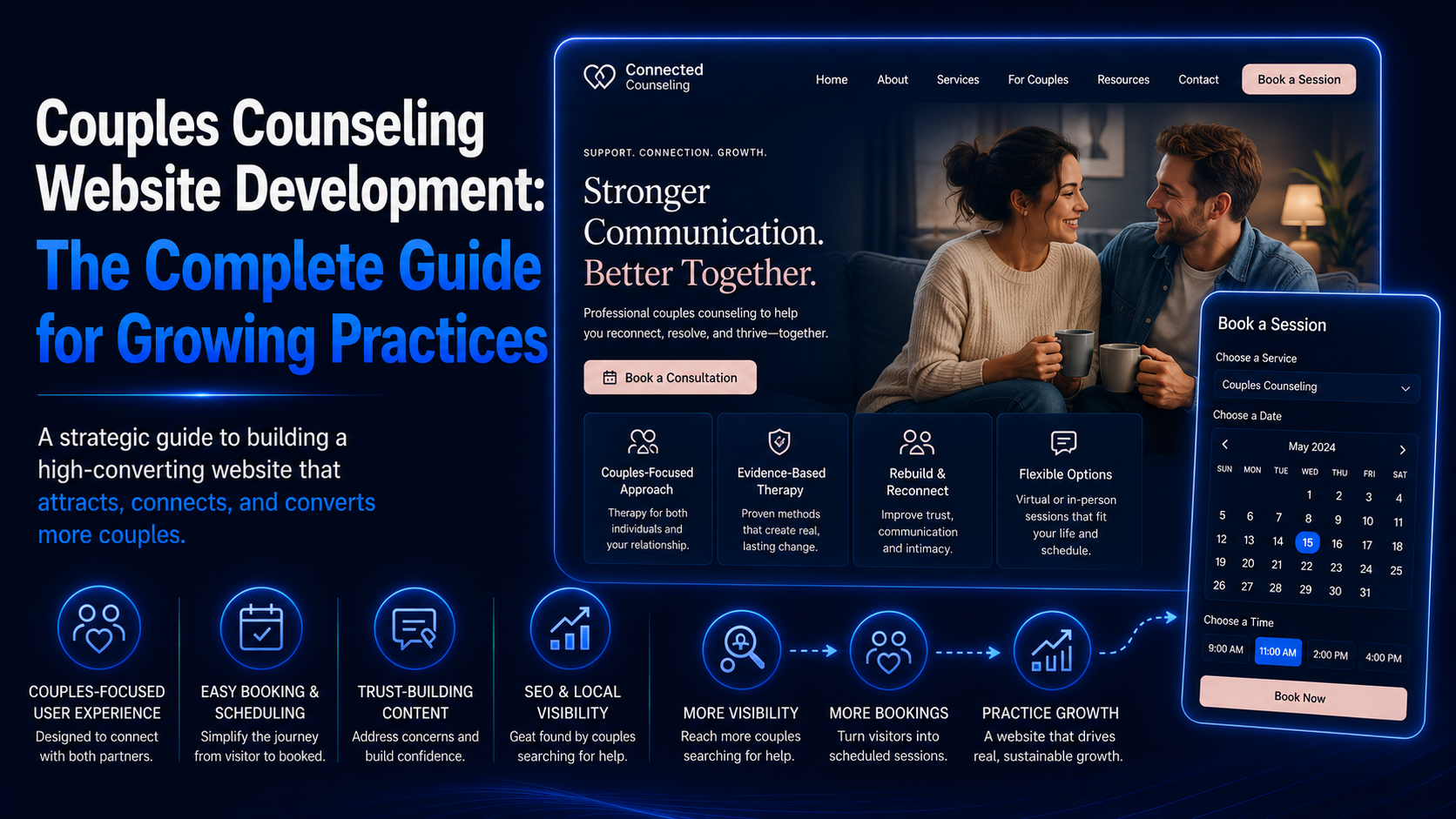
For a couples counseling practice, the website is rarely just an online business card. It is the single point where a stressed, uncertain couple decides whether to trust you with their relationship or click back to the results and try the next name on the list. Couples counseling website development is the work of building a site that wins that decision: one that ranks where couples are searching, loads fast on the phone they are searching from, earns trust in seconds, and makes booking effortless.
Most counseling websites do not do this. They are built as brochures, then quietly underperform for years. This guide covers how to build a couples counseling website the right way, from strategy and platform through design, SEO, AI search visibility, compliance, content, and conversion. Use it as your complete reference, and follow the linked deep dives where you want more detail on a specific piece.
What couples counseling website development involves, in short:
- Strategy and positioning before any design work begins
- The right platform for SEO, ownership, and long-term growth
- Design and user experience built for how couples actually decide
- A page architecture that matches what couples search for
- SEO foundations built into the site, not bolted on later
- Local SEO so couples in your area find you
- Visibility in AI search, where more couples now start their research
- HIPAA-conscious development that protects clients and your license
- Content that builds authority in a trust-driven field
- Conversion elements that turn visitors into booked consultations
- A plan to drive traffic while your rankings build
- Ongoing measurement and maintenance
What Couples Counseling Website Development Actually Involves
Website development for a couples practice is broader than design. Design is how the site looks. Development is the full process of turning your practice into a website that performs: strategy, platform selection, build, content, technical SEO, compliance, and the conversion systems that book couples.
A useful way to think about it: your website has three jobs. It has to get found (SEO, local search, and AI search), it has to build trust the moment a couple lands (design, message, and credibility), and it has to convert that trust into a booked session (clear paths, easy scheduling, and reassurance). A site that does one of these but not the others will always leak clients. Real development means building for all three at once. Our website design and development service is built around exactly this three-part standard.
Start With Strategy, Not Design
The most common mistake is jumping straight to how the site should look. The practices that win start with strategy, because a beautiful site aimed at no one still fails.
Before a single page is designed, you need clarity on a few things. Who is your ideal couple, and what are they actually struggling with? What outcome do they want, in their words, not clinical language? What makes you different from the ten other couples counselors in your area? And what is the one action you most want a visitor to take? For nearly every couples practice, that action is booking a consultation, and the entire site should be organized around it.
This clarity shapes everything downstream: your homepage headline, which services get their own pages, the words you use, and where the booking buttons go. Strategy first is what separates a website that reflects your practice from one that grows it.
Choosing the Right Platform: WordPress, Squarespace, or Wix
The platform decision affects your SEO ceiling, your ownership, and how far the site can grow. Squarespace and Wix are simple to start with and fine for a basic presence. For a couples practice that wants to rank competitively and scale over time, WordPress is usually the stronger foundation, because it gives you full control of technical SEO and schema, true ownership of your site and data, and room to keep adding service pages, location pages, and content without hitting a wall.
| Factor | WordPress | Squarespace | Wix |
|---|---|---|---|
| SEO flexibility | High, full control of technical SEO and schema | Moderate, limited technical control | Moderate, improving but still limited |
| Ownership and control | Full, you own the site and data | Hosted and tied to the platform | Hosted and tied to the platform |
| Scalability | High, grows with pages and content | Limited for larger sites | Limited for larger sites |
| Ease of starting | Steeper setup, best with a developer | Easy | Easy |
| Long-term fit for ranking practices | Strongest | Fair | Fair |
If you are already on Squarespace or Wix and feeling boxed in, a migration to WordPress is common and worth planning carefully, so you keep your existing rankings and redirect old URLs correctly. A botched migration can erase years of SEO progress, which is why this is one place where a specialist earns their fee.
Design and User Experience That Converts Couples
Couples arrive at your site in a specific emotional state. They are often anxious, sometimes in the middle of a conflict, and usually deciding together. Good design meets them there. It builds trust quickly, removes friction, and never makes them work to find the next step.
The essentials are consistent across high-performing couples sites: a clean, minimalist, professional look that signals competence; a mobile-first layout, since most couples are searching on a phone; fast load speed, ideally under three seconds, because a slow site loses people before they read a word; and a clear couples-specific message at the very top, so both partners immediately know they are in the right place. Trust cues matter more here than in almost any other field, because couples are handing you something deeply private.
For a full breakdown of the specific on-page elements that turn a couples counseling website into a booking machine, the features guide in our cluster covers each one in depth. At the development stage, the priority is simple: design for the couple’s state of mind, and make booking the easiest thing on the page.
The Core Pages Every Couples Counseling Website Needs
Architecture is where SEO and conversion meet. A couples counseling website should be structured so that each important search has a page built to answer it, and so that trust builds naturally as a couple moves through the site.
| Page | Purpose |
|---|---|
| Homepage | Establish your couples focus, build trust fast, and drive to booking |
| About and bio | Earn trust with credentials, your approach, and a real photo |
| Service pages | One per modality, so each search intent gets a dedicated page |
| Fees and FAQ | Set expectations on private pay, confidentiality, and process |
| Location pages | Rank locally for each area or state you serve |
| Blog or resources | Build authority and rank for the terms couples search |
| Contact and booking | Make the next step effortless |
The service pages are where many practices leave rankings and clients on the table. Couples counseling is not one search. Premarital counseling, affair recovery, discernment counseling, the Gottman Method, Emotionally Focused Therapy, and LGBTQ+ couples work are all distinct searches with distinct intent. A dedicated page for each one lets you speak directly to that couple’s situation and gives search engines a specific page to rank for each term. This single structural decision often does more for visibility than any amount of homepage tweaking.
Ready to build a couples counseling website with the right structure from day one? Our website design and development team builds every page above with SEO, trust, and conversion baked in.
SEO Built Into the Build
SEO is not something you add to a finished website. It is a set of decisions made during development that determine whether you ever rank at all. The practices that show up on the first page did the technical and structural work up front.
That work includes a clean, crawlable site structure, fast performance, mobile-first design, proper heading hierarchy, optimized titles and meta descriptions, internal linking between related pages, and schema markup that helps search engines and AI tools understand who you are and what you offer. It also includes keyword-aligned pages, so each service page targets the actual phrases couples type. When these are built in from the start, ranking becomes a matter of momentum rather than a rescue project later.
This is the difference between a site that looks done and a site that performs. Our mental health SEO services handle the technical foundation and ongoing optimization, so your couples counseling website is built to rank rather than retrofitted after the fact.
Local SEO: Getting Found in Your Area
Most couples want someone nearby, or someone licensed in their state for telehealth. Local SEO is how they find you, and it is a distinct discipline from general SEO.
The core moves are naming your city and service area clearly on your pages, creating a dedicated location page for each area you serve, keeping your name, address, and phone details consistent everywhere they appear, and fully optimizing a Google Business Profile so you can show up in the local map results. Local schema reinforces where you practice and what you offer. For a complete walkthrough, our local SEO guide for therapists breaks down the technical steps, and our overview of local marketing for therapists covers the wider picture of getting found in your community.
Ranking in AI Search: The New Frontier
More couples now begin their search inside an AI answer engine, whether that is Google’s AI Overviews, ChatGPT, or Perplexity. These tools increasingly sit between a couple’s question and your website, summarizing answers and recommending practices. Being visible here is quickly becoming as important as ranking in classic search.
You cannot control an AI engine, but you can build a site that these tools are more likely to surface and cite. The practical work overlaps heavily with good SEO and then goes further: structure content around real questions and answer them directly and clearly, keep your practice information (name, location, services, credentials) consistent and unambiguous across the web, use schema markup, publish genuinely helpful and accurate content, and earn reviews and third-party mentions that establish you as a real, trusted entity. Most counseling websites are not built this way, which is exactly why building yours to be AI-ready is an advantage available right now. This modern approach to visibility, often called GEO or answer-engine optimization, is core to how MHIS builds and optimizes sites today.
HIPAA-Conscious Development
Because couples counseling handles sensitive information, development choices carry compliance weight. This is not about turning your website into a fortress. It is about avoiding the common ways a counseling site quietly creates privacy risk.
The main areas to get right are your forms, your tracking, and your hosting. Contact and intake forms should use secure, encrypted submission and collect only what is necessary before a first call, rather than emailing sensitive clinical detail to your inbox in plain text. Standard analytics and advertising pixels are not built for protected health information and should be kept off sensitive pages such as intake and booking confirmations. Where a tool handles anything sensitive, it should be a provider you can put a proper agreement in place with. Building with these considerations from the start protects your clients and your license.
This section is general education and not legal advice. For your specific situation, confirm requirements with a qualified professional who knows your jurisdiction.
Content and Authority in a Trust-Driven Field
Couples counseling is a field where trust and expertise decide who gets the call, and content is how you demonstrate both. It is also how you rank for the wide range of questions couples ask before they ever book.
The strongest approach is a topic cluster, which is the model this very guide follows. A broad pillar page (like this one) covers a subject comprehensively, and focused cluster articles go deep on individual pieces, all linked together. This structure signals real authority to search engines and AI tools, and it keeps couples engaged as they explore. Content also reinforces expertise, authoritativeness, and trust, which matter more in health-related fields because search engines apply a higher bar to topics that affect people’s wellbeing. Accurate, well-organized, genuinely useful content is not optional here. It is the foundation of long-term rankings.
Conversion: Turning Visitors Into Booked Couples
Traffic that does not convert is a vanity metric. The final layer of development is the set of elements that turn an interested visitor into a booked consultation.
The highest-impact ones are frictionless online scheduling, so a couple can book a slot in under a minute while their intent is high; clear, repeated calls to action, with an obvious booking button in the header, partway down each page, and at the bottom; transparent fees and a short explanation of your private-pay rationale, since couples counseling is usually out of network and hiding the price only wastes consultation slots later; and ethical social proof that builds credibility without violating the testimonial restrictions most licensing boards enforce. Every unnecessary field, click, or moment of confusion between “we need help” and “we are booked” costs you couples. Development is where you remove that friction on purpose.
Driving Traffic While Your Rankings Build
A well-built site still needs people to see it, and SEO takes time to compound. In the early months especially, paid search bridges the gap by putting you in front of couples the exact moment they search.
Couples work is a strong fit for paid search because it is high-intent and largely private pay, so your ads reach people prepared to pay your full fee. Our Google Ads for couples counseling playbook covers the keywords, ad copy, and landing page approach that work for this niche. If you would rather focus on clients than campaigns, our Google Ads management service runs it for you. The most effective long-term strategy pairs the two: paid search for immediate visibility, SEO for durable, lower-cost traffic that grows over time.
Measuring and Maintaining Your Site
A website is not a one-time project. The practices that keep winning treat it as a living asset. That means measuring what matters, in a privacy-safe way: how many visitors book, which pages and services drive inquiries, and your cost per new client. It also means ongoing upkeep, since performance, security, and content all need attention over time, and search engines reward sites that stay current. Small, consistent improvements informed by real data are what turn a good website into a compounding source of new couples.
DIY vs Hiring a Specialist
You can build a couples counseling website yourself, and for a brand-new practice testing the waters, a simple site is a reasonable start. The question is not whether you can, but what your time is worth and how much you are leaving on the table.
A do-it-yourself site can get you online. What it rarely does well is rank competitively, convert consistently, handle compliance carefully, and stay optimized as search evolves, all at once. Those are the exact areas where a specialist who works only with mental health practices adds the most value, because they already know the market, the compliance landscape, and what actually converts couples. A partner built for counselors starts with that context instead of learning it on your budget. If your website is meant to be a serious source of new clients rather than a placeholder, professional development usually pays for itself in booked couples. The right partner does not just build a nice site. They build a system that grows your practice.
Frequently Asked Questions
What is couples counseling website development?
Couples counseling website development is the full process of building a website that grows a couples practice, not just one that displays information. It covers strategy and positioning, platform selection, design and user experience, site architecture, SEO, local and AI search visibility, HIPAA-conscious build choices, content, and the conversion systems that turn visitors into booked consultations. Done well, the site gets found, builds trust quickly, and books couples around the clock.
How long does it take to build a couples counseling website?
It depends on scope. A focused site can come together in a few weeks, while a larger build with multiple service pages, location pages, custom content, and a migration from another platform can take longer. The bigger factors are how many pages you need, how much content and SEO work is involved, and how quickly you can provide the details only you can supply, such as your bio and approach.
How much does couples counseling website development cost?
Costs vary with scope. A basic template site can run from a few hundred dollars, while a custom, SEO-ready couples counseling website built to rank and convert typically runs from around one thousand to several thousand dollars or more. The right investment depends on the number of service and location pages, whether you are migrating platforms, and how much SEO, content, and conversion work is included in the build.
Should couples counselors use WordPress or Squarespace?
Both can work, but WordPress usually gives a couples practice more SEO flexibility, full ownership of the site, and room to scale as you add service and location pages and content. Squarespace is simpler to start with but more limited over the long term. For a practice that wants to rank competitively and grow, WordPress is generally the stronger foundation.
Do I need a separate page for each couples service?
Yes, if you want to rank and convert well. Premarital counseling, affair recovery, discernment counseling, and method-based work like the Gottman Method or Emotionally Focused Therapy are all distinct searches with distinct intent. A dedicated page for each lets you match a couple’s exact situation and gives search engines a specific page to rank for each term.
How do I get my couples counseling website to show up in AI search?
Build the site to be clear and trustworthy to answer engines. Structure content around the real questions couples ask and answer them directly, keep your practice details consistent across the web, use schema markup, publish accurate and genuinely helpful content, and earn reviews and third-party mentions. This overlaps with strong SEO and then extends it, and because most counseling sites are not built this way, doing it well is a real advantage.
Can I put client testimonials on my couples counseling website?
Usually not from current clients. Most ethics codes and licensing boards restrict soliciting client testimonials, and couples counseling is especially sensitive because both partners are involved. Build trust instead with your credentials, training, professional memberships, media features, and unsolicited reviews that clients chose to leave on their own. Always follow your specific board’s rules.
Final Thoughts
A couples counseling website is one of the highest-leverage investments a practice can make, because it works whether or not you are working. Built well, it gets found in Google and in AI search, earns a couple’s trust in the first few seconds, and turns that trust into a booked consultation, day and night. Built as an afterthought, it quietly costs you couples for years. The difference is not luck. It is strategy, structure, and the discipline to build for getting found, building trust, and converting all at once.
Ready to turn your website into a reliable source of new couples? Get in touch with our team, and we will map out exactly what your couples counseling website needs to attract, convince, and convert the couples you want to work with.