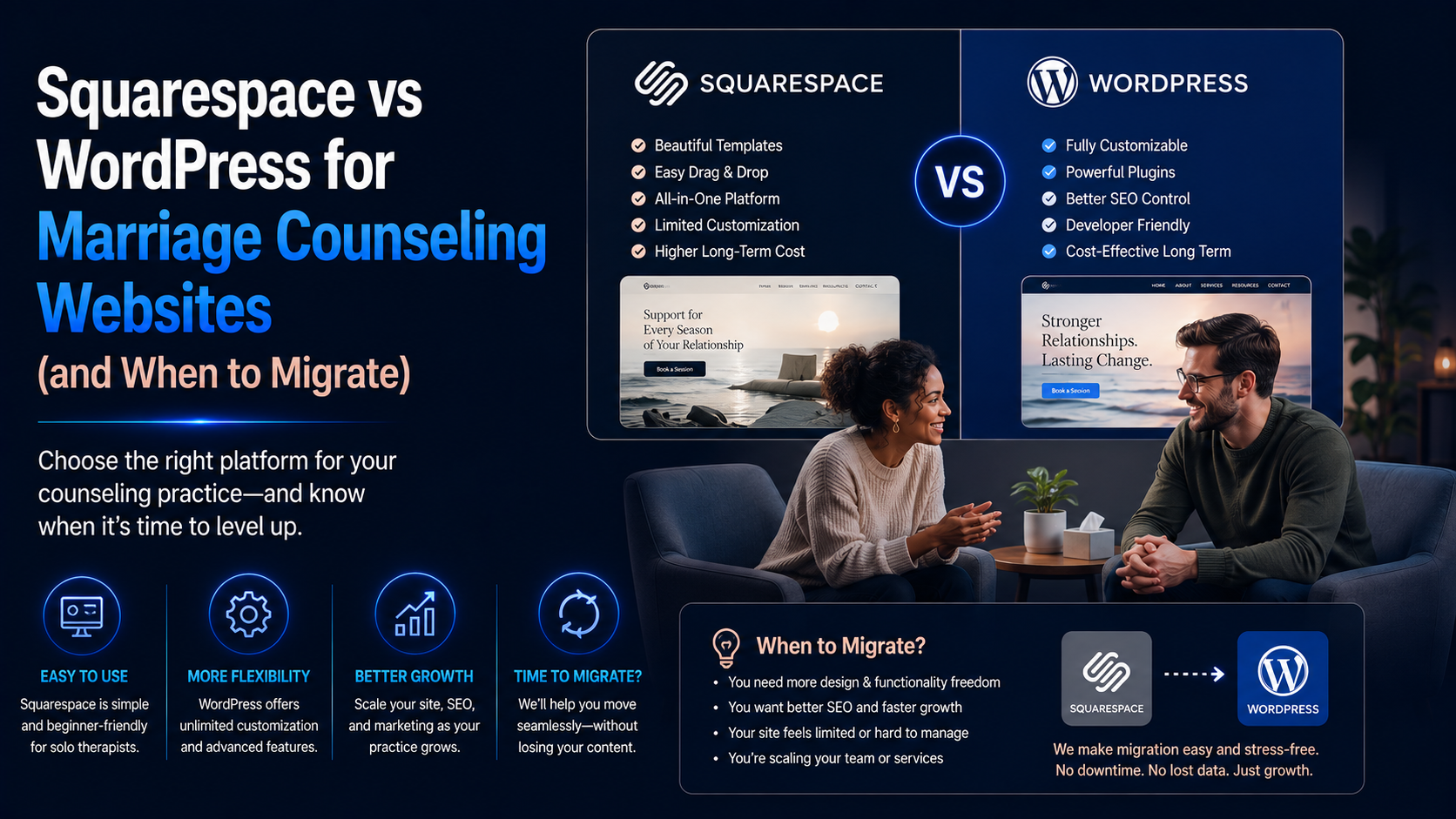
Most marriage counselors do not lie awake thinking about their website platform. It is worth thinking about once, though, because that single decision quietly sets the ceiling on how well your site can rank, convert, and grow for years afterward. Squarespace and WordPress are the two platforms most counselors weigh, and they represent a real trade-off: the convenience of an all-in-one builder against the control and ownership of an open platform.
This guide compares Squarespace and WordPress specifically for marriage counselor website design, across the things that actually move the needle for a private practice: getting found, building trust, booking clients, and being able to grow. Then it covers the question most counselors eventually face, which is whether and when to migrate.
The short version:
- Squarespace is the easiest to launch and the lowest maintenance, and it is good enough for a simple presence, but it limits your SEO control, ownership, and room to grow.
- WordPress asks more of you up front, but it gives you full SEO control, true ownership, and the scalability a growing practice needs.
- For most marriage counselors serious about ranking and booking clients, WordPress is the stronger long-term foundation.
- Migrate when your Squarespace site is capping your SEO, you need features it cannot support, or you are scaling, and always with proper 301 redirects to protect your rankings.
What Marriage Counselor Website Design Actually Needs
Before comparing platforms, it helps to be clear on what a marriage counselor website design is actually for. The platform only matters to the degree that it supports these goals.
A marriage counselor website has to do a handful of things well. It has to build trust quickly, since couples are deciding whether to share something private with you. It has to be found, through strong SEO and local search, because most couples start on Google. It has to load fast on mobile and make booking a consultation effortless. It has to handle contact and intake in a privacy-conscious way. And it has to be able to grow with your practice as you add services or locations. Platform choice is really a question of which option supports all of this with the least friction. For the full picture of everything that goes into building one of these sites, see our complete guide to couples counseling website development, which this comparison is one part of.
Squarespace for Marriage Counselors: Where It Shines and Where It Falls Short
Squarespace is popular with counselors for good reason. It is genuinely easy to use, which matters when you would rather see clients than learn web development.
Its strengths are real. You can launch a clean, professional-looking site quickly without a developer, using polished templates. Hosting, security, and updates are handled for you, so there is little ongoing maintenance. It includes SSL, mobile-responsive design, and the SEO basics like custom page titles and meta descriptions out of the box. For a brand-new practice that needs a simple, presentable site fast, that is a reasonable fit.
The limits show up as your practice gets more serious about being found and growing. Squarespace gives you far less control over technical SEO and structured data, which is a disadvantage when you are competing in local search. Its template system, while attractive, restricts deeper customization. You do not own the platform, so you are tied to its ecosystem, its pricing, and its feature set. It has limited integrations compared to open platforms, and it does not offer business associate agreements, which makes building a genuinely HIPAA-conscious intake flow harder. As you add services or locations, you can feel the ceiling.
WordPress for Marriage Counselors: More Power, More Responsibility
WordPress powers a large share of the web, and for practices that want to rank competitively, it is usually the stronger foundation. The trade-off is that it asks more of you up front.
Its strengths are exactly where Squarespace is limited. You get full control over technical SEO, schema markup, URL structure, and redirects, which is a meaningful edge in local search. You own your site, your content, and your data outright. It scales comfortably, so adding a page for each service (premarital counseling, affair recovery, discernment counseling, and so on) or each location is straightforward. Its plugin ecosystem and integrations are vast, and you can build a HIPAA-conscious setup by choosing compliant hosting and form tools and putting the right agreements in place.
The responsibilities are the flip side. WordPress needs upkeep, since updates, security, and backups are yours to manage or delegate. You choose your own hosting, which is one more decision. There is a steeper learning curve, and it is best set up by someone who knows what they are doing, because a poorly built WordPress site can underperform just like any other. For a serious practice, though, that setup usually pays for itself in visibility and flexibility.
Squarespace vs WordPress: Side by Side
Here is how the two compare across the factors that matter most for a marriage counselor website design.
| Factor | Squarespace | WordPress |
|---|---|---|
| Ease of setup | Fast and beginner friendly, no developer needed | Steeper, best set up with a developer |
| SEO control | Solid basics, limited advanced and technical control | Full control of technical SEO, schema, and redirects |
| Design flexibility | Polished templates, limited deep customization | Highly customizable, from simple to fully bespoke |
| Ownership | Hosted and tied to the platform | You own the site, data, and files |
| Scalability | Fine for small sites, limited as you grow | Scales to many service and location pages |
| Maintenance | Handled for you, less upkeep | You handle updates, security, and backups |
| Integrations | Limited to supported tools | Large plugin ecosystem and third-party integrations |
| HIPAA-conscious setup | Harder, closed ecosystem and no BAA | Easier, you can choose compliant hosting and form tools |
| Cost model | Predictable subscription including hosting | Variable, hosting plus theme and plugins |
| Best fit | A simple, quick, low-maintenance presence | A practice serious about ranking and growth |
A quick note on HIPAA: neither platform is HIPAA compliant on its own, and compliance depends on how you handle forms, data, hosting, and agreements, not on the platform name. This is general information and not legal advice, so confirm your specific requirements with a qualified professional.
Which Should a Marriage Counselor Choose?
The honest answer is that it depends on where your practice is and where you want it to go.
If you are just starting out, testing whether private practice is for you, or you need a simple site live this week and do not expect to scale soon, Squarespace is a perfectly reasonable choice. It gets you online with minimal fuss.
If you are serious about ranking in local search, plan to grow your services or locations, want full ownership of your site, or intend to invest in SEO and content over time, WordPress is the stronger long-term foundation. Most established and growth-minded marriage counselors are better served by it, precisely because it does not cap what you can do as you scale. The question is less “which is better” in the abstract and more “which fits the practice you are building.”
Whatever platform you land on, your rankings come down to how well the site is optimized. Our mental health SEO services make sure a marriage counselor website design actually competes in local search, on Squarespace or WordPress.
When to Migrate From Squarespace to WordPress
Plenty of counselors start on Squarespace and later outgrow it. These are the signs it is time to consider moving.
Your rankings have plateaued and you have hit the ceiling of what Squarespace’s SEO controls allow. You need features, integrations, or a level of customization the platform cannot support. You are scaling, adding multiple services or locations that each need their own optimized page. You want true ownership of your site rather than renting space on a closed platform. Or your subscription and add-on costs have crept up to the point where a self-hosted site makes more financial sense.
Just as important is knowing when not to migrate. If your current site works, you are a solo practitioner with a simple offering, and you are not feeling any of the constraints above, migrating for its own sake is not worth the effort or risk. Migrate when there is a clear reason tied to growth, not because a platform is trendy.
How a Migration Works Without Losing Your Rankings
The biggest fear counselors have about migrating is losing the Google rankings they worked for, and that fear is justified when a migration is done carelessly. Done properly, a migration preserves and often improves your search performance.
The essentials are straightforward in principle. You map every existing page to its new URL and set up 301 redirects, so search engines and visitors land in the right place. You move your content and rebuild the design on WordPress. You preserve or improve your titles, meta descriptions, and structure, and you add proper schema. Then you test everything, including redirects and forms, before and after launch, and monitor rankings closely in the weeks that follow. The step that ruins migrations is changing URLs without redirects, which is exactly the kind of detail a specialist handles as a matter of course.
Thinking about moving your practice to WordPress? Our website design and development team handles migrations end to end, so you keep your rankings and gain the flexibility WordPress offers.
Frequently Asked Questions
Is WordPress better than Squarespace for marriage counselors?
For most marriage counselors who want to rank in local search and grow, yes, WordPress is the stronger foundation, because it offers full SEO control, true ownership, and room to scale. Squarespace is easier to launch and lower maintenance, which can make it the better fit for a brand-new or very simple practice. The right choice depends on your goals.
Can you do SEO on a Squarespace site?
Yes, to a point. Squarespace covers the basics like custom titles, meta descriptions, clean URLs, mobile responsiveness, and SSL. What it lacks is deeper control over technical SEO and structured data, which matters in competitive local markets. You can rank on Squarespace, but you have a lower ceiling than on WordPress.
Will migrating from Squarespace to WordPress hurt my Google rankings?
It does not have to, and a well-planned migration often improves them. Rankings suffer when URLs change without proper 301 redirects or when content and structure are lost. Mapping every page to its new URL, setting up redirects, and preserving your on-page SEO protects your search performance through the move.
How much does a WordPress marriage counselor website cost?
It varies with scope. WordPress itself is free, but you pay for hosting, a theme or design, plugins, and either your time or a developer’s to build and maintain it. A simple site can be modest, while a custom, SEO-ready build with multiple service pages costs more. Over time and at scale, WordPress often delivers better value than stacking Squarespace plans and add-ons.
Is Squarespace HIPAA compliant for marriage counselors?
No platform is HIPAA compliant on its own, and Squarespace does not offer business associate agreements, which makes it harder to handle sensitive intake in a compliant way. A HIPAA-conscious setup depends on how you manage forms, data, hosting, and agreements. This is general information and not legal advice, so confirm your requirements with a qualified professional.
Should I switch platforms if my current site works fine?
Not necessarily. If your site works, you are not hitting SEO or growth limits, and you are a simple solo practice, there is no need to migrate for its own sake. Move when there is a clear reason tied to growth, such as a ranking plateau, missing features, or scaling to more services or locations.
Final Thoughts
For marriage counselor website design, the platform question comes down to a simple trade-off: Squarespace offers speed and simplicity, while WordPress offers control, ownership, and room to grow. A brand-new or very simple practice can do well on Squarespace. A counselor serious about ranking in local search and building a practice that scales is usually better served by WordPress, and the counselors who start on Squarespace often migrate once they feel its ceiling. Whichever you choose, the platform is a means to an end. What matters is a site that gets found, earns trust, and books couples, and that is built to grow with you.
Not sure which platform fits your practice, or whether it is time to migrate? Get in touch and we will help you choose the right foundation and build a marriage counselor website that competes and converts.