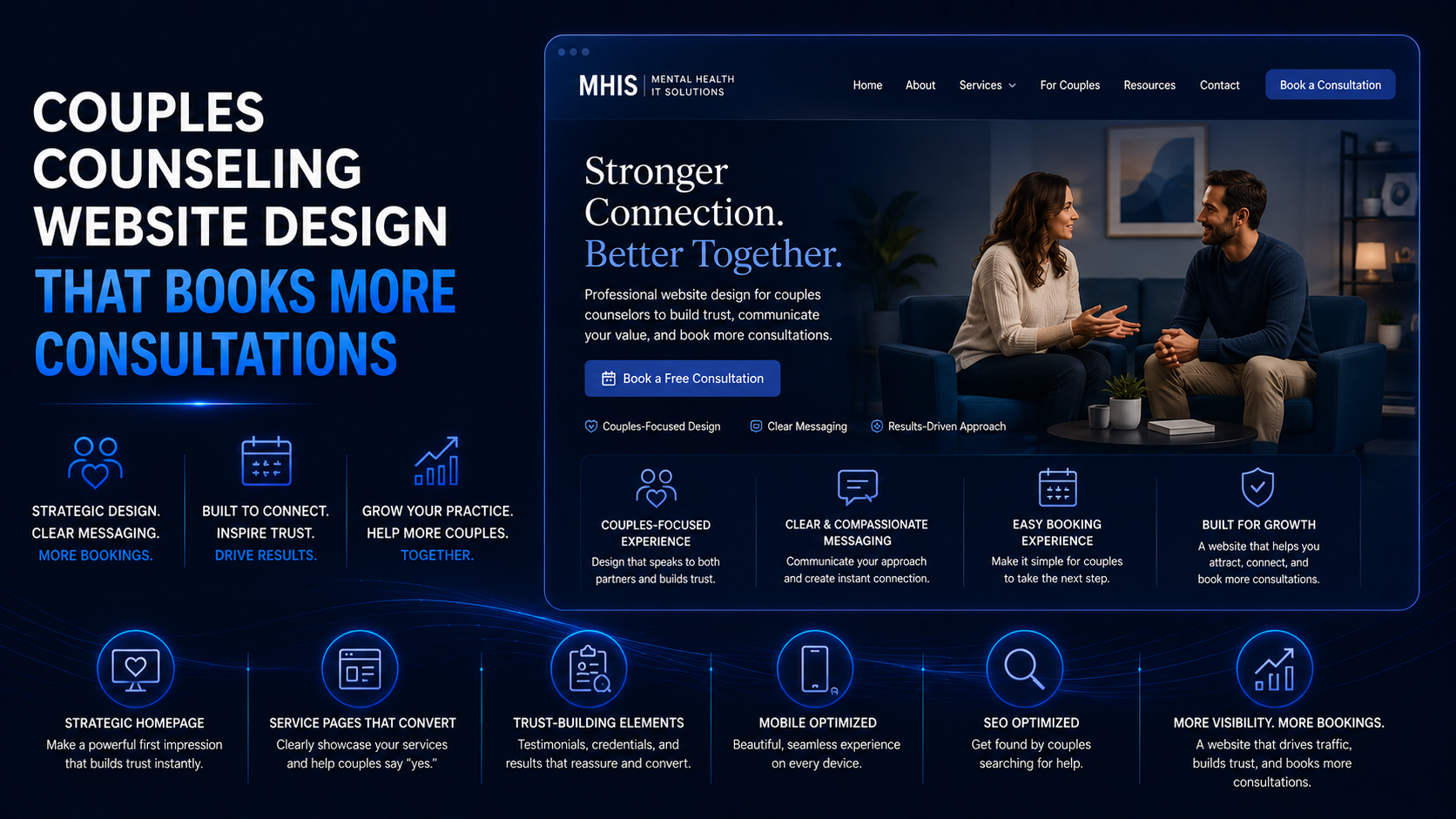
A couples counseling website has one real job: turn a couple who is quietly searching for help into a booked consultation. A site can look beautiful and still fail at this, because design that impresses is not the same as design that converts. Getting a couple to take the step from reading to booking is a specific skill, and it is what separates a website that fills your calendar from one that just exists.
This guide covers how to approach couples counseling website design so the site actually books consultations. Not how to make it pretty, though it will be, but how to design every part of it around the decision you want couples to make.
The short version:
- Design for the couple’s emotional state, not for other therapists or for design awards.
- Win the first screen, saying who you help and how to start before anyone scrolls.
- Build trust in seconds with a real photo, credentials, and a human voice.
- Make booking the single most obvious action on every page.
- Remove every point of friction between “we need help” and “we are booked.”
- A converting design still needs to be found, so build in SEO, speed, and traffic.
What It Takes to Design a Couples Counseling Website That Books Consultations
Most couples counseling websites are designed backward. They start with how the site should look, add the therapist’s background, list some services, and drop a contact form at the bottom. The couple’s decision to book is treated as something that just happens if the site is nice enough. It does not.
A site that books consultations is designed forward, from the decision back. You start by knowing exactly what you want a visitor to do, which is book a consultation, and then you shape the message, the layout, the trust cues, and the booking flow to make that decision as easy and reassuring as possible. Design becomes the servant of conversion. This piece focuses on that design work. For the full scope of building the site itself, from platform to SEO, see our guide to couples counseling website development.
Start With the Couple’s State of Mind
Good design begins with the person on the other side of the screen. A couple looking for counseling is rarely calm and methodical. They are often anxious, sometimes in the middle of conflict, frequently searching late at night, and usually deciding together, which means two people with two sets of doubts.
Design that books consultations meets them in that state. It feels calm and reassuring rather than clinical or busy. It answers the questions running through their heads, such as whether this will help, whether they can trust you, whether you are the right fit, and what happens if they reach out, before they have to go looking for answers. And it never adds stress through clutter, confusion, or friction. Every choice, from color and spacing to word count, should lower the emotional temperature, not raise it.
Win the First Screen
The top of your homepage, the part visible before anyone scrolls, decides whether most couples keep reading. It has seconds to do two things: tell the couple they are in the right place, and show them how to start.
That means a clear, couples-specific headline that names who you help and the outcome they want, not a generic “Welcome to my practice.” It means a short supporting line that adds warmth or specificity. And it means a visible booking button right there, so the path forward is obvious from the first moment. A couple should be able to land on your site and, without scrolling or thinking, know that you help couples like them and exactly how to take the next step.
Build Trust in Seconds
Couples are about to share the most private part of their lives, so trust is the currency of the entire site, and design carries most of that trust before a single word is fully read.
The elements that build it fast are a warm, professional photo of you, since couples want to see a real human rather than a logo or a stock image, your credentials and license shown clearly, a bio written in your own voice that explains why you do this work, and glimpses of the real environment, such as your office. Ethical social proof helps too, kept within the bounds most licensing boards set, which usually means leaning on your credentials, training, and any unsolicited reviews rather than soliciting client testimonials. The goal is for a couple to finish your homepage feeling they already have a sense of you.
Make Booking the Obvious Next Step
A couple who is ready to reach out should never have to look for how. Many otherwise good sites bury the booking option or offer so many competing actions that none stands out.
Design fixes this by making booking the single clearest action on every page. That means a prominent booking button in the header, repeated partway down each page and again at the end, using specific language like “Book a Free Consultation” rather than a vague “Contact.” It means simple navigation that guides rather than overwhelms. And it means resisting the urge to add five different calls to action, since one strong, repeated action always converts better than a crowd of weak ones. Decide the one thing you want couples to do, then make everything point toward it.
Remove Friction From the Booking Itself
The booking step is where the most consultations are lost. A couple decides together, often in a brief window of motivation, and if booking is hard or slow, that window closes.
The most consultation-friendly design lets a couple book in under a minute. Offer online scheduling with real availability rather than “call to book,” since a phone call during business hours is a barrier for two working partners. Lead with a low-commitment first step, usually a free consultation, which is far easier to say yes to than a full session. Keep any form short, asking only what you truly need before the first conversation. And make it clear that one partner can book on behalf of both. Every field you remove and every click you save turns more interested couples into booked ones.
Design That Gets Found
A website that converts beautifully still books nothing if no couple ever sees it. Design and visibility are not separate projects, because the best design is built to be found.
That means the site is fast, especially on mobile, since a slow page loses couples before the design ever gets a chance. It means the structure, headings, and content are built for SEO so you rank when couples search, and it means strong local visibility so couples in your area find you. A stunning site on page three of Google is invisible. This is where design and search work have to move together.
Want a couples counseling website design that ranks as well as it converts? Our mental health SEO services build search visibility into the site, and our overview of local marketing for therapists covers how couples in your area find you.
Send the Right Traffic to Your Site
Once your design converts and your SEO is building, the fastest way to fill your calendar is to send qualified traffic to the site directly. SEO grows over time, while paid search can put your consultation-ready design in front of couples the moment they search.
Couples work is well suited to this, because it is high-intent and largely private pay, so your ads reach people prepared to book and pay your full fee. Our Google Ads for couples counseling playbook covers how to do it, and if you would rather not run campaigns yourself, our Google Ads management service handles them for you. A converting design plus qualified traffic is what actually turns a website into booked consultations.
Design Mistakes That Quietly Lose Consultations
A few common design choices cost couples counselors consultations without their realizing it. Watch for these.
Leading with yourself instead of the couple, so the site is about your credentials before it is about their problem. Burying or hiding the booking option. Overwhelming visitors with dense text, jargon, or too many choices. Ignoring mobile, where most couples are actually searching. Slow load times that lose people before the page appears. And a generic, template feel that fails to build the trust couples specifically need. Each of these is fixable, and fixing them is often the difference between a site that looks fine and one that books.
Do It Yourself or Hire a Specialist
You can design a couples counseling website yourself, and for a brand-new practice a simple site is a fair start. The question is whether it will actually convert, because conversion-focused design is a specific skill that most templates do not provide on their own.
A specialist who works only with counselors already knows what couples respond to, how to build trust for this audience, and how to design the path to booking. If your website is meant to be a real source of clients rather than a placeholder, professional design usually pays for itself in booked consultations.
Ready for a couples counseling website design built to book consultations? Our website design and development team designs every element around turning couples into booked clients.
Frequently Asked Questions
What makes a couples counseling website design convert visitors into consultations?
Conversion comes from designing around the booking decision rather than around looks. That means a clear couples-specific message on the first screen, fast trust building through a real photo and credentials, an obvious and repeated path to booking, and a scheduling step with as little friction as possible. When every part of the design points a couple toward booking, more of them do.
How do I get couples to book instead of just browsing?
Make booking the easiest and most obvious thing on the site. Lead with a low-commitment free consultation, use online scheduling instead of asking couples to call, keep forms short, and place a clear booking button on every page. Reassure the hesitant partner with a warm, human tone and a clear sense of what happens next.
Should I offer a free consultation on my couples counseling website?
For most couples practices, yes. A free consultation is a low-commitment first step that is far easier for a couple to agree to than a full paid session. It gives both partners a chance to feel comfortable with you, and it consistently lifts the number of couples who take that first action.
How important is mobile design for a couples counseling website?
Very. Most couples search for a counselor on a phone, often late at night, so a design that is slow or awkward on mobile loses them before they read a word. A couples counseling website design should be mobile-first, load fast, and keep the booking button within easy reach on any screen.
Can I design a couples counseling website myself?
You can, and a simple site is a reasonable start for a brand-new practice. The limitation is that conversion-focused design is a specific skill, and most do-it-yourself sites look acceptable but do not book well. If the website is meant to be a real source of clients, professional design usually returns more than it costs.
Why isn’t my couples counseling website booking consultations?
The usual culprits are a design that talks about you before the couple’s problem, a buried or unclear booking path, a slow or non-mobile-friendly site, weak trust signals, or simply a site that no one finds because it is not built for search. Fixing the message, the booking flow, the speed, and the visibility is what turns browsing into booked consultations.
Final Thoughts
Couples counseling website design is not about impressing people. It is about making it easy and reassuring for a couple to take one specific step, which is booking a consultation with you. When you design from that decision back, meeting couples in their real state of mind, earning trust quickly, and removing friction from the booking, the website stops being a brochure and starts being a source of clients. Add the visibility to be found, and it works for you around the clock.
Want a couples counseling website that turns visitors into booked couples? Get in touch and we will design a site built to book consultations, not just to look good.