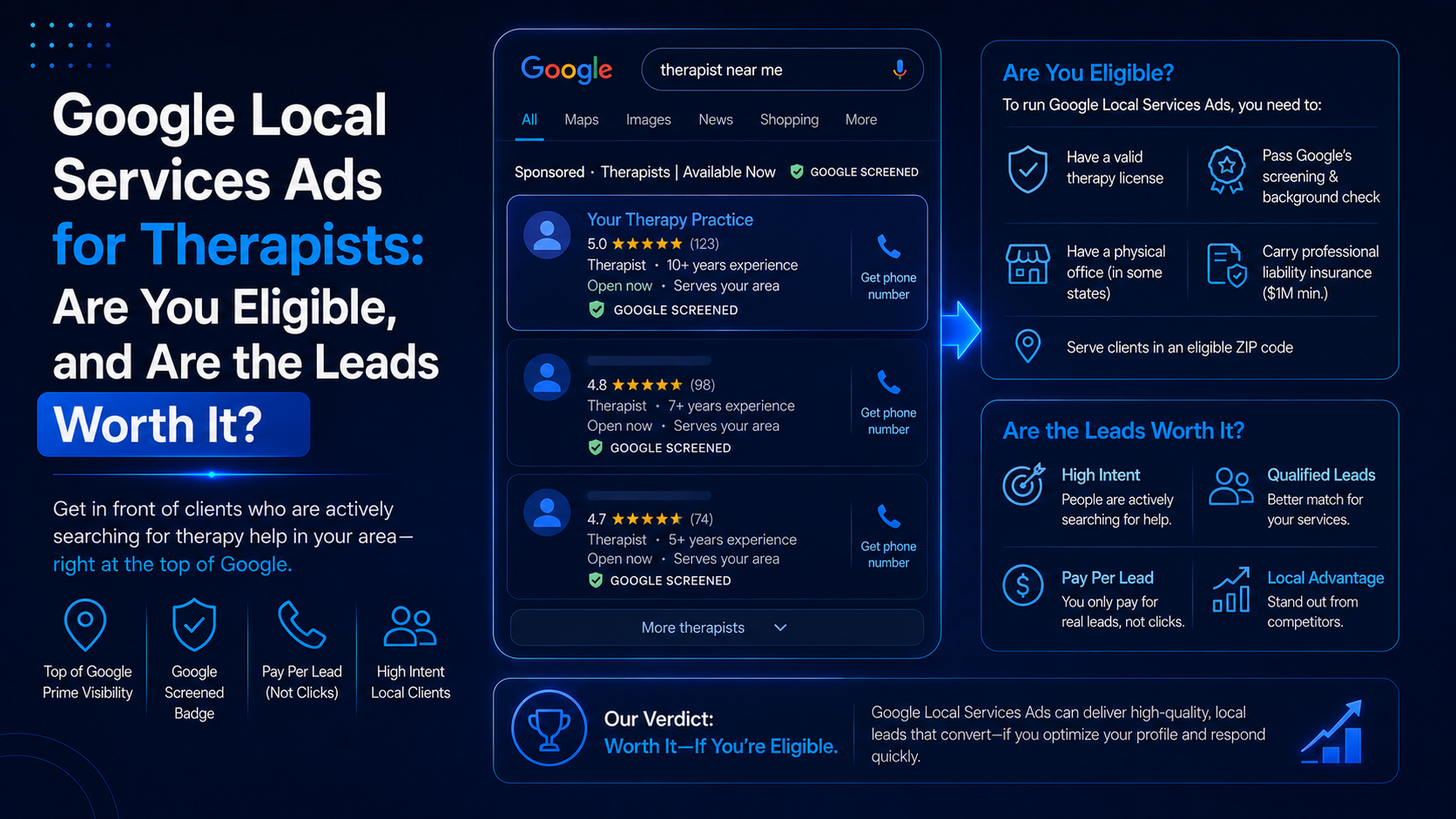
If you have seen those ads at the very top of Google search results, above everything else, with a green checkmark and a “Google Screened” badge, you have seen Local Services Ads. They look like the best possible placement: top of the page, a trust badge, and you pay only when someone contacts you. It is fair to wonder whether your therapy practice can get in on that, and whether the leads would be any good.
This guide gives you a straight answer on eligibility, explains how Local Services Ads actually work, weighs whether the leads would be worth it, and shows you exactly what to do instead while the category is not open to therapists.
Quick answer: As of now, mental health therapists and counselors are generally not eligible for Google Local Services Ads in the United States. Google has expanded the program into some health and wellness categories, such as massage, dentists, and chiropractors, but psychotherapy and counseling are not supported categories at this time. Availability can change and varies by market, so it is worth checking the sign-up flow for your area, and in the meantime, Google Business Profile, local SEO, and Search Ads deliver the same outcome.
Key Takeaways
- Therapists are generally not eligible for Local Services Ads right now. The category does not currently include psychotherapy or counseling.
- Google’s health and wellness expansion covers other providers, like massage therapists, dentists, dermatologists, and chiropractors, not mental health therapists.
- Local Services Ads use a pay-per-lead model and show a Google Screened badge at the very top of results, above regular search ads.
- Availability changes and varies by market, so check the sign-up flow for your location rather than assuming it is permanently closed.
- You can get the same result today through an optimized Google Business Profile, local SEO for the Map Pack, and Google Search Ads.
- If the category opens to therapists, evaluate the leads carefully, since responsiveness and lead quality determine whether pay-per-lead is worth it.
Want to rank at the top of local results without waiting for a category that is not open yet? MHIS builds local visibility for therapy practices through Google Business Profile, local SEO, and Search Ads. Book a free consultation with MHIS.
What Are Google Local Services Ads?
Local Services Ads are a pay-per-lead ad format that appears at the very top of Google search results, above regular search ads, with a verification badge. Instead of paying per click, you pay when a potential customer contacts you through the ad by calling or messaging.
Two things make them distinctive. The first is placement: Local Services Ads sit above the traditional “Sponsored” search ads, in the most prominent spot on the page. The second is the badge. Depending on the category, a business earns either a “Google Screened” or a “Google Guaranteed” badge after passing verification, which signals to searchers that Google has checked the business out.
The badges differ by industry:
- Google Screened applies to professional and service categories and involves license and background verification.
- Google Guaranteed applies mainly to home services and includes a limited money-back guarantee to the customer if they are unhappy with the work.
For any provider, the appeal is the same: top placement, a trust signal, and a cost model where you pay for contacts rather than clicks. The question for therapists is whether they can actually use it.
Are Therapists Eligible for Local Services Ads?
As of now, mental health therapists and counselors are generally not eligible for Local Services Ads in the United States. Psychotherapy and counseling are not among the supported categories, even though Google has been steadily adding health and wellness providers to the program.
Here is the current landscape. Google’s health and wellness expansion has brought in providers like massage therapists, yoga studios, dentists, dermatologists, and chiropractors, along with care categories like childcare and senior care. Psychotherapists, counselors, marriage and family therapists, and psychologists are not on that list at this time. Recent guidance aimed specifically at therapy practices confirms that mental health professionals are not currently eligible for the program.
That does not mean it will never happen. Google adds categories and expands availability regularly, and eligibility can vary by market. A category that was closed a year ago is sometimes open today, which is exactly why you should check for yourself rather than rely on a blanket statement. But the honest, current answer is that most therapy practices cannot run Local Services Ads today.
How to check your own eligibility
Do not take anyone’s word as permanent, including this article. Availability shifts, so verify it directly:
- Go to Google’s Local Services Ads sign-up flow and start the process.
- Enter your business category and your location or ZIP code.
- If therapy or counseling is supported in your area, it will appear as a selectable category, and you can proceed through verification.
- If it is not supported, the category will not be available, which tells you the program is not open to your practice in your market yet.
This five-minute check gives you a definitive answer for your specific location, which matters more than any general guide, because availability is market by market.
Why Therapists Want Local Services Ads
The appeal is obvious: the top spot on the page, a Google verification badge that builds instant trust, and a pay-per-lead model that feels lower risk than paying for every click. For a considered decision like choosing a therapist, that combination of visibility and credibility is genuinely valuable.
Prospective clients choosing a therapist are cautious, and trust is the deciding factor. A badge that signals Google has verified a provider can lower the hesitation that keeps people from reaching out. Add the most prominent placement on the results page, and it is easy to see why therapists would want in.
The frustration is that the format that offers exactly this trust-plus-visibility combination is not available to the profession that arguably needs it most. The good news, covered below, is that you can build the same trust and visibility through channels that are open to you today.
Are the Leads Worth It?
If the category does open to therapists, the leads can be worth it, but only for practices that respond fast and manage the account well. The pay-per-lead model rewards responsiveness and punishes neglect, and lead quality varies, so it is not automatically a better deal than Search Ads.
Since Local Services Ads are not currently open to therapy, this is a forward-looking evaluation based on how the format performs in other categories. Here is how to weigh it.
Potential advantages:
- Top placement and a trust badge can drive strong contact rates from ready-to-act searchers.
- Pay per lead, not per click, so you pay only when someone actually contacts you.
- Invalid leads can be disputed for credit, such as spam, wrong service, or out-of-area contacts.
- Ranking rewards good reviews and responsiveness, which favors quality practices.
Potential drawbacks:
- Lead quality varies. Some contacts are price-shoppers or poor fits, and you may pay for leads that do not convert.
- Responsiveness is demanding. The model favors businesses that answer quickly, which can be hard for a solo therapist between sessions.
- You share the space with other providers in the same badge unit.
- Handling client information carefully still applies. Any lead that arrives through a third-party system should be managed with the same privacy care as any other client contact.
The bottom line: if it becomes available, treat it as a channel to test and measure, not a guaranteed win, and compare its cost per booked client against your Search Ads.
What Therapists Should Do Instead, Right Now
Because Local Services Ads are not open to therapists, focus on the channels that produce the same outcome, top local visibility and trust, and that are fully available to you today: an optimized Google Business Profile, local SEO, and Google Search Ads.
Own the Local Map Pack with Google Business Profile and local SEO
The Google Map Pack, the group of local business listings with a map that appears for “therapist near me” style searches, is the closest thing to Local Services Ads placement that is open to you. Ranking there is driven by a complete, optimized Google Business Profile, genuine reviews, consistent business information across the web, and local SEO. This is where a large share of local therapy searches convert, and it costs no media spend, only the work to earn it. Our complete guide on local SEO for therapists walks through exactly how to do this.
Capture active demand with Google Search Ads
For immediate visibility, Google Search Ads put your practice at the top of results the moment someone searches for a therapist, and they are fully available to therapists. Unlike Local Services Ads, they use a pay-per-click model and require compliant setup, but they reach people at the exact point of intent. For most practices, this is the fastest way to appear at the top of the page today. See our guide to Google Ads for therapists for how to run them well.
Build trust the way clients actually evaluate it
Local Services Ads offer a badge, but trust for a therapist comes primarily from your credentials, reviews, a warm professional presence, and a clear description of who you help. Investing in these builds the same credibility the badge is meant to signal, and it works across every channel you use.
Getting to the top of local results without a channel that is not even open yet is exactly what MHIS does for therapy practices. We build Google Business Profile visibility, local SEO, and compliant Search Ads campaigns designed to fill your calendar. See how our Google Ads management for therapists works alongside our local SEO services.
Local Services Ads vs Search Ads vs Local SEO for Therapists
| Feature | Local Services Ads | Google Search Ads | Local SEO and Map Pack |
|---|---|---|---|
| Available for therapists now | Generally no | Yes | Yes |
| Placement | Very top, above search ads, where available | Top of results, marked Sponsored | Google Map Pack and local results |
| Cost model | Pay per lead | Pay per click | No media cost, ongoing effort |
| Trust signal | Google Screened badge | None built in | Reviews and profile completeness |
| Speed to visibility | Fast, if eligible | Fast | Gradual, then durable |
| Best fit for therapists | Not applicable yet | Active, ready-to-book searchers | Ongoing local visibility |
How to Know When Local Services Ads Open to Therapists
Since availability changes, it is worth checking periodically rather than assuming the door stays closed. A simple approach:
- Re-check the sign-up flow every few months by entering your category and location.
- Watch for Google announcements about health and wellness category expansion.
- Notice competitors. If other therapists in your area start appearing in the badge unit at the top of results, the category has opened in your market.
When it does open, you will already have the foundation that makes it work: strong reviews, a complete profile, and a responsive booking process, all of which you build through the channels available to you now.
Frequently Asked Questions
Can therapists use Google Local Services Ads?
Generally not at this time. Mental health therapists and counselors are not currently an eligible category for Google Local Services Ads in the United States. Google has expanded the program into a range of health and wellness providers, including massage therapists, dentists, dermatologists, and chiropractors, but psychotherapy and counseling are not supported categories as of now. This can change, since Google adds categories over time and availability varies by market, so the best move is to check the sign-up flow for your specific location rather than assume. In the meantime, therapists can achieve the same top-of-page visibility and trust through an optimized Google Business Profile, local SEO for the Map Pack, and Google Search Ads, all of which are fully available.
What are Google Local Services Ads?
Local Services Ads are a pay-per-lead advertising format that appears at the very top of Google search results, above the regular Sponsored search ads, and displays a verification badge. Rather than paying each time someone clicks, you pay when a potential customer contacts you through the ad, usually by calling or messaging. Businesses earn either a Google Screened badge, used for professional and service categories with license and background checks, or a Google Guaranteed badge, used mainly for home services with a limited customer money-back guarantee. The format is designed to combine prominent placement with a trust signal and a cost model based on contacts. Its main limitation for therapists is that psychotherapy and counseling are not currently supported categories.
Why aren’t therapists eligible for Local Services Ads?
Google controls which categories are supported, and it has simply not added psychotherapy or counseling to the program yet, even as it expanded into other health and wellness providers. There is no public detailed explanation, but the sensitive nature of mental health, the verification complexity, and Google’s cautious approach to health advertising likely all play a role. Whatever the reason, the practical effect is that the category is not available to most therapy practices today. It is worth emphasizing that this is a category-availability issue, not a permanent ban, and Google continues to expand the program, so the situation may change. Checking the sign-up flow for your market is the only way to get a definitive answer for your specific area.
How do I check if Local Services Ads are available for my practice?
Go to Google’s Local Services Ads sign-up flow and begin the process, then enter your business category and your location or ZIP code. If therapy or counseling is supported in your area, it will appear as a selectable category and you can continue through verification. If it is not supported, the category will not be available to choose, which tells you the program is not open to your practice in your market. This takes only a few minutes and gives you a definitive, location-specific answer, which matters because availability is decided market by market. Since Google expands categories over time, it is worth repeating this check every few months rather than assuming the answer stays the same.
What is the difference between Google Screened and Google Guaranteed?
They are two different badges within Local Services Ads, applied to different types of businesses. Google Screened is used for professional and service categories and involves verification of licenses and background checks, signaling that the provider has been vetted. Google Guaranteed is used mainly for home services, like plumbing or HVAC, and includes a limited money-back guarantee to the customer if they are dissatisfied with the completed work. Both badges appear in the Local Services Ads unit at the top of search results and serve as trust signals, but the verification requirements and the customer promise differ. For healthcare and professional categories that are supported, Google Screened is the relevant badge. Neither currently applies to therapists, since the category is not open.
How much do Local Services Ads cost?
Local Services Ads use a pay-per-lead model, so instead of paying per click, you pay when a potential customer contacts you through the ad. The cost per lead varies widely by industry and location, driven by local competition and demand. You set a budget, and you can dispute invalid leads, such as spam or out-of-area contacts, for credit. Because therapy and counseling are not currently eligible categories, there is no established cost-per-lead figure for therapists specifically, and any number would be speculative until the category opens. For now, the more useful cost comparison is between Google Search Ads, which are available to therapists on a pay-per-click basis, and the ongoing investment of local SEO, both of which are open channels you can budget for today.
Are Local Services Ads leads worth it?
In categories where they are available, the leads can be worth it for businesses that respond quickly and manage the account well, but they are not automatically a better deal than other channels. The pay-per-lead model and top placement can produce strong results, and the ability to dispute invalid leads helps. However, lead quality varies, some contacts are price-shoppers or poor fits, and the format rewards fast responsiveness, which can be challenging for a busy solo practitioner. For therapists specifically, the question is currently moot, since the category is not open. If it opens, the right approach is to test it, measure your cost per booked client, and compare it against your Search Ads rather than assuming it will outperform them.
What can therapists use instead of Local Services Ads?
The two strongest alternatives, both fully available, are local SEO and Google Search Ads. Local SEO, powered by an optimized Google Business Profile, genuine reviews, and consistent business information, gets you into the Google Map Pack, which is the closest open equivalent to Local Services Ads placement and captures a large share of local therapy searches. Google Search Ads put you at the top of results immediately when someone searches for a therapist, using a pay-per-click model, and reach people at the exact moment of intent. Together, these deliver the same outcome that makes Local Services Ads appealing, top local visibility and trust, through channels that are open to therapists today. Building trust through credentials and reviews reinforces both.
Do Local Services Ads appear above regular Google Ads?
Yes. When they are shown, Local Services Ads appear at the very top of the search results page, above the traditional Sponsored search ads and above the organic results. That prime placement, combined with the verification badge, is a large part of why the format is attractive. For therapists, though, this advantage is not currently accessible, since the category is not supported. The good news is that Google Search Ads still place your practice at the top of the Sponsored results, and a strong local SEO presence puts you in the Map Pack, so you can still occupy prominent positions on the page. You are not locked out of top visibility, just out of this specific ad unit for now.
Will Google add therapists to Local Services Ads in the future?
It is possible, though there is no announced timeline. Google has steadily expanded Local Services Ads into new categories, including a growing set of health and wellness providers, so adding mental health at some point would be consistent with that pattern. However, the sensitivity of mental health advertising and Google’s cautious approach to health categories may make it a slower addition. The practical advice is to prepare rather than wait: build the reviews, profile completeness, and responsive booking process that make the format work, through the channels open to you now, so you are ready if and when the category opens. Re-check the sign-up flow periodically, and watch whether competitors in your area begin appearing in the badge unit.
Are Local Services Ads HIPAA compliant for handling leads?
This is not a settled question for therapy, because the category is not currently available, so there is no established guidance specific to mental health leads flowing through the system. In general, any lead that arrives through a third-party platform should be handled with the same privacy care as any other client contact, and you should be mindful of what information is captured and how it is stored. If the category opens to therapists, this is exactly the kind of detail to review with a compliance professional before relying on it, alongside how call recordings, messages, and lead data are managed. For now, the channels therapists do use, like Search Ads and local SEO, come with their own well-understood privacy considerations that a knowledgeable partner can help you handle.
Should I wait for Local Services Ads or run Google Search Ads now?
Do not wait. Local Services Ads are not open to therapists, and there is no timeline for when they might be, so pausing your marketing in anticipation would mean leaving clients on the table indefinitely. Google Search Ads are available now, place you at the top of results when people search for a therapist, and reach clients at the moment of intent. Paired with local SEO to build your Map Pack presence, they give you strong visibility today. If Local Services Ads eventually open to your market, you can add them then and test whether they outperform what you are already running. The right move is to build with the channels that are available, not to wait for one that is not.
Final Key Takeaways
- Therapists are generally not eligible for Google Local Services Ads at this time, though the situation can change by market.
- Google’s health and wellness expansion covers other providers, not psychotherapy or counseling.
- Check the sign-up flow for your location, since availability is decided market by market.
- The same outcome, top local visibility and trust, is available now through Google Business Profile, local SEO, and Search Ads.
- If the category opens, evaluate the pay-per-lead leads carefully rather than assuming they beat Search Ads.
Action Checklist
- Check Google’s Local Services Ads sign-up flow for your category and location.
- If it is not available, do not wait for it to open.
- Optimize your Google Business Profile fully.
- Invest in local SEO to earn Map Pack visibility.
- Run compliant Google Search Ads to capture active demand.
- Build reviews and a strong, credible online presence.
- Re-check Local Services Ads availability every few months.
Conclusion
Local Services Ads look like the perfect placement for a therapy practice: the top of the page, a trust badge, and pay-per-lead pricing. The honest reality is that the category is not open to therapists in most markets today, and no one can promise when it will be. Rather than chase a channel that is not available, put your energy into the ones that produce the same result and are fully open to you: a strong Google Business Profile, local SEO that earns Map Pack visibility, and compliant Search Ads that reach people the moment they search. Build that foundation now, keep an eye on the sign-up flow, and you will be both visible today and ready if Local Services Ads open to therapists tomorrow.
If you would rather have a partner handle your local visibility and ads while this space evolves, that is exactly the work a therapy-focused marketing team does.
Ready to reach the top of local results without waiting? MHIS will review your current visibility, build your Google Business Profile, local SEO, and Search Ads, and give you a clear plan to fill your practice. Book your free consultation with MHIS today.