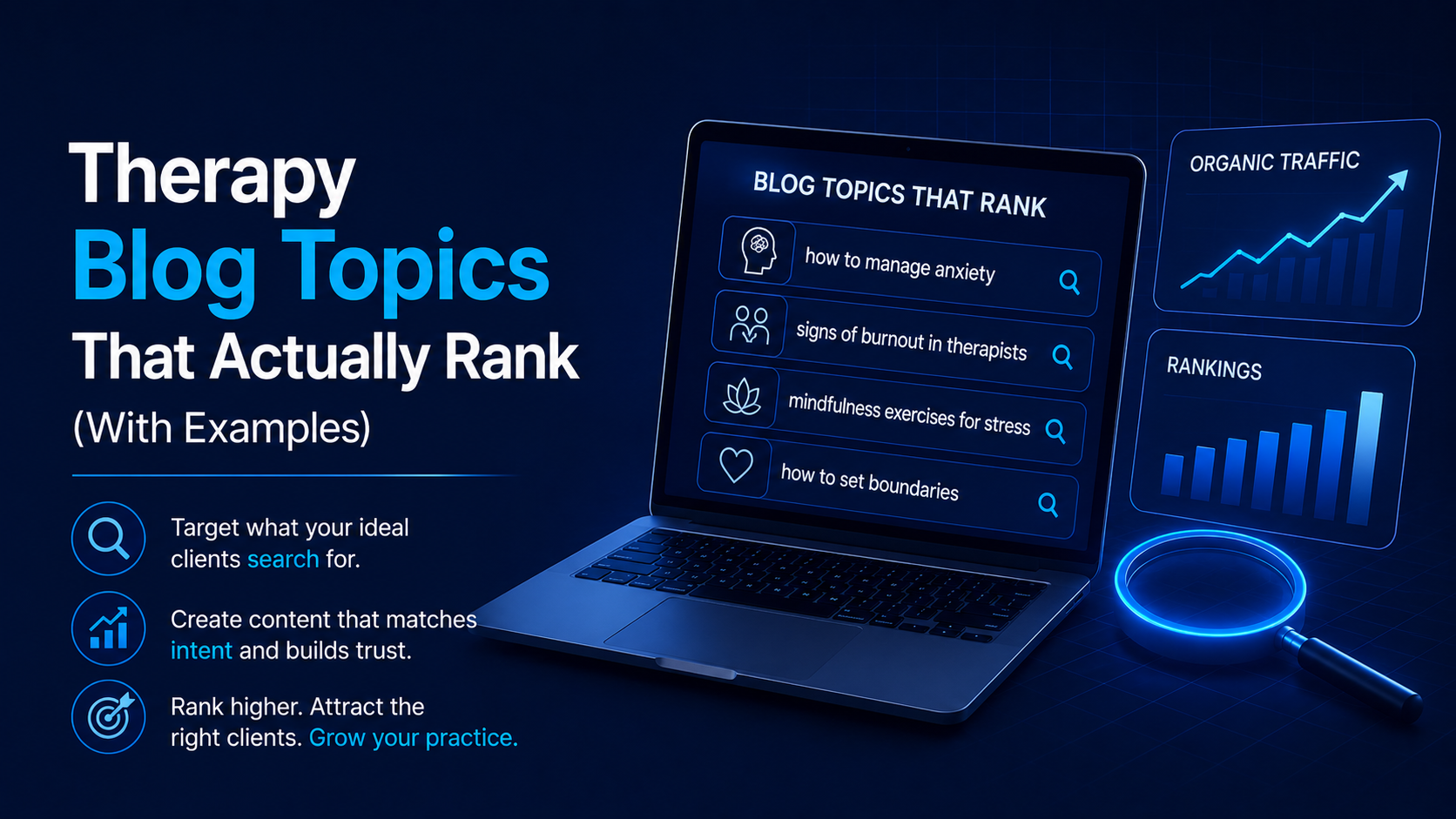
Most therapist blogs rank for nothing, because most therapist blogs are built around generic wellness topics that compete directly with national health sites and large publishers a practice cannot outrank. The blog topics that actually rank fall into five categories: condition-plus-approach terms, local-plus-specialty terms, practice-decision terms, comparison terms, and freshness terms tied to current events in the field. Each category targets a search where a focused practice website has a genuine shot at ranking.
This distinction matters because blog effort is finite. A practice publishing weekly has limited time, and every post spent on “10 tips to manage stress” is a post not spent on a topic that could realistically rank and bring in a qualified inquiry. The goal of this list is to redirect that effort toward topics with a real path to visibility.
This guide lists the categories that consistently rank for therapy practices, with concrete examples for each, and explains how to link each post into your site so it strengthens your overall SEO rather than sitting isolated. It is written for practice owners and the people who manage their marketing, not for therapy clients.
In short: stop writing generic wellness content and write topics built around what your practice actually offers: specific conditions paired with specific approaches, specific locations paired with specific specialties, the real decisions practice owners face, direct comparisons, and current developments in the field. Link every post into your site structure the day it publishes.
Category 1: condition-plus-approach topics
These pair a presenting condition with a treatment approach, which is how many real searches are phrased and where directory competition is weakest. This is the single highest-value blog category for a therapy practice, because it targets searchers who have already decided what kind of help they want.
Examples: “EMDR for complex trauma: what to expect,” “CBT for OCD versus exposure and response prevention,” “DBT skills for anxiety in daily life,” “when Gottman method couples therapy makes sense.” Each of these should link to the matching service page on your site, turning a research-stage reader into a booking.
Category 2: local-plus-specialty topics
These combine a specialty with a location, capturing searchers who want a specific kind of help nearby. Directory profiles rarely go deep here, which leaves real room for a well-built local post.
Examples: “finding a trauma-informed therapist in [city],” “teletherapy options for [state] residents,” “what group practices in [city] offer for couples counseling.” These posts work directly with the structure covered in local SEO for therapists, and they should link to your relevant location or service pages.
Category 3: practice-decision topics
These answer the real questions a prospective client asks before committing to therapy, the practical, logistical questions that sit just before a booking decision. They rank well because national sites rarely answer them with practice-specific detail.
Examples: “how much does therapy cost without insurance,” “insurance versus private pay: what to know before your first session,” “how long does therapy typically take to show results,” “what happens in a first therapy consultation.” These are high-intent, bottom-of-funnel topics, and each should end with a clear path to booking.
Category 4: comparison topics
Comparison content ranks consistently because it matches a specific, common decision point, and it performs well in both traditional search results and AI-generated answers, which frequently pull from comparison-style content to answer “which is better” questions.
Examples: “CBT versus DBT: which approach fits your situation,” “in-person versus teletherapy: what the research says,” “individual therapy versus couples therapy for relationship issues,” “psychologist versus therapist versus counselor: what’s the difference.” Structure these with a clear comparison table; that format is what both search engines and AI systems extract most reliably.
Category 5: freshness and current-event topics
These respond to something timely: a change in the field, a new research finding, a shift in how AI search or telehealth regulation works. They matter because recency is a ranking and citation signal in its own right, and they give your blog a reason to keep publishing rather than repeating evergreen topics indefinitely.
Examples: “what changed in teletherapy regulation this year,” “how AI search is changing how clients find therapists,” “new research on [a modality] for [a condition],” “what a recent Google update means for therapy practices.” Keep a visible “last updated” date on these and revisit them as the underlying facts change.
The five categories at a glance
| Category | What it targets | Example topic | Where it should link |
|---|---|---|---|
| Condition-plus-approach | Decided-intent searchers | EMDR for complex trauma | The matching service page |
| Local-plus-specialty | Nearby, specific searchers | Trauma-informed therapist in [city] | Local or location pages |
| Practice-decision | Bottom-of-funnel logistics | Cost of therapy without insurance | A booking or contact page |
| Comparison | Decision-stage research | CBT versus DBT | Both relevant service pages |
| Freshness | Timely, citation-worthy | AI search and finding a therapist | The SEO or AI-marketing pillar |
What topics should you avoid?
Generic wellness content is the biggest trap: “10 ways to manage stress,” “signs of burnout,” “why self-care matters.” These topics compete directly with massive health publishers and national platforms with far more domain authority than a private practice will build in years. They rarely rank, and even when they do, they attract client-facing traffic rather than the practice-owner or prospective-client traffic that actually converts.
The second trap is topic duplication: publishing several posts that target the same intent with slightly different titles. This splits your own ranking potential instead of building a single strong page. Before writing a new post, check whether an existing page already covers that intent, and strengthen that page instead of competing with yourself.
How should every blog post connect to your site?
A ranking blog post that leads nowhere is only doing half its job. Every post in these five categories should link up to the relevant pillar, whether that is your SEO for therapists pillar or a service-specific one, and it should link to the service page it supports. A reader who finishes a post on EMDR for complex trauma should have an obvious next step, not a dead end.
Planning a blog content calendar around topics built to rank, and linking each post into your existing structure, is part of what our mental health SEO services deliver.
How often should you publish, and what should you prioritize?
Consistency matters more than volume. A practice publishing one well-targeted post a month from these five categories will outperform a practice publishing weekly generic wellness content. Prioritize condition-plus-approach and local-plus-specialty topics first, since they carry the highest intent and the clearest path to a booking, then fill in practice-decision and comparison content, and use freshness topics to keep the blog current between larger pieces.
Frequently asked questions
What blog topics rank best for therapy practices?
Topics that pair a specific condition with a specific treatment approach rank best, followed by local-plus-specialty topics, practice-decision content, comparisons, and timely freshness pieces. Generic wellness topics rarely rank due to competition from large health publishers.
Should a therapy blog write for clients or for practice growth?
Blog content should support practice growth by targeting searches that lead to a booking, not general client education. A post can be informative and still be built around a topic with real ranking and conversion potential.
How long should a therapy blog post be?
Most supporting blog posts should run 800 words or more, with the depth matched to the topic. A comparison or condition-plus-approach post usually needs 1,200 to 1,800 words to cover the topic thoroughly and build the trust signals a YMYL topic requires.
Do blog posts need to link to service pages?
Yes. A blog post that ranks but does not link to a relevant service page or booking path captures interest without converting it. Every post should have a clear next step for the reader.
How do I know if a blog topic is too generic to rank?
If the topic could apply to any therapy practice anywhere, with no connection to a specific condition, approach, location, or decision point, it is likely too generic to compete against national health publishers.
The bottom line
The therapist blogs that rank are built around specific searches a practice can realistically win: condition-plus-approach combinations, local-plus-specialty searches, the practical decisions clients face, direct comparisons, and timely developments in the field. Generic wellness content rarely earns its place. Choose topics from these five categories, link every post into your site structure, and your blog becomes a genuine acquisition channel instead of a content archive nobody finds.