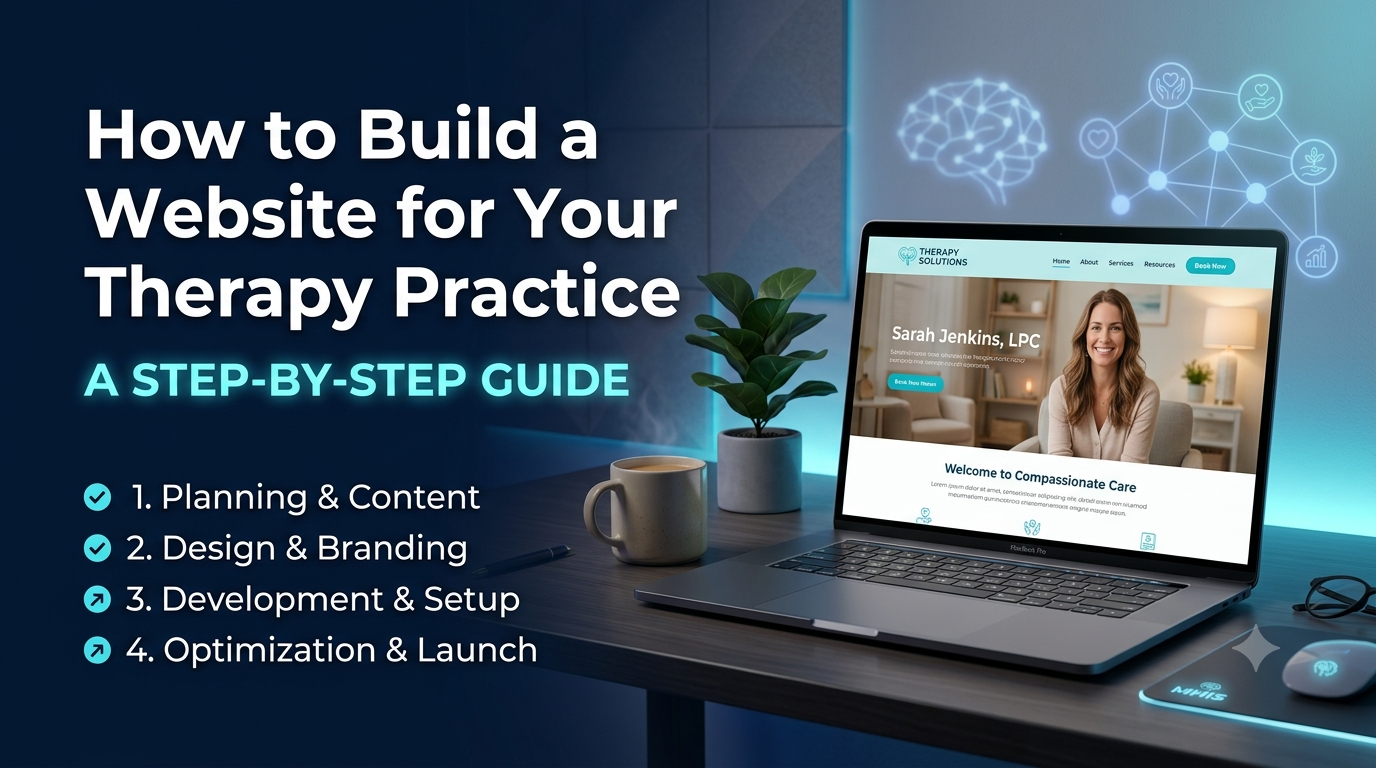
From planning and platform choice to pages, content, SEO, and launch, the full process for a website that brings you clients.
To build a website for your therapy practice, choose a platform, register a domain and hosting, create the core pages clients expect, write clear and warm content, add your SEO and HIPAA-conscious basics, then launch and keep improving. For a practice that wants strong SEO and full ownership, WordPress is the best foundation.
A therapist website is not complicated to build once you know the steps, whether you do it yourself or hire a professional. This guide walks through the whole process, from planning to launch, so you end up with a site that builds trust and turns visitors into booked clients.
Building your website is a key step in our guide to how to start a private therapy practice. At Mental Health IT Solutions, building websites for therapists is what we do.
Before you build: plan your website
Start by getting clear on your niche, your main goal for the site, and the pages you need. A little planning saves you from rebuilding later.
Decide who you help and how you want to be seen, because that shapes every word and image on the site. Your main goal is almost always to turn visitors into booked consultations, so keep that front of mind. Then gather your raw materials: your bio, credentials, a professional photo, and a clear description of your specialties. If you are still weighing whether a website is worth the effort, start with our take on whether therapists really need a website.
Choose your platform: WordPress, Wix, or Squarespace
For a practice that wants strong SEO and full ownership, WordPress is the best choice. Wix and Squarespace are simpler to start but more limited over time.
Your platform decision affects how well you can rank, how much control you have, and how easily you can grow. Here is how the main options compare.
| Platform | Best for | Tradeoff |
| WordPress | SEO, ownership, and long-term growth | Needs a little more setup or a developer |
| Squarespace | A polished site quickly, with little effort | Less SEO control and harder to migrate later |
| Wix | The easiest drag-and-drop start | The most limited for SEO and scaling |
WordPress gives you the most flexibility, the best SEO control, and full ownership of your site, which is why it is the strongest foundation for a practice that plans to grow. It takes a little more setup, which is where a developer helps. Wix and Squarespace are genuinely easy and quick to launch, but they trade away SEO control and make it harder to move your site later. Many therapists start on a simple builder and migrate to WordPress once they get serious about growth, so building on WordPress from the start can save you that step.
Register your domain and hosting
Choose a professional domain name and reliable hosting. On WordPress you pick your own host, while Wix and Squarespace bundle it in.
A good domain is short and clear, usually your name or practice name, and sometimes your specialty or city. Set up email on your own domain so your address looks professional. If you use WordPress, choose fast, secure hosting with an SSL certificate, and a HIPAA-conscious host if your site will handle any client information. On the all-in-one builders, hosting and security come included.
Build the core pages your practice needs
A therapist website needs only a small set of pages, each one built to build trust and lead to a booking.
- Home: who you help, your approach, and a clear call to book, all visible at a glance.
- About: your story, credentials, personality, and a warm professional photo.
- Services or specialties: ideally a page per specialty, which also gives you strong SEO pages.
- Fees and insurance: what you charge and whether you take insurance, which reduces hesitation.
- Contact or book a consultation: an easy, obvious form or scheduler on its own page.
- Optional: a blog for content and SEO, an FAQ, or a getting-started page.
Your service and specialty pages do double duty, giving clients the detail they want and giving search engines clear pages to rank for local searches.
Write content that builds trust and converts
Write for your ideal client in plain, warm language, and make the next step obvious on every page.
Speak to the problem your client is facing and how you help, rather than listing credentials in clinical language. Show your training and approach to build trust, keep paragraphs short and scannable, and put a clear call to action, usually to book a consultation, on every page. A warm, professional photo does more for trust than most people expect. For a deeper look at design and layout, see our guide to therapist website design.
Set up your SEO and HIPAA-conscious basics
Build SEO in from the start, and keep any client information secure.
For SEO, make sure the site is mobile-first and fast, give each page a clear title and description, create service pages targeting your specialty and city, set up a Google Business Profile, and link your pages together. These basics help you rank on Google and appear in AI search. Our guide to SEO for therapists covers the details.
For privacy, use a secure contact form and SSL, and keep analytics or ad tracking off any page that could capture client information. Building these habits from the start is far easier than fixing them later, and our HIPAA compliance checklist for a new therapy practice walks through what to cover.
Should you build it yourself or hire a professional?
You can build a basic site yourself, but a professional build usually converts better and ranks stronger, especially on WordPress.
Doing it yourself is cheaper and fine for a very simple starting point. A professional build gets you conversion-focused design, proper SEO foundations, and a HIPAA-conscious setup without the learning curve, and it frees your time to see clients. Costs vary with how the site is built, which we break down in what a therapist website costs.
Let us build your therapy website for you
We design fast, conversion-focused, HIPAA-conscious websites for therapists on a foundation built to rank. Explore website design and development
Launch, then keep improving
Launch once your core pages are solid, then treat your website as something you refine over time.
Before you go live, test everything on a phone, check your links and forms, and make sure booking works. After launch, connect Google Search Console and your Google Business Profile so you can be found, then keep adding content and refining based on what actually converts. A website is never truly finished, and the practices that keep improving theirs are the ones that keep growing.
A website is step one, getting found fills it
A great website only works when the right clients can find it.
On its own, a new site is a storefront no one has discovered yet. Paired with SEO and a strong presence in local and AI search, it becomes a steady source of clients, which along with your other channels is what builds a full caseload.
For the complete picture of filling your schedule, see our guide to how to get your first clients as a new therapist.
Get your new website found
Our mental health SEO services help your site rank on Google and appear in AI search, so clients keep finding you. See our mental health SEO services
Frequently asked questions
What is the best platform to build a therapist website?
WordPress is the best choice for most practices, because it offers the strongest SEO control and full ownership of your site. Wix and Squarespace are simpler to start but more limited for SEO and harder to grow or migrate later.
How much does it cost to build a therapy website?
Typically $500 to $5,000 or more, depending on whether it is a simple template or a custom, conversion-focused build. See our full breakdown of therapist website cost.
Can I build my therapy website myself?
Yes, especially for a simple starting site on a builder like Squarespace. For a site that converts well and ranks strongly, particularly on WordPress, many therapists prefer to hire a professional and spend their own time on clients.
What pages does a therapist website need?
At a minimum: a home page, an about page, a services or specialties page, a fees and insurance page, and a contact or booking page. A blog and an FAQ are useful additions for trust and SEO.
Should therapists use WordPress or Squarespace?
Use WordPress if you want flexibility, SEO control, and long-term ownership. Choose Squarespace if you want a polished site quickly with the least effort and are willing to trade some SEO control for simplicity.
How long does it take to build a therapist website?
A simple site can come together in a few days to a couple of weeks, while a custom, conversion-focused build usually takes a few weeks. Gathering your content in advance is the best way to move quickly.
Do I need special hosting for a therapy website?
You need fast, secure hosting with an SSL certificate, and a HIPAA-conscious host if your site handles any client information. On all-in-one builders, hosting and security are included.
Build a website that works as hard as you do
Building a website for your therapy practice comes down to a clear sequence: plan around your niche, choose a platform that supports your goals, create the core pages, write warm and trustworthy content, set up SEO and privacy from the start, and launch with room to improve. Get the foundation right, pair it with visibility, and your website will bring you clients for years.
Ready for a website that brings you clients?
Mental Health IT Solutions builds websites and SEO for therapists that turn visitors into booked consultations. Let us build yours. Contact our team for a free consultation