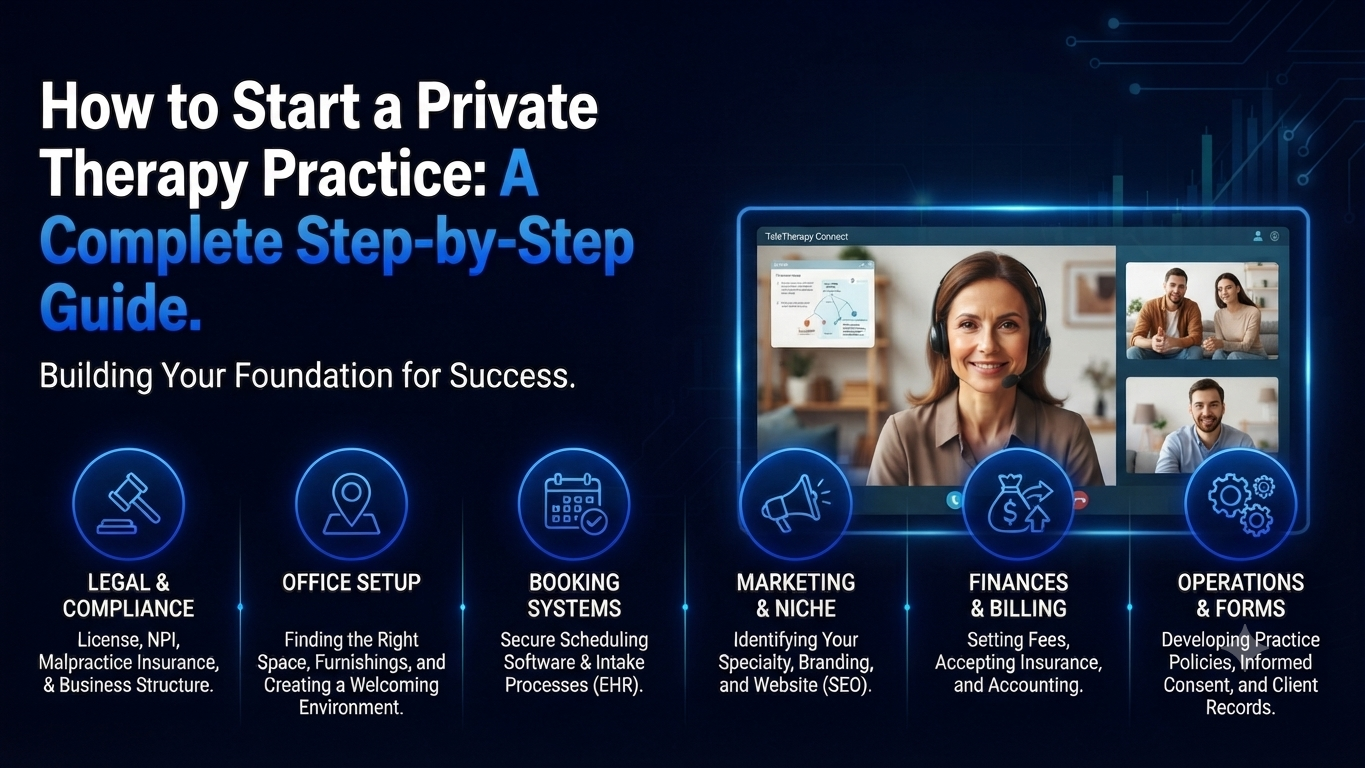
Learning how to start a private therapy practice is really about learning to run a small business on top of your clinical work. In short, you confirm your state license, define a niche, register a legal business entity, put your compliance and insurance in place, set your fees, choose your tools, build a professional website, and market your services so the right clients can find you.
This guide is written for licensed therapists, counselors, psychologists, marriage and family therapists, and clinical social workers who are ready to go independent. At Mental Health IT Solutions, we work exclusively with mental health professionals, so the steps below focus on what actually moves a new practice forward, not generic small-business filler.
The 10 steps to start a private therapy practice
- Confirm your license and your readiness
- Choose your niche and ideal client
- Register your business structure
- Set up legal, tax, and HIPAA compliance
- Decide private pay versus insurance and set your fees
- Choose your practice tools and location model
- Build your brand and website
- Get found with SEO and AI search
- Launch marketing and land your first clients
- Track, refine, and scale
Step 1: Confirm your license and your readiness
To start a private practice, you need an active, unrestricted license in the state where your clients are located, and in most states you must have completed your post-graduate supervised hours.
Requirements vary by profession and by state. A licensed professional counselor, clinical social worker, marriage and family therapist, or psychologist each has a distinct path, and many states do not allow pre-licensed or associate-level clinicians to practice independently. Confirm your exact standing with your state licensing board before you do anything else.
Readiness is more than a license. The therapists who launch smoothly usually have some clinical experience under supervision, a clear sense of the clients they want to serve, and enough financial runway to cover a few months of expenses while their caseload fills. If you are not there yet, many clinicians start part-time while keeping a salaried role, which we cover in the FAQ.
Step 2: Choose your niche and ideal client
A defined niche makes your practice easier to run clinically and far easier to market, because it tells the right clients that you are the therapist for them.
Trying to help everyone tends to attract no one. A focused positioning, for example trauma and EMDR, couples and relationships, anxiety in young professionals, or grief and loss, lets you build genuine expertise and speak directly to the people you serve. It also shapes every later decision, from the pages on your website to the keywords you want to rank for.
When you choose a niche, think about three things at once: the work you find meaningful, the demand in your area or licensed states, and how well you can reach that audience online. A clear niche is one of the strongest advantages a new practice can have in a competitive market.
Step 3: Register your business structure
Most therapists start as a sole proprietor, an LLC, or, in some states, a professional entity such as a professional corporation or PLLC that is required for licensed clinicians.
Your business structure affects your liability protection, your taxes, and how you register with the state. A sole proprietorship is simple and inexpensive, while an LLC adds a layer of personal liability protection. Several states, including California, require licensed providers to form a professional corporation rather than a standard LLC, so the right choice depends heavily on where you practice.
Once your entity is set, you will typically need an Employer Identification Number (EIN) from the IRS, a National Provider Identifier (NPI), and a dedicated business bank account so your practice finances stay separate from your personal ones. These few administrative steps make tax time and insurance billing much cleaner later.
Step 4: Set up legal, tax, and HIPAA compliance
Before you see a single client, put your malpractice insurance, HIPAA safeguards, informed consent, and any required local licenses or permits in place.
The compliance foundation of a therapy practice usually includes professional liability (malpractice) insurance, general business liability coverage, and clear clinical paperwork such as informed consent forms and practice policies. If you plan to see clients online, your consent documents should address telehealth specifically, including privacy and technology risks.
HIPAA is not optional. Any tool that touches protected health information, including your email, your electronic health record, your video platform, and your intake forms, should be covered by a Business Associate Agreement and configured for privacy. Building HIPAA-conscious habits from day one is far easier than retrofitting them once you have a full caseload.
This guide is general information for mental health professionals and is not legal, tax, or clinical advice. Confirm your specific obligations with your state licensing board and a qualified attorney or accountant.
Step 5: Decide private pay versus insurance and set your fees
You can build a private-pay practice, an insurance-based practice, or a hybrid of both, and that decision shapes your income, your paperwork, and how you market.
Accepting insurance can bring a steady stream of referrals, since many clients search only for in-network providers. The tradeoffs are lower per-session rates, credentialing that can take weeks or months, and more administrative work. A private-pay model gives you higher rates, full clinical autonomy, and simpler operations, but it asks more of your marketing because you have to reach clients who are willing to pay out of pocket.
To set your fees, look at typical rates for your license and specialty in your area, factor in your experience and your costs, and decide where you want to sit in the market. Many therapists begin with a hybrid approach, joining one or two insurance panels while keeping private-pay availability, then adjust as their reputation grows.
Step 6: Choose your practice tools and location model
Decide whether you will run an in-person, fully online, or hybrid practice, then choose a HIPAA-compliant electronic health record and video platform to support it.
Teletherapy has made it possible to launch with very little overhead, since you can see clients across your licensed states without renting an office. A hybrid model gives you the flexibility of virtual sessions plus the option of in-person work. Whichever you choose, your location model drives your remaining tool decisions.
At a minimum, most new practices need an electronic health record or practice management system that handles scheduling, documentation, and billing, a HIPAA-compliant video solution for virtual sessions, a professional phone and email setup, and secure intake forms. Choose tools that integrate well so you spend your time on clients rather than on admin.
Step 7: Build your brand and website
Your website is the foundation of a modern private practice, because it is the one place you fully own where potential clients decide whether to reach out.
A directory profile can help, but it puts you in a list next to dozens of competitors. Your own website lets you tell your story, explain your specialties, and turn visitors into booked consultations on your terms. For a new practice, that difference in trust and control is significant.
A therapist website that converts is mobile-first, loads quickly, and makes it obvious how to book a consultation. It should reflect your personality, speak to your niche, include clear service pages, and carry gentle trust signals such as your credentials and your approach. For a deeper walkthrough, see our guide to therapist website design, and if you are budgeting the project, our breakdown of what a therapist website costs will help you plan.
Want a website that turns visitors into booked clients?
We design fast, HIPAA-conscious, conversion-focused websites built specifically for therapists and private practices. Explore website design and development
Step 8: Get found with SEO and AI search
To attract clients consistently, your practice needs to appear when people search on Google and when they ask AI tools for a therapist, and that visibility comes from search engine optimization.
Most therapy clients begin their search online, often with local intent such as a specialty plus a city. Ranking for those searches is the difference between a website that quietly sits there and one that fills your calendar. Local SEO, an optimized Google Business Profile, clear service pages, and helpful content all work together to build that visibility over time.
Search is also changing. People increasingly ask AI assistants and AI overviews to recommend a provider, and those answers pull from well-structured, authoritative content. The same foundations that help you rank on Google, clear answers, strong topical depth, and clean technical structure, also help you show up in AI-generated results. Our guide to SEO for therapists explains how to put these pieces in place.
Rank on Google and in AI search from the start
Our mental health SEO services help new practices get found by the right clients, on Google and in AI-driven results. See our mental health SEO services
Step 9: Launch marketing and land your first clients
The fastest path to your first clients usually combines directory listings, referrals, and targeted online visibility, then compounds with SEO and content as your practice matures.
In the early weeks, listing on reputable directories and letting your professional network know you are open can generate quick inquiries. Referral relationships with physicians, schools, and other therapists build a steady pipeline over time. Meanwhile, your website and SEO work quietly in the background to bring in clients who found you on their own.
When you want to accelerate, paid search puts your practice in front of people actively looking for help right now. It works best once your website is ready to convert, so campaigns and landing pages point in the same direction. If you plan to run paid ads, start with our step-by-step guide to how to create a Google Ads campaign for your therapy practice. The strongest new practices do not rely on a single channel; they layer directories, referrals, SEO, and selective advertising so their caseload never depends on any one source.
Step 10: Track, refine, and scale
Once clients are coming in, track where they come from and how many inquiries turn into booked sessions, then double down on what works.
Simple measurement goes a long way. Note how each new client found you, watch how your website and marketing perform month over month, and pay attention to which specialties and channels bring the best fit. These signals tell you where to invest as you grow.
Scaling can mean raising your rates as demand grows, adding teletherapy in additional licensed states, expanding your content and SEO footprint, or eventually bringing on associate clinicians and becoming a group practice. Growth is easier when the foundations from the earlier steps are solid.
How much does it cost to start a private therapy practice?
Most therapists spend somewhere between $2,000 and $10,000 to launch a private practice, with the range driven mainly by your state requirements, your tools, and how much you invest in marketing.
Costs vary widely, so treat the figures below as directional rather than fixed. Your biggest long-term investment is usually not the setup, it is the marketing that keeps new clients coming in.
| Startup item | Typical range |
| Business registration and legal setup | $100 to $1,500 |
| Malpractice and liability insurance | $200 to $800 per year |
| Electronic health record or practice management software | $30 to $150 per month |
| Professional website | $500 to $5,000 and up |
| Initial marketing (directories, SEO, ads) | $300 to $2,000 and up per month |
For a detailed look at one of the most important line items, read our guide to therapist website cost.
How long does it take to start a private therapy practice?
Once your license is confirmed, most therapists can open their practice within 4 to 12 weeks, though building a steady caseload usually takes 3 to 6 months of consistent marketing.
The setup tasks, registering your entity, arranging insurance, choosing tools, and launching a website can move quickly if you stay organized. The slower part is reputation and visibility, which is exactly why starting your website and SEO early pays off.
Frequently asked questions
Do I need a license to start a private practice?
Yes. You need an active, unrestricted license in the state where your clients are located, and in most states you must have completed your supervised post-graduate hours. Pre-licensed or associate clinicians generally cannot practice independently, so confirm your standing with your licensing board.
Can I start a private therapy practice part-time?
Yes, and many therapists do. Starting part-time while keeping a salaried position lets you build a caseload and test your systems without the full financial pressure. You can transition to full-time once your practice can support you.
Do I have to take insurance?
No. You can run a private-pay practice, an insurance-based practice, or a hybrid. Insurance can bring more referrals but pays less per session and adds administration. Private pay gives you higher rates and more autonomy but asks more of your marketing.
Do therapists need a website to get clients?
In practice, yes. A directory profile helps, but your own website is the one place you control the message and convert visitors into consultations. It is also the foundation for ranking on Google and appearing in AI search. See our guide to therapist website design to get it right.
Can I run my therapy practice entirely online?
Yes. A teletherapy model lets you serve clients across your licensed states with very little overhead. You will need a HIPAA-compliant video platform, telehealth-specific consent forms, and awareness of where you are licensed to practice, since the client’s location at the time of the session determines which license applies.
How do I get my first therapy clients?
Start with directory listings and your professional network for quick inquiries, build referral relationships for steady flow, and invest in your website and SEO so clients can find you on their own. Paid search can accelerate results once your website is ready to convert.
What is the hardest part of starting a private practice?
For most therapists it is not the clinical work or the paperwork; it is consistent client acquisition. That is why a strong website plus a deliberate SEO and marketing plan matters so much in the first year.
Start your practice on a strong foundation
Starting a private therapy practice is a significant step, and the clinicians who thrive treat it as building a business as much as delivering care. Get your license, structure, and compliance right, choose a clear niche, and then invest in the visibility that keeps your calendar full. Do that, and you give your practice the best possible chance to grow.
Ready to launch and grow your practice?
Mental Health IT Solutions is a specialized growth partner for therapists, combining websites, SEO, and marketing built for the mental health field. Let us help you start strong. Contact our team for a free consultation