What an NPI is, which type you need, and how to apply for free in a few minutes.
To get an NPI number as a therapist, apply for free through the NPPES website. Most therapists need a Type 1 individual NPI, the online application takes about 10 to 15 minutes, and the number is often issued right away.
An NPI is a small but essential piece of setting up your practice. You need it to bill insurance, to give clients superbills for out-of-network reimbursement, and to get credentialed with payers. The good news is that it is quick, free, and something you do only once.
Getting your NPI is one step in the larger process we cover in our guide to how to start a private therapy practice. At Mental Health IT Solutions, we help therapists handle the setup and, more importantly, build the visibility that brings clients.
What is an NPI number, and why do therapists need one?
An NPI, or National Provider Identifier, is a unique 10-digit number that identifies you as a healthcare provider, and therapists need one to bill insurance and to provide superbills for out-of-network clients.
The NPI is required under HIPAA and is issued by the Centers for Medicare and Medicaid Services through a system called NPPES. It is free, it never expires, and it stays with you for your entire career, even if you change your name, address, or employer.
You will use your NPI on insurance claims, on superbills, and throughout the credentialing process. Even if you plan to be fully private pay, most therapists still need one, because clients often submit superbills to their insurer for partial reimbursement. If you plan to accept insurance, you will need it when you get on insurance panels.
Type 1 vs Type 2 NPI: which do therapists need?
Most solo therapists need only a Type 1 individual NPI. You also need a Type 2 organization NPI if you bill under a business entity or run a group practice.
A Type 1 NPI identifies you as an individual clinician and is tied to your Social Security number. Every therapist who bills or issues superbills gets one. A Type 2 NPI identifies an organization and is tied to an EIN, so it applies if you have formed a PLLC, LLC, or corporation and bill under it, or if you run a group practice. If you operate as a sole proprietor, a Type 1 is usually all you need. If you are still deciding on an entity, see how to structure your therapy practice.
What you need before you apply
Applying is quick if you have your basic information ready.
Have these on hand before you start:
- Your full legal name and Social Security number for a Type 1, or your EIN for a Type 2.
- A business or mailing address. Your NPI record is public, so use a professional address rather than your home address.
- Your contact information and an email address.
- Your provider taxonomy code, which is the standard code for your profession, such as counselor, marriage and family therapist, clinical social worker, or psychologist.
- Your license number and the state that issued it, if you are already licensed.
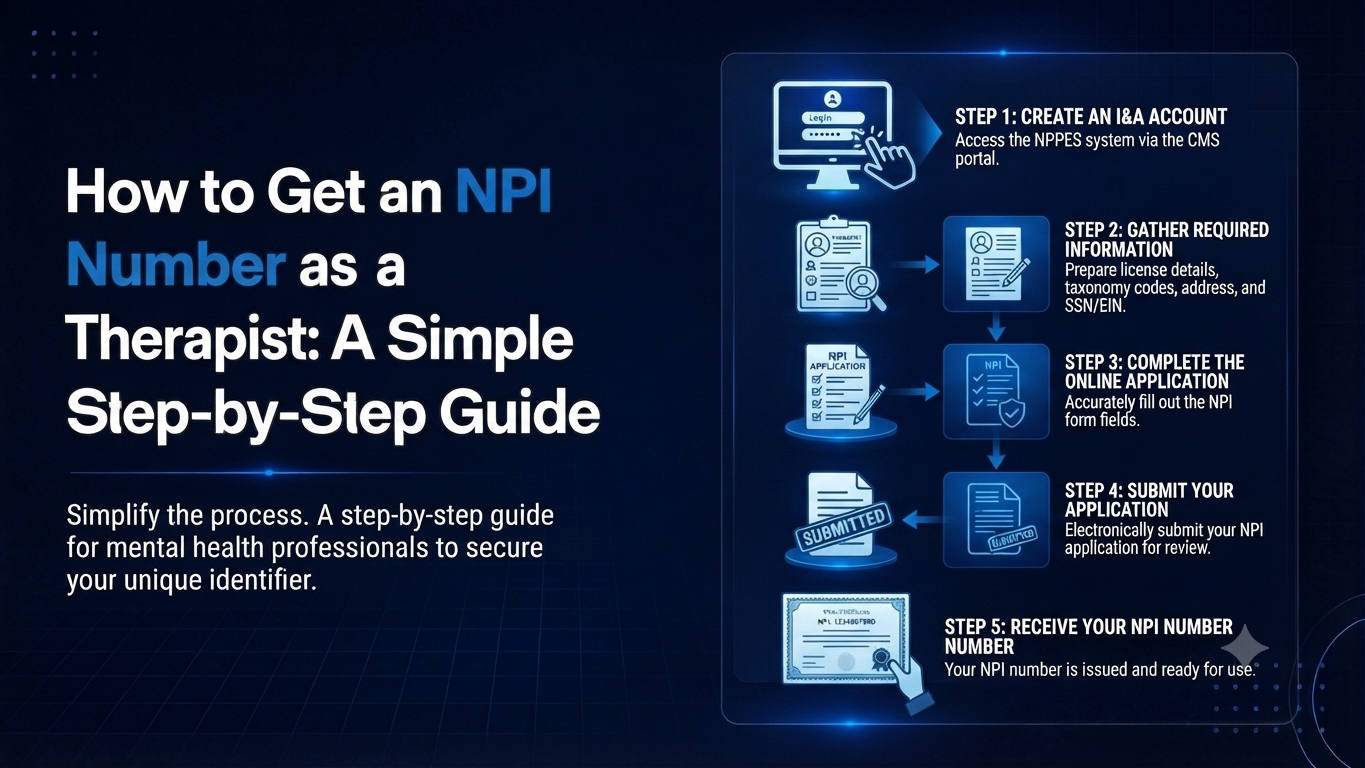
How to get an NPI number as a therapist, step by step
With your details ready, the online application takes only a few minutes.
Step 1: Create your NPPES account
Go to the NPPES website and create a login through the Identity and Access Management system.
NPPES, the National Plan and Provider Enumeration System, is the government site that issues NPIs. You set up a secure account first, then use it to apply.
Step 2: Start a new NPI application
Log in and begin a new application, selecting an individual, or Type 1, provider.
Choose the individual provider option unless you are applying for an organization NPI, which you can do separately.
Step 3: Enter your details and taxonomy
Provide your personal information and the taxonomy code that matches your profession.
Enter your name, Social Security number, business address, and contact details, then select the healthcare provider taxonomy for your profession and add your license number and state. The taxonomy tells payers what kind of provider you are.
Step 4: Review and submit
Check your information for accuracy and submit the application, which is free.
Take a moment to confirm your name, address, and taxonomy are correct, since errors can slow things down. There is never a fee to apply.
Step 5: Save your NPI and add a Type 2 if needed
Your NPI is often issued immediately or within a few business days. Record it, and repeat the process for a Type 2 if you bill under a business entity.
Keep your NPI somewhere safe, because you will use it on claims, superbills, and every credentialing application. If you have a PLLC, LLC, or group practice, apply for a Type 2 NPI using your EIN.
How much does an NPI cost, and how long does it take?
An NPI is completely free, and the online application usually takes about 10 to 15 minutes, with the number often issued right away.
Applying online is the fastest route, and many therapists receive their NPI immediately, though it can take up to about 10 business days if the application needs review. Be careful of third-party sites that charge a fee to get your NPI, since the official process is always free. Once issued, your NPI never expires.
Keep your NPI information current and private
Your NPI record is public, so use a business address and update it whenever your details change.
The NPPES registry lists your name, taxonomy, and business address publicly, which is one more reason to avoid using your home address. When you move, change your license, or update your practice information, log back into NPPES and keep your record accurate.
After you have your NPI, set up the rest of your practice
An NPI is one small building block. To actually see clients, you need the practice around it.
With your NPI in hand, the next steps are choosing your business structure, getting credentialed if you take insurance, budgeting for launch, and building the website and visibility that bring clients. We map the whole process in our guide to how to start a private therapy practice, including what it costs to start. When you are ready to attract clients, a well-designed therapist website and strong SEO for therapists do the heavy lifting.
Ready to build a practice clients can find?
We design fast, conversion-focused websites specifically for therapists and private practices. Explore website design and development
Most therapy clients start their search online, so being easy to find matters as much as any form you file.
Get found by the clients you want
Our mental health SEO services help your practice rank on Google and appear in AI search, so new inquiries keep coming in. See our mental health SEO services
Frequently asked questions
Do therapists need an NPI number?
Yes, in almost all cases. You need an NPI to bill insurance and to provide superbills, and even fully private-pay therapists usually need one, since clients often submit superbills for out-of-network reimbursement.
Is getting an NPI free?
Yes. Applying through NPPES is always free. Avoid any third-party website that charges a fee to obtain your NPI, because the official process never costs anything.
How long does it take to get an NPI?
The online application takes about 10 to 15 minutes, and many therapists receive their NPI immediately. If the application needs review, it can take up to roughly 10 business days.
What is the difference between a Type 1 and Type 2 NPI?
A Type 1 NPI identifies you as an individual provider and is tied to your Social Security number. A Type 2 NPI identifies an organization, such as a PLLC or group practice, and is tied to an EIN. Most solo therapists need only a Type 1.
Do I need a license to get an NPI number?
You provide your profession and, if you have it, your license number when you apply, and in some cases you can obtain an NPI before full licensure. Insurance credentialing, however, usually requires an active license, so check each payer’s rules.
Do I need an NPI if I only take private pay?
Usually yes. Even without billing insurance directly, most private-pay therapists need an NPI so clients can submit superbills to their own insurer for possible reimbursement.
Can I use my home address on my NPI?
You can, but it is not recommended. The NPPES registry is public, so your listed address is visible to anyone. Using a business or professional address protects your privacy.
A quick step, then on to the real work
Getting an NPI number as a therapist is one of the easiest parts of starting a practice: choose the right type, gather your details, and apply for free through NPPES in a few minutes. With that handled, you can focus on the steps that actually grow a practice, from your structure and credentialing to the website and marketing that bring clients through the door.
Want help building a practice that grows?
Mental Health IT Solutions helps therapists launch and grow, from websites to SEO built for the mental health field. Let us help you get found. Contact our team for a free consultation