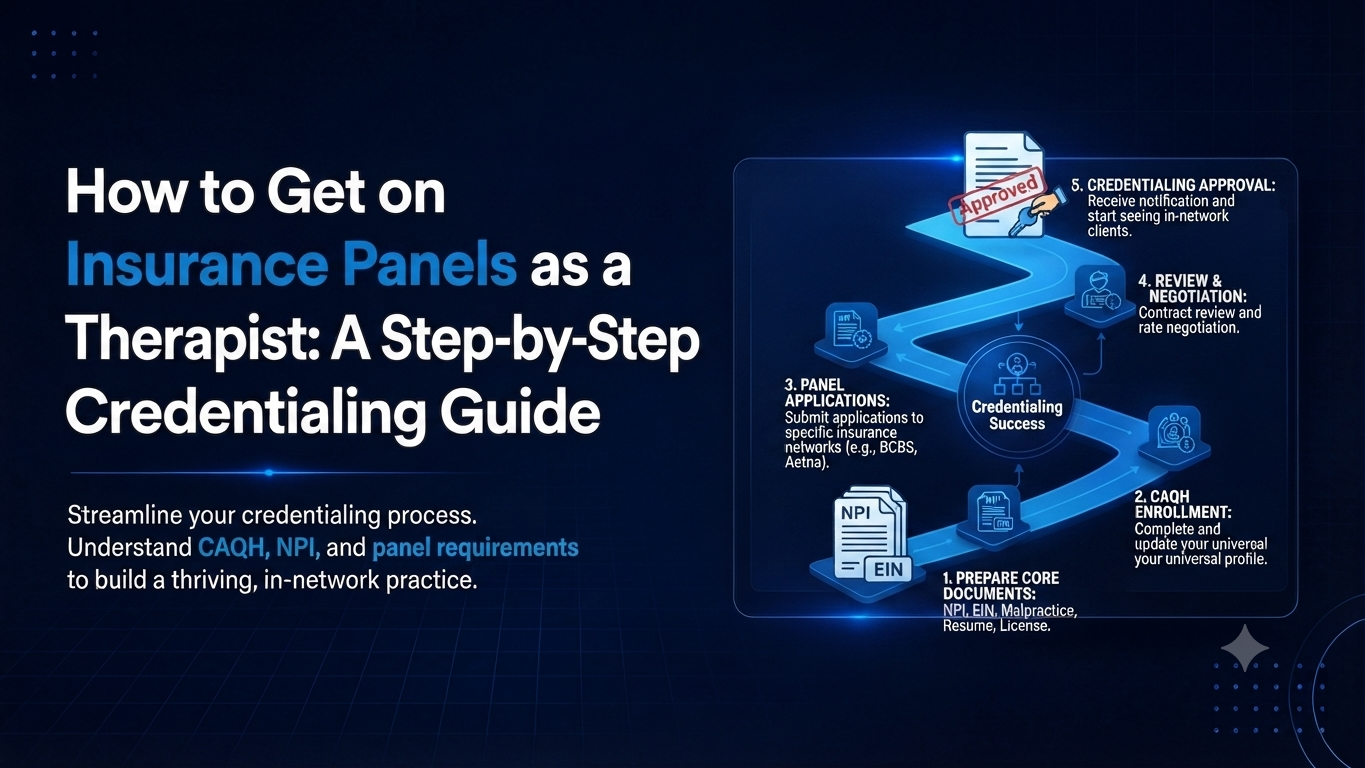
A practical guide to credentialing, from deciding whether to take insurance to getting an effective date with each payer.
Getting on insurance panels, also called credentialing, means becoming an in-network provider so clients can use their insurance benefits to see you. The process usually takes 60 to 120 days and runs through a CAQH profile plus a separate application to each insurer.
Being in-network can fill your caseload quickly, because many clients search only for providers their plan covers. It also comes with lower rates and more paperwork, so the first real decision is whether to take insurance at all, and the second is how to get credentialed efficiently. This guide walks through both.
Credentialing is one part of the larger process we cover in our guide to how to start a private therapy practice. At Mental Health IT Solutions, we help therapists set up and grow practices that are easy for the right clients to find.
Credentialing requirements, timelines, and reimbursement rates vary by insurer and by state, and they change over time. Confirm current requirements directly with each payer and your licensing board.
What does it mean to get on an insurance panel?
Getting on an insurance panel, or credentialing, is the process of being approved as an in-network provider with an insurance company, so you can bill them directly and your clients can use their coverage.
An in-network therapist has a contract with the insurer and is listed in its provider directory, so clients pay only their copay or coinsurance. An out-of-network therapist has no contract, so clients pay the full fee and may submit a superbill for partial reimbursement. Credentialing is how the insurer verifies your license, education, training, and background before adding you to the network.
Should you join insurance panels at all?
Before you apply, decide whether being in-network fits your practice, because insurance brings more referrals but lower rates and more administration.
Joining panels can bring a steady flow of clients, fuller and faster than private pay alone, and it makes therapy affordable for people who cannot pay out of pocket. The tradeoffs are real: insurers set the rates, which are usually lower than private-pay fees, and you take on claims, denials, and the occasional audit.
Some therapists stay fully private pay and provide superbills, while many blend a few panels with private-pay clients. This is part of the private pay versus insurance decision we cover in our guide to how to start a private therapy practice, and it shapes both your income and your marketing.
What you need before you apply
To credential, you need full state licensure, an NPI, malpractice insurance, and your professional documents ready to go.
Gathering these first makes every application faster:
- An active, unrestricted state license. Most panels require full licensure, so associates and pre-licensed clinicians are often not eligible.
- A National Provider Identifier (NPI), which is free from NPPES. You need a Type 1 individual NPI, and a Type 2 NPI if you bill under a group entity.
- An EIN if you have registered a business entity, or your SSN if you operate as a sole proprietor. See how to structure your therapy practice if you have not decided yet.
- Proof of malpractice and liability insurance, often with minimum coverage amounts set by the payer.
- Your professional documents: a current resume or CV, license copies, and diploma or transcripts.
- Your practice details: a business address, tax information, and a completed W-9.
Step-by-step: how to get on insurance panels as a therapist
Once your documents are ready, credentialing follows six steps.
Step 1: Complete your CAQH profile
Most major insurers credential through CAQH, so your first move is a complete, accurate CAQH ProView profile.
CAQH is a centralized database where you enter your professional information and upload your documents once, then authorize each insurer to access it. Some payers issue you a CAQH ID when you begin an application, and you can also register directly. Fill it in completely, because missing details are the most common reason credentialing stalls, and re-attest to keep it current about every 120 days.
Step 2: Choose which panels to apply to
Focus on the insurers your ideal clients actually use, and start with a handful rather than all at once.
Identify the plans that dominate in your area, such as Blue Cross Blue Shield, Aetna, Cigna, and UnitedHealthcare or Optum, plus Medicare or Medicaid if they fit your practice. Check whether each panel is open or closed to new providers, and look at the rates where you can. Applying to two to four panels first keeps the process manageable. If a panel is closed, you can still request to join with a short letter explaining the specialty, language, or access gap you fill, which is sometimes accepted.
Step 3: Submit your applications
Apply through each insurer’s provider process, and they will pull your CAQH profile and ask you to sign a provider agreement.
Complete the payer-specific application, provide your W-9, license, and malpractice proof, and sign the contract, which includes the fee schedule. Save a copy of everything you submit and note the date, because you will refer back to it while you follow up.
Step 4: Follow up until you get an effective date
Credentialing typically takes 60 to 120 days, and steady follow-up is often what keeps it moving.
Track every application with the date submitted, a contact name, and any reference number, then check in by phone or email on a regular schedule. Be patient but persistent. Do not start seeing clients under a plan until you have written approval and an effective date, or you may not be paid for those sessions.
Step 5: Review your contract and confirm enrollment
When you are approved, review the fee schedule, confirm your effective date, and make sure you appear in the insurer’s provider directory.
Understand what the plan pays for the codes you use, such as an intake and a standard session, and confirm the date you can begin billing. Check that your listing is live in the directory so clients can find you. Only then should you bill the plan.
Step 6: Maintain your credentialing
Credentialing is ongoing: re-attest your CAQH profile quarterly and re-credential with each payer every two to three years.
Keep your license, malpractice coverage, and profile details current, and respond promptly to re-credentialing requests. Letting any of these lapse is the easiest way to fall off a panel and interrupt your payments.
A faster alternative: credentialing services and platforms
If the process feels overwhelming, a credentialing service or a third-party network can get you in-network with far less work.
A credentialing service handles the paperwork and follow-up for you, usually for a fee per panel or a monthly rate, which is part of the startup budget we cover in how much it costs to start a therapy practice. Third-party networks such as Headway, Alma, Grow Therapy, and SonderMind go further: they let therapists accept insurance without full self-credentialing, and they handle credentialing, billing, and claims in exchange for a fee or a share of each session.
The tradeoff is less control and a cut of your rate, but for many new therapists these platforms are the fastest way to start accepting insurance while they build the rest of the practice. You can always move to direct contracts later.
How much do insurance panels pay therapists?
Reimbursement varies widely by insurer, region, and license, but in-network rates are usually lower than private-pay fees, often in the range of $60 to $120 per session.
Medicaid typically pays the least, commercial plans vary, and your license type and location affect the number. As a solo provider you have limited leverage to negotiate, though you can sometimes request a higher rate or renegotiate once you have a track record. Because the rates are set for you, many therapists balance a few panels with private-pay clients to protect their overall income.
After you are credentialed, keep your practice full
Being in-network helps clients find you, but you still need a strong online presence to turn a directory listing into a booked client.
Insurer directories send some referrals, but most clients still check you out online before they call. A clear, well-designed therapist website builds trust, and strong SEO for therapists helps you rank for local searches like a therapist who takes a specific plan nearby, on Google and in AI search.
Turn directory listings into booked clients
We build fast, conversion-focused websites specifically for therapists and private practices. Explore website design and development
Search is where most therapy clients begin, whether or not they use insurance.
Get found by the clients you want
Our mental health SEO services help your practice rank on Google and appear in AI search, so new inquiries keep coming in. See our mental health SEO services
Frequently asked questions
How long does it take to get on insurance panels?
Credentialing usually takes 60 to 120 days from a complete application, and sometimes up to six months. Following up regularly and keeping your CAQH profile complete are the best ways to avoid delays.
Do I need to be fully licensed to get credentialed?
In most cases, yes. Panels typically require an active, unrestricted license, so associates and pre-licensed clinicians are often not eligible, though some Medicaid programs and states allow supervised clinicians. Confirm with each payer.
What is CAQH?
CAQH is the centralized database most major insurers use for credentialing. You complete one CAQH profile with your information and documents, authorize insurers to access it, and re-attest about every 120 days to keep it current.
Should I take insurance as a therapist?
It depends on your goals. Insurance brings more referrals and makes therapy affordable for more clients, but it pays less and adds administration. Many therapists blend a few panels with private pay. See the private pay versus insurance discussion in our guide to how to start a private therapy practice.
Can I join a closed insurance panel?
Sometimes. If a panel is closed to new providers, you can request to join with a short letter explaining the specialty, language, or access gap you fill. Insurers sometimes accept applicants who meet a need in the area.
How much do insurance panels pay therapists?
Rates vary by insurer, region, license, and service code, but are commonly in the $60 to $120 per session range and usually lower than private-pay fees. Medicaid tends to pay the least and commercial plans vary.
Is it worth using a platform like Headway or Alma?
For many new therapists, yes. These platforms handle credentialing and billing so you can accept insurance quickly with little admin, in exchange for a fee or a share of each session. The tradeoff is less control and a lower net rate, and you can switch to direct contracts later.
Get credentialed, then focus on filling your practice
Getting on insurance panels is mostly a matter of preparation and persistence: decide whether in-network fits your practice, complete your CAQH profile, apply to the right panels, and follow up until you have an effective date. Once you are credentialed, the work shifts to making sure the right clients can find and choose you, which is where your website and visibility do the heavy lifting.
Ready to build a practice clients can find?
Mental Health IT Solutions helps therapists launch and grow, from websites to SEO built for the mental health field. Let us help you fill your caseload. Contact our team for a free consultation