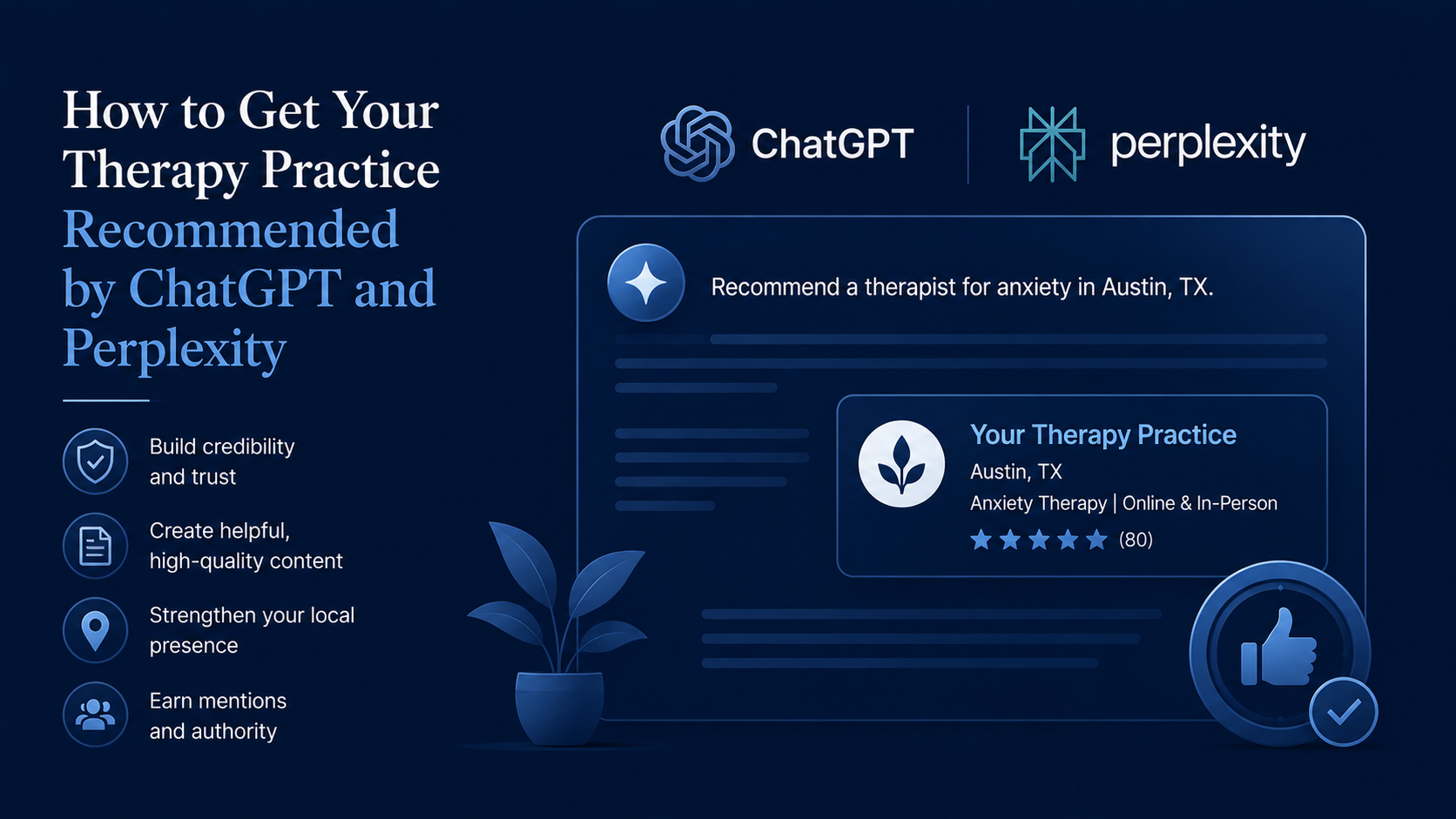
The Way Clients Find Therapists Has Changed Fast
A potential client sits with their anxiety at 11 p.m. and types into ChatGPT: “Who is a good trauma therapist near me who accepts insurance?”
They are not opening Psychology Today. They are not scrolling Google results. They are asking an AI and the AI is answering with specific recommendations, based on what it can find, verify, and trust about practices online.
This is happening at scale right now. ChatGPT reached 900 million weekly users as of early 2026. Perplexity processes millions of mental health queries every month. Google AI Overviews appear in more than half of all US searches. Across all of these platforms, a growing number of people are turning to AI to find their next therapist.
The question is simple: when someone asks one of these AI engines for a therapist in your city and your specialty, does your practice show up?
If you have not yet optimized for AI search, the answer is probably no, regardless of how skilled you are clinically, how long you have been in practice, or how strong your Psychology Today profile looks.
This guide explains exactly what to do about it.
Why AI Search Works Differently for Therapy Referrals
Before diving into tactics, it is worth understanding a core shift in how AI recommends anything.
Traditional search engines rank pages. AI search engines cite sources they trust. That distinction changes everything.
Google, Bing, ChatGPT, and Perplexity are not just looking for keyword-optimized pages. They are evaluating whether your practice is a credible, verifiable, clearly defined entity with demonstrated expertise. They pull from multiple signals across the web: your website content, your Google Business Profile, your directory listings, external mentions, review signals, and how your information is structured. They then synthesize an answer they are confident enough to recommend to a real person.
For therapists, this means your visibility in AI search is not just an SEO problem. It is a credibility, clarity, and digital authority problem. The good news is that all of those are fixable.
The Three AI Search Channels Therapists Must Win in 2026
There are now three distinct pathways through which a potential client might find your practice via AI.
Google AI Overviews appear at the top of search results for roughly 55% of US searches. When someone types “EMDR therapist in Denver,” they may see an AI-generated summary before any traditional results. If your content is structured correctly, your practice can be cited inside that summary.
ChatGPT Search (also called SearchGPT) uses Bing’s index as its primary live data source. This matters practically: if you have been ignoring Bing Webmaster Tools, you are invisible to ChatGPT’s live search layer regardless of your Google rankings. ChatGPT also draws on its training data, which means older, authoritative content from high-credibility sources can still influence what it recommends.
Perplexity AI crawls the web in real time at the moment a query is made. Fresh content, structured headers, clear topic ownership, and authoritative external mentions all influence whether Perplexity includes your practice in its citations.
These three are not interchangeable. Optimizing for one without considering the others leaves real visibility on the table.
Step 1: Make Your Practice Easy for AI to Understand
AI engines do not judge clinical skill. They judge how clearly your practice communicates who you are, who you help, where you work, and why you are credible.
Most therapy websites fail this test, not because the therapist lacks expertise, but because the website buries that information under vague copy, slow loading pages, or unstructured content that machines cannot extract reliably.
What AI needs to understand about your practice:
- Your name, credentials, and specialty
- The specific conditions and populations you work with
- Your location and service area (in-person and/or telehealth)
- Your insurance and fee structure
- External validation: reviews, directory listings, mentions, credentials
Start with your homepage and service pages. Every one should answer these questions in plain, direct language within the first 100 words of each section, not buried at the bottom. AI search engines extract early, answer-forward content. If your page opens with an atmospheric paragraph about your therapeutic philosophy before getting to who you help, you are losing AI citations to competitors who lead with specifics.
MHIS Recommendation: If your website is built on Wix or Squarespace, you are likely leaving significant AI visibility on the table due to structural limitations. WordPress gives you the technical control needed for proper schema implementation, crawlability, and content architecture. Explore MHIS website migration services
Step 2: Fix Your Technical Crawlability First
One of the most common and damaging mistakes is accidentally blocking AI crawlers from ever seeing your site. Many websites block bots by default, and this invisibility extends to GPTBot (ChatGPT’s crawler), PerplexityBot, and ClaudeBot.
Check your robots.txt file. If you see a blanket Disallow: / or if GPTBot and PerplexityBot are explicitly blocked, you are invisible to those platforms regardless of how much content you publish.
Allow these crawlers in your robots.txt:
User-agent: GPTBot
Allow: /

User-agent: PerplexityBot
Allow: /

User-agent: ClaudeBot
Allow: /
Next, make sure your site is indexed in Bing Webmaster Tools. Because ChatGPT’s live search layer uses Bing’s index, Google rankings alone do not guarantee ChatGPT visibility. Submit your sitemap to Bing and verify your property. This single step is overlooked by the vast majority of therapy practices and represents a real competitive advantage.
Step 3: Implement the Right Schema Markup
Structured data (schema markup) tells AI systems and search engines exactly what type of entity your site represents. For therapy practices, this means implementing the right JSON-LD schema on the right pages.
The most important schema types for therapists:
- LocalBusiness / MedicalBusiness schema on your homepage: includes your practice name, address, phone, hours, specialties, and service area
- Person schema on your About page: your name, credentials, biography, and professional affiliations
- FAQPage schema on pages with frequently asked questions about your services or approach
- Article schema on every blog post: includes author, publish date, and topic category
Recent data confirms that accurate, content-matched schema helps AI systems verify claims and establish entity relationships during answer synthesis. The emphasis is on accuracy. Schema that misrepresents your content can hurt rather than help. The goal is to make it easier for machines to confirm what your page already says, not to game the system with markup that does not reflect real content.
Step 4: Write Content the Way AI Extracts It
AI engines reward content that leads with the direct answer and supports it with evidence. This is structurally different from traditional SEO content, which often builds context before delivering a conclusion.
For AI search visibility, every section of your content should open with the core answer or claim, then support it. Think of it as writing for someone who will only read the first sentence of each paragraph, because AI systems often extract exactly that.
Practical formatting principles for AI-ready content:
- Use H2 and H3 headings that match the natural question a client would ask (“What is EMDR therapy?” not “Our Approach”)
- Open every section with a direct answer in plain language
- Include geographic specificity: city, neighborhood, metro area throughout your content
- Write in a conversational but authoritative tone that reflects actual clinical expertise
- Use FAQ sections on your key service pages, formatted with clear questions and direct answers
The content on your therapy blog matters here more than most therapists realize. Every detailed, well-structured article on anxiety therapy, EMDR, trauma-informed care, or couples counseling is an opportunity to be cited by Perplexity or referenced by ChatGPT when a client asks a question in that category.
MHIS maintains 500+ mental health industry articles built specifically for voice search and AI citation. Learn about MHIS content and SEO services
Step 5: Build E-E-A-T Signals Across the Web
E-E-A-T (Experience, Expertise, Authoritativeness, Trustworthiness) is the framework Google uses to evaluate whether a source is credible enough to surface in high-stakes searches like healthcare. ChatGPT evaluates sources through a similar lens.
For therapists, building E-E-A-T means more than having a credential listed on your website. It means demonstrating that expertise across multiple trusted locations online.
Named authorship on all content. Every blog post, every service page biography, and every resource on your site should carry your full name, credentials, and a bio link. Anonymous content gets deprioritized by AI systems evaluating trustworthiness.
Consistent NAP (Name, Address, Phone) across directories. Your practice information should be identical across your website, Google Business Profile, Psychology Today, TherapyDen, Healthgrades, Zocdoc, and any other directory where you appear. Inconsistencies signal low credibility to both traditional search algorithms and AI citation systems.
External mentions and citations. When other credible sites, such as medical publications, local news, professional organizations, or therapy resource sites, mention your practice or link to your content, AI systems interpret this as third-party validation. Guest articles, podcast appearances, and contributions to mental health publications all generate this signal.
Verified Google Business Profile. Your GBP is one of the primary sources AI systems pull from when answering local queries. Keep it complete, accurate, and updated, including photos, hours, service categories, and regular posts.
Client reviews. Reviews on Google, Healthgrades, and Psychology Today are public signals that AI systems can read and interpret. A practice with consistent positive reviews appears more credible than one with none, even when both have equivalent credentials listed.
Step 6: Optimize Specifically for Perplexity
Perplexity is different from ChatGPT in one important way: it crawls the web live at the moment of each query. This means new content can appear in Perplexity citations within days, not months. Freshness, specificity, and topical relevance matter enormously here.
Publish content regularly. A therapy blog that is updated monthly has a structural advantage over one that was last updated two years ago. Perplexity favors sources that are actively maintained and clearly current.
Own a specific topic area. Perplexity tends to cite sources that have comprehensive, authoritative coverage of a narrow subject. A therapist who has published ten detailed articles on trauma therapy in San Francisco will outperform a therapist with one generic services page when Perplexity answers queries about trauma therapists in that area.
Use structured headers that mirror real questions. Perplexity actively matches page headings to user queries. If your page has an H2 that reads “How long does EMDR therapy take?” and someone asks Perplexity that question, your page becomes a strong candidate for citation.
Link to primary sources. Perplexity and ChatGPT both favor content that cites research, clinical guidelines, or authoritative external references. A therapy article that references APA guidelines or peer-reviewed studies reads as more credible than one that makes unsupported claims.
Step 7: Test Whether Your Practice Is Being Recommended
The only way to know if your AI visibility efforts are working is to test them directly.
Open ChatGPT, Perplexity, and Google and ask the questions your potential clients would ask:
- “Who is a good anxiety therapist in [your city]?”
- “Find a trauma-informed therapist near [your neighborhood] who takes insurance”
- “Best EMDR therapist in [your metro area]”
- “Therapist specializing in [your specialty] in [your city]”
Document what comes back. Note which practices appear, how they are described, and what sources are cited. If your practice is not showing up, identify which signals (crawlability, schema, content, external mentions, GBP) are weakest and prioritize those.
Run this test monthly. AI search visibility shifts as content is updated, new competitors enter the market, and platforms update their retrieval systems.
The Connection Between AI Visibility and Traditional SEO
AI search optimization and traditional SEO are not competing strategies. They reinforce each other.
The signals that make your practice visible in AI answers, including authoritative content, structured data, strong E-E-A-T, consistent directory presence, and external citations, are the same signals that drive Google rankings. A well-executed SEO strategy for therapists in 2026 naturally produces AI visibility as a byproduct.
The reverse is also true: practices that shortcut traditional SEO with thin content, weak local signals, and poor site structure will find AI visibility nearly impossible to achieve, because AI engines pull from many of the same quality signals that Google uses.
This is why MHIS builds both simultaneously for the private practices we work with. Ranking on Google and appearing in ChatGPT answers are increasingly two outcomes of the same strategy.
What Therapists Should Not Do
A few approaches are tempting but counterproductive.
Do not stuff your content with AI-related keywords hoping to game systems that do not work that way. AI engines evaluate meaning, credibility, and structure, not keyword density.
Do not publish AI-generated content without substantial human review and customization. Generic AI-written content reads as low-authority to the very systems you are trying to impress. Unique clinical perspective, specific examples, and authentic voice are what differentiate your content from the hundreds of other therapist sites competing for the same citations.
Do not ignore Bing. It is the overlooked distribution channel that connects directly to ChatGPT’s live search layer. Submit your sitemap to Bing Webmaster Tools today.
Do not treat Psychology Today as your only online presence. Directory profiles are one channel, not a strategy. Practices that rely on Psychology Today alone are increasingly invisible in AI search, which cannot cite a directory listing as a primary recommendation.
A Note on HIPAA and Ethical Marketing
Optimizing for AI search does not require collecting or sharing any client data. All of the strategies in this guide involve your public-facing website, published content, directory listings, and professional credentials, none of which involve protected health information.
MHIS works exclusively with mental health professionals and understands the ethical and regulatory boundaries around practice marketing. All SEO, GEO, and content strategies we build are designed to operate within HIPAA-conscious guidelines, with no invasive tracking, no misleading claims, and full compliance with APA ethical standards for marketing.
Summary: The AI Visibility Checklist for Therapists
Technical Foundation
- Allow GPTBot, PerplexityBot, and ClaudeBot in robots.txt
- Submit sitemap to Bing Webmaster Tools
- Verify fast mobile loading speed (under 3 seconds)
- Use WordPress for maximum technical control
Content Structure
- Lead every section with the direct answer
- Use H2s and H3s that mirror real client questions
- Add FAQ sections to all key service pages
- Publish location and specialty-specific content regularly
Schema and Markup
- Implement LocalBusiness / MedicalBusiness schema on homepage
- Add Person schema to About page
- Use FAQPage schema where applicable
- Add Article schema to every blog post
Authority and Trust Signals
- Named authorship on all content with credentials
- Consistent NAP across all directories
- Completed, active Google Business Profile
- External mentions from credible healthcare and local publications
- Active Google reviews
Testing and Monitoring
- Query ChatGPT, Perplexity, and Google monthly for your specialty and location
- Track which competitors appear and what sources are cited
- Adjust content and technical signals based on what is working
Frequently Asked Questions
Can ChatGPT recommend my specific therapy practice?
Yes. When ChatGPT’s live search layer (SearchGPT) is active, it pulls from Bing’s index and can surface specific practice names, websites, and contact information in response to location-based and specialty-based queries. Practices with complete GBPs, crawlable websites, and structured content are more likely to be cited.
How long does it take to appear in Perplexity search results?
For Perplexity, structural improvements to your website, such as fixing crawler access, adding schema, and rewriting content to answer-first format, can produce results within two to six weeks in some cases, since Perplexity crawls the live web at query time. ChatGPT training data updates more slowly.
Do I need a separate strategy for Google AI Overviews versus ChatGPT?
The foundational strategies are shared: strong E-E-A-T signals, structured content, schema, and external authority. Platform-specific tactics include Bing indexing for ChatGPT and fresh content prioritization for Perplexity. Google AI Overviews also respond to FAQ schema and direct-answer content structure.
Is it HIPAA-compliant to optimize for AI search?
Yes. AI search optimization involves only public-facing content: your website, directories, Google Business Profile, and published articles. No client data is involved. MHIS builds all strategies with HIPAA-conscious standards for mental health practices.
What if my practice is not showing up in any AI search results?
Start with crawlability (check robots.txt), then Bing Webmaster Tools submission, then content structure, then schema. In most cases, practices are invisible to AI because of technical access issues or content that is not structured for machine extraction, both of which are correctable.
Does having more Google reviews help with AI search visibility?
Yes. Reviews are public signals that AI systems can read and interpret. A practice with consistent, recent positive reviews across Google and Healthgrades reads as more credible and established than one with none. They reinforce E-E-A-T signals that both Google and AI citation engines rely on.
Conclusion
The shift from traditional search to AI-powered recommendations is not coming. It is already here. ChatGPT, Perplexity, and Google AI Overviews are actively shaping which therapists potential clients find, trust, and reach out to. Practices that understand this shift and act on it now will build a significant and compounding advantage over those that do not.
The strategies in this guide are not shortcuts or hacks. They are the same principles that have always made a therapy practice discoverable online: clarity, credibility, consistent presence, and content that genuinely serves the person searching. The difference is that in 2026, the person doing the initial searching is often an AI, and the recommendations it makes carry real weight.
Getting recommended by ChatGPT or Perplexity is not about gaming a system. It is about building a practice presence that is clear enough, credible enough, and structured enough that AI engines are confident recommending you to someone who needs help.
Mental Health IT Solutions helps therapists, psychologists, and private practices build exactly that kind of presence. Every strategy we develop is built specifically for the mental health industry, combining technical SEO, content, GEO, and local search into a single growth system designed to work across both traditional and AI-powered search.