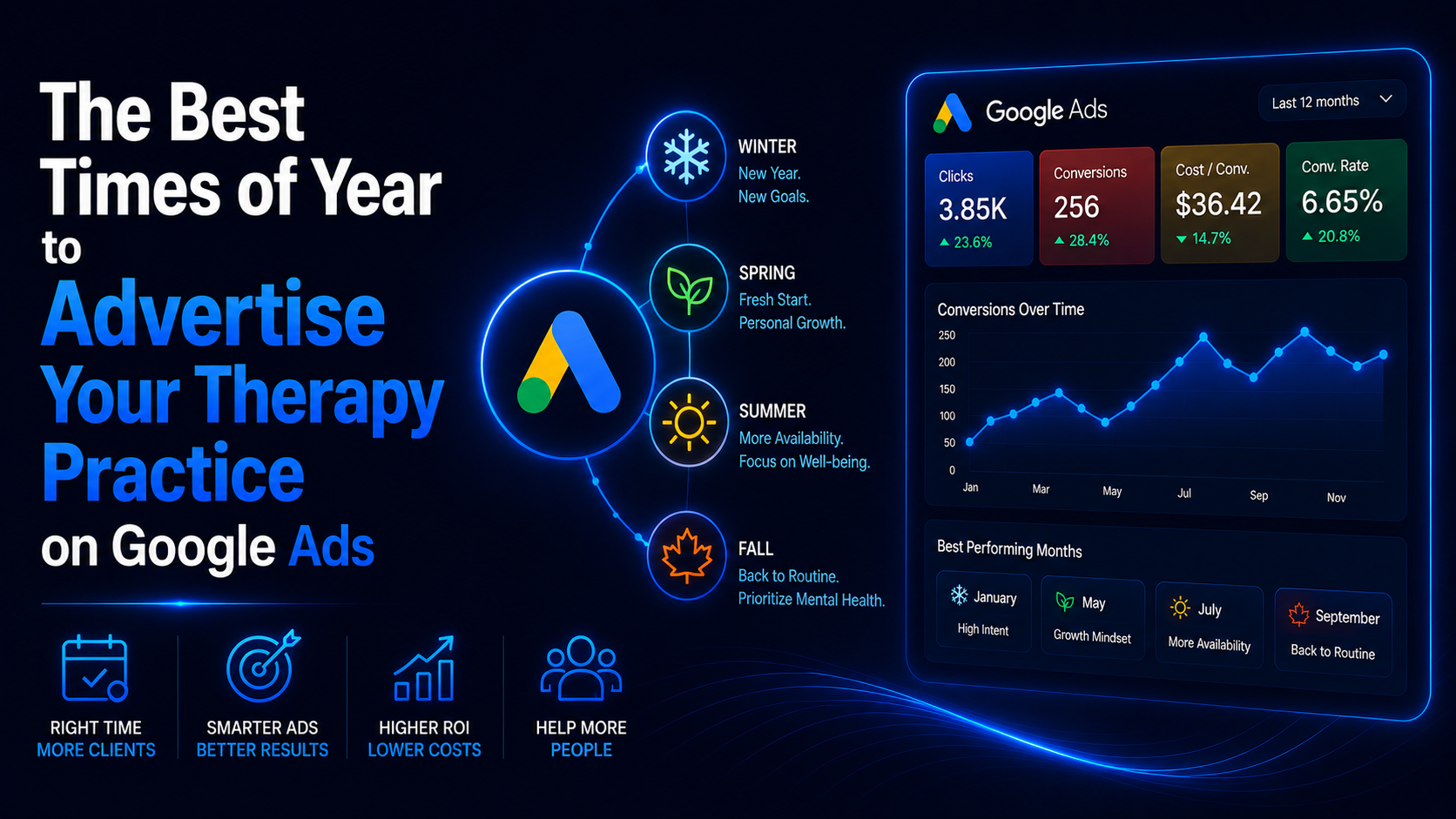
Demand for therapy is not the same in July as it is in January. People search for a therapist far more in some months than others, and a practice that understands this calendar can put its advertising budget where it does the most work. Yet almost no one explains how the seasons of mental health should shape a therapy practice’s Google Ads. The result is that practices either spend all year evenly and miss the peaks, or worse, switch their ads off during slow months and lose ground.
This guide walks through the therapy demand calendar, month by month, and shows you how to plan your ad budget around it, so you capture the surges without wasting money in the quiet stretches.
Quick answer: Demand for therapy peaks in January, with the New Year and a fresh-start mindset, and again at back-to-school in late summer, while summer is typically the slowest season. The best strategy is to run Google Ads consistently year-round, weighting more budget toward the high-demand windows and reducing, but not stopping, during slow periods.
Key Takeaways
- January is the biggest month. New Year resolutions and post-holiday reflection make it the busiest time for people seeking a therapist.
- Back-to-school is a second peak, especially for family, teen, and parenting work, as routines return in late summer and fall.
- Summer is the slowest season, with vacations and disrupted routines lowering demand, but also lower competition and cheaper clicks.
- The holidays are mixed. Emotional demand is high, but travel and holiday load slow bookings, and many people defer starting until January.
- Run consistently, weight toward peaks. Because Google Ads captures active demand, going dark loses momentum, so reduce in slow months rather than stopping.
- Match timing to your specialty and capacity. Different niches peak at different times, and you should advertise hardest when you have openings.
Want your ad budget working hardest when demand is highest? MHIS plans and manages seasonal Google Ads strategies for therapy practices. Book a free consultation with MHIS.
Why Timing Matters for Therapy Ads
Demand for therapy rises and falls with the calendar, so when you advertise affects how far your budget goes. But because Google Ads captures active demand, the goal is not to advertise only in peak season. It is to be present whenever people search, while weighting more budget toward the high-demand windows.
Research using Google search data consistently shows that interest in mental health follows seasonal patterns, generally peaking in the winter and early spring and reaching its lowest point in summer. Therapists see this in their own practices too, with the New Year bringing a rush of new clients and summer slowing down. Understanding this rhythm lets you spend strategically rather than evenly.
The key distinction from retail seasonality is that people need therapy all year, not just during a shopping season. So the smart approach is not to turn ads on and off, but to maintain a consistent presence and then increase your budget and attention during the peaks. This captures the surges while keeping you visible to the people who search in quieter months, who are often highly motivated. For the fundamentals of the channel, see our guide to Google Ads for therapists.
The Therapy Demand Calendar
Therapy demand moves through a predictable yearly cycle: a major peak in January, a second peak at back-to-school, steady demand through fall and spring, a mixed holiday season, and a summer slowdown. Knowing what each period brings lets you plan your budget in advance.
January and the New Year, the biggest peak
January is the busiest month for people seeking a therapist. The New Year brings a fresh-start mindset, resolutions to finally address long-standing concerns, and reflection prompted by the emotional intensity of the holidays. Search interest is high, and people are ready to act. This is the time to increase your budget the most. One caveat: because everyone knows January is peak season, competition and costs per click rise too, so you often need to increase your budget simply to maintain your position, not just to capture more volume.
Late winter and early spring, strong search interest
Interest in mental health tends to remain elevated through late winter and into early spring, which research using search data identifies as a peak period. Momentum from January carries forward, and demand stays healthy. Maintain a strong presence through this stretch, as it is one of the better windows of the year.
Back-to-school, the second peak
As summer ends and routines return, late August into September brings a second surge, particularly for family, teen, and parenting-focused practices. Parents regain time and structure, children are back in school, and families address concerns that went unattended over the summer. If your practice serves families, adolescents, or parents, this is a window to increase your budget alongside January.
Fall, steady to strong
Through fall, routines settle and demand stays steady to strong. As daylight shortens later in the season, seasonal patterns begin to build. This is a solid period to maintain or gradually increase your presence heading toward winter.
The winter holidays, mixed
The stretch from late November through December is the most nuanced. Emotional demand is genuinely high, driven by holiday stress, family conflict, grief, and loneliness, so many people are struggling and searching for support. At the same time, travel, holiday logistics, and the general mental load of the season disrupt schedules, so bookings and appointment attendance often dip, and many people who inquire decide to wait until the New Year to actually start. The practical takeaway is to keep advertising through the holidays, since the need is real, but to expect that some inquiries will convert into booked clients in January rather than immediately.
Summer, the slowest season
Summer, roughly June through August, is typically the slowest period for therapy. Vacations, school breaks, shifting routines, and nicer weather all pull people away from starting or maintaining therapy, and search interest reaches its yearly low. However, summer is not a reason to go dark. Competition often drops as some advertisers pull back, which can lower your cost per click, and the people who do search in summer tend to be motivated. Reduce your budget rather than eliminating it, use the lower costs to stay visible and test improvements, and capture the ready clients who are still looking.
A Seasonal Calendar at a Glance
| Period | Demand for new clients | What to do | Notes |
|---|---|---|---|
| January, New Year | Highest | Increase budget most | Fresh-start mindset; competition and costs also rise |
| Late winter to spring | Steady to strong | Maintain a strong presence | Search interest peaks in winter and early spring |
| Back-to-school, late Aug to Sept | High | Increase budget | Strong for family and teen work |
| Fall, Sept to Nov | Steady to strong | Maintain or gradually increase | Routines settle; seasonal patterns build |
| Winter holidays, late Nov to Dec | Mixed | Keep advertising, expect deferred starts | High emotional need, but travel and load slow bookings |
| Summer, June to Aug | Slowest | Reduce, do not stop | Lower competition, cheaper clicks, motivated searchers |
How to Plan Your Budget Around the Calendar
Plan your budget as a consistent baseline that you increase for the peaks and trim for the slow season. Have your campaigns and budget ready before each surge, align your spending with your capacity, and use the quiet summer months to test and capture motivated searchers cheaply.
A practical framework:
- Run a consistent baseline year-round. Never go completely dark, so you stay visible to the motivated people who search in any month and keep your account’s momentum.
- Increase budget for the peaks. Put more behind January and back-to-school, the two biggest windows, and plan for higher costs per click during peak competition.
- Prepare before the surge. Have your campaigns built and your budget allocated ahead of January and September, so you catch the wave from day one rather than scrambling once it has started.
- Trim, do not stop, in summer. Reduce your budget during the slow season, take advantage of lower competition, and use the time to test new ads and landing pages.
- Align with your capacity. Advertise hardest when you have openings you want to fill, since the calendar interacts with how many clients you can take.
For realistic budget figures to plan around, see our guide on how much therapists should spend on ads.
The Counterintuitive Part: Don’t Only Advertise in Peak Season
It is tempting to switch ads on for January and off for summer, but that is usually a mistake. Because Google Ads captures active demand, going dark in slow months costs you momentum, cedes ground to competitors, and misses the motivated people still searching. Meanwhile, peak season requires more budget just to hold your position.
Here is why on-and-off does not work well. Google Ads rewards consistency, and pausing a campaign can disrupt its performance history and the momentum that keeps your costs efficient. When you go dark, you also hand the quiet-season searchers, who are often the most motivated, straight to whatever competitor stayed live. And the people who search in summer or a slow week still need help and still convert.
At the other end, simply keeping your budget flat into January means getting outbid, because competition and costs per click climb during the peak. So you actually need to raise your budget in peak season just to maintain the same visibility, let alone capture the extra volume. The winning pattern is therefore consistent presence plus deliberate weighting: always on, spending more when demand is high and less when it is low, rather than flipping a switch.
Planning and adjusting this rhythm across the year, while keeping campaigns efficient, is exactly the kind of ongoing work that benefits from expertise. MHIS plans and manages seasonal ad strategies for therapy practices, so your budget is always aligned with demand. See how our Google Ads management for therapists works.
Seasonal Timing by Specialty
Different specialties peak at different times, so your seasonal plan should reflect the work you do. Family and teen practices lean into back-to-school, general and mood-focused practices into January and winter, and grief or seasonal work into fall and winter.
| Specialty | Peak window |
|---|---|
| General, anxiety, depression | January and winter |
| Couples counseling | January, after the holidays |
| Family, teen, parenting | Back-to-school and late summer |
| Grief, seasonal affective | Fall and winter, including the holidays |
| College students | Summer and late summer |
A few notes on using this. Family, teen, and parenting practices should treat back-to-school as a major window, sometimes rivaling January, because that is when parents re-engage with their children’s needs. Couples work often surges in January, as the strain of the holidays prompts partners to seek help in the New Year. Grief and seasonal-affective concerns rise through fall and winter, including the holiday period. And practices serving college students may find their own rhythm around academic breaks. Weighting your budget toward your specialty’s specific peak, rather than a generic calendar, sharpens your results.
Weekly and Daily Timing
Beyond the yearly calendar, there are patterns within the week and day worth knowing. Mental health searches tend to rise in the evening and at night, and often early in the week, so if your budget is constrained, ad scheduling can weight your spend toward those higher-intent times.
Research on search behavior finds that queries related to mental health increase toward the evening and night, when people have time to reflect and reach out. Many people also search around the start of the week or on Sunday evenings, as the coming week looms. If you have plenty of budget, the simplest approach is to stay present at all times, since you never want to miss a ready client. If your budget is limited, ad scheduling lets you concentrate spend on the evenings and days when your audience is most likely to search, and ideally when you are able to respond quickly. Being present when people search, and responding fast when they reach out, matters more than fine-tuning the exact hours, but these patterns can help you stretch a smaller budget.
Common Seasonal Timing Mistakes
- Going dark in slow periods, which loses momentum and hands motivated searchers to competitors.
- Not increasing budget in peak season, so you get outbid when competition and costs rise.
- Scrambling to launch campaigns after a surge has started, missing the beginning of the wave.
- Ignoring capacity, advertising hard when you have no openings, or holding back when you do.
- Treating therapy like retail seasonality, turning ads fully on and off rather than weighting a consistent baseline.
- Using a generic calendar instead of your specialty’s, missing the window that matters most for your work.
A Seasonal Ad-Planning Checklist
| Step | Action |
|---|---|
| Baseline | Run ads consistently year-round, never fully dark |
| Peaks | Increase budget for January and back-to-school |
| Preparation | Have campaigns and budget ready before each surge |
| Slow season | Reduce but keep running in summer; test and capture motivated searchers |
| Capacity | Align your spending with your current openings |
| Specialty | Weight toward your specialty’s peak window |
| Costs | Budget for higher costs per click during peak competition |
| Holidays | Keep advertising, and expect some inquiries to start in January |
Frequently Asked Questions
When is the best time of year to advertise a therapy practice?
The single best window is January, because the New Year brings a fresh-start mindset, resolutions to address long-standing concerns, and reflection prompted by the holidays, making it the busiest month for people seeking a therapist. Back-to-school in late summer is a strong second peak, especially for family and teen practices. That said, the best overall strategy is not to advertise only during these peaks. Because Google Ads captures active demand, you should run consistently year-round and weight more budget toward the high-demand windows, while reducing rather than stopping during the slow summer season. This keeps you visible to motivated searchers all year and captures the surges when they come. Timing your heaviest spending to January and back-to-school, on top of a steady baseline, gives you the best return.
Should I run Google Ads all year or only in busy seasons?
Run them all year, but adjust your budget with the seasons. It is tempting to switch ads on for January and off for the summer, but going completely dark is usually a mistake with Google Ads. Pausing campaigns can disrupt their performance momentum, and while your ads are off, the motivated people who still search in slow months go straight to competitors who stayed live. Instead, maintain a consistent baseline year-round and weight your budget toward the peaks, increasing it for January and back-to-school and trimming it in summer. This captures the high-demand surges while keeping you present for the ready clients who search in quieter periods. Consistency also helps keep your costs efficient over time. So the answer is year-round presence with seasonal weighting, not an on-and-off switch tied to busy seasons.
Why does therapy demand spike in January?
January sees the biggest surge because of the psychology of the New Year. Resolutions prompt people to finally address concerns they have been putting off, the fresh-start feeling of a new year makes change feel possible, and the emotional intensity of the holidays leaves many people reflecting on their wellbeing and relationships. Together these drive a wave of people deciding to seek therapy, so search interest and inquiries both climb. It is widely regarded as the busiest month for therapists taking on new clients. The main practical wrinkle is that because everyone recognizes January as peak season, more advertisers compete and costs per click rise, so you often need to increase your budget simply to maintain your usual position. Still, the volume of ready clients makes it the most important window of the year to advertise strongly.
Is summer a bad time to advertise therapy?
Summer is the slowest season for therapy, but it is not a bad time to advertise, and going dark is a mistake. Demand drops because vacations, school breaks, shifting routines, and nicer weather pull people away from starting or continuing therapy, and search interest reaches its yearly low. However, competition often falls too, as some advertisers pull back, which can lower your cost per click and let your budget stretch further. The people who do search in summer also tend to be motivated. The right approach is to reduce your budget rather than eliminate it, take advantage of the lower costs to stay visible and capture ready clients, and use the quieter time to test new ads and landing pages. So treat summer as a period to spend efficiently and prepare, not one to disappear entirely.
Should I increase my ad budget in January?
Yes, January is the window to increase your budget the most, for two reasons. First, demand is at its yearly high, so more budget lets you capture more of the ready clients searching for a therapist. Second, and often overlooked, competition and costs per click rise sharply in January because so many practices advertise then, which means you need to increase your budget just to hold your usual position, let alone gain more visibility. Keeping your budget flat into January effectively means losing ground, since competitors bidding more will outrank you. So plan ahead: have your campaigns ready and your increased budget allocated before January begins, so you capture the surge from the start of the month rather than scrambling once it is underway. It is the single most valuable time of year to invest more in your ads.
When should family and teen therapists advertise?
Family, teen, and parenting-focused practices should treat back-to-school, roughly late August into September, as a major advertising window, sometimes rivaling January. As summer ends and routines return, parents regain time and structure, children are back in school, and families address concerns that went unattended over the summer, so demand for family and adolescent work surges. January remains important for these practices too, but the back-to-school window is distinctly strong for them in a way it is not for every specialty. Beyond those peaks, maintain a consistent presence year-round, and note that summer tends to be especially slow for family work as children are home and routines are disrupted. Weighting your budget toward the back-to-school surge, on top of a steady baseline, aligns your spending with when families are most actively seeking help.
Do therapy ad costs change by season?
Yes. Costs per click tend to rise during peak demand periods, especially January, because more practices are advertising and competing for the same searches, which pushes up auction prices. This is why you often need to increase your budget in January simply to maintain your position. Conversely, during the slow summer season, competition frequently eases as some advertisers reduce or pause their spending, which can lower your cost per click and let your budget go further. This seasonal cost pattern is one reason the on-and-off approach backfires: pulling out of peak season to avoid higher costs means missing the highest-demand window, while going dark in summer wastes the cheaper clicks available then. Planning your budget with these cost swings in mind, spending more in peak season and taking advantage of cheaper summer clicks, helps you get the most from your advertising year-round.
Should I advertise during the holidays?
Yes, keep advertising through the holidays, but with realistic expectations. Emotional demand is genuinely high during this period, driven by holiday stress, family conflict, grief, and loneliness, so many people are struggling and searching for support. At the same time, travel, holiday logistics, and the mental load of the season disrupt schedules, so bookings and appointment attendance often dip, and many people who inquire choose to wait until the New Year to actually begin therapy. So while you should stay visible to meet the real need, expect that some holiday-season inquiries will convert into booked clients in January rather than immediately. Think of late-year advertising as partly planting seeds for the January surge. Maintaining your presence through the holidays ensures you capture both the people ready now and the ones who will start once the season settles.
How far ahead should I plan my seasonal campaigns?
Plan at least several weeks ahead of each major surge, so your campaigns and budget are fully ready before demand climbs. For January, that means having everything in place in December, or earlier, so you capture the wave from the first days of the month rather than scrambling once it has begun. For back-to-school, prepare in the weeks before late August. The reason timing matters so much is that the peaks arrive quickly and competition ramps up fast, so a practice still building its campaigns in early January has already missed part of the most valuable window of the year. Planning ahead also lets you allocate your increased budget deliberately and ensure your landing pages and tracking are ready. A little advance preparation before each surge makes a large difference in how much of the peak demand you actually capture.
Does the best time to advertise depend on my specialty?
Yes, significantly. While January is a strong window for nearly every practice, different specialties have their own peak periods. Family, teen, and parenting practices see a major surge at back-to-school in late summer and fall, as parents re-engage with their children’s needs. Couples work often peaks in January, when the strain of the holidays prompts partners to seek help. Grief and seasonal-affective concerns rise through fall and winter, including the holidays. Practices serving college students may find their rhythm around academic breaks. So rather than following a generic calendar, weight your budget toward the window that matters most for your specific work. Aligning your heaviest advertising with your specialty’s true peak, on top of a consistent year-round baseline, sharpens your results and ensures you are spending most when your particular clients are most actively searching.
What days and times should therapy ads run?
If your budget allows, run your ads at all times, since you never want to miss a ready client, and being present when someone searches matters more than fine-tuning hours. That said, there are patterns worth knowing if your budget is limited. Research on search behavior shows that mental health searches tend to rise in the evening and at night, when people have time to reflect and reach out, and many people search around the start of the week or on Sunday evenings. So if you need to concentrate a smaller budget, ad scheduling lets you weight your spend toward evenings and the early week, ideally times when you can also respond quickly to inquiries. For most practices with adequate budget, staying consistently present and responding fast to inquiries is more important than optimizing exact hours, but these patterns can help stretch a constrained budget.
Should I hire someone to manage my seasonal ad strategy?
It depends on your time and comfort with ongoing management. The seasonal principles here are straightforward to understand, and a hands-on therapist can adjust their own budget through the year. The challenge is execution: preparing campaigns before each surge, adjusting budgets up and down with demand, managing the higher costs of peak season, and keeping the account efficient throughout, all while running a practice. Because timing errors, like missing the January window or going dark in summer, directly cost you clients, professional management often pays for itself by ensuring your budget is always aligned with demand. A specialist who understands both Google Ads and the seasonal rhythms of therapy can plan and adjust your strategy so you capture every peak. If you have the time and interest, you can manage the seasonal plan yourself, but many practices find that expert handling of the year-round rhythm delivers better, more consistent results.
Final Key Takeaways
- January is the biggest window for new clients, driven by the New Year mindset, and worth your heaviest budget.
- Back-to-school is a second peak, especially for family and teen practices.
- Summer is slowest but offers cheaper clicks, so reduce rather than stop.
- The holidays bring high emotional demand but slower bookings, with many starts deferred to January.
- Run a consistent baseline and weight budget toward the peaks, rather than switching ads on and off.
Action Checklist
- Set a consistent year-round advertising baseline.
- Increase your budget for January and back-to-school.
- Prepare campaigns and budget before each surge, not after.
- Reduce but keep running through summer, and test during the quiet.
- Weight your budget toward your specialty’s peak window.
- Align your spending with your current openings.
- Budget for higher costs per click during peak competition.
- Keep advertising through the holidays, expecting some starts in January.
Conclusion
Therapy has a rhythm, and your advertising should move with it. Demand surges in January as people resolve to seek help, rises again at back-to-school, stays steady through fall and spring, runs high but complicated through the holidays, and quiets in summer. The practices that get the most from their budgets do not chase these swings with an on-and-off switch. They maintain a consistent presence and weight their spending toward the peaks, preparing before each surge, spending more when demand and competition climb, and trimming rather than disappearing when things slow down. Align that rhythm with your specialty and your capacity, and your ad budget will always be working where it matters most, capturing ready clients throughout the year rather than only during the busy months.
If planning and adjusting your advertising with the seasons is not how you want to spend your time, a therapy-focused marketing partner can keep your budget aligned with demand all year.
Want your ad budget aligned with demand every month of the year? MHIS will build your seasonal strategy, prepare your campaigns for each surge, and manage them across Google Ads and beyond. Book your free consultation with MHIS today.