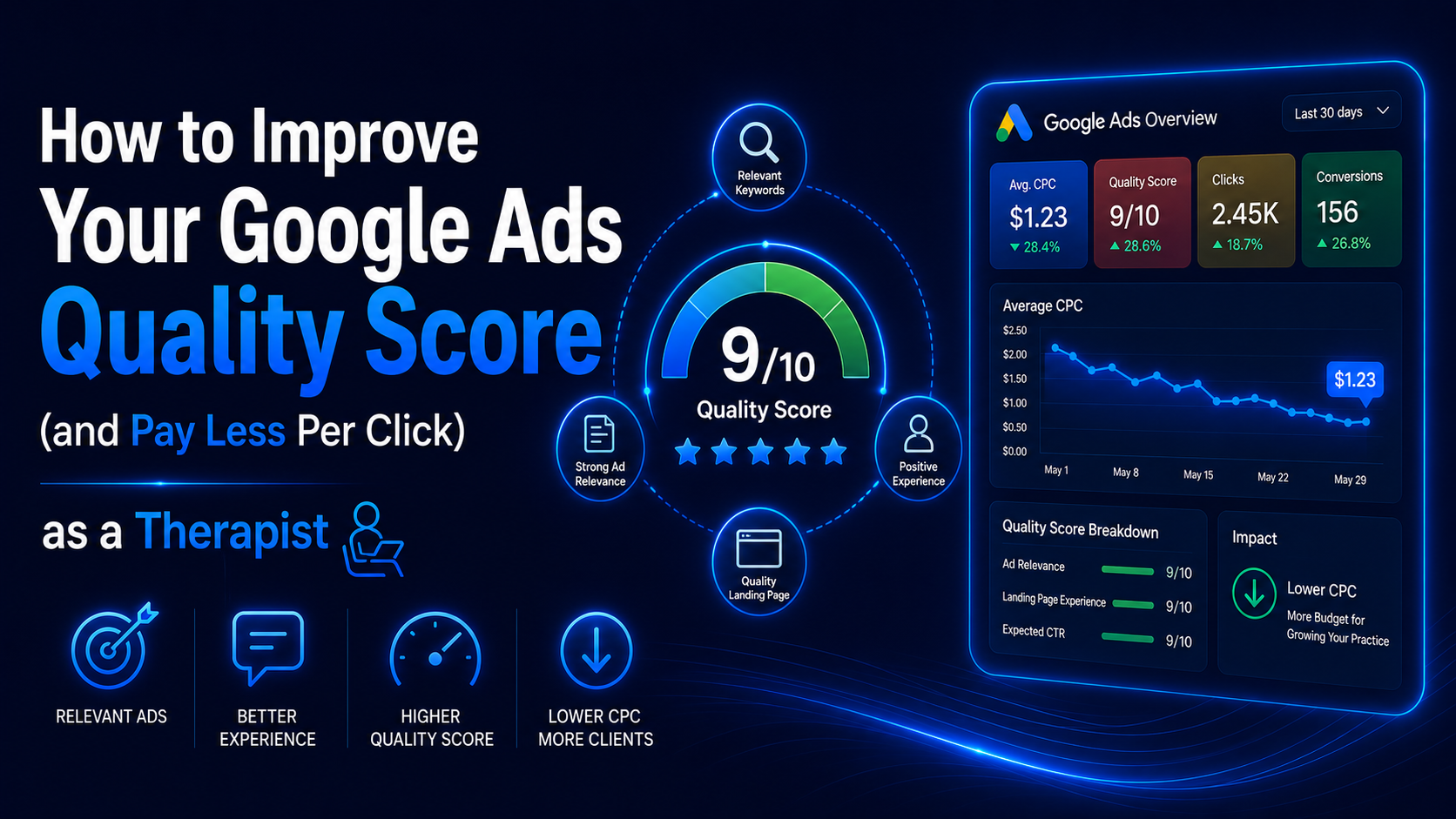
Two therapists can bid the exact same amount on the exact same keyword and pay very different prices per click. One pays $4, the other pays $9, for the same position. The difference is Quality Score, Google’s rating of how relevant and useful your ads are. It is one of the few levers that directly lowers what you pay, yet it gets mentioned constantly and explained rarely, especially for a therapy practice working under strict advertising rules.
This guide explains what Quality Score is, how to check it, and exactly how to improve each part of it, so you pay less per click and get more clients from the same budget.
Quick answer: Quality Score is Google’s 1-to-10 rating of your keyword’s expected click-through rate, ad relevance, and landing page experience. A higher score lowers your cost per click and improves your position, so you get more clients for the same budget. You improve it by tightly aligning your keywords, your ad copy, and your landing pages.
Key Takeaways
- Quality Score directly affects what you pay. A higher score lowers your cost per click for the same position, so you get more clicks per dollar.
- It has three parts: expected click-through rate, ad relevance, and landing page experience, each rated below average, average, or above average.
- Alignment is the secret. When your keyword, ad, and landing page all speak to the same thing, your score rises.
- Tight ad group structure is the backbone. Group closely related keywords so your ads can match them precisely.
- Your landing page matters as much as your ad. Sending traffic to a homepage instead of a matched page drags your score down.
- Therapists can score high while staying compliant by earning relevance through specific, service-focused copy and tight structure, not condition-implying headlines.
Paying more per click than you should? MHIS restructures therapy ad accounts to raise Quality Score and lower cost per click. Book a free consultation with MHIS.
What Is Quality Score, and Why It Matters for Therapists
Quality Score is a 1-to-10 rating Google assigns to each of your keywords, based on how relevant your ad and landing page are to what the person searched. It feeds into your Ad Rank, so a higher score lets you achieve a better position at a lower cost per click. For therapists, whose keywords are expensive, that discount adds up quickly.
Here is the mechanic in plain terms. When someone searches, Google runs an auction that combines your bid with the quality of your ad to decide your position and your actual cost per click. Because quality is part of the equation, a high Quality Score means you can outrank a competitor who bids more, and you pay less for the same spot. A low Quality Score works the other way: you pay a premium on every click, or you do not show at all.
This matters more for therapy than for many industries for two reasons. First, therapy keywords are costly, often $3 to $15 or more per click, so a Quality Score discount saves real money. Second, health is a sensitive advertising category with strict copy rules, which makes earning relevance a bit more work, and therefore more valuable to get right. For the fundamentals of the channel, see our guide to Google Ads for therapists.
The Three Components of Quality Score
Quality Score is built from three components, each of which Google rates as below average, average, or above average: expected click-through rate, ad relevance, and landing page experience. Diagnosing which one is weak is the first step to improving your score.
| Component | What it measures | How you improve it |
|---|---|---|
| Expected click-through rate | How likely people are to click your ad for that keyword | Specific, compelling copy, the keyword in your headline, and ad assets |
| Ad relevance | How closely your ad matches the intent behind the keyword | Tight, single-theme ad groups with the keyword theme in the ad |
| Landing page experience | How relevant, useful, and fast your landing page is | Message-matched pages that are fast and mobile-first |
The important insight is that these three are connected. They all measure some form of relevance, from the keyword to the ad to the page. When you tighten the alignment between them, all three components improve together, which is why the structural approach later in this guide is so effective. When they are misaligned, for example a broad ad shown for a specific search, or a homepage used for a targeted ad, one or more components drop and your score falls.
How to Check Your Quality Score
You can see your Quality Score and its three components directly in Google Ads. Add the Quality Score column and the three component columns to your keyword view, then look for any component rated below average, which tells you exactly where to focus.
To check it:
- In your Google Ads account, go to the keywords view.
- Add columns for Quality Score, plus Expected CTR, Ad Relevance, and Landing Page Experience.
- Each keyword will show a score from 1 to 10, and each component will show below average, average, or above average.
This is the most useful diagnostic in the account, because it tells you not just that a keyword is underperforming, but why. If ad relevance is below average, your ad does not match the keyword closely enough. If landing page experience is below average, the page is the problem. If expected click-through rate is below average, your ad is not compelling enough to earn clicks. Fixing the specific weak component is far more efficient than guessing, so always start by reading these columns.
How to Improve Expected Click-Through Rate
Expected click-through rate reflects how likely people are to click your ad for a given keyword. Improve it by writing specific, compelling copy that includes the keyword theme and your location, using every ad asset available, and giving a clear reason to click, all while staying within the rules for health ads.
Practical tactics:
- Include the keyword theme and location in your headline. An ad for “trauma therapy in Denver” should say that, so it matches the search visually and by intent.
- Write specific, benefit-led copy. Name your specialty, your credentials, and a clear next step, rather than generic phrases like “professional counseling services.”
- Use all your ad assets. Sitelinks, callouts, call buttons, and location assets take up more space and give more reasons to click, which lifts click-through rate.
- Give a strong, clear call to action, such as “Book a Free Consultation.”
- Test multiple headlines. Responsive search ads let Google test combinations, so provide several strong options and let the best perform.
Because you cannot use condition-implying headlines, your edge comes from specificity and completeness: a precise, well-structured ad with full assets that speaks directly to the search will earn clicks without breaking any rules.
How to Improve Ad Relevance
Ad relevance measures how closely your ad matches the intent behind the keyword. The most effective way to improve it is tight ad group structure: group closely related keywords into single-theme ad groups so your ad can speak directly to them, and include that theme in the ad itself.
The core move here is structural. If you dump many loosely related keywords, say trauma therapy, couples counseling, and teen therapy, into one ad group, no single ad can be relevant to all of them, so ad relevance suffers across the board. Instead, create tightly themed ad groups where every keyword shares an intent, then write an ad that reflects that exact theme.
Supporting tactics:
- One theme per ad group, so the ad matches every keyword in it.
- Include the keyword theme in the ad headline, reinforcing the match.
- Match search intent, making sure the ad answers what the searcher actually wants.
- Use tighter match types and negative keywords, so your ad only shows for genuinely relevant searches, which keeps relevance high.
This tight structure is the single most impactful change most therapy accounts can make for Quality Score, and it also improves your click-through rate and landing page alignment at the same time. Our step-by-step guide on how to create a Google Ads campaign for a therapy practice covers building well-structured ad groups.
How to Improve Landing Page Experience
Landing page experience measures how relevant, useful, and fast your landing page is for the person who clicked. Improve it by sending each ad to a matched, relevant page rather than your homepage, and by making that page fast, mobile-first, and easy to act on.
This is where many therapy accounts quietly lose Quality Score, because they send all traffic to a general homepage. Google evaluates whether the page delivers what the ad promised, so a mismatch or a poor page drags the whole keyword’s score down.
To strengthen it:
- Match the page to the ad. A couples-counseling ad should land on a couples-counseling page, not a general homepage, so the content reflects the search.
- Make the page fast. Slow load times, especially on mobile, hurt both your score and your conversions.
- Ensure it is mobile-first. Most therapy searches happen on phones, so the page must work cleanly there.
- Provide relevant, useful content that matches the ad’s promise, with a clear call to action.
- Include trust signals and transparency, such as your credentials, clear contact information, and a privacy policy, and keep the page secure.
- Avoid intrusive pop-ups that make the content hard to reach.
Because landing page experience is one full third of your Quality Score, improving your pages often produces the biggest gains, and it lifts your conversion rate at the same time.
Aligning keywords, ads, and pages into a high-scoring structure is detailed work, and it directly lowers what you pay. MHIS restructures and manages therapy ad accounts to raise Quality Score and cut cost per click. See how our Google Ads management for therapists works.
The Structural Key: Align Keywords, Ads, and Pages
The secret to a high Quality Score is alignment. When your keyword, your ad, and your landing page all speak to the same specific thing, every component of your score rises together. The way to build that alignment is a tightly themed account structure, usually organized by specialty.
Think of it as a chain: a tightly themed ad group of related keywords, an ad written specifically for that theme, and a landing page dedicated to it. When the chain is intact, someone searching “online trauma therapy” sees a trauma therapy ad and lands on a trauma therapy page, and Google rewards that relevance across all three components. When the chain breaks anywhere, a broad ad group, a generic ad, or a homepage destination, the score drops.
For a therapy practice, this usually means structuring your account by specialty, with a themed ad group, matched ad, and dedicated landing page for each service you offer. This is the same structural discipline that helps couples campaigns and group practices perform, and it is the foundation that makes every other Quality Score tactic work. Get the structure right, and high scores and lower costs follow naturally.
What a Higher Quality Score Actually Saves You
A higher Quality Score lowers your cost per click for the same position, improves your ad rank, and earns you more impressions for the same budget. In a category where clicks are expensive, that means meaningfully more clients from the same spend.
The savings are real and compounding. Because Quality Score is part of the auction, improving it can reduce your cost per click for the same position, sometimes substantially. That has two effects: each click costs less, and your budget therefore buys more clicks, which means more inquiries and more clients without spending an additional dollar. A better score also improves your ad rank, so you appear more often and in better positions, further increasing your visibility.
Put simply, Quality Score is one of the few ways to lower your advertising costs without lowering your bids or your presence. For an expensive category like therapy, the difference between a poor score and a strong one can be the difference between ads that barely break even and ads that comfortably pay off. It is one of the highest-return areas to work on, because the gains apply to every click you buy.
Compliance and Quality Score for Therapists
Health advertising rules do not prevent a high Quality Score; they just change how you earn it. Because you cannot imply the client’s condition in your copy, you build relevance through specific, service-focused messaging, tight structure, and full ad assets, while keeping your landing pages and tracking free of protected information.
The tension some therapists feel is that condition-based headlines, like “Struggling with depression?”, might earn more clicks but are not allowed. The good news is that you do not need them. A precise, well-structured ad that names your specialty and location, backed by strong assets and a matched landing page, earns strong relevance and click-through rate while staying fully compliant. In fact, the tight, specialty-based structure that keeps you compliant and organized is exactly what drives a high Quality Score. Keep your landing pages fast and useful, your tracking free of protected information, and your copy neutral and specific, and you can score well without ever crossing a rule. This is educational, not legal advice, so confirm your setup with a compliance professional.
Common Mistakes That Hurt Therapists’ Quality Score
- Broad, mixed ad groups with many unrelated keywords, which make ads impossible to keep relevant.
- Sending all traffic to the homepage instead of matched, specialty-specific pages.
- A slow or non-mobile landing page, which drags down landing page experience.
- Generic ad copy that does not reflect the keyword or give a reason to click.
- No negative keywords, so ads show for irrelevant searches and click-through rate suffers.
- Ignoring the component columns, so you cannot see which part of the score is weak.
- Condition-implying copy that gets disapproved, which is a separate but related problem.
Quality Score Improvement Checklist
| Area | Action |
|---|---|
| Ad group structure | Group closely related keywords into single-theme ad groups |
| Ad copy | Write specific, compliant copy with the keyword theme and location |
| Ad assets | Add sitelinks, callouts, call, and location assets |
| Keywords | Use tighter match types and strong negative keywords |
| Landing page | Send each ad to a matched, relevant page, not the homepage |
| Page performance | Make the page fast and mobile-first |
| Monitoring | Add the component columns and fix whatever is below average |
Frequently Asked Questions
What is a good Quality Score for therapy Google Ads?
Quality Score runs from 1 to 10, and generally, 7 or above is considered good, while 8 to 10 is strong. Scores of 5 to 6 are average and have room to improve, and anything at 4 or below signals a real problem you should address, because it means you are paying a premium on those keywords. That said, the exact number matters less than the trend and the components. A keyword sitting at 5 with a below-average landing page experience tells you precisely what to fix, and moving it to a 7 or 8 will lower your cost per click. Rather than chasing a specific target across every keyword, focus on identifying below-average components and improving them. In an expensive category like therapy, even modest score improvements produce meaningful savings, so steady progress matters more than hitting a perfect number.
How does Quality Score affect my cost per click?
Quality Score is part of the auction that determines your ad position and your actual cost per click, so it directly affects what you pay. Because Google factors quality into the equation alongside your bid, a higher Quality Score lets you achieve a given position at a lower cost per click, and it can even let you outrank competitors who bid more. A low Quality Score does the opposite, effectively charging you a premium on every click, or keeping your ads from showing. This means Quality Score is one of the few levers that lowers your costs without lowering your bid or your visibility. For therapy, where clicks are expensive, the difference between a weak and a strong score can substantially change your cost per click, and therefore how many clients your budget produces.
What are the three parts of Quality Score?
Quality Score is built from three components. The first is expected click-through rate, which estimates how likely people are to click your ad when they search that keyword. The second is ad relevance, which measures how closely your ad matches the intent behind the keyword. The third is landing page experience, which assesses how relevant, useful, fast, and easy to use your landing page is for the person who clicks. Google rates each component as below average, average, or above average, and you can see these ratings in your keyword view. The three are connected, since all measure a form of relevance, so aligning your keyword, ad, and landing page improves all three together. Diagnosing which component is below average is the fastest way to know what to fix to raise your score and lower your costs.
How do I check my Quality Score in Google Ads?
You check it in the keywords view of your Google Ads account. Add the Quality Score column, along with columns for Expected CTR, Ad Relevance, and Landing Page Experience. Each keyword will then show a score from 1 to 10, plus a rating of below average, average, or above average for each of the three components. This is the most useful diagnostic in the account, because the component ratings tell you exactly where a keyword is weak. If ad relevance is below average, your ad does not match the keyword closely enough; if landing page experience is below average, the page is the issue; if expected click-through rate is below average, your ad is not compelling enough. Reading these columns before making changes lets you fix the right thing rather than guessing, which is far more efficient.
Why is my Quality Score low?
A low Quality Score usually traces to one of the three components being weak, so the first step is to check the component columns. The most common causes for therapy accounts are broad ad groups mixing unrelated keywords, which hurts ad relevance because no single ad can match them all; sending traffic to a generic homepage instead of a matched page, which hurts landing page experience; and generic ad copy that does not reflect the keyword, which hurts click-through rate. A slow or non-mobile landing page also drags down the score, as does a lack of negative keywords that lets ads show for irrelevant searches. Identify which component is below average, then address that specific issue. In most cases, tightening your ad group structure and matching your landing pages to your ads resolves the bulk of a low score.
How do I improve ad relevance as a therapist?
The most effective way is tight ad group structure. Group closely related keywords that share an intent into single-theme ad groups, and write an ad that speaks directly to that theme, including the theme in the headline. If you lump trauma therapy, couples counseling, and teen therapy into one ad group, no ad can be relevant to all of them, so relevance suffers. Instead, create a separate, tightly themed ad group for each, so the ad matches every keyword in it. Support this by matching search intent, using tighter match types, and adding negative keywords so your ads only appear for genuinely relevant searches. For a therapy practice, structuring by specialty naturally produces this alignment. Tight structure is the single most impactful change most accounts can make for ad relevance, and it lifts the other Quality Score components at the same time.
Does my landing page affect my Quality Score?
Yes, significantly. Landing page experience is one of the three components of Quality Score, so your page directly affects the score and therefore your costs. Google evaluates whether the page is relevant to the ad and the keyword, whether it loads quickly, whether it works well on mobile, and whether it is useful and easy to navigate. Sending traffic to a generic homepage rather than a page matched to the ad is one of the most common ways therapy accounts lose Quality Score, because the content does not reflect what the person searched. Improving your landing pages, matching them to your ads, making them fast and mobile-first, and giving them clear, relevant content, often produces the biggest Quality Score gains. It also improves your conversion rate at the same time, so it benefits your results twice over.
Can compliant therapy ad copy still get a high Quality Score?
Yes, absolutely. Health advertising rules change how you earn relevance, but they do not prevent a high Quality Score. You cannot use condition-implying headlines like “Struggling with anxiety?”, but you do not need them. A specific, well-structured ad that names your specialty and location, uses strong ad assets, and points to a matched landing page earns strong ad relevance and click-through rate while staying fully compliant. In fact, the tight, specialty-based account structure that keeps therapy ads compliant and organized is exactly what drives a high Quality Score. So there is no trade-off between compliance and a strong score. Build a clear, specific, well-aligned account, keep your landing pages fast and your tracking free of protected information, and you can score well within all the rules that apply to a therapy practice.
How much can improving Quality Score save me?
The savings can be substantial, because Quality Score directly affects your cost per click. Since a higher score lets you achieve the same position at a lower cost per click, improving weak keywords can meaningfully reduce what you pay per click, which in turn stretches your budget to buy more clicks, more inquiries, and more clients without spending more. The exact savings depend on how much room your account has to improve and how competitive your keywords are, but in an expensive category like therapy, the difference between a poor score and a strong one can change your effective costs considerably. Because the gains apply to every click you buy, Quality Score is one of the highest-return areas to work on. Rather than a fixed percentage, expect that fixing below-average components across your keywords compounds into real, ongoing savings.
Does bidding higher improve Quality Score?
No. Quality Score is based on relevance and user experience, specifically your expected click-through rate, ad relevance, and landing page experience, not on how much you bid. Raising your bid can improve your ad position, but it does not improve your Quality Score, and it means paying more per click rather than less. The way to lower your costs is the opposite: improve your Quality Score so you can achieve a good position at a lower bid. This is a common misunderstanding, and it leads practices to overspend by simply bidding up rather than fixing the underlying relevance issues. Focus your effort on tightening your ad group structure, writing specific and compliant copy, and matching your landing pages to your ads. Those improvements raise your score and lower your cost per click, which is a far better use of budget than bidding higher.
How long does it take to improve Quality Score?
It varies, but you can often see improvement within a few weeks of making changes, since Quality Score updates as Google gathers new performance data. Structural changes, like tightening ad groups and matching landing pages to ads, take effect as your ads accumulate impressions and clicks under the new setup, so the score reflects the improvement over time rather than instantly. Landing page changes may show up somewhat faster once Google re-evaluates the page. The key is to make the right changes based on your component diagnostics, then give the account time to gather data before judging the result. Quality Score is not a set-and-forget metric; it responds to ongoing optimization, so treat improving it as a continuous process. Practices that regularly review their component columns and refine their structure tend to see their scores climb and their costs fall steadily.
Should I hire someone to improve my Quality Score?
It depends on your time and comfort with account structure. The principles are learnable, and a motivated therapist can improve Quality Score by tightening ad groups, writing better copy, and matching landing pages to ads. That said, doing it well involves restructuring the account, building matched landing pages, and continuously diagnosing and fixing weak components, which takes time and experience. Because Quality Score directly lowers your costs, the savings from expert optimization often exceed the cost of help, especially in an expensive category like therapy. A specialist who understands both Google Ads structure and the compliance constraints of therapy advertising can raise your scores and cut your cost per click efficiently. If you have the time and interest, improving it yourself is realistic, but given the direct impact on what you pay, many practices find professional optimization pays for itself.
Final Key Takeaways
- Quality Score directly lowers your cost per click for the same position, making it one of the best ways to reduce ad costs.
- It has three components, and diagnosing which is below average tells you exactly what to fix.
- Alignment between your keyword, ad, and landing page is what raises all three components together.
- Tight, specialty-based ad group structure is the backbone of a high score.
- Compliant therapy copy can score well, because relevance comes from specificity and structure, not condition-implying headlines.
Action Checklist
- Add the Quality Score and component columns to your keyword view.
- Identify which component is below average for weak keywords.
- Group closely related keywords into tight, single-theme ad groups.
- Write specific, compliant ad copy with the keyword theme and location.
- Add all relevant ad assets.
- Match each ad to a relevant, fast, mobile-first landing page.
- Add negative keywords to keep impressions relevant.
- Monitor scores over time and keep refining.
Conclusion
Quality Score is one of the few tools that lowers what you pay without lowering your bids or your presence, which makes it especially valuable in a category as expensive as therapy. The path to a higher score is not complicated, but it is specific: understand the three components, check which one is weak, and fix it, with the whole effort anchored in aligning your keywords, ads, and landing pages through tight, specialty-based structure. Do that, and Google rewards you with lower costs per click and better positions, so the same budget produces more inquiries and more clients. Best of all, you can earn a strong score entirely within the rules that govern therapy advertising, because relevance comes from being specific and organized, not from crossing any lines.
If restructuring your account to raise Quality Score and cut costs is not how you want to spend your time, a therapy-focused marketing partner can do it for you.
Want to pay less per click and get more from your ad budget? MHIS will audit your Quality Scores, restructure your account, and match your landing pages to your ads, across Google Ads and beyond. Book your free consultation with MHIS today.