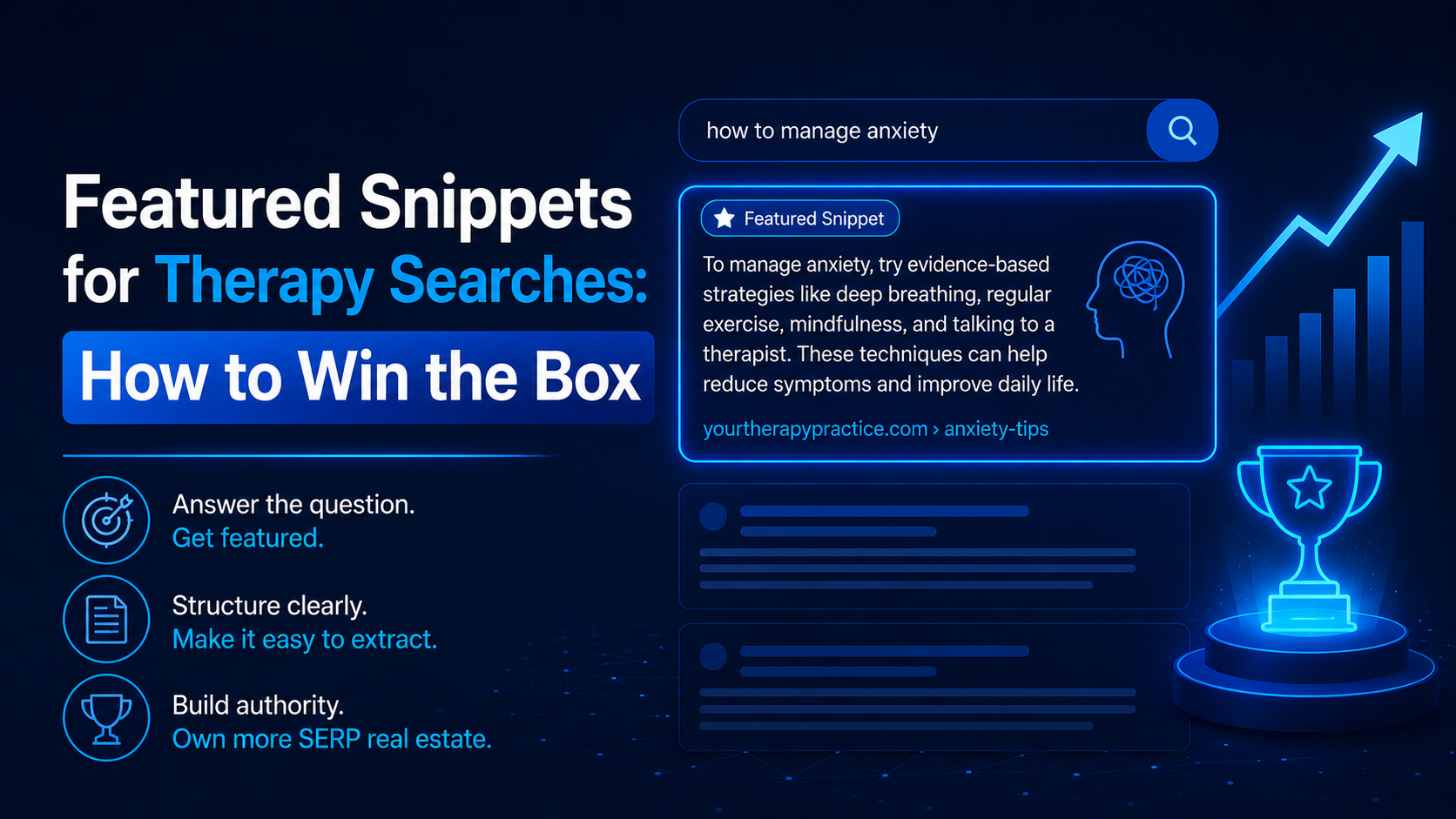
Winning a featured snippet for a therapy search means structuring your content so Google can lift a direct, self-contained answer straight out of your page and display it above the standard results, in position zero. The same structure that wins a featured snippet is what gets pulled into Google’s AI Overviews, cited by tools like ChatGPT and Perplexity, and read aloud in a voice search result. One well-built answer block now competes for four different placements at once.
This matters because position zero and its AI equivalents capture attention before a searcher ever scrolls to the standard results, including yours. For a therapy practice competing against directories with far more domain authority, a featured snippet or an AI citation is one of the few places where a smaller, well-structured site can outperform a much bigger one, because extraction rewards structure and clarity, not size.
This guide explains how featured snippets work, the specific content formats Google extracts most often, and exactly how to structure a therapy page to win one. It is written for practice owners and the people who manage their marketing, not for therapy clients.
In short: answer the exact question in the first 40 to 60 words after the heading, use the format Google already extracts for that query type (a short paragraph, a numbered list, or a table), and make every answer self-contained so it can be lifted out of context and still make sense. Structure earns the placement; length does not.
The mechanics are well documented. Google pulls the large majority of featured snippets from pages already ranking in the top ten results, and it favors content where the answer sits close to the matching heading rather than buried mid-paragraph. AI Overviews and chat-based AI answers follow a closely related pattern, extracting concise, clearly labeled answers from pages with strong topical relevance, which means one snippet-ready section can serve both purposes at once.
What is a featured snippet, and why does it matter for therapy searches?
A featured snippet is the highlighted answer box that appears above Google’s normal search results for many informational queries, pulled directly from a page’s content along with a link back to the source. It is often called position zero because it appears above the first organic ranking.
For therapy searches, snippets show up constantly on question-style queries: what a modality is, how long therapy typically takes, whether insurance covers a service, the difference between two approaches. A practice that wins these snippets gets visibility and a click before any competitor’s standard listing is even seen, which is a meaningful edge in a niche where trust and first impression matter as much as ranking position.
What types of therapy queries trigger featured snippets?
Snippets appear most reliably for four query patterns, each pulling a different content format.
| Query pattern | Example | Snippet format Google usually pulls |
|---|---|---|
| Definition question | what is EMDR therapy | Short paragraph |
| Process or steps | how does CBT treat OCD | Numbered list |
| Comparison | CBT versus DBT | Table |
| Yes or no with nuance | does insurance cover therapy | Short paragraph, sometimes with a list |
Matching your content structure to the expected format for a given query type is the single highest-leverage move in this guide. A comparison query rarely earns a snippet from a plain paragraph; a process query rarely earns one from an unstructured block of text.
How do you structure a page to win a featured snippet?
Start with the heading. Phrase it as the exact question a searcher would type, using a question-style H2 or H3, since Google matches headings to queries closely. Directly beneath that heading, answer the question in 40 to 60 words, stated plainly and completely, before adding any additional context or nuance.
The answer has to stand on its own. If a sentence relies on something explained three paragraphs earlier to make sense, it cannot be lifted out and used as a snippet. Write each answer block as though it will be read in complete isolation, because for the person seeing it in the snippet box, it will be.
Structuring existing content into snippet-ready, AI-citable sections is part of what our mental health SEO services team does when auditing a practice’s site.
How do you format lists and tables for extraction?
For process or steps queries, use a true numbered list, with each step as a short, complete sentence rather than a sprawling paragraph broken by numbers. Google extracts ordered lists cleanly when each item is genuinely one discrete step, not when a paragraph has simply been chopped into pieces.
For comparison queries, build an actual markdown or HTML table with clear column headers, not a comparison described in prose. A table is the format most reliably pulled for “X versus Y” queries, and it is also the format both Google’s AI Overviews and chat-based AI tools extract most consistently, because a table’s rows are already self-contained units of information.
How does this connect to voice search and AI answers?
Voice assistants read the featured snippet aloud for many spoken queries, which means winning the snippet also wins the voice answer. AI Overviews and conversational AI tools work on a related principle: they retrieve and synthesize short, clearly structured answers from pages that demonstrate topical authority, often the same pages that already hold a featured snippet or rank near the top for that query.
This is why the work described in SEO for therapists and the extraction-focused structure in this guide are not separate strategies. A page built to win a featured snippet is, by design, also built to be cited by an AI system, because both reward the same thing: a clear, direct, self-contained answer near the top of well-organized content.
What content already ranks well but is not winning snippets?
The most common missed opportunity is a page that already ranks in the top ten for a question-style query but buries the answer deep in the article instead of stating it plainly near the matching heading. If a page already ranks well, restructuring the opening of the relevant section is often enough to capture the snippet without any new content.
Audit your top-ranking pages for question-style queries first. Check whether the heading matches the query closely, whether the answer appears within the first sentence or two beneath it, and whether the format matches what the query calls for. Small structural fixes on already-ranking content are usually faster than building new pages from scratch.
What mistakes cost a practice the featured snippet?
The most common mistake is a slow, indirect answer, opening a section with background or a rhetorical lead-in instead of the answer itself, which pushes the extractable content too far from the heading. The second is mismatched format, writing a paragraph for a query that calls for a list or a table, or vice versa. The third is context dependency, writing an answer that only makes sense alongside the surrounding paragraphs, which prevents it from being lifted cleanly. The fourth is skipping question-style headings entirely, since Google and AI systems both rely heavily on the heading to match content to a query.
Frequently asked questions
How long should a featured snippet answer be?
Roughly 40 to 60 words for a paragraph snippet. Lists and tables can run longer, but each item or row should still be short, direct, and self-contained.
Do I need to rank first to win a featured snippet?
Almost always. Google pulls the large majority of featured snippets from pages already ranking in the top ten results, so strong on-page and technical SEO still comes first. Snippet-ready structure is the layer on top of a page that already ranks well.
Does winning a featured snippet help with AI search too?
Yes, in most cases. AI Overviews and chat-based AI tools tend to favor the same clear, structured, self-contained answers that win traditional featured snippets, so one well-built section often competes for both.
Should every page target a featured snippet?
No. Target question-style, informational queries where a direct answer genuinely helps the searcher. Transactional or service pages, such as a page selling EMDR for PTSD, should focus on conversion rather than snippet structure.
Can a table win a snippet for a non-comparison query?
It is possible but far less common. Match the format to the query type: paragraphs for definitions, lists for processes, tables for comparisons. Using the wrong format for the query usually means losing the snippet to a competitor who matched it correctly.
The bottom line
Featured snippets for therapy searches are won by structure, not size. Phrase headings as real questions, answer them directly and completely within the first 40 to 60 words, match the format to the query type, and keep every answer self-contained. That same structure is what carries a page into AI Overviews and AI-generated answers, which means one disciplined content structure now competes for search, voice, and AI visibility at once.
If you want your top-ranking content audited and restructured to win featured snippets and AI citations, talk to our team and we will identify the pages closest to position zero.