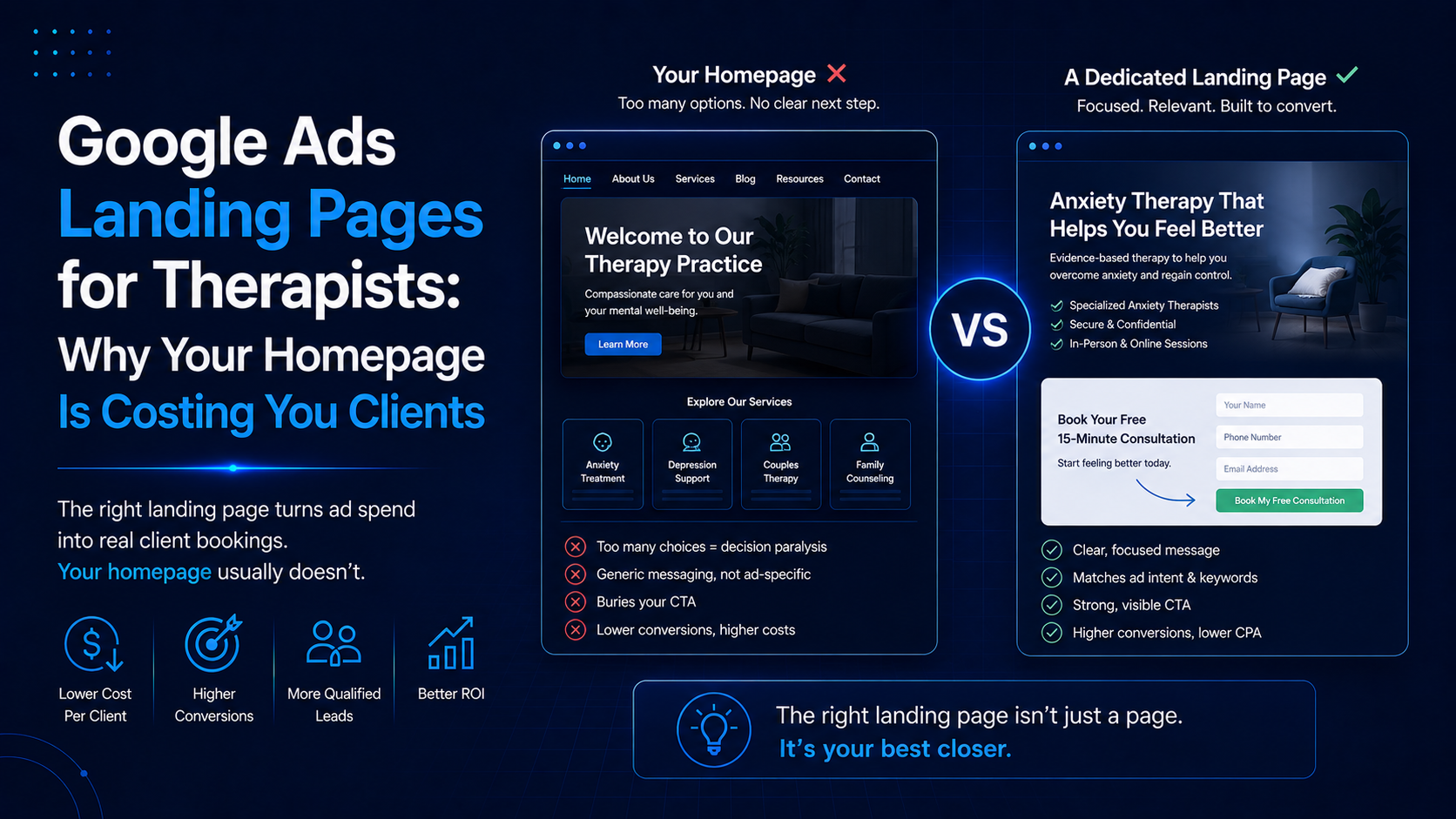
You are paying for every click, and most of those clicks land on your homepage. It feels like the obvious place to send them, since your homepage is the front door to your practice. But the homepage was built to introduce everything you do, not to turn one specific searcher into a booked consultation, and that mismatch quietly wastes a large share of your ad budget.
This guide explains why a homepage underperforms as an ad destination, what a high-converting therapy landing page actually looks like, and how to build one that turns paid clicks into clients.
Quick answer: A landing page is a single, focused page built to convert an ad click into a booked consultation, while a homepage serves many goals at once. Sending therapy ad traffic to a dedicated landing page that matches the ad, leads with one clear action, and builds trust quickly converts far better than sending it to your homepage.
Key Takeaways
- A homepage and a landing page do different jobs. A homepage introduces your whole practice; a landing page converts one visitor.
- Sending paid clicks to your homepage wastes budget, because navigation, competing goals, and generic messaging give visitors reasons to leave instead of book.
- Message match matters. The landing page should reflect the exact service the person searched for, which lifts both conversions and your Quality Score.
- Trust is the currency of a therapy landing page. A photo of you, your credentials, and a clear sense of what to expect do more than clever copy.
- Therapists face ethics rules on client testimonials. Build credibility through credentials and approach, not solicited reviews.
- One clear call to action, a fast mobile page, and an easy way to book are the difference between paying for clicks and getting clients.
Paying for clicks that land on a page that was not built to convert? MHIS designs conversion-focused therapy websites and landing pages that turn ad traffic into booked consultations. Book a free consultation with MHIS.
Homepage vs Landing Page: What Is the Difference?
A homepage is built to introduce your entire practice and send visitors in many possible directions. A landing page is built to do one thing: convert the visitor who clicked your ad into a booked consultation. For paid traffic, that single-goal focus is exactly what a homepage lacks.
The table below shows the difference in plain terms.
| Homepage | Landing page for ads | |
|---|---|---|
| Purpose | Introduce the whole practice | Convert one ad click into a booking |
| Number of goals | Many (about, services, blog, contact) | One (book a consultation) |
| Navigation | Full menu | Minimal or none |
| Audience | Everyone | The specific searcher who clicked |
| Message | General | Matched to the ad and keyword |
| Result for paid traffic | Visitors wander and often leave | Visitors take the intended action |
Both pages are useful, but they are not interchangeable. Your homepage does important work for organic visitors and referrals. It just is not the right destination for a paid click. For the bigger picture on running the channel, see our guide to Google Ads for therapists.
Why Your Homepage Is Costing You Clients
A homepage gives visitors too many choices and too little direction. Every menu item, service link, and blog teaser is an invitation to wander away from the one action you actually want. When you pay for the click, that wandering is money leaving the building.
Here is what goes wrong when paid traffic lands on a homepage:
- Competing goals dilute the action. A homepage asks the visitor to explore, read, and decide where to go. A person ready to book needs one clear next step, not a menu.
- Navigation creates escape routes. Every link is a way to leave without booking. Landing pages remove them for a reason.
- The message does not match the ad. Someone who clicked an ad for “couples counseling” lands on a general homepage and has to hunt for what they came for. Many give up first.
- It is usually slower and busier. Homepages carry more content and load elements, which hurts speed, especially on mobile where most therapy searches happen.
- It lowers your Quality Score. Google rewards relevance between the ad and the destination. A mismatched homepage can raise your cost per click and lower your ad rank.
The result is measurable. Healthcare is one of the stronger categories for search conversion, averaging around 24% in recent benchmark data, yet a therapy account sending clicks to a generic homepage often converts far below that. The gap is rarely the ads. It is the page.
The Anatomy of a High-Converting Therapy Landing Page
A strong therapy landing page does three things at once: it matches the ad, it builds trust fast, and it makes booking effortless. Every element below serves one of those three jobs, and anything that does not belong on the page is left off.
A headline that matches the ad
The first thing a visitor reads should echo what they searched for and what the ad promised. If the ad said “Trauma Therapy in Denver,” the headline should say the same, not “Welcome to My Practice.” This continuity reassures the visitor they are in the right place and keeps them reading.
One clear call to action, above the fold
Decide on a single action, usually “Book a Free Consultation” or a call button, and make it visible without scrolling. Repeat it further down the page, but keep it the same action throughout. Competing calls to action split attention and lower conversions.
A photo of you
For therapy, this matters more than almost anything else. People choosing a therapist want to see a warm, real human before they reach out. A genuine, professional photo of you reduces anxiety about making contact and builds trust faster than any paragraph.
A warm, neutral description of what you help with
Describe the concerns you work with in a way that is welcoming without assuming the reader’s condition. Keep it neutral to stay compliant with Google’s health advertising rules, and warm enough that the visitor feels understood. Focus on your services and who you help, not on diagnosing the reader.
Trust signals: license, credentials, specialties, and approach
State your license and credentials clearly, name your specialties, and briefly describe your approach. These details answer the quiet questions every prospective client has: Are you qualified? Do you help with my situation? Will this feel right?
A simple “how it works” in a few steps
Reaching out for therapy is intimidating. A short, three-step outline (“Book a free call, we talk about what you need, we schedule your first session”) removes uncertainty and makes the next step feel manageable.
Ethical credibility instead of solicited testimonials
This is where therapy differs sharply from other industries. Standard landing page advice says to load up on client testimonials, but mental health ethics codes restrict this. The APA Ethics Code, Standard 5.05, states that psychologists do not solicit testimonials from current clients or others vulnerable to undue influence, and the ACA, NBCC, and NASW codes carry similar prohibitions. Confidentiality rules also limit displaying identifiable client information.
Build credibility a different way: highlight your credentials, training, years of experience, professional affiliations, and specialties, and let your approach and presentation carry the trust. You can review the standard directly in the APA Ethics Code.
An on-page FAQ
Answer the practical questions that stop people from booking: fees, insurance, telehealth availability, and what the first session is like. Removing these uncertainties on the page keeps the visitor moving toward the action instead of leaving to look for answers.
A low-friction way to book
Make booking as easy as possible. Offer an online scheduler and a click-to-call button, and keep any form short. A long intake form as the first ask is one of the most common conversion killers, because it demands too much before trust is established.
Fast, mobile-first, and accessible
Most therapy searches happen on a phone, so the page must load quickly and work cleanly on mobile. A slow or clunky page loses visitors before they read a word, which means you paid for a click that never had a chance.
Message Match: The Piece Most Therapists Skip
Message match is the alignment between your ad and your landing page. When the keyword, the ad, and the page all speak to the same service, visitors convert at a higher rate and Google rewards you with a better Quality Score and lower costs. When they do not align, both conversions and costs suffer.
The practical implication is that one generic page cannot serve every campaign well. A visitor who searched “couples counseling” and a visitor who searched “trauma therapy” need different headlines, different framing, and different reassurance. Sending both to the same broad page weakens the connection for each.
How to apply it: Build a dedicated landing page for each core service or specialty you advertise, and match its headline and content to the corresponding ad. If you run three campaigns, you likely need three pages. Our step-by-step guide on how to create a Google Ads campaign for a therapy practice covers how the ad and page work together.
Your landing page is where your ad budget either converts or disappears, and it is one of the highest-return things to get right. MHIS designs and builds conversion-focused therapist websites and campaign landing pages, matched to your ads and built to turn clicks into booked consultations. See how our Google Ads management for therapists works.
Landing Page Mistakes Therapists Make
- Sending ads to the homepage instead of a focused, message-matched page.
- Leaving the full navigation menu on the page, giving visitors easy ways to leave.
- No photo of the therapist, which removes the single biggest trust signal in therapy.
- A buried or missing call to action, or several competing ones.
- A long intake form as the first ask, demanding too much before trust exists.
- A slow, non-mobile page that loses visitors before they engage.
- One generic page for every specialty, which breaks message match.
- Copy that implies the reader’s condition, which risks ad disapproval and feels off-putting.
- Walls of text with no clear hierarchy, so visitors cannot scan and act.
- No credentials or trust signals, leaving the quiet qualification questions unanswered.
A Simple Landing Page Structure You Can Copy
- Headline that matches the ad and the searched service.
- Subheadline, hero photo of you, and the primary call to action above the fold.
- A short trust bar: license, credentials, specialties, insurance or fees.
- What you help with, described warmly and neutrally.
- How working together works, in three simple steps.
- About you, with your photo, approach, and credentials.
- Credibility, through affiliations, training, and ethical trust signals rather than solicited testimonials.
- An FAQ covering fees, insurance, telehealth, and the first session.
- A final call to action with an online scheduler and a click-to-call button.
This structure works because it mirrors how a prospective client actually decides: Am I in the right place, can I trust this person, what happens next, and how do I take the step?
Therapy Landing Page Checklist
| Area | Check |
|---|---|
| Headline | Matches the ad and the searched service |
| Call to action | One clear action, visible above the fold, repeated consistently |
| Photo | A warm, professional photo of the therapist |
| Copy | Neutral and compliant, warm, focused on services not diagnosis |
| Trust signals | License, credentials, specialties, and approach are clear |
| Process | A simple “how it works” reduces the anxiety of reaching out |
| Credibility | Built on credentials and affiliations, not solicited testimonials |
| FAQ | Fees, insurance, telehealth, and first session addressed |
| Booking | Online scheduler and click-to-call, with a short form |
| Performance | Fast, mobile-first, and accessible |
| Message match | A dedicated page for each advertised specialty |
Frequently Asked Questions
Should therapists send Google Ads to their homepage or a landing page?
Send them to a dedicated landing page, not your homepage. A homepage is built to introduce your entire practice and send visitors in many directions, which is the opposite of what a paid click needs. A landing page has one goal, matches the ad the person clicked, removes distractions like navigation, and makes booking easy. Because you pay for every click, the destination has to be built to convert, and a homepage rarely is. Healthcare converts well on average, but therapy accounts sending clicks to a general homepage usually fall far below that, and the gap is almost always the page. A focused landing page recovers the budget a homepage quietly wastes.
What is a landing page, and how is it different from a homepage?
A landing page is a single, focused page designed to turn one specific visitor into one specific action, usually booking a consultation. A homepage, by contrast, is the front door to your whole practice, built to introduce your services, share your story, and route visitors to many different pages. The key differences are focus and navigation: a landing page has one goal and little or no menu, while a homepage has many goals and full navigation. For organic visitors and referrals, a homepage is exactly right. For paid ad traffic, a landing page converts far better because it gives the visitor one clear path instead of a dozen possible detours.
What should a therapy landing page include?
A high-converting therapy landing page includes a headline that matches the ad, one clear call to action above the fold, and a warm professional photo of you. It should state your license, credentials, and specialties, describe what you help with in a neutral and welcoming way, and outline a simple three-step process for getting started. Build credibility through your qualifications and affiliations rather than solicited client testimonials, which mental health ethics codes restrict. Add an FAQ covering fees, insurance, telehealth, and the first session, and make booking easy with an online scheduler and a click-to-call button. Finally, the page must load fast and work cleanly on mobile, where most therapy searches happen.
Do I need a separate landing page for each service or specialty?
In most cases, yes. This comes down to message match, the alignment between the ad someone clicked and the page they land on. A visitor who searched “couples counseling” and one who searched “trauma therapy” have different needs, so a page tailored to each converts better than a single generic page trying to serve both. Matching the page to the ad also improves your Quality Score, which can lower your cost per click and improve your ad position. If you advertise three services, you likely need three landing pages, each with a headline and content that reflect the corresponding campaign. It is more work upfront, but it meaningfully increases how many clicks become booked clients.
Why do landing pages convert better than homepages?
Landing pages convert better because they eliminate choice and distraction. A homepage asks visitors to explore and decide where to go, with a full menu offering many ways to leave. A landing page gives one clear action and removes the escape routes, so a visitor who is ready to book is guided straight to it. Landing pages also match the ad the person clicked, which reassures them they are in the right place, while a homepage delivers a general message that may not reflect what they searched for. Add faster load times and a single focused layout, and the landing page simply makes it easier to take the intended action, which is the entire point of paying for the click.
Can therapists use client testimonials on a landing page?
Therapists should be very cautious here, because mental health ethics codes restrict testimonials. The APA Ethics Code, Standard 5.05, prohibits soliciting testimonials from current clients or others vulnerable to undue influence, and the ACA, NBCC, and NASW codes have similar rules, with some extending the restriction to former clients. Confidentiality rules also limit displaying identifiable client information. Soliciting a review from a current client is widely considered off-limits with no gray area, because of the power imbalance in the therapeutic relationship. Instead of client testimonials, build credibility through your credentials, training, years of experience, professional affiliations, specialties, and a clear description of your approach. These signals establish trust ethically and often carry more weight with prospective clients than a generic review would.
What is message match, and why does it matter for therapy ads?
Message match is the consistency between your keyword, your ad, and your landing page. When all three speak to the same service, a visitor who clicks feels they have landed exactly where they intended, which increases the chance they book. It also matters to Google: strong relevance between the ad and the destination improves your Quality Score, which can lower your cost per click and raise your ad position. For therapy ads, this means the page a couples-counseling ad points to should lead with couples counseling, not a general welcome message. Weak message match sends visitors to a page that does not clearly reflect their search, which lowers conversions and raises your costs at the same time.
How fast should my therapy landing page load?
As fast as possible, and definitely within a few seconds, especially on mobile. Most people searching for a therapist are on a phone, and a slow page loses visitors before they read anything, which means you paid for a click that never had a chance to convert. Page speed also affects your Google Ads Quality Score and your search rankings, so a slow page costs you twice. Practical steps include compressing images, limiting heavy scripts and plugins, and keeping the page focused rather than overloaded. A fast, lightweight landing page respects the visitor’s time and keeps them engaged long enough to take the next step, which is exactly what you are paying for.
Do I need a form, or is a phone number enough?
Offer both, because different people prefer different ways to reach out. Some visitors want to call immediately, so a visible click-to-call button matters, especially on mobile. Others prefer to book without talking first, so an online scheduler or a short contact form gives them an easy path. The key is to keep any form short, since a long intake form as the first ask demands too much before trust is established and drives people away. Ask only for what you need to start a conversation, and save detailed intake for after they have booked. Giving visitors multiple low-friction ways to take the next step consistently converts better than forcing everyone through a single channel.
Can I use my Psychology Today profile as a landing page?
It is not ideal. A Psychology Today profile is useful, but it lives on a platform you do not control, sits on a page shared with competing therapists, and cannot be tailored to match a specific ad. That means no real message match, limited control over the layout and call to action, and a visitor who can easily click away to other profiles. A dedicated landing page on your own site gives you full control over the message, the design, and the single action you want, and keeps the visitor focused on you. If you are running Google Ads, sending that paid traffic to your own conversion-focused page will almost always outperform sending it to a directory profile.
How long should a therapy landing page be?
Long enough to build trust and answer key questions, but focused enough to keep the visitor moving toward booking. There is no fixed word count. The page should include a clear headline, your photo, what you help with, your credentials and approach, a simple process, an FAQ, and a strong call to action, without padding. Prospective therapy clients often want a bit more reassurance than buyers in other industries, so a slightly longer page that addresses their concerns can convert well. The test is whether every section earns its place by moving the visitor closer to reaching out. If a section does not build trust or reduce friction, it does not belong on the page.
Should I build the landing page myself or hire someone?
It depends on your time and comfort with web design and conversion copy. The principles in this guide are learnable, and a motivated therapist can build a solid page using a good website platform. That said, an effective landing page combines message match, trust-building design, fast mobile performance, compliant copy, and easy booking, and getting all of those right takes experience. Since the page determines whether your ad budget converts or disappears, many practices find it worth having a specialist build it. A partner who understands both therapy marketing and conversion design can create pages that turn more clicks into clients, which usually pays for itself through the ad budget you stop wasting on a page that was not built to convert.
Final Key Takeaways
- A homepage and a landing page do different jobs, and a homepage is the wrong destination for paid ad traffic.
- Homepages waste budget through competing goals, navigation, generic messaging, and weaker relevance.
- A high-converting therapy landing page matches the ad, builds trust fast, and makes booking effortless.
- Build credibility with credentials and affiliations, since ethics codes restrict client testimonials.
- Message match means a dedicated page per specialty, which lifts conversions and lowers costs.
Action Checklist
- Stop sending ad traffic to your homepage.
- Build a dedicated landing page for each advertised service.
- Match each page’s headline to its ad and keyword.
- Add a warm, professional photo of yourself.
- Lead with one clear call to action, repeated consistently.
- Include license, credentials, specialties, and a simple process.
- Build credibility ethically, without solicited client testimonials.
- Add an FAQ, an online scheduler, and a click-to-call button.
- Make the page fast and mobile-first.
Conclusion
Sending paid clicks to your homepage feels natural, but it is one of the most expensive habits in therapy advertising. A homepage is built to introduce your practice, not to convert a single searcher, so it hands visitors reasons to wander and leave. A dedicated landing page does the opposite: it matches the ad, builds trust with your photo and credentials, answers the questions that hold people back, and makes booking easy. Build a focused page for each service you advertise, keep it fast and mobile-first, and the same budget that felt wasted starts turning clicks into booked consultations.
If designing pages that convert is not how you want to spend your time, that is exactly the work a therapy-focused web and marketing partner handles.
Ready to turn your ad traffic into booked clients? MHIS will review your current pages, design conversion-focused landing pages matched to your ads, and build a plan to grow your practice across website design, Google Ads, and local SEO. Book your free consultation and website review with MHIS today.