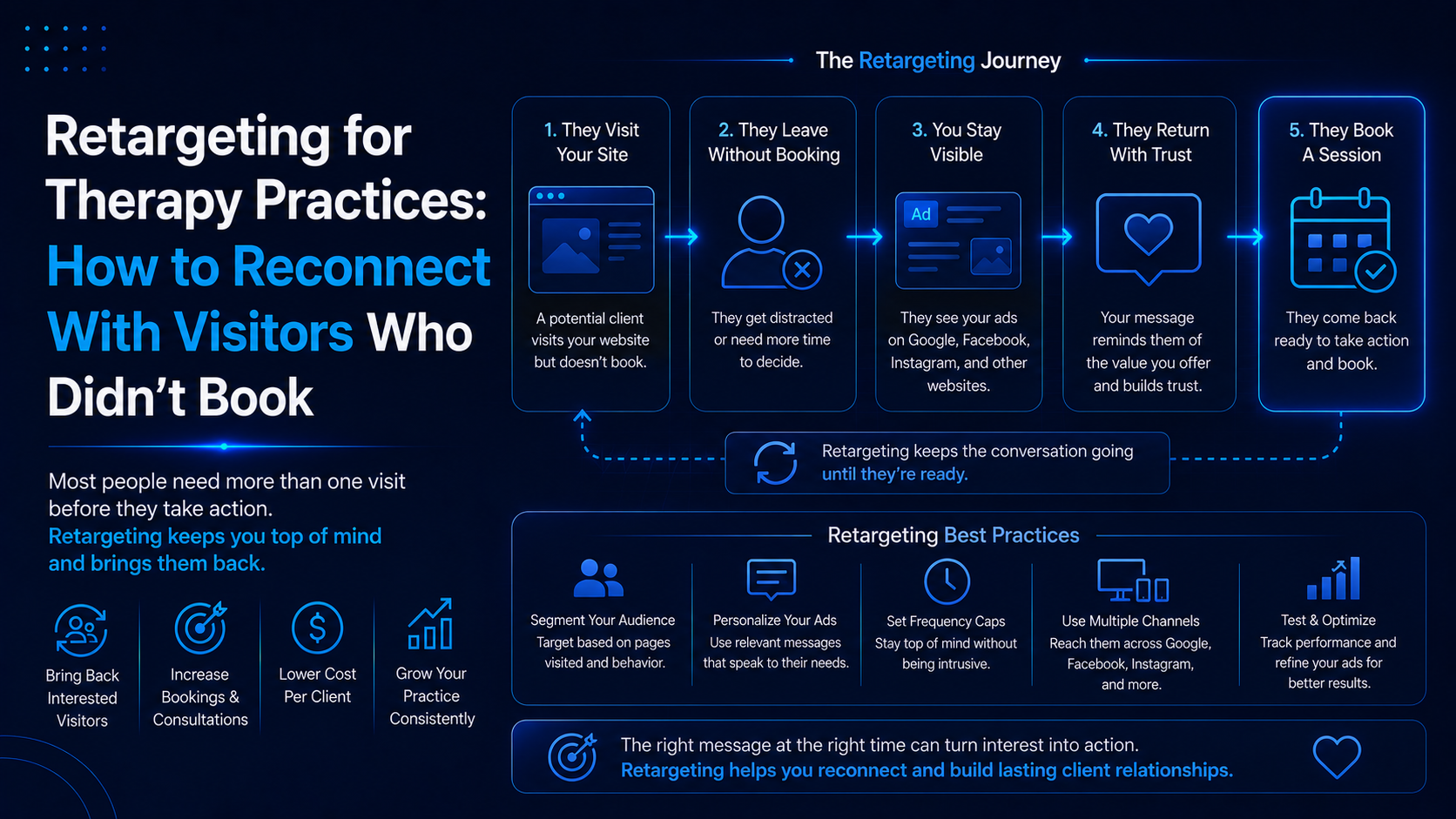
Someone finds your website, reads about your trauma work, spends a few minutes on your fees page, and then leaves without booking. It happens constantly, because most people do not book a therapist on their first visit. The natural instinct is to bring those visitors back with retargeting, the ads that seem to follow people around the web after they visit a site. For most businesses, that is a standard move. For a therapy practice, it is not that simple.
This guide explains why traditional retargeting is largely restricted for mental health, what is actually allowed, and the compliant methods that genuinely help you reconnect with the people who did not book.
Quick answer: Classic website retargeting, where ads follow people who visited your therapy pages, is largely restricted for therapy practices because health is a sensitive advertising category and because of HIPAA. You can still reconnect with people who did not book, through a narrow set of compliant methods: engagement-based retargeting, consent-based email follow-up, converting more visitors on the first visit, and owning local search.
A quick note: This article is educational and reflects current ad platform policies and privacy law. It is not legal advice. Rules in this area change, so confirm your specific setup with a healthcare attorney or compliance professional.
Key Takeaways
- Traditional website retargeting is largely off-limits for therapy. Health is a sensitive category, and platform rules restrict targeting people based on it.
- Google disables remarketing for health advertisers, including website visitor lists, Customer Match, and site-visit audiences.
- The standard Meta pixel is not HIPAA compliant, and retargeting people who viewed your condition pages carries real privacy and legal risk.
- There is a compliant lane on Meta: retargeting people based on their interest in your content, such as video viewers and post engagers, rather than their health status.
- The best “retargeting” is often not needing it. Converting more visitors on the first visit, capturing consent-based emails, and owning local search do the same job compliantly.
- Never build audiences or conversions that name a condition, and keep the pixel off pages that reveal what someone is seeking help for.
Not sure what you are actually allowed to do to bring visitors back? MHIS builds compliant, HIPAA-aware marketing systems for therapy practices, so you re-engage the right people without crossing a line. Book a free consultation with MHIS.
What Retargeting Is, and Why Therapists Want It
Retargeting, sometimes called remarketing, is showing ads to people who already visited your website or engaged with your content, in order to bring them back. The appeal is obvious: most visitors do not convert the first time, so re-engaging warm visitors usually costs less and converts better than reaching cold strangers.
For a typical local business, retargeting is one of the most efficient tactics available. You tag your website visitors, then show them reminder ads across the web or social media until they return. Because these people already know you, they are more likely to act.
Therapists want this for the same reason. Choosing a therapist is a considered decision, often made over days or weeks, so the ability to stay visible to someone who was interested but not ready is genuinely valuable. The problem is not the goal. It is that the standard mechanics of retargeting run straight into rules built to protect exactly the kind of sensitive information a therapy practice deals with. For the broader channel context, see our guide to Google Ads for therapists.
Why Traditional Retargeting Is Restricted for Therapy Practices
Standard website retargeting depends on building an audience of people who visited specific pages, then following them with ads. When those pages are about mental health, that audience is effectively a list of people you are inferring have a health concern, which both Google and Meta restrict, and which HIPAA treats as sensitive.
There are three reasons it does not work the way it does for other businesses.
Google disables remarketing for health advertisers
Google classifies health, including mental health conditions and treatments, as a sensitive interest category. Its policy is explicit: advertisers in sensitive categories cannot use advertiser-curated audiences. In plain terms, that disables website and app remarketing lists, Customer Match (uploading your own contact data), custom segments based on the sites people visit or the terms they search, and similar or lookalike audiences.
The practical result is that you cannot build a “visited our anxiety therapy page” audience and follow those users with display or search ads. Google would treat that as sensitive, health-based targeting and make it ineligible. What remains available is predefined Google audiences, which are built without sensitive signals, along with location and keyword targeting. You can read the rule on Google’s Restricted targeting in Personalized advertising page and its Health in personalized advertising page.
Meta restricts health-based audiences, and its pixel is not HIPAA safe
Meta removed sensitive health-interest targeting categories and, through 2025 and 2026, tightened enforcement further, flagging and disabling custom and lookalike audiences and custom conversions whose names, rules, or metadata imply sensitive traits. A custom audience or conversion that references a condition can be disabled.
The bigger issue is the pixel. The standard Meta pixel is not HIPAA compliant, because it automatically captures and transmits potentially sensitive information. Building a website custom audience from people who viewed your therapy service or condition pages means feeding exactly that kind of data to Meta. Uploading client contact lists for matching would require a Business Associate Agreement that Meta does not provide for this use, which makes it unsuitable for a practice handling protected information.
The HIPAA pixel problem applies to both platforms
Neither Google nor Meta will sign a Business Associate Agreement covering their advertising and analytics tools, so protected health information must never flow to them. Tracking pixels placed on pages that reveal a person is seeking mental health care, and especially on client portals, telehealth pages, or intake forms, can expose that information. This is not hypothetical: tracking pixels on healthcare sites have led to large, publicly reported settlements. You can review current guidance on the HHS online tracking technologies page.
The takeaway is straightforward: retargeting people because they visited your therapy pages is off-limits or high-risk. But that is not the end of the story.
What You Can Do: Compliant Ways to Reconnect With Visitors
You cannot follow people around the web based on their health concern, but you can still bring interested people back, using methods based on their interest in your content and your own consent-based data rather than inferred health status. These approaches are compliant, and several of them work better than classic retargeting anyway.
Engagement-based retargeting, the one real retargeting lane
On Meta, there is a compliant form of retargeting, and it is based on content engagement rather than health status. You can build audiences from people who watched a meaningful portion of your video, for example fifty percent or more of a therapist introduction or educational video, or who engaged with your Facebook or Instagram posts. Retargeting these people is compliant because the audience is defined by their interest in your content, not by any inference about their mental health.
Two rules keep this clean. First, configure your pixel to fire only on generic confirmation pages, such as a contact-form thank-you page or a booking confirmation, and never on pages that name a condition or service type. Many practices remove the pixel from therapy service pages entirely when the page reveals what is being treated. Second, never name a condition in an audience or conversion, since that gets the audience flagged and disabled.
Convert more visitors on the first visit
The most reliable way to reduce lost visitors is to lose fewer of them in the first place. A visitor who books does not need to be retargeted. Send your ad traffic to a focused, message-matched landing page rather than your homepage, make it fast and mobile-first, show a warm photo and your credentials, and make booking effortless. Strengthening first-visit conversion often recovers more clients than any retargeting campaign would, and it is fully compliant. Our step-by-step guide on how to create a Google Ads campaign for a therapy practice covers pairing ads with pages that convert.
Capture consent-based contact info and follow up by email
If a visitor is not ready to book, give them a lower-commitment way to stay connected, such as an option to receive a helpful resource or join a newsletter, with clear, explicit consent. Once someone opts in, you can re-engage them through email, which is first-party and under your control. Keep the emails neutral and free of any protected information, and never reference an assumed condition. Done this way, consent-based email is the ethical equivalent of retargeting your genuinely interested visitors, and it does not depend on any ad platform’s audience tools.
Follow up quickly with inquiries who did not book
Many visitors who “did not book” actually did reach out, then went quiet. These are your warmest possible contacts. A prompt, respectful follow-up by phone or email, with appropriate consent, re-engages them directly and often recovers people who simply got busy or hesitated. Speed matters here, because someone who reached out in a moment of readiness may move on if they do not hear back. This is retargeting in the truest sense, reconnecting with people who already raised their hand, and it is entirely compliant.
Own local search so past visitors find you again
People who leave your site often search again later, sometimes several times, before choosing a therapist. If you own local search, you recapture them without any tracking at all. A complete, optimized Google Business Profile, genuine reviews, and strong local SEO keep you visible when they come back to look. This kind of “passive retargeting” through visibility is durable, compliant, and compounding, because it works for every future searcher, not just the ones you tagged.
What to Avoid
- Building audiences from visitors to your condition or service pages, on either platform.
- Uploading client email lists to Customer Match or Meta without a Business Associate Agreement, which they do not provide for this.
- Firing a tracking pixel on condition, service, portal, telehealth, or intake pages.
- Naming a condition in a custom audience or conversion, which gets it flagged and disabled.
- Any retargeting that implies you know the person’s health status.
- Assuming Google or Meta retargeting works for therapy the way it does for e-commerce.
Working out what is allowed, and setting it up so it stays compliant, is exactly the kind of thing that is easy to get wrong alone. MHIS builds compliant re-engagement systems for therapy practices, from conversion-focused websites to consent-based email and engagement-based campaigns. See how our Google Ads management for therapists works.
A Compliant Reconnect Plan, Step by Step
- Convert better on the first visit with a focused, fast, message-matched landing page and easy booking.
- Set up engagement-based audiences where you run Meta, using video viewers and people who engaged with your content.
- Configure the pixel to fire only on confirmation pages, and keep it off any page that names a condition or service.
- Add a consent-based email capture and a neutral, protected-information-free nurture sequence.
- Follow up quickly with inquiries who did not book.
- Strengthen local SEO and your Google Business Profile so past visitors find you again.
- Keep every audience and conversion free of condition names, and confirm your tracking setup with a compliance professional.
Retargeting Methods for Therapy: Quick Reference
| Method | Allowed for therapy? | What to do instead or how to do it compliantly |
|---|---|---|
| Website remarketing on condition or service pages (Google) | No, disabled for the health category | Use predefined Google audiences, location, and keyword targeting |
| Customer Match or uploading client lists | No, not without a BAA the platforms do not provide | Use consent-based email follow-up you control |
| Meta pixel on therapy service or condition pages | No, HIPAA and disapproval risk | Fire the pixel only on confirmation or thank-you pages |
| Meta custom or lookalike audiences implying a condition | No, gets flagged and disabled | Build engagement audiences instead |
| Retargeting video viewers on Meta | Yes, based on content interest | Create a video, then retarget people who watched a meaningful portion |
| Retargeting people who engaged with your posts | Yes | Build engagement custom audiences from your Page or Instagram |
| Consent-based email nurture | Yes, if consented and free of protected information | Capture emails with clear consent, then send neutral, helpful emails |
| Local SEO and Google Business Profile | Yes | Own local search so past visitors find you again |
Frequently Asked Questions
Can therapists use retargeting ads?
Only in a limited, careful way. Classic website retargeting, where ads follow people who visited your therapy pages, is largely off-limits, because health is a sensitive advertising category and because of HIPAA. Google disables remarketing for health advertisers entirely, and Meta’s standard pixel is not HIPAA-compliant, so building audiences from people who viewed your condition pages carries real risk. However, therapists can use engagement-based retargeting on Meta, reaching people based on their interest in your content, such as watching your video or engaging with your posts, rather than their health status. They can also reconnect with visitors through compliant, first-party methods like consent-based email and strong local search. So retargeting is possible, but it looks very different from the standard playbook.
Why can’t I retarget people who visited my therapy website?
Because doing so builds an audience of people you are inferring have a mental health concern, which platforms restrict and privacy law treats as sensitive. Google classifies health as a sensitive interest category and disables advertiser-curated audiences, including website remarketing lists, for advertisers in that category. So you cannot create a “visited my anxiety page” audience and follow those users with ads. On top of the platform rules, tracking pixels on pages that reveal someone is seeking mental health care can expose protected information, and neither Google nor Meta will sign a Business Associate Agreement covering their ad tools. The combination of sensitive-category targeting rules and HIPAA is why standard website retargeting is not available to therapy practices the way it is to other businesses.
Is the Facebook or Meta pixel HIPAA compliant for therapists?
The standard Meta pixel is not HIPAA compliant, because it automatically captures and transmits potentially sensitive information without giving you control over what data leaves your site. For a therapy practice, that is a real problem, since pixels on pages revealing a condition or on booking and intake flows can send protected information to Meta, which does not provide a Business Associate Agreement for this use. Tracking pixels on healthcare sites have driven large, publicly reported settlements. The safer approach is to fire the pixel only on generic confirmation pages, such as a thank-you page, and never on pages that name a condition or service. Some practices remove the pixel from therapy service pages entirely. Always confirm your tracking configuration with a compliance professional before relying on it.
What kind of retargeting is actually allowed for therapy practices?
The compliant lane is engagement-based retargeting on Meta, where you reach people based on their interest in your content rather than their health status. You can build audiences from people who watched a meaningful portion of your video, for example half or more of a therapist introduction, or who engaged with your Facebook or Instagram posts. This is acceptable because the audience is defined by content engagement, not by any inference about mental health. Beyond that, the most effective compliant re-engagement methods are not ad-based at all: converting more visitors on their first visit, capturing consent-based emails and following up, responding quickly to inquiries, and owning local search so past visitors find you again. Together these do the job retargeting is meant to do, without the compliance risk.
Can I upload my client email list to run retargeting ads?
No, that is one to avoid. Uploading a client list to Google Customer Match or to Meta for audience matching means handing protected information to a platform that will not sign a Business Associate Agreement for that purpose, which makes it unsuitable for a therapy practice. Google also disables Customer Match for health advertisers as part of its sensitive-category restrictions. The compliant alternative is consent-based email that you control directly. If a visitor opts in to hear from you, with clear consent, you can re-engage them by email through your own system, keeping the messages neutral and free of any protected information. That gives you a direct line to interested people without exposing client data to an ad platform.
How can I reconnect with website visitors who didn’t book, without retargeting?
Several compliant methods work well. First, convert more of them on the first visit by sending ad traffic to a focused, fast landing page with a clear path to book, which reduces how many you lose. Second, offer a low-commitment way to stay connected, such as a helpful resource or newsletter with explicit consent, then follow up by email. Third, respond quickly to anyone who reached out but did not book, since those are your warmest contacts. Fourth, invest in local SEO and your Google Business Profile so people who leave and search again later find you at the top. These approaches reconnect you with interested people through your content, your consent-based data, and your visibility, rather than through health-based ad targeting.
Should therapists run Google Ads or Facebook Ads for retargeting?
For capturing people who are actively searching for a therapist, Google Ads is usually the stronger starting point, because it reaches active demand. For retargeting specifically, Google offers little for therapy, since it disables remarketing for health advertisers, so you rely on predefined audiences, location, and keywords there. Meta is where the compliant retargeting lane exists, through engagement-based audiences like video viewers and post engagers, and it is generally better suited to awareness and staying visible than to capturing immediate demand. A common approach is to use Google to capture people already looking, and Meta to reinforce your presence with people who engaged with your content. Both require careful, compliant setup given the sensitivity of mental health advertising.
Where should the Meta pixel fire on a therapy website?
The pixel should fire only on generic confirmation pages, such as a contact-form thank-you page or a booking confirmation page, where the URL and content do not reveal a specific condition or service. It should never fire on pages that name a condition or service type, on client portals, on telehealth pages, or on intake forms, because those can expose protected information. Some practices go further and remove the pixel from therapy service pages entirely, especially when the page URL itself reveals what is being treated. The goal is to gather only non-sensitive conversion signals while keeping any information about a person’s health concern away from the ad platform. Because configurations can go wrong, have a compliance professional review your setup.
Is email follow-up a compliant alternative to retargeting?
Yes, when done correctly, and it is one of the best options available to therapists. If a visitor opts in with clear consent, you can re-engage them through email using your own system, which keeps you in control of the data and avoids handing anything to an ad platform. The important guardrails are to obtain genuine consent, keep the emails neutral and free of any protected health information, and never reference an assumed condition or imply you know why they visited. Used this way, email is essentially retargeting your interested visitors through a channel you own, and it sidesteps the sensitive-category and pixel problems that make ad-based retargeting difficult. It is compliant, effective, and fully within your control.
Can I retarget people who watched my video or engaged with my posts?
Yes, this is the compliant retargeting lane for therapy practices on Meta. Building an audience from people who watched a meaningful portion of your video, such as fifty percent or more, or who engaged with your Facebook or Instagram content, is acceptable because the audience is defined by interest in your content, not by any inference about their mental health. Retargeting those people keeps your practice visible to a warm audience without relying on health-based targeting. Just make sure your audiences and conversions never reference a condition, since names or rules that imply sensitive traits can get them disabled. Pairing engaging video and social content with these engagement audiences gives you a genuine, compliant way to stay in front of interested people.
Does local SEO help me recapture visitors who left?
Yes, and it is one of the most durable ways to do it. People choosing a therapist often visit a site, leave, and search again later, sometimes multiple times before deciding. If your practice ranks well in local search and has a complete, optimized Google Business Profile with genuine reviews, you stay visible every time they look, so you recapture them organically without any tracking. Unlike a retargeting campaign that only reaches the specific people you tagged, strong local visibility works for every future searcher, which makes it a compounding asset. It is fully compliant, since it involves no health-based targeting or pixel data, and it supports your whole marketing effort rather than a single campaign. For most therapy practices, this is a foundational investment.
Should I hire someone to set up compliant retargeting?
It is worth considering, because the rules here are nuanced and the cost of getting them wrong is high. The line between what is allowed and what is not depends on platform policies that change frequently, plus HIPAA considerations around pixels and data. A specialist who understands mental health marketing can set up the compliant lanes, engagement-based audiences, proper pixel placement, and consent-based email, while keeping you clear of the practices that create risk. They can also build the first-visit conversion and local search foundations that often outperform retargeting anyway. If you would rather not track evolving ad policies and privacy rules yourself, bringing in help protects both your compliance and your budget, and it usually pays off in a re-engagement system that actually works.
Final Key Takeaways
- Traditional website retargeting is largely restricted for therapy because health is a sensitive category and because of HIPAA.
- Google disables remarketing for health advertisers, and the standard Meta pixel is not HIPAA compliant.
- The compliant retargeting lane on Meta is engagement-based: video viewers and post engagers, not health status.
- Consent-based email, better first-visit conversion, fast follow-up, and local search reconnect you with visitors compliantly.
- Never name a condition in an audience or conversion, and keep the pixel off pages that reveal what someone is seeking.
Action Checklist
- Send ad traffic to focused landing pages to convert more visitors on the first visit.
- On Meta, build engagement audiences from video viewers and post engagers.
- Configure your pixel to fire only on confirmation pages, never on condition or service pages.
- Add a consent-based email capture and a neutral, PHI-free follow-up sequence.
- Follow up quickly with inquiries who did not book.
- Strengthen your local SEO and Google Business Profile.
- Audit your audiences and conversions to ensure none name a condition.
- Have a compliance professional review your tracking setup.
Conclusion
The instinct to bring back visitors who did not book is a good one, but for a therapy practice, the standard tool for it is mostly off the table. Health is a sensitive advertising category, so Google disables remarketing for it, and the usual pixel-based retargeting on your therapy pages creates real privacy and legal risk. What works instead is a compliant version of the same idea: engagement-based retargeting on Meta, consent-based email you control, stronger first-visit conversion, fast follow-up with the people who reached out, and local visibility that recaptures searchers naturally. Reconnect through interest, consent, and presence rather than inferred health status, and you get the benefit of retargeting without the exposure.
If keeping up with shifting ad policies and privacy rules is not how you want to spend your time, a therapy-focused marketing partner can build a re-engagement system that is both compliant and effective.
Want to reconnect with the people who visited but did not book, the right way? MHIS will review your current setup, build a compliant re-engagement system across your website, email, and campaigns, and give you a clear plan to grow your practice. Book your free consultation with MHIS today.