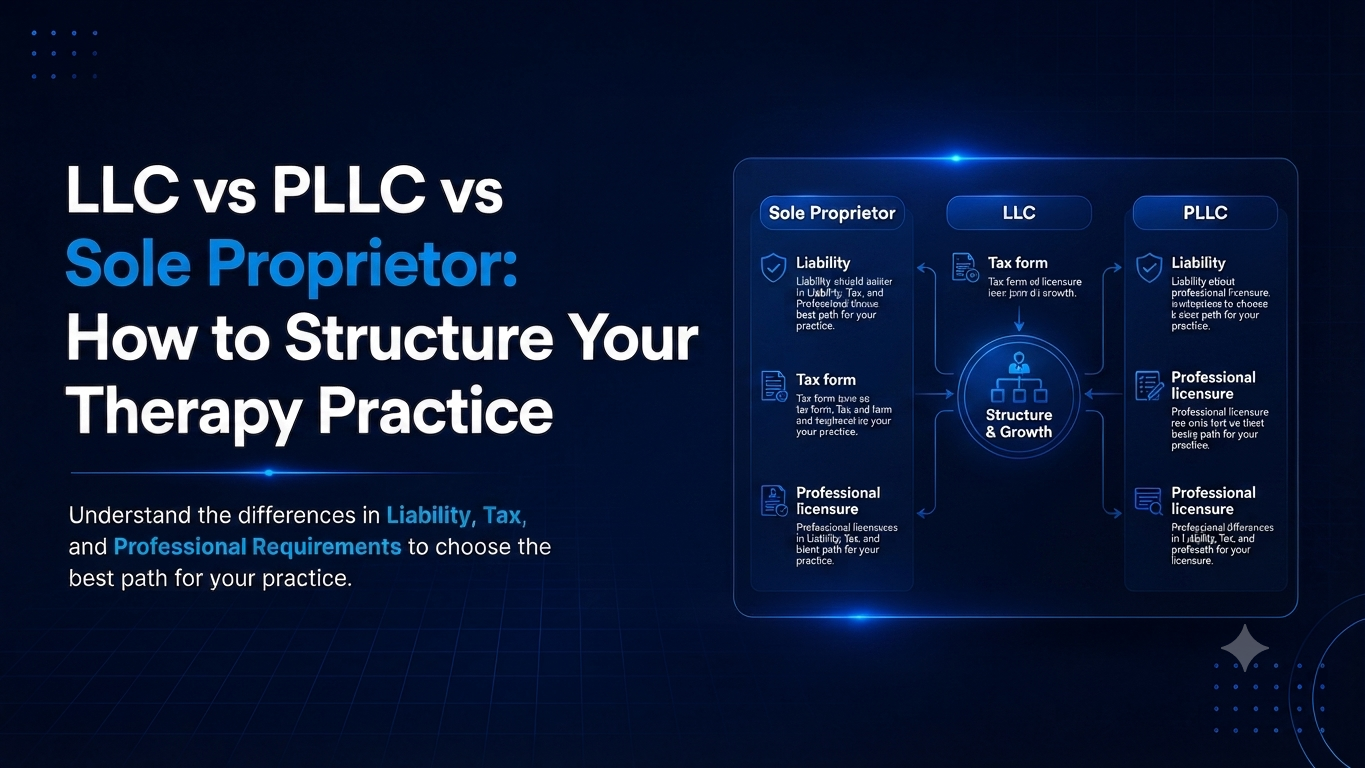
A plain-language look at the three main ways to structure a private practice, what each means for your liability and taxes, and how to choose the right one for your state.
Most therapists structure their practice as a sole proprietorship, an LLC, or a PLLC. The right choice depends heavily on your state, because many states require licensed clinicians to form a PLLC or a professional corporation rather than a standard LLC.
Your business structure affects three things that matter to every practice owner: how well your personal assets are protected, how you are taxed, and how much paperwork you take on. Choosing well early saves you from costly changes later.
This decision is one step in the larger process we cover in our guide to how to start a private therapy practice. At Mental Health IT Solutions, we help therapists build practices that are set up to grow.
This article is general education for mental health professionals and is not legal, tax, or financial advice. Business and licensing rules vary by state and change over time. Confirm your options with your state licensing board, your Secretary of State, and a qualified attorney or accountant before you file.
The quick answer: which structure is right for therapists?
If your state allows it, a solo therapist who wants liability protection usually chooses an LLC or, where required, a PLLC. A sole proprietorship is fine for testing the waters, and a professional corporation is the route in states that do not offer PLLCs.
| Structure | Liability protection | Taxes | Best for |
| Sole proprietorship | None beyond your insurance | Pass-through on your personal return | Testing the waters, part-time or very small practices |
| LLC | Shields personal assets from business debts | Pass-through by default, can elect S-corp | Solo practices in states that allow LLCs for clinicians |
| PLLC | Same as an LLC, for licensed owners | Pass-through by default, can elect S-corp | Practices in states that require a professional entity |
| Professional corporation | Shields personal assets from business debts | Corporate rates or S-corp election | States with no PLLC option, such as California |
The table above is a starting point. The single most important factor is what your state permits, so begin there before comparing the finer details below.
What is a sole proprietorship, and is it right for a therapist?
A sole proprietorship is the simplest structure and the default when you start seeing clients without registering an entity, but it gives you no liability protection beyond your insurance.
With a sole proprietorship, there is no legal separation between you and your practice. You report income and expenses on your personal tax return, and you pay self-employment tax on your net earnings. There are no formation filings, which makes it the cheapest and fastest way to begin.
The tradeoff is exposure. Because you and the business are legally the same, your personal assets are not shielded from business debts or claims. Many therapists start here while part-time or testing demand, then convert to an LLC or PLLC once the practice is established. It is a reasonable starting point, not usually a long-term home.
What is an LLC, and when should a therapist use one?
An LLC separates your personal and business assets and offers flexible, pass-through taxation, but not every state lets licensed therapists use a standard LLC for clinical work.
A limited liability company creates a legal line between you and your practice, so your personal assets are generally protected from business debts and many liabilities. By default, an LLC is taxed as a pass-through entity, meaning profits flow to your personal return, and as income grows, you can elect S-corp status to potentially reduce self-employment tax. It also looks more established to clients and referral partners.
The catch for clinicians is that many states do not allow licensed professionals to deliver services through a standard LLC. Those states require a PLLC or a professional corporation instead. So before you form an LLC, confirm that your state allows it for licensed therapy services.
What is a PLLC, and why do many therapists need one?
A PLLC is the licensed-professional version of an LLC, and in many states it is the required structure for therapists who want the protection an entity provides.
A professional limited liability company gives you the same liability separation and pass-through taxation as an LLC, but it is formed under your state’s rules for licensed professions. Typically, every owner must hold the relevant professional license, and some states require your licensing board to verify or approve the formation.
A PLLC protects your personal assets from general business debts and, in many cases, from the malpractice of co-owners or employees. It is a common and sensible choice for solo therapists in states that require it and for group practices where several licensed clinicians share ownership.
What about a professional corporation?
Some states, including California, do not offer PLLCs, so licensed therapists there form a professional corporation instead.
A professional corporation provides liability protection similar to a PLLC but comes with more formality, such as bylaws, a board, and recorded meeting minutes. Many owners pair it with an S-corp tax election, which can lower self-employment tax once the practice earns enough to justify the added administration. If you are in a state without PLLCs, this is usually your entity option, and a local accountant can tell you whether the S-corp election makes sense for your income.
Does forming an LLC or PLLC protect you from malpractice claims?
No. No business structure protects you from your own professional malpractice. That is what malpractice insurance is for.
This is the most common misunderstanding about entities. An LLC, PLLC, or corporation can shield your personal assets from general business debts and, in some cases, from the malpractice of other owners or staff. It does not shield you from a claim about your own clinical work. Every therapist needs professional liability insurance regardless of how the practice is structured, which is part of the compliance foundation we cover in our guide to how to start a private therapy practice.
How to choose the right structure for your therapy practice
Start with what your state requires, then weigh liability, taxes, cost, and whether you have partners.
A simple way to work through the decision:
- Check your state first: find out whether it allows an LLC for clinicians, requires a PLLC, or requires a professional corporation. Your Secretary of State and licensing board are the sources.
- Decide on protection: if you want your personal assets shielded from business liabilities, you want an entity rather than a sole proprietorship.
- Consider taxes: pass-through is simplest, and an S-corp election can save on self-employment tax once your net income is high enough, often in the range of $60,000 to $90,000, though a CPA should confirm your number.
- Factor in cost and upkeep: a sole proprietorship is cheapest, an LLC or PLLC has modest annual fees, and a professional corporation carries the most formalities.
- Think about ownership: if you will have partners or associate clinicians, a PLLC or professional corporation is usually the better fit.
- Get advice for your state: a short consultation with an accountant and an attorney is inexpensive next to the cost of choosing wrong.
You are not locked in forever. Many therapists start as a sole proprietor and convert to a PLLC or LLC once the practice is steady, so do not let this decision delay your launch.
What does it cost to set up an LLC or PLLC?
State filing fees typically run $50 to $500, plus any optional attorney or formation-service fees and a registered agent.
Beyond the one-time filing fee, some states charge an annual report or franchise fee, and a registered agent service usually costs $100 to $300 per year if you do not act as your own. An operating agreement or attorney review is optional but wise, especially for group practices. These entity costs are a small part of your overall launch budget, which we break down fully in how much it costs to start a therapy practice, along with startup line items like therapist website cost.
After you choose a structure, build the practice that fills it
Your business structure is the legal foundation. What actually brings clients is a professional website and the visibility to be found.
Once your entity is registered, the next priority is a home online that turns visitors into booked consultations. A clear, well-designed therapist website builds trust quickly, and strong SEO for therapists helps the right clients find you on Google and in AI search. Those two pieces do more for a new practice than any entity decision.
Give your new practice a professional home online
We design fast, conversion-focused websites built specifically for therapists and private practices. Explore website design and development
Search is where most therapy clients begin, so visibility is not optional for a growing practice.
Get found by the clients you want
Our mental health SEO services help your practice rank on Google and appear in AI search, so new inquiries keep coming in. See our mental health SEO services
Frequently asked questions
Do therapists need an LLC or PLLC?
No structure is required to practice, and many therapists begin as sole proprietors. However, an LLC or PLLC is recommended if you want to protect your personal assets from business liabilities. In many states, if you want an entity, a PLLC or professional corporation is the only option allowed for licensed clinicians.
What is the difference between an LLC and a PLLC?
They work almost identically for liability and taxes. The difference is that a PLLC is formed under your state’s rules for licensed professions, usually requires all owners to be licensed, and is the version many states require for therapists. A standard LLC is for general businesses and is not always permitted for clinical services.
Can a therapist form a standard LLC?
It depends on the state. Some states allow licensed therapists to use a regular LLC, while others require a PLLC or a professional corporation. Always confirm with your Secretary of State and licensing board before filing.
Does an LLC protect a therapist from malpractice?
No. An LLC or PLLC protects your personal assets from general business debts and sometimes from the malpractice of co-owners, but it does not protect you from claims about your own clinical work. Professional liability insurance is what covers that, and every therapist should carry it.
Is a sole proprietorship okay for a therapist?
It is fine for getting started, testing demand, or working part-time, since it is simple and inexpensive. The drawback is that it offers no liability protection, so many therapists move to a PLLC or LLC as the practice grows.
Should I elect S-corp status for my therapy practice?
An S-corp election can reduce self-employment tax once your net income is high enough to justify the extra payroll and accounting, often somewhere in the $60,000 to $90,000 range. Whether it makes sense for you is a numbers question best answered by a CPA.
How much does it cost to form a PLLC?
State filing fees are usually $50 to $500, with optional costs for a registered agent and attorney review. See the full startup budget in how much it costs to start a therapy practice.
Get the structure right, then focus on growth
Choosing between a sole proprietorship, an LLC, and a PLLC comes down to what your state allows and how much protection and tax flexibility you want. For most therapists who plan to build a lasting practice, an LLC or a required PLLC is the sensible foundation, with a professional corporation as the route in states without PLLCs. Confirm the details for your state, then put your energy into the work that actually grows a practice.
Not sure how to set up your practice for growth?
Mental Health IT Solutions helps therapists build practices that are ready to scale, from websites to SEO built for the mental health field. Let us help. Contact our team for a free consultation