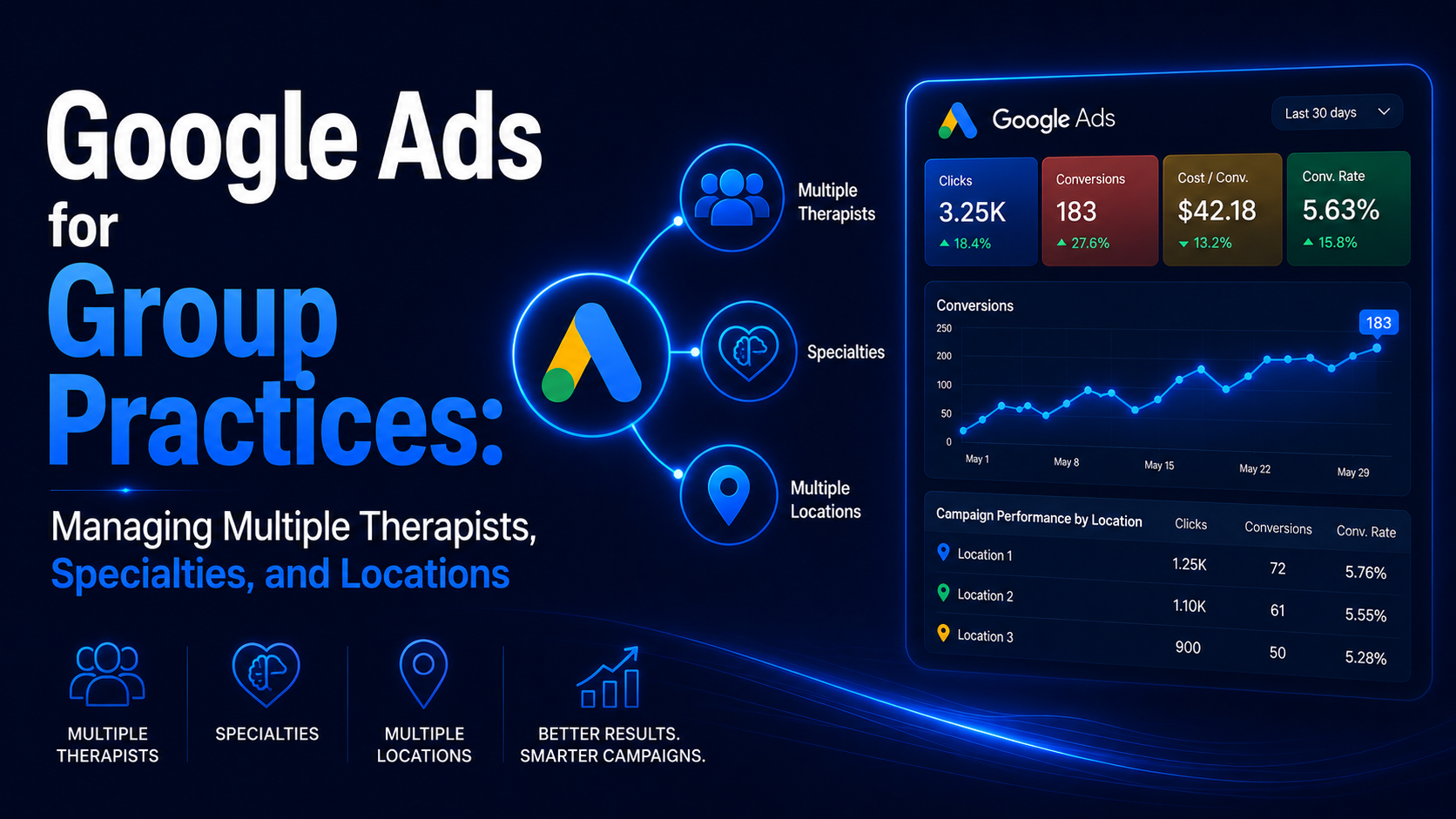
A group practice is not just a bigger solo practice. You have multiple clinicians with different specialties, often more than one location, a single budget stretched across all of it, and the constant challenge of getting the right inquiry to the right therapist. Most Google Ads advice assumes one therapist, one service, one place, which leaves group practices to figure out the hard parts, structure, routing, and budget allocation, on their own.
This guide is written for that reality. It covers how to structure a group practice’s Google Ads account, route leads to the right clinician and office, manage a shared budget, and measure what is actually working across specialties and locations.
Quick answer: Running Google Ads for a group practice means structuring your account by specialty and location, routing each inquiry to the right clinician or office, and allocating a shared budget by priority and capacity. The advantage is scale: group practices have the budget and volume to run structured, profitable campaigns, but only with real management.
Key Takeaways
- A group practice needs structure, not one campaign. Organize by specialty and location so each has its own keywords, ad, and landing page.
- Lead routing is the defining challenge. Every inquiry must reach the right clinician or office, usually through central intake or per-campaign call tracking.
- Advertise only where you have capacity. Running ads for full clinicians or waitlisted specialties wastes budget.
- Allocate a shared budget by priority, weighting toward capacity, return, and growth goals rather than splitting evenly.
- Measure per segment. Track cost per client by specialty and location so you can shift budget to what works.
- Scale is the advantage. Group practices have the budget and data to run structured campaigns profitably, with the right management.
Managing ads across multiple therapists, specialties, and locations? MHIS builds and manages structured Google Ads accounts for group therapy practices. Book a free consultation with MHIS.
Why Group Practices Are Different
A group practice runs one brand and one budget across many clinicians, specialties, and often locations, which turns Google Ads from a single campaign into a portfolio to manage. The core challenges, structuring the account, routing leads to the right therapist, and matching advertising to who actually has openings, simply do not exist for a solo practice.
Think about what varies inside a group practice. Different clinicians specialize in different things, from trauma to couples to teen therapy. Availability shifts constantly, with some clinicians full and others with openings. If you have multiple offices, each serves a different area. Yet it all sits under one budget and one account. A generic single-campaign setup dumps every inquiry into one undifferentiated funnel, sends everyone to the same homepage, and keeps spending on specialties or clinicians who cannot take new clients.
The upside is that group practices have something solo practices do not: the budget and volume to run a properly structured, multi-campaign account and gather enough data to optimize it. Handled well, that scale is a real advantage. Handled generically, it is a lot of budget quietly wasted. For the general framework of the channel, see our guide to Google Ads for therapists.
How to Structure Your Campaigns
Structure your account around what varies in your practice: specialty and location. A single-location group organizes campaigns by specialty; a multi-location group organizes by location first, then specialty within. Each segment gets its own keywords, ad, and dedicated landing page.
The right structure depends on your practice’s shape:
| Practice type | Recommended structure |
|---|---|
| Single location, multiple specialties | Campaigns or ad groups by specialty, each with its own landing page |
| Multiple locations, similar services | Campaigns by location, geo-targeted, with location landing pages |
| Multiple locations and specialties | A matrix: location campaigns, with specialty ad groups or campaigns within each |
| Large practice, high budget | Fully segmented by location and specialty, with per-segment budgets and tracking |
The principle behind all of these is message match. Someone searching “trauma therapist in Denver” should see an ad about trauma therapy in Denver and land on a page about exactly that, not a general practice homepage. That relevance both improves conversions and lowers your costs, because Google rewards it. It does mean building dedicated landing pages for your key specialties and locations rather than sending everyone to one page, which is the single highest-leverage structural decision a group practice makes. Our step-by-step guide on how to create a Google Ads campaign for a therapy practice covers the mechanics of building each campaign.
Lead Routing: Getting Inquiries to the Right Clinician
The defining challenge of a group practice campaign is making sure each inquiry reaches the right clinician or office. This usually happens through a central intake that triages inquiries, or through per-campaign and per-location call tracking, with the routing handled inside your own systems rather than in Google.
There are a few practical approaches, often used together:
- Central intake triage. Most group practices route ads to a central “book a consultation” step, and an intake coordinator matches each inquiry to the right clinician based on specialty, location, and availability. This is simple and flexible, and it keeps a human in the loop for good matching.
- Specialty and location landing pages. Because your ads point to specialty- and location-specific pages, the inquiry already carries context about what the person wants. A form can capture their preferred service or office, and your intake or CRM uses that to route them. Crucially, that routing happens inside your own systems, so no protected information is sent to Google.
- Per-campaign and per-location call tracking. Assign tracking numbers by campaign or office so calls reach the right location, while only a PHI-free conversion signal, that a call happened, is sent to Google.
Above all, match your advertising to your capacity. Only advertise specialties, clinicians, and locations that actually have openings, and pause campaigns for full clinicians or waitlisted specialties. Advertising a service you cannot deliver is one of the fastest ways a group practice wastes budget.
Managing Multiple Locations
For a multi-office practice, treat each location as its own geo-targeted campaign with its own landing page, phone number, and Google Business Profile, and take care that nearby offices do not compete against each other for the same searches.
The essentials for multi-location advertising:
- Geo-target each office to its service area, and use location assets so your address and distance show in ads.
- Build a dedicated landing page per location, which also strengthens your local SEO. Pair this with a complete Google Business Profile for each office, as covered in our guide on local SEO for therapists.
- Use location-specific copy and phone numbers, so each office’s ads feel local and calls route correctly.
- Prevent cannibalization. When two offices serve overlapping areas, define clear geographic boundaries so their campaigns do not bid against each other and inflate your costs.
Multi-location practices that get this right dominate local results across all their markets. Those that run one blended campaign for the whole practice miss the local relevance that drives both ads and organic visibility.
Structuring, routing, and managing all of this across a growing practice is exactly the kind of work that benefits from expertise. MHIS builds and manages segmented Google Ads accounts for group practices, matched with the landing pages and tracking that make them perform. See how our Google Ads management for therapists works.
Managing a Shared Budget
Allocate your budget by priority rather than splitting it evenly. Weight spend toward the specialties and locations that have capacity, produce the best return, and align with your growth goals, and control per-campaign budgets so your priorities are protected.
Three factors should drive allocation:
- Capacity. Put budget where clinicians have openings. There is no point funding a campaign for a specialty that is fully booked, so shift that spend to where you can actually take clients.
- Return. Some specialties and locations convert better or serve higher-value clients. Track which segments produce clients most efficiently and weight toward them.
- Growth goals. If you are trying to build a new location or grow a particular specialty, deliberately fund that campaign even if it is not yet your best performer, as an investment.
Practically, this usually means setting and controlling individual campaign budgets so your priorities are not overrun, rather than pooling everything into a shared budget that Google spends wherever it likes. Shared budgets and portfolio bid strategies have their place at scale, but they need careful use so they do not divert spend away from your priorities. And because your capacity and performance shift over time, budget allocation is not a set-and-forget decision; revisit it regularly. For realistic budget context, see our guide on how much therapists should spend on ads.
Measuring Performance Per Segment
A group practice should measure results by segment, tracking cost per client for each specialty and location, so you can move budget toward what works and away from what does not. This requires PHI-free conversion tracking organized around your campaign structure.
Because your account is structured by specialty and location, your reporting can be too. Track conversions for each campaign, so you can see which specialties and offices generate inquiries and at what cost. Then, using your internally measured close rates, work out the cost per client for each segment. That tells you where your budget produces clients efficiently and where it does not, which is the basis for reallocation.
Keep all of this compliant by ensuring your conversion tracking sends no protected information to Google, and by measuring the client-level steps, like which inquiries became clients, inside your own systems in aggregate. Segment-level measurement is what turns a large, complex account from a guessing game into a managed portfolio, where every location and specialty earns its budget or loses it.
Compliance for Group Practices
Group practices follow the same advertising rules as any therapy practice, with one added layer: you must advertise each service only where the relevant clinician is licensed. Keep copy neutral, avoid standard remarketing, keep tracking free of protected information, and handle central intake compliantly.
The standard rules apply throughout: health is a sensitive category, so you cannot target by condition or run standard remarketing, your ad copy must not imply anyone’s condition, and your conversion tracking must never send protected information to Google. The group-specific wrinkle is licensing and scope. With multiple clinicians, you need to advertise each specialty and location only where the clinician who provides it is licensed, and any teletherapy must respect each clinician’s state authorizations. Your central intake also handles a lot of sensitive information, so it should follow proper privacy practices. This is educational, not legal advice, so confirm your setup with a compliance professional.
Common Mistakes Group Practices Make
- Running one generic campaign for the whole practice, with no specialty or location structure.
- Sending all traffic to the homepage instead of specialty and location landing pages.
- Advertising specialties or clinicians with no capacity, spending on clients you cannot take.
- Having no lead routing, so inquiries are lost or reach the wrong clinician.
- Splitting the budget evenly instead of weighting by capacity, return, and growth priority.
- Not tracking performance per segment, so you cannot see which specialties and locations pay off.
- Letting nearby location campaigns cannibalize each other and inflate costs.
A Group Practice Campaign Blueprint
- Map your specialties, locations, and current capacity, so you know what to advertise and where.
- Structure campaigns by location and specialty, following the model that fits your practice.
- Build a dedicated landing page for each key specialty and location.
- Set up routing, through central intake or per-campaign call tracking, to the right clinician or office.
- Allocate budget by capacity, return, and growth priority, with controlled per-campaign budgets.
- Track conversions and cost per client per segment, using PHI-free tracking.
- Advertise only segments with openings, and pause the rest.
- Reallocate regularly as capacity and performance shift.
Frequently Asked Questions
How should a group practice structure its Google Ads?
Structure your account around what varies in your practice: specialty and location. A single-location group with several specialties should organize campaigns or ad groups by specialty, each with its own keywords, ad, and landing page. A multi-location group should organize by location first, geo-targeting each office, then handle specialties within each location. A practice with both multiple locations and specialties needs a matrix: location campaigns with specialty ad groups or campaigns inside them. The guiding principle is message match, so that someone searching for a specific service in a specific place sees a relevant ad and lands on a matching page, rather than a generic homepage. This structure both improves conversions and lowers costs, and it is the foundation everything else, routing, budget, and measurement, builds on.
How do I route Google Ads leads to the right therapist?
Most group practices route leads through a central intake that triages each inquiry to the right clinician based on specialty, location, and availability, which keeps a human in the loop for good matching. Because your ads point to specialty- and location-specific landing pages, each inquiry already carries context about what the person wants, and a form can capture their preferred service or office to help route them. Per-campaign and per-location call tracking sends calls to the right office directly. The important compliance point is that all of this routing happens inside your own intake or CRM systems, so no protected information is sent to Google; only PHI-free conversion signals go to the ad platform. Matching inquiries to the right clinician quickly is one of the biggest levers a group practice has for converting more of them.
Should each specialty have its own campaign?
For most group practices, yes, or at least its own ad group with dedicated ads and a matching landing page. Different specialties attract different searchers with different needs, so a trauma campaign, a couples campaign, and a teen therapy campaign each perform better when their keywords, copy, and landing pages speak specifically to that service. This message match improves conversion rates and can lower your costs, since Google rewards relevance. Whether you use separate campaigns or ad groups depends on your budget and how much control you need; separate campaigns give you independent budgets and clearer reporting, which larger practices usually want. The key point is to avoid lumping all specialties into one generic campaign pointing at your homepage, which dilutes relevance and makes it impossible to see which specialties actually pay off.
How do I run Google Ads for multiple locations?
Treat each location as its own geo-targeted campaign with its own landing page, phone number, and Google Business Profile. Geo-target each office to the specific area it serves, use location assets so your address and distance appear in ads, and build a dedicated landing page for each office, which also strengthens local SEO. Use location-specific copy and tracking numbers so each office’s ads feel local and calls route correctly. A crucial detail is preventing cannibalization: when two offices serve overlapping areas, define clear geographic boundaries so their campaigns do not bid against each other and drive up your costs. Multi-location practices that structure by office dominate local results across all their markets, while those running one blended campaign lose the local relevance that drives both paid and organic visibility. Pair each location campaign with a complete Google Business Profile for the best results.
How should a group practice allocate its ad budget?
Allocate by priority, not evenly. Weight your budget toward three things: capacity, meaning fund campaigns where clinicians actually have openings; return, meaning put more into specialties and locations that produce clients efficiently or serve higher-value clients; and growth goals, meaning deliberately invest in a new location or specialty you are trying to build. Practically, this usually means setting and controlling individual campaign budgets so your priorities are protected, rather than pooling everything into one shared budget that Google spends wherever it chooses. Shared budgets and portfolio strategies can help at scale but need careful use. Because your capacity and performance shift over time, revisit your allocation regularly and move budget toward segments with openings and strong returns. Even budget splits ignore that some specialties and locations need clients more, and can take more, than others.
Should I advertise specialties where clinicians are full?
No. Advertising a specialty, clinician, or location that has no capacity is one of the fastest ways a group practice wastes budget, because you pay for inquiries you cannot serve, and turning people away damages their experience. Match your advertising to your actual openings: pause campaigns for full clinicians or waitlisted specialties, and shift that budget to services and offices that can take new clients. This is a constant adjustment in a group practice, since availability changes as clinicians fill up or open up. Building this discipline in, checking capacity and updating which campaigns are active, protects your budget and ensures every ad dollar goes toward clients you can actually help. It is a simple principle that generic advice ignores, but it makes a large difference to a group practice’s return.
How do I avoid my location campaigns competing with each other?
Define clear geographic boundaries for each office’s campaign so they do not overlap. When two locations serve nearby areas, their geo-targeting can overlap, causing both campaigns to bid on the same searches, which inflates your costs and effectively means you are bidding against yourself. To prevent this, assign each location a distinct service area, and where areas naturally overlap, decide which office should own that zone based on proximity or capacity, then set your targeting and exclusions accordingly. This keeps each campaign focused on its own market and stops internal competition from driving up your cost per click. Regularly review your location reports to catch any overlap that develops. Careful geographic boundaries are essential once a practice has more than one office, and they are easy to overlook when campaigns are set up one at a time.
Do I need separate landing pages for each specialty and location?
For the best results, yes. Dedicated landing pages are what make message match work: a person searching for a specific service in a specific place should land on a page about exactly that, not a general practice homepage. Specialty pages let you speak directly to what each type of client is looking for, and location pages provide local relevance that helps both your ads and your local SEO. This precision improves conversion rates and can lower your ad costs, since Google rewards relevant destinations. Building these pages is more work upfront, but it is the single highest-leverage structural decision a group practice makes for its ads. You do not necessarily need a page for every possible combination at once; start with your priority specialties and locations, and expand as you scale. Sending everyone to the homepage is the most common and costly shortcut.
How do I measure which specialties and locations are profitable?
Because your account is structured by specialty and location, measure results the same way. Track conversions for each campaign so you can see which specialties and offices generate inquiries and at what cost per lead. Then apply your internally measured close rates to calculate cost per client for each segment, which tells you where your budget produces clients efficiently. Comparing cost per client against the value of a client in each segment shows you what is genuinely profitable. Keep this compliant by ensuring conversion tracking sends no protected information to Google, and by measuring the client-level steps inside your own systems in aggregate. This segment-level view is what lets you shift budget toward profitable specialties and locations and away from underperforming ones, turning a large, complex account into a managed portfolio where every part earns its keep.
What are the compliance considerations for a group practice running ads?
Group practices follow the same rules as any therapy advertiser, plus a licensing layer. The standard rules apply: health is a sensitive category, so you cannot target by condition or use standard remarketing, your copy cannot imply anyone’s condition, and your conversion tracking must never send protected information to Google. The group-specific consideration is that you must advertise each service only where the clinician who provides it is licensed, and any teletherapy must respect each clinician’s state authorizations, which gets more complex with multiple clinicians across multiple states. Your central intake also handles a great deal of sensitive information, so it should follow proper privacy and security practices. Because the compliance picture is more involved for a group practice, and the stakes are higher, it is worth reviewing your setup with a compliance professional rather than assuming a standard configuration covers you.
Is Google Ads worth it for a group practice?
For most group practices, yes, and often more clearly than for solo practices, because group practices have advantages that make ads pay off. They have larger budgets that can gather enough data to optimize well, more capacity to fill across multiple clinicians, and multiple specialties and locations to advertise, which spreads risk and opportunity. The key is structure: a group practice that runs one generic campaign will waste much of its budget, while one that structures by specialty and location, routes leads well, advertises only where it has capacity, and measures per segment can produce strong, scalable returns. The scale that makes a group practice complex is also what makes it well suited to advertising, provided the account is managed properly. Judge it as you would any channel, by cost per client against client value, measured for each segment.
Should a group practice manage ads in-house or hire an agency?
It depends on your internal resources, but the complexity of a group practice account often tips the balance toward expert help. Running a structured, multi-campaign account, with specialty and location segmentation, lead routing, capacity-based budget allocation, per-segment measurement, and multi-clinician compliance, is substantially more involved than a solo campaign, and getting it wrong wastes a larger budget. If you have dedicated, experienced marketing staff, in-house management is feasible. Many group practices, though, find that a specialist who understands both Google Ads and the operational realities of a group therapy practice delivers better returns, because they build the structure correctly, keep it compliant, and continuously reallocate budget toward what works. Given the size of the budgets involved and the value of each client, professional management frequently pays for itself. Whichever route you choose, the structure and discipline described here are what make the account succeed.
Final Key Takeaways
- A group practice needs a structured account organized by specialty and location, not one generic campaign.
- Lead routing, through central intake or per-campaign call tracking, is the defining challenge, and it stays inside your own systems.
- Advertise only where you have capacity, and pause campaigns for full clinicians or specialties.
- Allocate a shared budget by capacity, return, and growth priority, with controlled per-campaign budgets.
- Measure cost per client per segment so you can reallocate toward what works.
Action Checklist
- Map your specialties, locations, and current clinician capacity.
- Structure campaigns by location and specialty to fit your practice.
- Build dedicated landing pages for priority specialties and locations.
- Set up lead routing to the right clinician or office, kept inside your own systems.
- Allocate budget by capacity, return, and growth priority.
- Track conversions and cost per client per segment, PHI-free.
- Advertise only segments with openings, and pause the rest.
- Prevent nearby location campaigns from cannibalizing each other.
Conclusion
A group practice’s size is both its complexity and its advantage. The multiple clinicians, specialties, and locations that make a generic campaign fail are exactly what a well-structured account turns into strength. Organize your campaigns by specialty and location, build landing pages that match, route every inquiry to the right clinician, advertise only where you have capacity, and allocate your budget by priority rather than splitting it evenly. Measure cost per client for each segment, and keep reallocating toward what works. Do this, and the scale that overwhelms an unstructured account becomes a genuine edge, letting your practice fill openings across every specialty and office efficiently and profitably.
If building and managing a structured account across your whole practice is not where your time is best spent, a therapy-focused marketing partner can run it for you.
Want a Google Ads account built for the complexity of a group practice? MHIS will structure your campaigns, build your landing pages, set up routing and tracking, and manage the whole account across Google Ads and local SEO. Book your free consultation with MHIS today.