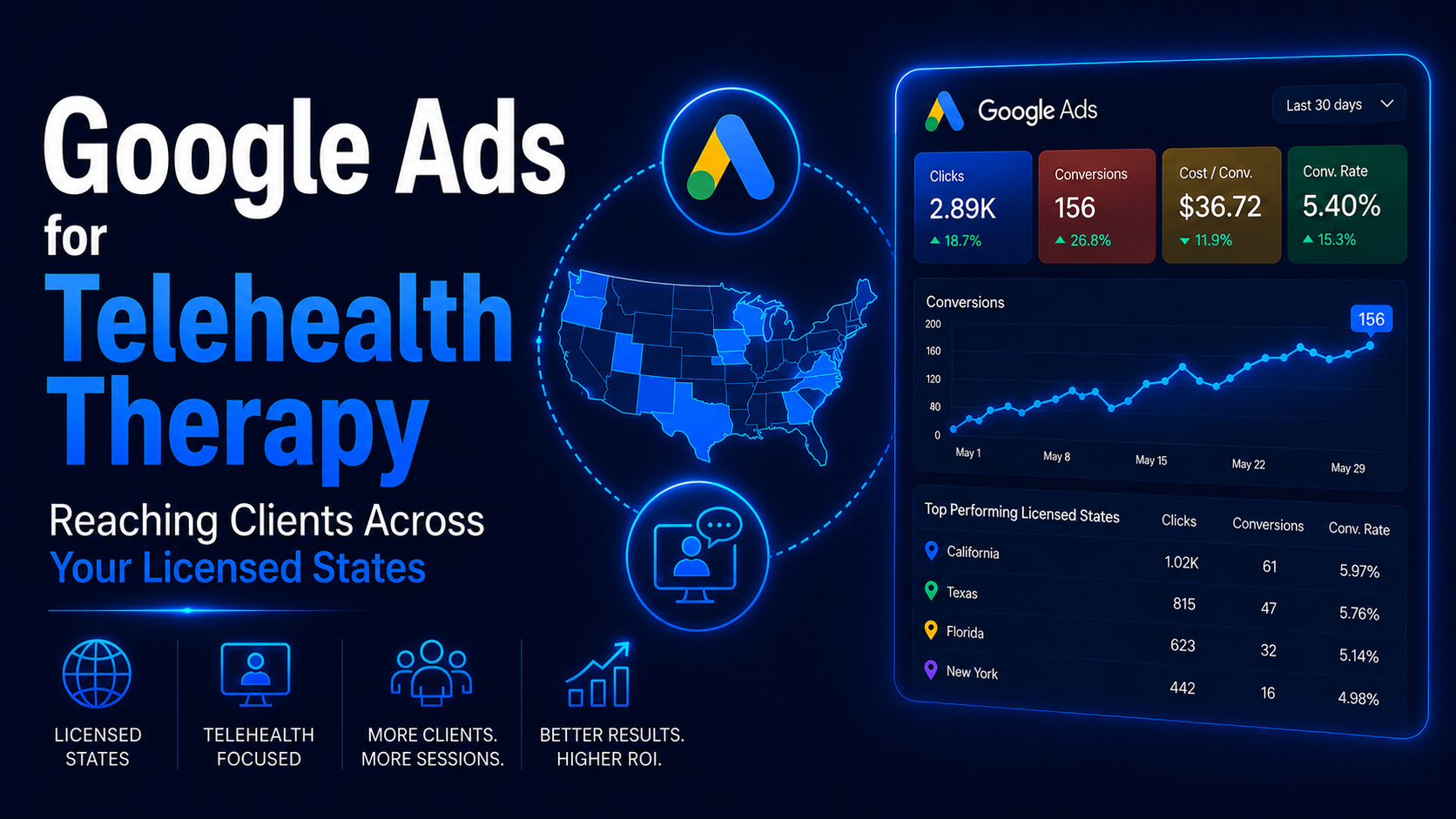
Teletherapy changed the size of your market. Instead of reaching only the people near your office, you can serve clients anywhere you are licensed, which for many therapists now means several states at once. Google Ads is one of the most direct ways to reach those clients, but only if you get two things right: advertising exactly where you are authorized to practice, and standing out from the large online-therapy platforms that dominate the generic searches.
This guide covers how to run Google Ads for telehealth therapy the right way, from the licensing rules that decide where you can advertise, to multi-state targeting, to messaging and keywords that reach online-first clients without competing head-on with the big platforms.
Quick answer: To advertise telehealth therapy on Google Ads, geo-target only the states where you are licensed, or where an interstate compact such as PSYPACT authorizes you, and exclude everywhere else. Structure your targeting by state, message online-first clients clearly, and compete on state and specialty specificity rather than generic “online therapy” terms.
Key Takeaways
- You can only advertise teletherapy where you are licensed. The client’s physical location during the session decides which state’s license you need.
- Telehealth does not extend your license across state lines. Being online does not remove state licensing requirements.
- Interstate compacts can expand your reach. PSYPACT lets eligible psychologists practice across many states, with counseling and social work compacts developing.
- Target only your licensed states, set to presence, and exclude everywhere else so you never advertise where you cannot practice.
- Compete on state and specialty specificity, not generic “online therapy” terms dominated by large platforms with huge budgets.
- Message online-first clients directly, emphasizing convenience, security, effectiveness, and how virtual sessions work.
Want to reach clients across every state you are licensed in, without stepping outside the rules? MHIS builds compliant, multi-state Google Ads campaigns for teletherapy practices. Book a free consultation with MHIS.
A quick note: This article is educational and reflects the licensing and advertising landscape as of 2026. It is not legal advice, and compact membership and rules change frequently. Always confirm your current authorization with your licensing board before advertising in any state.
Why Telehealth Is a Distinct Google Ads Opportunity
Teletherapy expands your addressable market from your local area to your entire licensed footprint, which may span multiple states. Demand for online therapy is high and normalized, and Google Ads lets you reach clients who specifically want virtual care. The catch, and the whole game, is that you can only advertise where you are licensed.
For a local, in-person practice, Google Ads reaches people in one city or region. For a teletherapy practice, the same ads can reach clients across every state where you hold a license, which dramatically increases the pool of people you can serve. Demand supports it: many clients now actively prefer online therapy for its convenience, and search for it directly.
That larger market is the opportunity. The constraint that shapes everything is licensing. Unlike a local practice, where geo-targeting is simply about your service radius, a teletherapy practice must align its targeting precisely with where it is legally authorized to practice, because advertising in a state where you are not licensed is a real problem. Get that alignment right, and telehealth is one of the most scalable ways to grow a practice. For the general framework of the channel, see our guide to Google Ads for therapists.
The Licensing Rule You Must Get Right
You can only provide, and therefore only advertise, teletherapy in states where you are licensed or otherwise legally authorized. The client’s physical location at the time of the session determines which state’s license applies, so you must be licensed where the client is, not where you are. Telehealth does not extend your license across state lines.
This is the single most important rule in teletherapy advertising, and it is where practices most often go wrong. It feels like online therapy can happen from anywhere, but licensure remains tied to physical location. If a client is sitting in a state during their session, you generally need to be licensed, compact-authorized, or otherwise permitted to practice in that state, regardless of where you are located.
The practical implications for your ads:
- Advertise only in states where you are authorized. Every state you target must be one where you can legally see clients.
- Exclude everywhere else. Your campaigns should never serve in states where you are not licensed.
- Target by the client’s location. Set your geo-targeting to reach people physically located in your licensed states.
Getting this wrong is not a minor optimization issue. It is a compliance and scope-of-practice problem, which is why aligning your targeting exactly with your licensing is the foundation of any teletherapy campaign.
Interstate Compacts That Expand Where You Can Advertise
Interstate licensure compacts can significantly expand the states where you are authorized to practice teletherapy, which in turn expands where you can advertise. PSYPACT is operational for eligible psychologists across roughly 40 states, while the counseling and social work compacts are developing, and there is no compact for marriage and family therapists yet.
Compacts are one of the most important and least understood tools for scaling a teletherapy practice, because they can multiply your addressable market. Here is the current landscape, which you must verify for your own profession and states.
| Profession | Compact | Status as of 2026 |
|---|---|---|
| Psychologists | PSYPACT | Operational across roughly 40 participating states; eligible psychologists use an Authority to Practice Interjurisdictional Telepsychology through the E.Passport system |
| Licensed professional counselors | Counseling Compact | Enacted in around 40 states, but issuing privileges in only a handful so far, expanding through the year; verify which of your states are live |
| Social workers | Social Work Licensure Compact | Enacted in 20-plus states and activated, but multistate privileges are not yet being issued |
| Marriage and family therapists | None | No national compact yet; add licenses state by state |
A crucial distinction to understand: a state having enacted a compact is not the same as the compact being operational and issuing privileges there. Many states have passed compact legislation but are not yet live for actual practice authority. Before you advertise in a state based on a compact, confirm that the compact is operational there for your profession and that you hold the required authorization. Compacts reduce the licensing barrier, but they do not change the client’s state rules, which still apply. Because this landscape changes constantly, verify current membership and operational status with your licensing board and the official compact commission before relying on it.
How to Structure Multi-State Targeting
Structure your campaigns around your licensed states. Geo-target only those states, set targeting to people physically present in them, and exclude everywhere else. For a few states, per-state campaigns give you control over budget, bids, and messaging; for many states, group them into regional campaigns and prioritize by demand and competition.
Your structure depends on how many states you serve:
| Your licensing situation | Recommended structure |
|---|---|
| Licensed in one state | Single campaign geo-targeted to that state |
| Licensed in a few states | Per-state campaigns for budget and message control, or one multi-state campaign for simplicity |
| Compact-authorized across many states | Group states into regional campaigns, prioritized by demand and competition |
| Online-only across states and specialties | State campaigns with specialty ad groups and state-specific landing pages |
Two settings matter especially here. First, set your location targeting to reach people who are physically present in your targeted states, not merely interested in them, so your ads do not serve to someone in a state where you cannot practice. Second, add exclusions for every state outside your license, as a safeguard.
Per-state campaigns are worth the extra effort when your states differ in cost, competition, or client value, because they let you set budgets and bids for each and tailor the messaging. State-specific landing pages, such as a page for online therapy in a given state, also improve relevance and support your visibility. Our step-by-step guide on how to create a Google Ads campaign for a therapy practice covers building each campaign, and the multi-state approach parallels how a multi-location practice structures its account.
Keywords for Telehealth Therapy
Target online-specific terms combined with state and specialty for the best results. Generic terms like “online therapy” are dominated by large platforms with huge budgets, so state and specialty specificity, such as “online trauma therapist” in a given state, reaches motivated clients at lower cost.
| Keyword type | Examples |
|---|---|
| Core online terms | online therapist, virtual therapy, teletherapy, online counseling |
| State-specific | online therapist in your state, online counseling in your state, virtual therapy in your state |
| Specialty plus online | online anxiety therapist, online trauma therapy, online couples counseling |
| State plus specialty, best against big platforms | online trauma therapist in your state, virtual couples counseling in your state |
| Negative keywords | free, app, jobs, become a, in-person, and platform brand terms if you prefer not to compete on them |
The strategic point is that the most generic, highest-volume terms are also the most expensive and most competitive, because venture-backed platforms bid aggressively on them. A solo or small teletherapy practice usually wins by going specific: combining a state, a specialty, and the online modality reaches people who want exactly what you offer, at a cost you can afford. Negative keywords matter too, filtering out people seeking free resources, apps, or training. Review your search terms report regularly and keep refining.
Messaging Online-First Clients
Speak directly to clients who want virtual care. Emphasize that sessions are fully online and convenient, delivered securely, available across the states you serve, and just as effective as in-person therapy. Address the common hesitations about online therapy, and keep your copy neutral and compliant.
What resonates with online-first clients:
- Convenience and access. Sessions from home, flexible scheduling, no commute.
- Security and privacy. A secure, HIPAA-aware video platform, which reassures privacy-conscious clients.
- Effectiveness. Online therapy is evidence-based and effective, which addresses a common doubt.
- Availability across your states. Make clear which areas you serve, honestly and specifically.
- How it works. A simple explanation of what a virtual session looks like removes uncertainty.
Keep two compliance points in mind. Your copy must stay neutral and not imply the client’s condition, and it must be accurate about where you serve. Do not suggest nationwide availability if you are licensed in a few states. Honest, specific messaging both keeps you compliant and builds trust with clients weighing whether online therapy is right for them.
Building a compliant, multi-state teletherapy campaign that competes effectively is exactly the kind of work that benefits from expertise. MHIS builds and manages teletherapy Google Ads campaigns matched to your licensing and designed to reach online-first clients. See how our Google Ads management for therapists works.
Competing With the Big Teletherapy Platforms
Large online-therapy platforms like BetterHelp and Talkspace dominate generic “online therapy” searches with enormous budgets, so competing head-on there is a losing game for most practices. Win instead by targeting state and specialty specificity, and by emphasizing what platforms cannot offer: a consistent, licensed therapist and genuine specialty depth.
The reality of this niche is that venture-funded platforms outspend individual practices by orders of magnitude on the most generic keywords. Trying to outbid them on “online therapy” will drain your budget fast. Your advantages lie elsewhere:
- Specificity. Platforms compete on broad terms; you can own “online [specialty] therapist in [state]” style searches, which they cover thinly.
- Consistency. Platforms often match clients to rotating or changing therapists. You offer a real, consistent relationship with one licensed clinician, which many clients specifically want.
- Specialty depth. You can go deep in a niche, such as trauma or couples work, in a way a general platform cannot.
- A human, not an app. Emphasize that clients work directly with you, a licensed professional, rather than being matched by an algorithm.
Leaning into these differences, rather than fighting on the platforms’ turf, is how an independent teletherapy practice competes and wins.
Compliance for Telehealth Ads
Teletherapy advertising follows the standard therapy rules plus the licensing requirement. Advertise only where you are licensed or compact-authorized, keep copy neutral and honest about where you serve, avoid standard remarketing, keep tracking free of protected information, and deliver sessions on a HIPAA-aware platform under a Business Associate Agreement.
The requirements to keep in mind:
- License-matched targeting. Only advertise in states where you can legally practice, determined by the client’s location.
- Accurate claims. Do not imply broader availability than your licensing allows.
- Neutral copy. Health is a sensitive category, so your ads cannot imply the client’s condition.
- No standard remarketing, which is restricted for health advertisers.
- PHI-free tracking. Your conversion tracking must never send protected information to Google.
- A compliant platform. Deliver sessions on a HIPAA-aware video platform that will sign a Business Associate Agreement.
This is educational, not legal advice, and the licensing landscape shifts, so confirm your specific situation with your licensing board and a compliance professional.
Common Mistakes in Telehealth Campaigns
- Advertising in states where you are not licensed, the most serious and common error.
- Targeting people interested in a location rather than physically present in it, which can reach clients you cannot serve.
- Competing head-on with platforms on generic “online therapy” terms and burning through budget.
- Skipping state and specialty specificity, which is where independent practices actually win.
- Not addressing online-therapy hesitations on the landing page.
- Ignoring interstate compacts that could legitimately expand your reach.
- Assuming enacted compacts are operational, when many are not yet issuing privileges.
- Sending traffic to a generic homepage instead of a teletherapy-focused, ideally state-specific, page.
A Telehealth Campaign Blueprint
- List every state where you are licensed or compact-authorized, and verify current status with your board.
- Geo-target only those states, set targeting to physical presence, and exclude the rest.
- Structure campaigns by state or region for budget and message control.
- Build teletherapy landing pages, ideally state-specific, rather than using your homepage.
- Target state and specialty keywords to avoid competing with the big platforms.
- Message online-first clients, emphasizing convenience, security, effectiveness, and how it works.
- Keep copy neutral and honest, and tracking free of protected information.
- Re-verify licensing and compact status before adding or continuing any state.
Frequently Asked Questions
Can therapists advertise teletherapy on Google Ads?
Yes, teletherapy is well suited to Google Ads, because it lets you reach clients across every state where you are authorized to practice, not just your local area. The essential requirement is that you can only advertise in states where you are licensed or otherwise legally permitted to practice, since the client’s physical location during a session determines which state’s license applies. So you geo-target only your licensed states, exclude everywhere else, and target people physically present in those states. Beyond that, teletherapy advertising follows the same rules as any therapy campaign: neutral copy, no standard remarketing, and PHI-free tracking. Done correctly, it is one of the most scalable ways to grow a practice, because your addressable market can span multiple states rather than one city.
Where can I legally advertise my online therapy services?
You can advertise online therapy only in states where you are licensed or otherwise legally authorized to practice, such as through an interstate compact. The governing principle is that the client’s physical location at the time of the session determines which state’s license you need, so being online does not free you from state licensing. In practice, that means your Google Ads should geo-target only your licensed and compact-authorized states, with everywhere else excluded, and your targeting set to reach people physically present in those states. If you hold licenses in several states, or qualify for a compact like PSYPACT, you can advertise across all of them. Before advertising in any state, confirm your current authorization there, because advertising where you cannot legally practice is a compliance and scope-of-practice problem.
Does offering telehealth let me practice in any state?
No. This is one of the most common misconceptions in teletherapy. Offering services online does not extend your license across state lines, because licensure remains tied to physical location. You generally need to be licensed, compact-authorized, or otherwise legally permitted in the state where the client is located during the session, regardless of where you are. So a therapist licensed in one state cannot simply see clients nationwide by going virtual. To serve clients in additional states, you must either hold a license in each state, qualify for an interstate compact that covers your profession and is operational in those states, or use another lawful authorization pathway. This directly shapes your advertising, since you can only target states where you are authorized. Always verify your authorization before serving or advertising to clients in a given state.
What is PSYPACT, and how does it affect my advertising?
PSYPACT, the Psychology Interjurisdictional Compact, is an interstate compact that lets eligible licensed psychologists practice telepsychology across participating states without obtaining a separate license in each one. As of 2026 it is operational and adopted in roughly 40 states, and qualifying psychologists obtain an Authority to Practice Interjurisdictional Telepsychology through the E.Passport system. For your advertising, PSYPACT can dramatically expand where you can legally reach clients, because if you hold the authorization, you can advertise across all participating jurisdictions rather than a single state. Two caveats matter: PSYPACT is for psychologists only, not counselors, social workers, or marriage and family therapists, and you must actually hold the authorization and meet compact requirements. Verify your current PSYPACT authorization and the participating states before targeting them, since the compact continues to evolve.
Can counselors and social workers use a compact for teletherapy?
It depends on the compact’s operational status, which is developing. The Counseling Compact, for licensed professional counselors, has been enacted in around 40 states, but as of 2026 it is only issuing practice privileges in a handful of live states, with more expected to come online. The Social Work Licensure Compact has been enacted in over 20 states and activated, but multistate privileges are not yet being issued. So while both compacts are progressing, they are not yet as broadly usable as PSYPACT is for psychologists. The key distinction is that a state enacting a compact is not the same as the compact being operational and issuing privileges there. Counselors and social workers should verify, for each state, whether the compact is actually live for their profession before relying on it to advertise or practice, since this landscape is changing quickly.
How do I target multiple states in Google Ads?
Set your campaign geo-targeting to include only the states where you are licensed or compact-authorized, exclude everywhere else, and set your location options to reach people physically present in those states rather than merely interested in them. For a few states, you can either run one campaign targeting all of them for simplicity, or, better for control, run a separate campaign per state so you can set individual budgets, bids, and messaging, since states differ in cost and competition. For many states under a compact, group them into regional campaigns and prioritize by demand and competition. Pair this with state-specific landing pages where practical, which improves relevance. The critical safeguard is the exclusions: make sure your ads can never serve in a state where you are not authorized to practice, which protects you from advertising outside your license.
Should I run a separate campaign for each state?
For most multi-state teletherapy practices, per-state campaigns are worth the extra effort, though it depends on how many states you serve and how different they are. Separate campaigns let you set individual budgets and bids, which matters because cost per click and competition vary significantly between states, and they let you tailor messaging and use state-specific landing pages. That control helps you invest more where returns are strong and less where they are not. If you serve just two or three similar states on a small budget, a single multi-state campaign can be simpler to manage. If you serve many states through a compact, grouping them into regional campaigns is more practical than one campaign per state. The general principle is that more granular structure gives more control, which pays off as your state footprint and budget grow.
What keywords should I target for online therapy?
Target online-specific terms combined with state and specialty, rather than competing on the most generic terms. Core online terms include “online therapist,” “virtual therapy,” “teletherapy,” and “online counseling,” but these are expensive and dominated by large platforms. You will get better results combining the online modality with a state and a specialty, such as “online trauma therapist” in your state or “virtual couples counseling” in your state, which reaches motivated clients who want exactly what you offer at a lower cost. Add specialty-plus-online terms like “online anxiety therapist” as well. Use negative keywords to filter out searches for free resources, apps, jobs, and training, and consider excluding platform brand terms if you prefer not to compete on them. Specificity is your advantage as an independent practice, so lean into state and specialty combinations rather than broad, costly terms.
How do I compete with BetterHelp and Talkspace?
Do not compete with them head-on. Large online-therapy platforms outspend individual practices enormously on generic “online therapy” keywords, so bidding against them there drains your budget quickly. Instead, compete on the advantages they cannot match. Target state and specialty specificity, owning searches like “online [specialty] therapist in [state]” that platforms cover only thinly. Emphasize consistency, since platforms often match clients to rotating or changing therapists, while you offer a genuine, ongoing relationship with one licensed clinician, which many clients specifically want. Highlight specialty depth, going deeper in a niche than a general platform can. And stress that clients work directly with you, a real licensed professional, rather than being matched by an algorithm. By focusing on specificity, consistency, and a human relationship, an independent practice competes on quality and fit rather than budget, which is a game it can actually win.
What should a teletherapy landing page include?
A teletherapy landing page should match your ad, speak to online-first clients, and make booking easy. Include a headline about virtual therapy that reflects the ad, a clear statement of which states you serve, and an explanation of how online sessions work to remove uncertainty. Address the common hesitations directly: reassure clients that online therapy is effective and evidence-based, and that sessions are private and secure on a HIPAA-aware platform. Show your photo, credentials, and specialties to build trust, and emphasize the convenience of therapy from home with flexible scheduling. Make booking a consultation simple, ideally with online scheduling. Because therapists face ethical limits on client testimonials, build credibility through your qualifications and approach rather than reviews. State-specific pages, where practical, improve relevance further. The page should convert an interested visitor into a booked session while honestly reflecting where you can serve.
How do I reassure clients who are unsure about online therapy?
Address their specific concerns directly on your landing page and in your messaging. The most common hesitations are whether online therapy actually works, whether it is private and secure, and how it practically functions. Reassure them that online therapy is evidence-based and effective, comparable to in-person care for many needs, which addresses the effectiveness doubt. Explain that sessions take place on a secure, HIPAA-aware video platform, which reassures privacy-conscious clients. Walk through what a virtual session looks like, so the unfamiliar becomes concrete and less intimidating. Emphasize the convenience of attending from home on a flexible schedule, which is often what drew them to consider online therapy in the first place. By acknowledging and answering these concerns rather than ignoring them, you meet hesitant clients where they are and make it easier for them to take the step of booking.
Can I advertise teletherapy nationally?
Only if you are actually licensed or compact-authorized nationally, which almost no individual therapist is. Advertising teletherapy nationally while licensed in only a few states is a compliance and scope-of-practice problem, because you would be marketing services you cannot legally provide in most of the country. Your advertising must match your authorization: target only the states where you can practice, and exclude the rest. Even psychologists using PSYPACT, which is broad, are limited to participating jurisdictions where they hold authorization, not the entire country. If you want to expand your reach, the lawful path is to add licenses in more states or use an operational compact that covers your profession, then extend your targeting to match. Advertising honestly and only where you are authorized protects both your license and your clients, and it is a firm requirement rather than a best practice.
What are the compliance rules for advertising teletherapy?
Teletherapy advertising combines the standard therapy rules with a licensing requirement. First and foremost, advertise only in states where you are licensed or compact-authorized, determined by the client’s location, and keep your claims about where you serve accurate. Then the usual rules apply: health is a sensitive category, so your copy cannot imply the client’s condition, you cannot use standard remarketing, and your conversion tracking must never send protected information to Google. On the delivery side, sessions should take place on a HIPAA-aware video platform that will sign a Business Associate Agreement. Because the licensing landscape and platform rules both change, and because scope-of-practice questions can be nuanced across states, confirm your specific setup with your licensing board and a compliance professional. This is educational, not legal advice, and getting the licensing piece right is essential before you advertise anywhere.
Should I hire someone to run my teletherapy ads?
It depends on your comfort with the complexity, which is higher for teletherapy than for a single-location practice. A teletherapy campaign involves precise multi-state targeting aligned to your licensing, structuring campaigns by state or region, building teletherapy landing pages, competing intelligently against well-funded platforms, and keeping everything compliant, including the critical requirement never to advertise where you are not authorized. That is a lot to manage well, and mistakes carry compliance risk. A specialist who understands both Google Ads and the licensing realities of teletherapy can build the campaign correctly, keep your targeting aligned with your authorizations, and help you compete on specificity rather than budget. If you have the time and expertise, you can run it yourself, but given the licensing stakes and the competitive landscape, many teletherapy practices find professional management worthwhile. Whatever you choose, verifying your licensing before advertising is non-negotiable.
Final Key Takeaways
- Teletherapy expands your market to every state where you are authorized, which Google Ads can reach efficiently.
- You can only advertise where you are licensed, determined by the client’s physical location during the session.
- Interstate compacts, led by PSYPACT for psychologists, can expand your reach, but verify operational status per state.
- Target only your licensed states, set to physical presence, and exclude everywhere else.
- Win against big platforms with state and specialty specificity and a consistent, human, specialized relationship.
Action Checklist
- List every state where you are licensed or compact-authorized, and verify current status.
- Geo-target only those states, set to physical presence, and exclude the rest.
- Structure campaigns by state or region for control.
- Build teletherapy landing pages, ideally state-specific.
- Target state and specialty keywords, not generic “online therapy” terms.
- Message online-first clients on convenience, security, effectiveness, and how it works.
- Keep copy neutral and honest, and tracking PHI-free.
- Re-verify licensing and compact status before adding or continuing any state.
Conclusion
Teletherapy gives your practice a far larger market than a local office ever could, and Google Ads is one of the most direct ways to reach it. The two things that decide your success are discipline and differentiation. Discipline means advertising only where you are licensed or compact-authorized, targeting by the client’s location, and verifying your authorization as compacts and rules evolve. Differentiation means competing on state and specialty specificity and on the consistent, human, specialized relationship the big platforms cannot offer, rather than outspending them on generic terms. Get the licensing right, structure your targeting by state, message online-first clients clearly, and you can grow a teletherapy practice across every state you serve, compliantly and profitably.
If building and managing a compliant, multi-state teletherapy campaign is not where your time is best spent, a therapy-focused marketing partner can handle it for you.
Want to reach online-first clients across every state you are licensed in? MHIS will build your multi-state targeting, teletherapy landing pages, and compliant campaigns, and manage them across Google Ads and beyond. Book your free consultation with MHIS today.