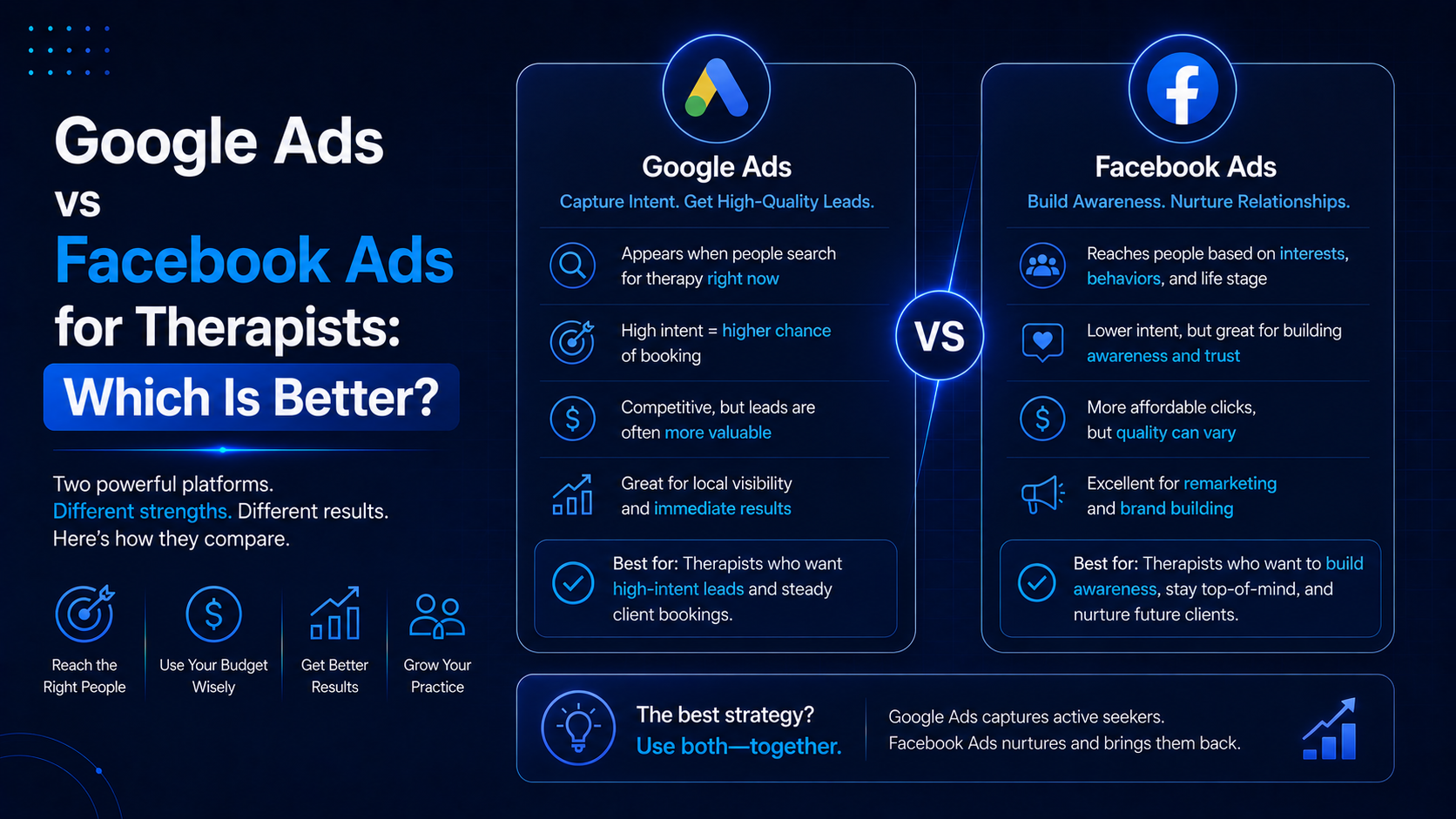
You have a marketing budget and a choice to make: put it into Google Ads, Facebook Ads, or split it between them. The question sounds like it should have a winner, but it does not, at least not in the way most people expect. Google and Facebook are not two versions of the same thing. They do fundamentally different jobs, and the right choice depends on what you need and where your practice is.
This guide explains the real difference between the two, how each handles the compliance limits around mental health, and which one fits your practice, so you can put your budget where it will actually work.
Quick answer: Google Ads and Facebook Ads do different jobs for a therapy practice. Google captures people who are actively searching for a therapist, which makes it higher intent and usually the better starting point for direct client acquisition. Facebook and Instagram reach people who are not searching yet, so they work for awareness, education, and staying visible. For most therapists, start with Google, then add Facebook.
Key Takeaways
- They do different jobs. Google captures existing demand; Facebook creates awareness and interest.
- Intent is the core difference. Google reaches people actively looking for a therapist, while Facebook interrupts people who are not.
- For direct client acquisition, Google usually wins, especially for practices that need clients now and have a limited budget.
- Facebook is for awareness and reinforcement, reaching people before they search and staying top of mind, which takes longer to pay off.
- Both restrict mental health targeting, but differently, and neither pixel is HIPAA safe out of the box.
- The strongest approach is often both, in sequence: start with Google to capture demand, then add Facebook to build awareness and retarget engaged audiences.
Not sure where to put your ad budget? MHIS helps therapy practices choose the right channel for their goals and runs compliant campaigns on both. Book a free consultation with MHIS.
The Core Difference: Active Demand vs Interruption
Google captures active demand, and Facebook interrupts. Someone on Google is typing “trauma therapist near me” because they have decided to find help. Someone on Instagram is scrolling through friends, memes, and news, not looking for a therapist at all. That single difference in mindset drives everything else about the two platforms.
Think about how people actually behave. No one opens Instagram thinking, “I should find a therapist today.” That is not how the decision to start therapy begins. So on Facebook and Instagram, your ad meets a person who was not looking for you, which means the job is to catch attention, build awareness, and plant a seed. On Google, your ad meets a person at the exact moment they are ready to act, so the job is simply to be there and make it easy to book.
This is why the two platforms differ on funnel stage, cost model, creative demands, and expected results. Google works lower in the funnel, closer to the decision. Facebook works higher in the funnel, closer to the first spark of interest. Neither is better in the abstract. They are better at different things.
Google Ads for Therapists: Capturing Active Demand
Google Ads place your practice at the top of search results when someone searches for a therapist, and you pay per click. Because these people are actively looking, Google delivers the highest-intent traffic and is usually the fastest way to book new clients.
How it works: you bid on keywords like “anxiety therapist Denver” or “couples counseling near me,” write ads, set a budget, and target your service area. When someone searches, your ad can appear at the top, and you pay only when they click.
The strengths for a therapy practice:
- Highest intent. You reach people who have already decided to find a therapist.
- Fast results. Ads can generate inquiries within days.
- Full control and measurement. You choose keywords, locations, and budget, and you can track exactly which searches produce inquiries.
- Scalable. When it works, raise the budget to get more clients.
The costs and limits: therapy keywords typically run $3 to $15 per click, higher in major metros and competitive specialties. On compliance, Google treats health as a sensitive category, so your ads run as “Eligible (limited),” you cannot use remarketing or your own audience lists, and your copy cannot imply the reader’s condition. For a fuller look at the channel, see our guide to Google Ads for therapists.
Google is the tool for direct client acquisition, right now, from people already searching.
Facebook and Instagram Ads for Therapists: Building Awareness
Facebook and Instagram Ads show your practice to people based on who they are and what they are interested in, not what they are searching for. Because you are interrupting rather than answering a search, these platforms work best for awareness, education, and staying visible over time, not for immediate bookings from cold audiences.
How it works: you target by demographics, location, adjacent interests, and life events, then run creative in the feed and stories. Success depends heavily on the creative, because you have to earn attention from someone who was not looking for you.
The strengths for a therapy practice:
- Awareness and education. You can introduce yourself, share helpful content, and build familiarity before someone needs you.
- Reaching people before they search. You can target life events that often precede seeking support, like becoming a new parent, a recent move, or a relationship change.
- Engagement-based retargeting. You can build audiences from people who watched your video or engaged with your content, and stay in front of them.
- Lower cost to reach people, though that traffic is colder and lower intent.
The weaknesses and limits: intent is much lower, so cold audiences rarely book immediately, and it takes strong creative and a longer nurture to see results. On compliance, Meta removed health-interest targeting, so you cannot target people by a mental health condition. You can only use adjacent interests, like mindfulness, self-improvement, or parenting, that are not diagnostic. Meta’s personal attributes policy prohibits copy that implies you know the reader’s condition, and the standard Meta pixel is not HIPAA compliant, so it should fire only on generic confirmation pages, never on pages that name a condition. Uploading client lists for matching would require a Business Associate Agreement that Meta does not provide.
Facebook is the tool for building awareness and staying visible, not for capturing people at the moment of decision.
Google Ads vs Facebook Ads: Head-to-Head
In short, Google is better for capturing people ready to book, and Facebook is better for building awareness with people who are not searching yet. The table below lays out the differences that matter to a therapy practice.
| Factor | Google Ads | Facebook and Instagram Ads |
|---|---|---|
| What it does | Captures active demand | Creates awareness and interest |
| Searcher mindset | Actively looking for a therapist | Scrolling, not looking for therapy |
| Funnel stage | Bottom and mid | Top |
| Intent | High | Lower |
| Cost model | Pay per click | Pay per impression and reach |
| Speed to clients | Fast | Slower, nurture-based |
| Creative demands | Moderate, text and assets | High, scroll-stopping video and education |
| Targeting | Keywords plus location | Demographics, adjacent interests, life events |
| Health targeting limits | Sensitive category, no remarketing | No health interests, personal attributes limits |
| Best for | Direct client acquisition now | Brand, education, and staying visible |
Compliance: How Each Platform Limits Mental Health Advertising
Both Google and Facebook restrict mental health advertising, but in different ways, and neither platform’s tracking pixel is HIPAA compliant by default. Whichever you choose, you must avoid targeting people by health status, avoid implying you know their condition, and keep protected information out of your tracking.
The shared rules across both platforms:
- You cannot imply the reader’s condition. “Struggling with depression?” style copy is restricted on both, so keep language neutral and service-focused.
- Neither will sign a Business Associate Agreement for their advertising and analytics tools, so protected health information must never reach them.
- Tracking pixels require care. Keep them off pages that reveal a person’s condition, and off client portals and intake forms.
Where they differ: Google classifies health as a sensitive category and disables advertiser-curated audiences, so remarketing and Customer Match are off the table for therapy. Facebook removed health-interest targeting and enforces a personal attributes policy, and its custom audiences that imply sensitive traits get disabled. You can read Google’s stance on its Health in personalized advertising page. Because these rules shift and carry real risk, treat this as a starting point and confirm your setup with a compliance professional.
Running compliant campaigns on either platform is not a plug-and-play task for a therapy practice. MHIS builds and manages compliant Google and Facebook campaigns for therapists, paired with conversion-focused websites and careful tracking. See how our Google Ads management for therapists works.
Which Should You Choose?
For most therapists, start with Google Ads, because it captures people already looking for a therapist and produces clients faster. Add Facebook once you have a brand presence to reinforce, engaged audiences to retarget, or a specific awareness goal. The strongest approach is usually both, in that order.
Here is how to decide based on your situation.
| Your situation | Better fit |
|---|---|
| You need clients now and have a limited budget | Google Ads |
| You have a conversion-ready website and want direct bookings | Google Ads |
| You want to build brand awareness and educate over time | Facebook and Instagram |
| You can target a clear life-event audience, like new parents | Facebook and Instagram |
| You already have brand presence and engaged followers to retarget | Facebook and Instagram, plus Google |
| You want maximum growth and can manage both | Both, Google first |
The reason Google is the usual starting point is simple: when your budget is limited, spending it on people who are actively searching for a therapist gives you the best chance of a fast, measurable return. Facebook rewards a longer runway, stronger creative, and an existing presence to build on, so it tends to come second.
Common Mistakes With Each Platform
On Google Ads:
- Sending clicks to a homepage instead of a focused landing page.
- Bidding on broad symptom keywords that attract browsers, not ready clients.
- Running with no negative keywords and no conversion tracking.
On Facebook Ads:
- Expecting immediate bookings from a cold audience, when the platform is built for awareness.
- Using weak creative that does not earn attention in the feed.
- Writing copy that implies the reader’s condition, which gets disapproved.
- Placing the pixel on pages that name a condition, creating privacy risk.
- Testing with a budget too small to gather data.
A Realistic Approach for a Growing Practice
Consider a practice with some budget and room to grow that wants both immediate clients and long-term visibility.
The smart sequence is to start with Google Ads, targeting high-intent local keywords and sending traffic to focused landing pages, so the practice books clients quickly and sees a measurable return. Once that is working and the practice has produced some educational videos and social content, it layers in Facebook and Instagram: awareness campaigns that introduce the practice and educate, plus engagement-based retargeting that stays in front of people who watched a video or interacted with a post. Google does the capturing, Facebook does the reinforcing.
This order matters because Facebook works best when there is already a presence to amplify. Starting with Facebook alone, especially on a small budget, often means paying to interrupt cold audiences with nothing yet to reinforce. Starting with Google, then adding Facebook, builds on a foundation of demand you are already capturing.
Frequently Asked Questions
Are Google Ads or Facebook Ads better for therapists?
Neither is universally better, because they do different jobs. Google Ads capture people actively searching for a therapist, which makes them higher intent and usually the better choice for booking clients quickly and measurably. Facebook and Instagram Ads reach people who are not searching, so they work for awareness, education, and staying visible over time, but they rarely produce immediate bookings from cold audiences. For most therapists, especially those with a limited budget who need clients now, Google is the stronger starting point. Facebook becomes valuable once you have a brand presence to reinforce and engaged audiences to retarget. The best approach for many growing practices is to use both, starting with Google to capture demand and adding Facebook to build awareness.
Should therapists start with Google Ads or Facebook Ads?
Most therapists should start with Google Ads. The reason is intent: Google puts you in front of people who have already decided to find a therapist, so a limited budget goes further and produces a faster, more measurable return. Facebook rewards a longer nurture, stronger creative, and an existing brand presence to build on, which makes it a better second step than a first one. Starting with Facebook alone, particularly on a small budget, often means paying to interrupt cold audiences before you have anything to reinforce. Once your Google campaigns are working and you have some educational content and social presence, adding Facebook for awareness and engagement-based retargeting makes sense. Build on captured demand first, then expand into awareness.
Why is Google Ads higher intent than Facebook Ads for therapy?
Because of what the person is doing when they see your ad. On Google, someone searches “anxiety therapist near me,” which means they have recognized a need and are actively looking for a provider. Your ad answers that search at the moment of decision. On Facebook or Instagram, the person is scrolling through their feed and was not thinking about therapy at all, so your ad interrupts them. That interruption can build awareness, but it reaches someone far earlier in the process, before they have decided to act. Higher intent means a warmer prospect and a higher chance of booking, which is why Google tends to convert faster for direct client acquisition. Facebook’s lower intent is not a flaw; it just suits a different goal, namely awareness rather than immediate booking.
Can therapists run Facebook Ads for their practice?
Yes, but within real limits. Facebook removed health-interest targeting, so you cannot target people by a mental health condition, and its personal attributes policy prohibits copy that implies you know the reader’s condition. You can target by demographics, location, adjacent interests like mindfulness or parenting, and life events, and you can build engagement audiences from people who watched your content. The standard Meta pixel is not HIPAA compliant, so it should fire only on generic confirmation pages, never on pages that name a condition, and uploading client lists would require a Business Associate Agreement Meta does not provide. Within those guardrails, Facebook works well for awareness and education. It is not the right tool for capturing people at the moment of decision, but it can build familiarity and keep your practice visible.
Is the Facebook pixel HIPAA compliant for therapists?
The standard Facebook pixel is not HIPAA compliant, because it automatically captures and transmits potentially sensitive information without giving you control over what leaves your site. For a therapy practice, placing it on pages that reveal a condition, or on booking and intake flows, can expose protected information, and Meta does not provide a Business Associate Agreement for this use. The safer approach is to fire the pixel only on generic confirmation pages, such as a thank-you page, and never on pages that name a condition or service. Some practices remove it from therapy service pages entirely. This is the same caution that applies to Google’s tools, and because the details matter and carry real risk, it is worth confirming your tracking setup with a compliance professional before relying on it.
How much do Facebook Ads cost for therapists vs Google Ads?
The cost models differ, which makes a direct comparison tricky. Google Ads charge per click, with therapy keywords typically running $3 to $15 or more, and you pay only when someone clicks your ad. Facebook generally charges based on impressions and reach, so clicks are often cheaper, but that traffic is colder and lower intent, meaning more of those cheaper clicks will not convert. In other words, Facebook can look less expensive per click while costing more per actual client, because the audience is not actively looking. The more useful comparison is cost per booked client, not cost per click. For direct client acquisition on a limited budget, Google’s higher-intent clicks usually produce a better return, while Facebook’s value shows up in awareness and long-term visibility rather than immediate bookings.
Can I target people who need therapy on Facebook?
Not directly, and that is by design. Facebook removed the ability to target people by health conditions, so you cannot build an audience of people who “need therapy” or who have a specific condition. What you can do is target adjacent, non-diagnostic signals: interests like mindfulness, self-improvement, or parenting, and life events such as becoming a new parent, a recent move, or a relationship change, which are often high-stress transitions when people seek support. You can also retarget people who engaged with your content, like video viewers. This keeps your targeting compliant while still reaching people who may be receptive. The key is that you are reaching people based on interests and life stages, not on any inference about their mental health, which Facebook’s policies and privacy rules prohibit.
Do Facebook Ads work for getting therapy clients?
They can, but usually indirectly and over a longer period. Because Facebook reaches people who are not actively searching for a therapist, it rarely produces immediate bookings from cold audiences the way Google does. What it does well is build awareness, educate, and keep your practice visible, so that when someone is ready, they already know and trust you. It also supports engagement-based retargeting to stay in front of people who interacted with your content. For a practice with capacity, strong creative, and a longer runway, Facebook can contribute meaningfully to client flow over time. For a practice that needs clients now and has a limited budget, Google’s higher-intent traffic is the more reliable path, with Facebook added later as a reinforcement layer rather than the primary source.
Should therapists run both Google and Facebook Ads?
For many growing practices, yes, but in the right order. Google and Facebook complement each other: Google captures people actively searching, and Facebook keeps your practice visible to people who are not searching yet and reinforces your presence with those who engaged with you. The strongest approach is usually to start with Google to capture demand and produce clients quickly, then add Facebook for awareness and engagement-based retargeting once you have a brand presence and some content to build on. Running both from day one on a small budget often spreads you too thin, especially since Facebook needs strong creative and a longer nurture. Sequence matters: build on captured demand first, then expand into awareness. If you have the budget and can manage both well, the combination is powerful.
What kind of Facebook ad content works for therapists?
Educational and human content works best, because you are earning attention from people who were not looking for a therapist. Short videos that introduce you, share a helpful perspective, or gently normalize seeking support tend to perform well, as do educational posts and low-commitment formats like a helpful guide. The creative has to meet people where they are, in a scrolling feed, rather than pitching a hard sell. Crucially, the content must stay compliant: it cannot imply the viewer’s condition or make promises about outcomes. Warm, credible, and useful content that builds familiarity and trust is the goal, since Facebook’s job for a therapy practice is awareness and connection over time, not an immediate booking. Content that showcases who you are and how you help builds the recognition that pays off later.
Are Facebook Ads worth it for a solo therapist?
It depends on your budget, capacity, and time. For a solo therapist with a limited budget who needs clients now, Facebook is usually not the best first investment, because it reaches lower-intent audiences and takes a longer nurture and stronger creative to pay off. Google Ads, which capture people already searching, tend to deliver a faster, more measurable return for that situation. Facebook becomes worth it for a solo therapist once there is some brand presence, content to reinforce, and capacity to nurture over time, or when there is a clear life-event audience to reach. If your priority is filling your calendar quickly, start with Google. If you are also building long-term visibility and have the bandwidth for content, Facebook can be a worthwhile addition rather than the starting point.
Which platform is cheaper for therapists, Google or Facebook?
Facebook usually has a lower cost per click, but that does not make it cheaper in the way that matters. Because Facebook reaches people who are not actively looking for a therapist, more of those cheaper clicks fail to convert into clients, so the cost per booked client can end up higher than Google’s. Google charges more per click, but those clicks come from people actively searching, so a larger share become inquiries and clients. The right way to compare cost is per client acquired, not per click. For direct client acquisition, Google’s higher-intent traffic typically delivers better value despite the higher click price. Facebook’s lower costs are better understood as buying awareness and reach rather than immediate clients, which is a different and longer-term kind of value.
Final Key Takeaways
- Google and Facebook do different jobs: Google captures active demand, Facebook builds awareness.
- Intent is the core difference, and it drives cost model, creative needs, and speed to clients.
- For direct client acquisition, especially on a limited budget, Google is usually the better starting point.
- Facebook works for awareness, education, and reinforcement, and rewards a longer runway and strong creative.
- Both restrict mental health targeting differently, and neither pixel is HIPAA safe by default.
- The strongest approach for many practices is both, starting with Google and adding Facebook.
Action Checklist
- Decide your primary goal: immediate clients or long-term awareness.
- If you need clients now, start with Google Ads.
- Send Google traffic to focused, conversion-ready landing pages.
- Add Facebook once you have a brand presence and content to reinforce.
- On Facebook, target adjacent interests and life events, never health conditions.
- Keep all ad copy neutral and compliant on both platforms.
- Configure pixels to fire only on confirmation pages, and confirm your setup with a compliance professional.
- Measure cost per booked client, not cost per click.
Conclusion
Google Ads versus Facebook Ads is not a contest with a single winner. It is a question of matching the tool to the job. Google captures people who are actively searching for a therapist, which makes it the stronger choice for booking clients quickly and measurably, and usually the right place to start. Facebook and Instagram reach people before they search, which makes them well suited to awareness, education, and staying visible over time. Both come with real compliance limits around mental health that you have to respect. For most practices, the answer is to begin with Google to capture demand, then add Facebook to build awareness and reinforce your presence. Choose based on your goal, your budget, and where your practice is, and you will put your money where it actually works.
If you would rather have a partner decide the right mix and run it compliantly, that is exactly what a therapy-focused marketing team does.
Want help choosing the right platform and running it the right way? MHIS will review your goals and budget, recommend the best channel mix, and build compliant campaigns across Google, Facebook, and your website. Book your free consultation with MHIS today.