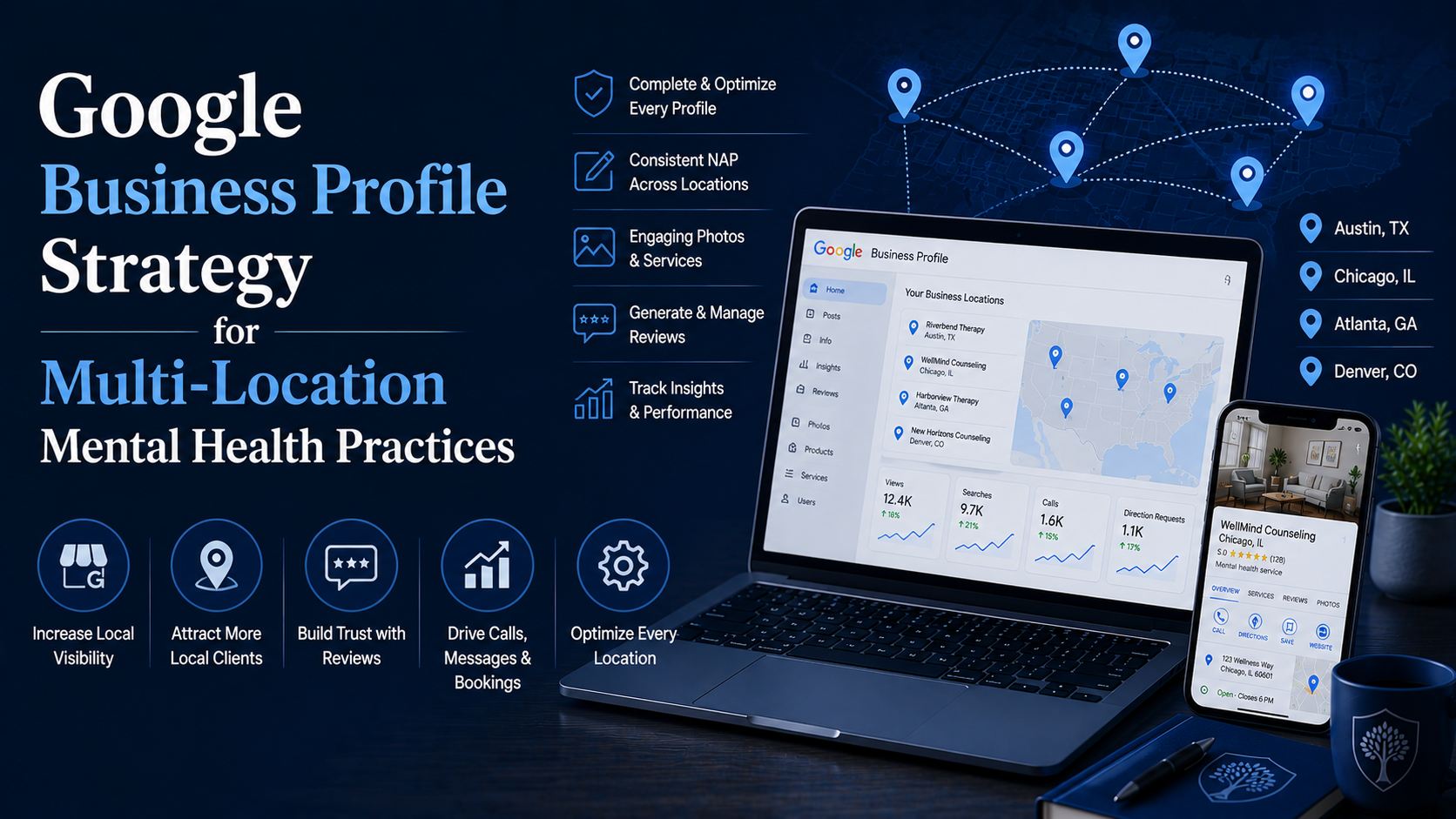
For a local practice, your Google Business Profile is often more powerful than your website. It is what feeds the map results at the top of local searches, and it is frequently the first impression a prospective client gets. For a multi-location mental health practice, it is also one of the trickiest things to get right, because every office needs its own optimized Profile, and the rules changed meaningfully in 2026.
This guide lays out a complete Google Business Profile strategy for practices with more than one location, including how to structure and verify your Profiles, the optimization levers that actually move rankings this year, the mental health nuances most guides ignore, and how to keep every office visible and out of trouble.
Why Google Business Profile Is Non-Negotiable For Multi-Location Practices
The numbers make the case. More than 70 percent of local searches now lead to a Profile interaction, and the top three map listings capture a large share of all local clicks. Profiles that are fully completed are roughly 2.7 times more likely to be seen as trustworthy. Critically for a group practice, a single Profile at your headquarters does not extend coverage to your other offices. Each location only appears in its own city’s results if it has its own verified, optimized Profile. If you are still learning the fundamentals, our Google Business Profile guide for therapists covers the basics this strategy builds on.
There is a newer reason this matters too. In 2026, Google generates AI summaries of places that pull from your Profile’s reviews, posts, and content. A thin or outdated Profile produces a weaker AI summary regardless of your star rating, which means your Profile now shapes how AI describes your practice, not just where you rank.
Set Up The Right Structure And Verification
Multi-location management lives in Business Profile Manager at business.google.com. The old per-profile and mobile-only interfaces were retired in 2025, so everything now runs through one dashboard. The first step is to create a business group, formerly called a business account, which lets you organize every office under one umbrella, share access safely, and apply changes across Profiles. How you verify depends on how many locations you have.
| Locations | How to verify | How to manage |
| 2 to 9 | Verify each location individually, with video verification now the default | Add all offices to one business group, keep naming consistent, assign location managers |
| 10 or more | Request bulk verification under the Verifications and Chain option in Business Profile Manager | Manage from the group dashboard with bulk edits and role-based access per office |
Two practical notes. First, video verification is now the default for new listings in most regions. Record one continuous, unedited clip that shows your exterior signage with the exact practice name, a pan of the interior, and a live management action like signing into the Profile. That single clip is what gets you approved on the first try. Second, use a consistent naming convention across offices, such as your practice name followed by the city, so Google reads them as one brand with distinct locations.
Optimize Every Profile: The Levers That Move Rankings
Choose the narrowest accurate primary category
Your primary category is the single biggest on-Profile ranking lever, and most practices set it too broadly. Choose the most specific category that fits, such as Psychologist, Mental Health Clinic, Counselor, or Psychiatrist, rather than a generic medical category. Add relevant secondary categories for your other services. For a group practice, match each location’s primary category to the services actually delivered there, since offices can differ.
Complete every field, for every location
A complete Profile is a more trusted Profile. For each office, fill in the local address, a local phone number, accurate hours including holidays, the full list of services offered there, relevant attributes, and a description written for that specific community. Add at least ten genuine photos of that actual location, not stock images or photos of a different office. Empty fields are missed ranking and trust opportunities, multiplied across every location you run.
Keep reviews flowing at every location
Reviews are among the strongest local signals, and in 2026 velocity beats raw count. A steady flow of two to five fresh reviews per week over a rolling 90-day window outranks a one-time burst of fifty followed by silence. Reviews are also location-specific, so a strong count at your flagship does nothing for a newer office. Build a simple, ongoing system to request reviews at every location, respond promptly and specifically, and never paste the same response across multiple reviews, because Google’s duplicate detection flags it and clients notice.
Use posts and Q and A as conversion and AI signals
Regular posts lift engagement and click-through, even though they are not a direct ranking factor. In 2026, Google added native multi-location post scheduling, so you can compose one post and push it across offices while still allowing local variations. The Q and A section has quietly grown more important, because its answers are now a grounding source for AI responses about your practice. Seed and answer the questions clients actually ask, in your own voice, at each location.
Set up messaging deliberately
Google is shifting Profile messaging toward WhatsApp and SMS channels, with conversations flowing through the Business inbox. For a mental health practice, treat messaging as a first-contact and scheduling channel only. Never use it to collect or discuss protected health information, and route anything clinical to your secure intake process. A short auto-reply that sets that expectation protects both you and your clients.
The Mental Health Nuances Most Guides Miss
General Profile advice can quietly get a therapy practice into trouble. These are the points that matter specifically in this field.
- Protect privacy in review responses. Never confirm that someone is a client, reference their treatment, or share any detail that identifies them. Even a warm, specific reply can breach confidentiality. Keep responses appreciative and generic, such as thanking them for the kind words without acknowledging care.
- Handle practitioner versus practice listings carefully. Public-facing individual clinicians can sometimes qualify for their own Profiles, but multiple listings at one address is a leading cause of suspension. Follow Google’s healthcare guidelines closely before creating practitioner Profiles alongside your location Profiles.
- Make every location’s content genuinely unique. Google’s 2026 spam policies, which now extend to AI summaries, penalize thin or templated content duplicated across locations. Each office’s description, photos, and posts should be distinct.
- Know the AI content rules. Google permits AI-assisted drafting of posts, descriptions, and review responses, but prohibits AI-generated reviews and fake Q and A answers posed as if from real clients. Drafting help is fine. Fabrication is a violation.
Avoid These Suspension Triggers
A suspended Profile can pull an entire location off Search and Maps, so prevention matters more for a group practice than for a solo office. The most common triggers are duplicate Profiles at the same address, a mismatch between your category and what Google can verify, keyword-stuffed business names, and failed verification. Suspensions come in two forms: a soft suspension that limits features while Google re-reviews, and a hard suspension that removes the Profile entirely. If a location is suspended, file for reinstatement through Google’s form with dated photos of your exterior signage and a lease or utility bill matching the address, and never create a duplicate Profile while under review, since that deepens the problem.
| Is every one of your locations verified, optimized, and ranking? We audit and optimize a Google Business Profile for each of your offices, then keep them active and protected. Request a free Profile audit. |
Track Performance For Each Location
Manage what you measure, office by office. The Performance view at the location level shows how many searches each Profile is appearing in, how many map views and direction requests it generates, and how many calls it drives. When one location lags well behind the others, the cause is usually an incomplete Profile or the wrong primary category. Set realistic timelines too. Most practices see early improvements in impressions within two to four weeks, while meaningful local pack movement in competitive markets typically takes 60 to 90 days of consistent work.
How Mental Health IT Solutions manages multi-location Profiles
Optimizing and maintaining a Profile for every office is ongoing work, and it is exactly what we handle for mental health group practices. We set up your business group and verification, optimize each location’s categories, fields, and photos, build review systems per office, keep posts and Q and A active, and watch for suspensions and inconsistencies before they cost you visibility. This pairs with the broader local work in our local SEO guide and our mental health SEO services, and we focus specifically on group practices that need every location performing.
| Turn every location’s Profile into a client-generating engine. From setup and verification to reviews and AI visibility, we manage multi-location Profiles end to end. Explore our SEO services. |
Frequently asked questions
Can I use one Google Business Profile for multiple office locations?
No. Each physical office needs its own verified Profile to appear in that location’s local results. A single Profile at one address does not extend visibility to your other offices. Organize them together using a business group in Business Profile Manager.
How do I verify multiple locations for my group therapy practice?
For two to nine locations, verify each one individually, with video verification now the default. For ten or more, you can request bulk verification under the Verifications and Chain option in Business Profile Manager, and Google typically responds within a few business days.
What is the best Google category for a mental health practice?
Choose the narrowest accurate primary category, such as Psychologist, Mental Health Clinic, Counselor, or Psychiatrist, rather than a broad medical category. The primary category is the single biggest on-Profile ranking lever, so be specific, and add secondary categories for your other services.
How do I respond to reviews without breaking confidentiality?
Never confirm that someone is a client or reference their care. Keep responses warm but generic, for example thanking the person for their kind words without acknowledging treatment. Even a specific, well-meant reply can breach confidentiality, so err on the side of saying less.
Can each therapist have their own Google Business Profile?
Sometimes. Public-facing individual clinicians may qualify for their own Profiles, but multiple listings at one address is a common suspension trigger. Review Google’s healthcare guidelines carefully, and when in doubt, prioritize clean, well-optimized location Profiles.
Why did my location’s Profile get suspended?
Common causes include duplicate Profiles at the same address, a category that does not match what Google can verify, a keyword-stuffed business name, or a failed verification. File for reinstatement with dated signage photos and a lease or utility bill, and do not create a duplicate while under review.
How long until my Profiles start ranking?
Most practices see early gains in impressions within two to four weeks. Meaningful local pack ranking in competitive markets usually takes 60 to 90 days of steady optimization, reviews, and activity across each Profile.
The Bottom Line For Your Practice
For a multi-location mental health practice, your Google Business Profiles are the front door to local discovery, and every office needs its own. Get the structure right with a business group and proper verification, optimize each Profile with a precise category, complete fields, local photos, and a steady flow of reviews, and handle the field-specific risks around confidentiality and duplicate listings with care. Do that, and each location earns its place in its own city’s map results.
This is not a one-time setup. It is ongoing management, and it now feeds your AI visibility as much as your traditional rankings. The practices that treat their Profiles as living assets, location by location, are the ones clients find first.
If you want every location’s Profile set up, optimized, and managed for you, that is what we do. Talk to our team about a multi-location Profile strategy built for your practice.