Open your Google Ads account lately and you have probably been nudged, more than once, to try Performance Max. Google promotes it as the AI-powered campaign that runs everywhere and drives more conversions with less work. It sounds like exactly what a busy therapist would want. But for a therapy practice specifically, the honest answer to whether you should use it is not a simple yes, and the reasons are worth understanding before you hand your budget to automation.
This guide explains what Performance Max is, the real catch it carries for mental health advertisers, when it might make sense, and what to do instead.
Quick answer: Performance Max is Google’s fully automated campaign type that runs across all of Google’s inventory using AI. For most therapy practices, it is not the right choice, because the audience signals it relies on are restricted for health advertisers, it removes control in a category with strict rules, and it can cannibalize your Search results. A focused Search campaign is the better starting point.
Key Takeaways
- Performance Max is automation-first. You give Google a goal, a budget, and assets, and its AI decides where, when, and to whom your ads show.
- The catch for therapists is the audience signals. Performance Max leans on first-party audiences to guide its AI, and those are restricted for health advertisers.
- You give up control in a category that needs it most. Auto-generated assets and broad placements raise both disapproval and brand-safety risk.
- It can cannibalize your Search campaigns, absorbing traffic you would have captured anyway and inflating reported results.
- For most therapy practices, a focused Search campaign is the better choice, with more control, higher intent, and lower compliance risk.
- Performance Max may suit large, data-rich group practices with expert management, as a carefully monitored supplement, not a starting point.
Not sure whether to trust automation with your ad budget? MHIS helps therapy practices choose the right campaign type and run it compliantly, without wasting money on the wrong one. Book a free consultation with MHIS.
What Is Performance Max?
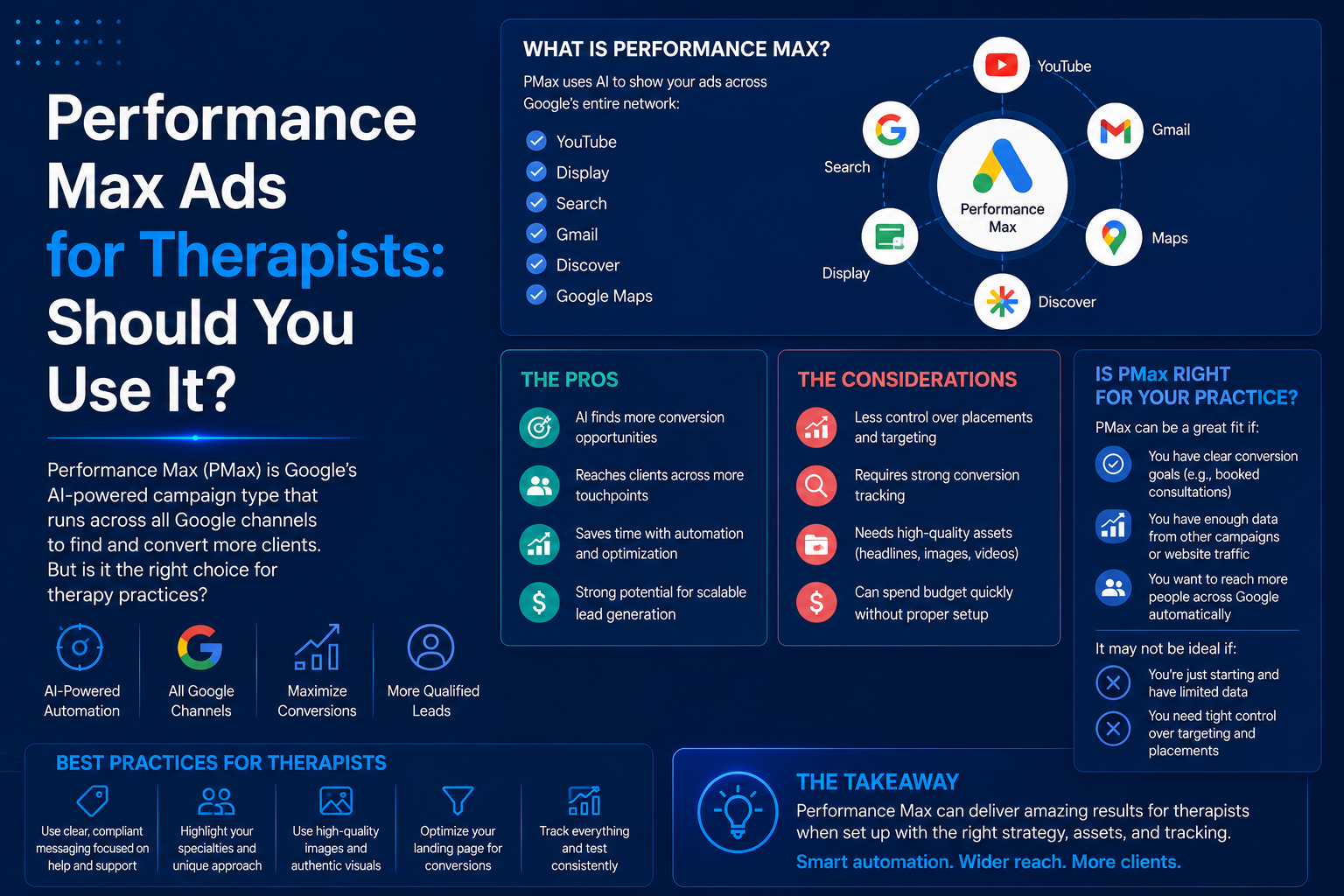
Performance Max is a single, fully automated Google Ads campaign that runs across all of Google’s inventory at once: Search, YouTube, Display, Gmail, Discover, and Maps. You provide a goal, a budget, and a set of assets, and Google’s AI decides the targeting, placements, and ad combinations to maximize conversions.
Instead of choosing keywords, placements, and audiences yourself, you give Performance Max raw materials: headlines, descriptions, images, videos, and a logo, grouped into asset groups, plus optional audience signals to hint at who might convert. From there, the automation takes over. It assembles ad combinations, picks where to show them across Google’s networks, and optimizes toward your conversion goal.
By early 2026, Performance Max accounts for roughly 45% of all Google Ads conversions, so it is not a fringe option. It is central to how Google wants advertising to work. It has also grown more capable over time, adding search themes to guide the AI, brand exclusions, and better reporting. But at its core, it trades control for automation, and that trade lands differently for a local, sensitive-category service like therapy than it does for a large online retailer. For the fundamentals of the channel, see our guide to Google Ads for therapists.
Why Google Pushes Performance Max So Hard
Performance Max is Google’s growth engine, so your account will actively encourage you to use it. That does not mean it is the right fit for your practice. What works for Google’s automation and for high-data advertisers is not automatically what works for a local therapy practice.
Performance Max performs well for advertisers with large budgets, lots of conversion data, and broad inventory needs, like e-commerce brands with thousands of products and millions of data points to feed the AI. For those advertisers, automation across all of Google’s networks makes sense, because no human could manage that scale manually.
A therapy practice is a different animal: local, focused on a considered decision, working in a restricted category, and usually without the volume of conversion data that automation needs to optimize well. So when your account nudges you toward Performance Max, it is worth pausing. The prompt reflects Google’s priorities and the tool’s general strengths, not an assessment of whether it suits your specific practice. The rest of this guide is that assessment.
The Catch: Automated Audiences Meet Sensitive-Category Rules
Here is the core problem for therapists. Performance Max relies on audience signals, your first-party data, Customer Match lists, and custom segments, to guide its AI toward likely converters. For health advertisers, those exact audiences are restricted, the same rules that block remarketing. So the mechanism that makes Performance Max powerful is blunted for a therapy practice.
This is educational, not legal advice, and platform rules change, so confirm your setup with a compliance professional.
Google treats health, including mental health, as a sensitive category, and its restrictions are not just about ad content. They are about targeting. Advertisers in sensitive categories cannot use advertiser-curated audiences, which includes the customer lists, remarketing audiences, and custom segments built from your own data. Sensitive-category policy exists precisely so advertisers cannot reach people based on inferred health status.
The problem is that those first-party audiences are the richest signals you can feed Performance Max. When they are off the table, you are left hinting at the automation with broad demographics, general interests, and search themes, which is a much weaker steer. You can read the underlying rule on Google’s Health in personalized advertising page.
In practice, this means Performance Max for a therapy practice runs with one hand tied. The automation that is supposed to find your ideal clients is missing the data it would normally use to do so, so it leans harder on broad, lower-intent inventory, which is exactly where a sensitive service does not want to be spending blindly.
You Give Up Control in a Category That Needs It Most
Performance Max runs across Display and YouTube using auto-generated ad combinations, which raises two risks that matter more for therapy than for most businesses: ad copy that implies a condition and gets disapproved, and ads appearing on low-quality or inappropriate placements. In a category with strict copy and placement expectations, less control means more risk.
Because the automation assembles headlines, descriptions, and images into combinations you do not fully control, it can produce messaging that drifts toward implying the viewer’s condition, which violates Google’s rules and gets flagged. And because it places ads across Google’s networks, your therapy ads can show in contexts you would not have chosen.
Google has added controls, and they help, but they are blunt and mostly operate at the account level, applying across campaigns:
- Content suitability settings and inventory type govern how sensitive the adjacent YouTube and Display content can be.
- Placement exclusion lists and sensitive-content-category exclusions keep ads off specific channels, apps, and themes.
- Account-level negative keyword lists and brand exclusions narrow where Search and Shopping portions appear.
Reporting has also improved: placement reports now show where ads actually ran, and search-terms insights show what triggered them, which lets you detect and exclude waste. Still, this is account-level, coarse control that requires expert setup and ongoing monitoring, not the precise, ad-by-ad control a Search campaign gives you. For a sensitive service, that difference is not a minor inconvenience. It is a real exposure.
It Can Cannibalize Your Search Results
Performance Max tends to absorb search queries, including your branded and highest-intent traffic, and prioritize the cheapest, easiest conversions. For a therapy practice, that can inflate reported results while eating traffic your Search campaign would have captured anyway, making it hard to see whether it added any real new clients.
Because Performance Max can serve on search queries, it often claims credit for conversions that would have happened through your Search campaign or your organic presence regardless. The reported numbers look good, but the incremental value, actual new clients you would not otherwise have gotten, can be much smaller than it appears. In a small practice with a limited budget, paying automation to capture demand you already own is a poor use of money.
This is one of the least visible problems with Performance Max, and one of the most important for a therapy practice to understand before switching budget into it.
Tracking and Protected Information
Performance Max optimizes toward conversions, so it depends heavily on solid conversion tracking to work at all. That tracking has to be free of protected health information, since Google will not sign a Business Associate Agreement for its ad tools. Conversion events should carry no names, symptoms, or appointment details. Weak or non-compliant tracking not only creates risk, it also starves the automation of the signal it needs, which makes an already-blunted tool perform even worse for therapy.
Choosing the right campaign type, and running it without wasting budget or crossing a compliance line, is exactly the kind of decision that benefits from experience. MHIS builds and manages Google Ads for therapy practices, and will tell you honestly when automation is not the right call. See how our Google Ads management for therapists works.
So, Should Therapists Use Performance Max?
For most therapy practices, no, at least not as a starting point, and often not at all. Performance Max suits large, data-rich advertisers, and its core strengths are undercut for a local, sensitive-category service. It may be worth testing only for large group practices with substantial budgets, lots of conversion data, and expert management, and even then as a carefully monitored supplement to Search.
The table below sorts the two situations.
| Performance Max is likely wrong for you if you | It might be worth testing if you |
|---|---|
| Are a solo or small practice | Are a large group practice |
| Have a limited budget | Have a substantial budget to test with |
| Have little conversion data | Have significant conversion data feeding the account |
| Want control over copy and placements | Have expert management and monitoring in place |
| Run a single location or a few services | Run many locations and services |
| Need a simple, reliable channel now | Already run a strong Search campaign and want to test more |
If you land mostly in the left column, which most therapy practices do, Performance Max is not your tool. If you land in the right column, it is something to test carefully alongside Search, not to replace it with.
What to Do Instead
Start with a focused Search campaign. It gives you control over your keywords, copy, and placements, reaches people at the high-intent moment they are searching, and keeps you on safer compliance footing. Then build durable local visibility, and consider Performance Max only later, with data, budget, and expert oversight.
- Run a Search campaign first. It is the most controllable, highest-intent, and most compliance-friendly option for a therapy practice. Our step-by-step guide on how to create a Google Ads campaign for a therapy practice walks through it.
- Build local SEO and your Google Business Profile. This earns you visibility in the Map Pack without media spend and compounds over time. Our local SEO for therapists guide covers it.
- Only then consider Performance Max, and only if you are a larger practice with the data, budget, and management to test it responsibly as a supplement.
If You Do Test Performance Max, Do It Safely
For the advanced case, where a large practice has decided to test it, treat Performance Max as an automated buyer to be supervised, not trusted blindly:
- Run it alongside Search, not instead of it, so you keep a controlled, high-intent baseline.
- Set account-level brand-safety controls: content suitability, inventory type, and sensitive-content-category exclusions.
- Build placement exclusion lists and negative keyword lists, and apply brand exclusions.
- Use search themes to steer the automation toward relevant queries.
- Keep conversion tracking live and free of protected information.
- Review placement and search-terms reports regularly, and feed waste back into exclusions.
- Watch for Search cannibalization by comparing incremental results, not just reported conversions.
- Keep every asset neutral and compliant, never implying the viewer’s condition.
Performance Max vs Search for Therapists
| Factor | Performance Max | Search campaign |
|---|---|---|
| Control | Low, automated | High, manual |
| Intent | Mixed, across broad inventory | High, active search |
| Audience signals for health | Restricted and blunted | Keyword-based and compliant |
| Transparency | Improved but limited | Full |
| Compliance risk | Higher, auto assets and placements | Lower, you control copy and placement |
| Best for therapists | Advanced, large, data-rich, supplement only | Recommended starting point |
Frequently Asked Questions
Should therapists use Performance Max?
For most therapy practices, no, at least not as a starting point. Performance Max is built for advertisers with large budgets, lots of conversion data, and broad inventory needs, and its core strengths are undercut for a local, sensitive-category service like therapy. The audience signals it relies on are restricted for health advertisers, you give up control in a category with strict copy and placement rules, and it can cannibalize your Search results. A focused Search campaign is the better choice for most practices, offering more control, higher intent, and lower compliance risk. Performance Max may be worth testing only for large group practices with substantial budgets, significant conversion data, and expert management, and even then as a carefully monitored supplement to Search rather than a replacement.
What is Performance Max in Google Ads?
Performance Max is a fully automated Google Ads campaign type that runs across all of Google’s inventory at once, including Search, YouTube, Display, Gmail, Discover, and Maps. Instead of choosing keywords, placements, and audiences yourself, you provide a goal, a budget, and assets like headlines, descriptions, images, and videos, plus optional audience signals to hint at likely converters. Google’s AI then decides the targeting, placements, and ad combinations to maximize your conversion goal. By early 2026, it accounts for roughly 45% of all Google Ads conversions, so it is a major part of how the platform works. Its defining trait is that it trades control for automation, which is powerful for high-data advertisers but works against a local, sensitive-category service like a therapy practice.
Why isn’t Performance Max ideal for therapy practices?
Three reasons. First, its audience signals are restricted for health advertisers. Performance Max relies on first-party data, Customer Match, and custom segments to guide its AI, and those are exactly the audiences the sensitive-category rules disable for health, so the automation runs without the data it needs. Second, you lose control in a category with strict rules, since auto-generated ad combinations can imply a condition and get disapproved, and broad placements can put your ads in inappropriate contexts. Third, it can cannibalize your Search results, absorbing traffic you would have captured anyway and inflating reported numbers. Together, these mean Performance Max runs with one hand tied for a therapy practice, which is why a focused Search campaign is usually the better choice.
Does Performance Max work for local businesses like a therapy practice?
It can technically run for a local business, but it is not well suited to a small, local, sensitive-category practice. Performance Max is designed to optimize across large volumes of data and broad inventory, which favors advertisers with big budgets and lots of conversions. A local therapy practice usually lacks that data volume, works in a restricted category that limits the automation’s audience signals, and benefits more from the control and high intent of a focused Search campaign. Local visibility for therapists is often better served by a Search campaign paired with local SEO and a strong Google Business Profile, which get you into the Map Pack. Performance Max can spread a small local budget across broad, lower-intent inventory, which is rarely the best use of limited funds.
Can Performance Max target people by mental health condition?
No. Health is a sensitive category, and Google’s rules prohibit targeting people based on a health condition or inferred medical status, in Performance Max as in any campaign type. You also cannot use advertiser-curated audiences, like customer lists or custom segments built from your data, as the automation would normally rely on. This is precisely why Performance Max is blunted for therapy: the audience signals that make it effective are restricted. What remains available is broad, non-sensitive guidance, such as general demographics, broad interests, and search themes, which is a weaker steer for the automation. The guardrail is the same across Google: you cannot reach people by targeting or implying their mental health condition, so the automation cannot use that information to find your clients.
Will Performance Max get my therapy ads disapproved?
It can raise the risk. Because Performance Max automatically assembles your headlines, descriptions, and images into combinations you do not fully control, it can generate messaging that drifts toward implying the viewer’s condition, which violates Google’s personalized advertising rules and leads to disapprovals. It also runs across broad inventory, which can surface other policy issues. You reduce this risk by keeping every asset neutral and service-focused, never implying a diagnosis, and by applying account-level brand-safety controls and monitoring your reports. But the fundamental issue is that automation gives you less direct control over exactly what runs, which in a strict category like mental health means more chances for a combination to be flagged. A Search campaign, where you control each ad precisely, carries lower disapproval risk.
Does Performance Max cannibalize my Search campaigns?
It can, and this is one of the most important things to understand before using it. Performance Max is able to serve on search queries, including your branded and highest-intent terms, so it often claims conversions that would have happened through your Search campaign or your organic presence anyway. The reported results look strong, but the incremental value, genuinely new clients you would not otherwise have gotten, can be much smaller. For a small practice with a limited budget, that means paying automation to capture demand you already own, which is a poor use of money. If you do test Performance Max, judge it by incremental results rather than reported conversions, and run it alongside Search so you can see whether it actually adds new clients or just reallocates existing ones.
Is Performance Max cheaper than Search ads for therapists?
Not necessarily, and cheaper reported conversions can be misleading. Performance Max often shows a lower cost per conversion, but that is partly because it captures easy, cheap conversions, including branded searches and traffic you would have gotten anyway, which inflates its apparent efficiency. For a therapy practice, the relevant question is not the reported cost per conversion but the cost per genuinely new client. When you account for cannibalization and the restricted audience signals that limit the automation’s effectiveness for health, Performance Max is not reliably cheaper in real terms. A well-managed Search campaign gives you clearer, more controllable costs and higher-intent traffic, which for most practices produces better real value than automation optimizing across broad, lower-intent inventory.
When would Performance Max make sense for a therapy practice?
It makes the most sense for a large group practice that has a substantial budget, significant conversion data feeding the account, multiple locations and services, and expert management in place. Under those conditions, and only as a supplement to a strong Search campaign rather than a replacement, Performance Max can be worth testing. The practice needs enough conversion data for the automation to optimize, the budget to test without straining finances, and the expertise to set account-level brand-safety controls, maintain exclusions, keep tracking compliant, and monitor for cannibalization. Even then, it is an advanced move that requires ongoing supervision. For solo and small practices, which is most of the field, the requirements are not met, and a focused Search campaign remains the better and safer choice.
How do I control where Performance Max shows my ads?
You control it mainly through account-level settings that apply across campaigns, since Performance Max does not offer the placement-by-placement control of other campaign types. The key levers are content suitability settings and inventory type, which govern how sensitive the adjacent YouTube and Display content can be; placement exclusion lists and sensitive-content-category exclusions, which keep ads off specific channels and themes; and account-level negative keyword lists and brand exclusions. Google has also expanded reporting, so placement reports show where ads ran and search-terms insights show what triggered them, which lets you find and exclude waste. These controls help, but they are coarser and less direct than a Search campaign’s, and they require expert setup and ongoing monitoring to keep a sensitive service’s ads in appropriate contexts.
Should I let Google switch my campaign to Performance Max?
Be cautious. Your Google Ads account and representatives will often encourage switching to or adding Performance Max, because it is central to Google’s strategy and performs well for high-data advertisers. That prompt reflects Google’s priorities, not an assessment of your specific practice. For most therapy practices, switching a working Search campaign to Performance Max means giving up control, running into the restricted audience signals for health, and risking cannibalization, which is rarely an improvement. If you have a Search campaign that is producing clients, there is usually no reason to replace it. If you are curious about Performance Max and have the budget and data, test it as a separate, supervised campaign alongside your Search efforts rather than converting what already works, so you can compare real results before committing.
Should I hire someone to run Performance Max?
If you are going to use Performance Max at all, expert management is close to essential, because it is an automated system that must be supervised carefully, especially in a sensitive category. A specialist can set the account-level brand-safety controls, maintain placement and negative keyword exclusions, keep conversion tracking compliant and free of protected information, use search themes to steer the automation, and monitor for cannibalization and policy issues. Without that oversight, Performance Max can waste budget on broad inventory, generate non-compliant ad combinations, and claim credit for conversions you would have gotten anyway. That said, for most therapy practices the better advice is not to run Performance Max at all, but to invest that expertise into a well-managed Search campaign and local SEO, which deliver more reliable results for a therapy practice.
Final Key Takeaways
- Performance Max trades control for automation, which suits high-data advertisers but works against a local, sensitive-category therapy practice.
- Its audience signals are restricted for health advertisers, so the mechanism that makes it powerful is blunted for therapy.
- It reduces control over copy and placements, raising disapproval and brand-safety risk in a strict category.
- It can cannibalize your Search results, inflating reported numbers without adding real clients.
- For most practices, a focused Search campaign is the better choice; Performance Max suits only large, data-rich practices with expert management.
Action Checklist
- Do not switch a working Search campaign to Performance Max by default.
- Start with a focused Search campaign for control and intent.
- Build local SEO and your Google Business Profile for durable visibility.
- Keep conversion tracking live and free of protected information.
- Consider Performance Max only if you are a large, data-rich practice with expert management.
- If you test it, run it alongside Search, not instead of it.
- Set account-level brand-safety controls and exclusions, and monitor for cannibalization.
Conclusion
Performance Max is powerful, and Google will keep encouraging you to use it, but powerful is not the same as right for your practice. For a therapy practice, the tool’s greatest strength, its data-hungry automation, is exactly what the sensitive-category rules restrict, and the control you give up matters more in mental health than in almost any other field. Add the risk of cannibalizing traffic you already own, and Performance Max becomes a poor first move for most practices. Start with a focused Search campaign, build your local presence, and keep your tracking compliant. If you are a large practice with the data, budget, and expertise, you can test Performance Max carefully as a supplement, but for most therapists, it is a channel to approach with clear eyes rather than to adopt because your account suggested it.
If you want a straight answer on which campaign type actually fits your practice, that is exactly the kind of guidance a therapy-focused marketing partner provides.
Wondering whether Performance Max or a Search campaign is right for you? MHIS will review your practice, your goals, and your budget, and build the campaign that actually fits, across Google Ads, landing pages, and local SEO. Book your free consultation with MHIS today.