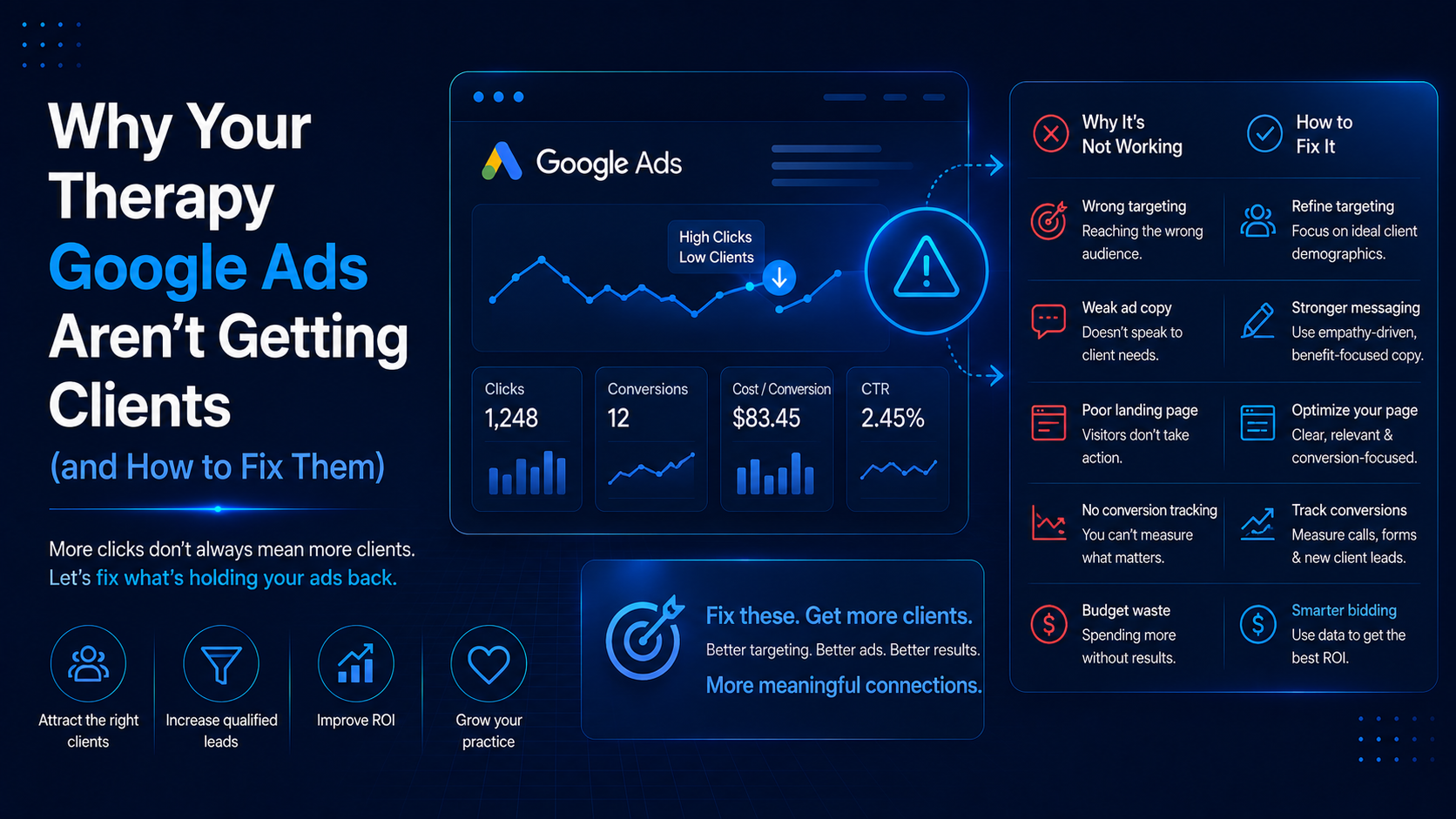
You turned on Google Ads, the budget is going out every day, and the calendar still is not filling. Clicks are happening, maybe even a lot of them, but the phone is quiet and the inquiry form stays empty. It is one of the most frustrating positions a practice owner can be in, because it feels like the money is disappearing with nothing to show for it.
Here is the good news: when therapy ads spend money without producing clients, the cause is almost always specific, findable, and fixable. This guide walks through the real reasons campaigns fail to convert, in the order they usually happen, with a concrete fix for each one.
Quick answer: Most therapy Google Ads fail for one of a handful of reasons: clicks are sent to a homepage instead of a focused landing page, the keywords attract browsers instead of ready clients, there is no conversion tracking to guide decisions, or the follow-up is too slow. The fix is to find where your funnel breaks and repair that stage, not to abandon Google Ads.
Key Takeaways
- Clicks without clients almost always means the leak is after the click, usually the landing page, not the ads themselves.
- In 2026, click-through rates rose while conversion rates fell across nearly every industry. The bottleneck for most accounts is the page, not the traffic.
- Symptom keywords like “anxiety” attract article readers, while intent keywords like “trauma therapist in Austin” attract people ready to book.
- No negative keywords and no conversion tracking are two of the most common and most expensive mistakes.
- Speed of follow-up decides whether an inquiry becomes a client. Slow responses lose people who were ready to start.
- Diagnose the funnel stage first. Different symptoms point to different fixes, and guessing wastes budget.
Spending on ads with nothing to show for it? MHIS offers a free Google Ads and landing page review for therapy practices, so you can see exactly where your funnel is breaking before you spend another dollar. Book a free consultation with MHIS.
First, Diagnose Where Your Funnel Is Breaking
Before changing anything, figure out which stage of the funnel is failing. “Ads not working” is four different problems wearing the same coat, and each one has a different fix. Trace the path from impression to booked client and find the first place the numbers fall off a cliff.
In 2026, this matters more than ever. WordStream’s benchmark data put the average search click-through rate at 6.64% and the average conversion rate at roughly 4%, down about 9% year over year. The pattern across the industry was clear: ads are getting better at generating clicks, and pages are getting worse at converting them. Healthcare is actually one of the strongest categories for conversion, averaging around 24% in those benchmarks. Treat that number as a directional signal rather than a target, since it depends on how a conversion is defined, but the implication holds: if your therapy ads pull clicks and almost no inquiries, you are sitting far below where a healthcare account should be, and the ads are rarely the culprit.
Use this table to locate the breakpoint.
| What you are seeing | Where the funnel is breaking | What to check first |
|---|---|---|
| Ads rarely show, very few impressions | Eligibility, budget, bids, or geo | Disapprovals, daily budget, bid levels, location settings |
| Impressions but almost no clicks | Ad relevance and rank | Ad copy, keyword match, assets and extensions, position |
| Clicks but no inquiries | Landing page and website | Page speed, message match, clear call to action, mobile, trust |
| Inquiries but no booked clients | Follow-up and lead fit | Response speed, keyword quality, intake friction |
Once you know the stage, the specific reasons below tell you what to fix. For a refresher on how the channel works overall, see our guide to Google Ads for therapists.
1. You Are Sending Paid Clicks to Your Homepage
This is the single most common reason therapy ads fail. A homepage is built to introduce your whole practice, not to convert a specific searcher. When someone clicks an ad for “couples counseling” and lands on a general homepage, they have to hunt for what they came for, and most of them leave.
A homepage asks the visitor to make decisions: which service, which page, where to go next. A landing page asks them to do one thing: book a consultation. That difference in focus is often the entire gap between paying for clicks and getting clients.
How to fix it: Build a dedicated landing page for each campaign or specialty. Match the page to the ad, lead with the specific service the person searched for, keep one clear call to action above the fold, and remove distractions like a full navigation menu. Send couples-counseling clicks to a couples-counseling page, not to the front door of your site.
2. Your Website Is Not Built to Convert
Even a dedicated page fails if the fundamentals are broken. A slow, cluttered, or hard-to-navigate page loses people before they ever read your message. Since the whole point of a paid click is the action that follows, a weak site quietly wastes every dollar you spend.
The conversion story of 2026 is that pages, not ads, are where performance is leaking. Fixing the page is usually the highest-return change you can make.
Common conversion killers on therapy websites:
- Slow load times, especially on mobile, where most therapy searches happen
- No clear call to action, or several competing ones
- A hard-to-find phone number or booking option
- No photo of the therapist, which matters enormously for trust in therapy
- Weak trust signals, such as missing credentials, specialties, or approach
- Long or intimidating intake forms as the first ask
How to fix it: Make the page fast and mobile-first, put a single clear action front and center, show your face and credentials, and make booking a call effortless. A conversion-focused therapist website turns the traffic you are already paying for into actual inquiries.
3. You Are Targeting Symptom Keywords, Not Intent Keywords
There is a large difference between someone searching “anxiety” and someone searching “anxiety therapist near me.” The first is usually looking for information, self-help, or an article. The second is looking for you. Bidding on broad symptom terms fills your account with clicks from people who were never going to book.
Symptom words like “depression,” “anxiety,” or “stress” pull in students, researchers, and people seeking free resources. Intent words signal that a person has decided to find a provider and is ready to act.
How to fix it: Prioritize high-intent, location-based keywords such as “therapist in Chicago,” “trauma therapist near me,” or “couples counseling Denver.” Let the searcher’s language show intent. You will pay for fewer clicks, but far more of them will convert. Our step-by-step guide on how to create a Google Ads campaign for a therapy practice covers keyword selection in detail.
4. You Have No Negative Keywords, So Your Budget Is Leaking
Without negative keywords, Google will show your ads for searches you never intended to pay for. A therapist with no negatives routinely pays for clicks on “physical therapy,” “massage therapy,” “therapy jobs,” and “free counseling,” none of which will ever become a client.
Every irrelevant click is budget that could have gone to a real prospect. In a category with cost per click often running $3 to $15 or more, that waste adds up quickly.
How to fix it: Build a negative keyword list before you launch, and keep adding to it. Start with obvious ones like “physical,” “massage,” “free,” “jobs,” “salary,” “school,” and “self-help,” and review your search terms report every week to catch new waste. This single habit is one of the highest-impact things you can do for a therapy account.
5. You Are Not Tracking Conversions, So You Are Optimizing Blind
If you cannot see which keywords and ads produce calls and form fills, you cannot improve anything. You are guessing. Many therapists run ads for months without conversion tracking, then wonder why performance never gets better. It never gets better because there is no data to act on.
Conversion tracking is what turns Google Ads from a slot machine into a system. It shows you which searches lead to inquiries, so you can put money toward what works and cut what does not.
How to fix it: Set up conversion tracking for phone calls and form submissions before spending more. Do it in a way that keeps client data out of the tracking, since Google will not sign a Business Associate Agreement for Ads, so conversion events should carry no names, symptoms, or appointment details. Once tracking is live, let the data guide your bids, keywords, and budget.
6. Your Ad Copy Gives No Reason to Choose You
When your ad looks like every other ad on the page, people click the one at the top and ignore the rest. Generic copy like “Professional Counseling Services” does not tell a searcher why you are the right fit. Worse, copy that implies the reader’s condition can get your ads disapproved under Google’s health rules.
Two problems live here: ads that do not stand out, and ads that get flagged. Both cost you clients.
How to fix it: Write specific, benefit-led copy that names your specialty and location, signals trust, and ends with a clear action, for example “Trauma Therapy in Denver. Licensed and Accepting New Clients. Book a Free Call.” Add ad assets like call buttons, location, and sitelinks to take up more space and give more reasons to click. Keep language neutral and service-focused so it stays compliant. Avoid headlines that assume a diagnosis, such as “Struggling With Depression?”, which violate Google’s personalized advertising policy.
7. Your Geo-Targeting Is Too Broad or Set to “Interest”
If your ads serve outside your service area, or to people merely interested in your city rather than located in it, you pay for clicks that cannot become clients. Broad or misconfigured location settings are a quiet, steady drain on a therapy budget.
By default, Google can show ads to people who are interested in your targeted location, not only those physically in it. For a local practice, that often means paying for the wrong audience.
How to fix it: Tighten your targeting to the specific state, metro, or radius you serve, and set your location options to people in your targeted area rather than interested in it. Add exclusions for regions you cannot serve. If you are licensed in one state, do not let your budget bleed into searches from another.
8. Your Budget Is Spread Too Thin to Compete or Learn
A small budget stretched across too many keywords and too wide an area produces too few clicks to gather useful data, and too little presence to compete. Below roughly $300 to $400 per month, therapy campaigns rarely produce consistent results, and even a decent budget fails if it is scattered.
Google Ads needs enough volume to learn what works. When your spend is diluted, every keyword gets a trickle, and the account never gathers the signal it needs to improve.
How to fix it: Concentrate your budget on your highest-intent keywords and your core service area. Fewer, better keywords with enough spend behind them will outperform a long, thin list every time. For a full breakdown of realistic numbers, see our guide on how much therapists should spend on ads.
Getting clicks but no clients is exactly the problem MHIS is built to solve for therapy practices. We audit the full path from keyword to booked call, fix the leaks in your targeting, ad copy, tracking, and landing pages, and manage the account so it keeps improving. See how our Google Ads management for therapists works.
9. You Are Running the Wrong Campaign Type or Left Default Settings On
Google’s defaults are built to spend your budget widely, not to protect it. If you launched with the wrong campaign type, or left settings like network expansion switched on, your ads may be showing in low-quality places that produce clicks but not clients.
For a local therapy practice, Search campaigns targeting high-intent keywords are usually the right foundation. Automated formats and default network settings can send your budget to the Display Network or Search Partners, where relevance and conversion tend to be far lower.
How to fix it: Start with a Search campaign focused on intent keywords. Review your campaign settings and turn off network expansions you did not intend to use. Watch where your impressions and clicks are actually coming from, and cut placements that do not convert. As your account matures and you have conversion data, you can test automation responsibly. Our guide on AI-powered Google Ads for therapists covers doing that without losing control.
10. You Are Too Slow to Follow Up With the Leads You Do Get
Sometimes the ads work and the inquiries come in, but they never turn into clients because the response is too slow. A person reaching out for therapy is often in a moment of readiness that fades fast. If they do not hear back quickly, they book with whoever answers first.
This is the most overlooked stage because it happens outside Google Ads entirely. You can have a perfect campaign and still lose every client to a slow inbox.
How to fix it: Respond to new inquiries as fast as you can, ideally within minutes to a few hours. Set up notifications, consider a simple booking link so people can schedule without waiting, and make the first reply warm and easy to act on. Speed of follow-up frequently separates practices that fill their calendars from those that do not.
11. You Set It and Forgot It
Google Ads is not a set-and-forget tool. Campaigns need ongoing attention: reviewing search terms, adding negatives, adjusting bids, testing ad copy, and refining landing pages. Accounts that are launched and left alone almost always drift toward wasted spend.
Most therapy campaigns that fail were not badly built at the start. They were simply never maintained, so waste accumulated and performance decayed.
How to fix it: Put a weekly rhythm in place. Check the search terms report and add negatives, look at which keywords and ads produce inquiries, pause what is not working, and test new ad copy against your best performer. If you do not have time for this, it is the clearest sign to bring in help, because ongoing optimization is where most of the results actually come from.
How to Diagnose Your Own Account in 15 Minutes
- Check for disapprovals. Open the account and look for disapproved ads or “Not Eligible” status.
- Look at impressions. Very low impressions point to budget, bids, geo, or eligibility.
- Look at click-through rate. Low CTR points to ad relevance and copy.
- Open the search terms report. Irrelevant terms mean you need negative keywords.
- Confirm conversion tracking exists and is firing on calls and form fills.
- Click your own ad on a phone. Experience the landing page as a client would.
- Time your follow-up. Send yourself a test inquiry and see how fast you would respond.
This quick pass usually reveals the biggest leak within minutes.
Fix-It Checklist
| Area | Check |
|---|---|
| Landing page | Clicks go to a focused page that matches the ad, not the homepage |
| Website | Page is fast, mobile-first, with a clear single call to action and a photo |
| Keywords | Targeting intent and location terms, not broad symptom words |
| Negatives | A negative keyword list exists and is reviewed weekly |
| Tracking | Conversion tracking is live and PHI-free |
| Ad copy | Specific, compliant, benefit-led, with assets and a clear action |
| Geo | Targeting your service area only, set to presence, with exclusions |
| Budget | Concentrated on best keywords and core area, above the practical floor |
| Settings | Search-first, unnecessary network expansions turned off |
| Follow-up | Inquiries answered fast, with an easy way to book |
| Maintenance | Weekly review of search terms, bids, and ad performance |
Frequently Asked Questions
Why am I getting clicks on my therapy ads but no clients?
Clicks without clients almost always means the problem is after the click, not in the ads. The most common cause is sending traffic to a homepage or a page that is not built to convert, so people arrive, do not immediately find what they searched for, and leave. In 2026, this pattern is widespread: click-through rates rose while conversion rates fell, and the bottleneck for most accounts is the landing page. Other frequent causes are broad keywords attracting browsers rather than ready clients, and slow follow-up losing the inquiries you do get. The fix is to trace your funnel, find the stage where numbers drop, and repair that stage, usually starting with a focused, fast landing page.
Why aren’t my Google Ads showing at all?
If your ads rarely appear, the issue is usually eligibility, budget, bids, or geo-targeting. Start by checking for disapproved ads or a “Not Eligible” status, since health is a sensitive category and copy that implies a condition can get flagged. Next, confirm your daily budget is high enough to compete, because a very small budget can limit how often ads show. Low bids can keep you out of the auction, and overly narrow location or keyword settings can starve the account of impressions. Review each of these in order. Often a single fix, such as resolving a disapproval or widening a too-narrow setting, restores visibility.
What is a good conversion rate for therapy Google Ads?
Benchmarks vary widely depending on how you define a conversion, but healthcare is one of the stronger categories for search conversion, averaging around 24% in 2026 benchmark data, with the cross-industry average closer to 4%. Treat these as directional rather than as fixed targets. The practical point is that if your therapy account is getting steady clicks but almost no inquiries, you are far below where a healthcare account should be, which points to a landing page or targeting problem rather than bad luck. Focus less on hitting an exact percentage and more on whether your conversion rate is improving as you fix your page, tighten your keywords, and add negatives.
How much should I spend on Google Ads as a therapist before it works?
Most solo therapists see consistent results starting around $500 to $1,200 per month in ad budget, depending on their city and specialty. Below roughly $300 to $400 per month, campaigns usually lack the volume to gather useful data, and a scattered budget fails even at higher levels. Just as important as the amount is the focus: concentrating spend on a few high-intent, location-based keywords in your core service area will outperform spreading the same budget across a long, broad list. Give the account enough spend and enough time, typically a few weeks, to gather data before judging it, and make sure a conversion-ready website is in place so the budget has somewhere effective to send traffic.
What keywords should therapists avoid in Google Ads?
Avoid broad symptom words on their own, such as “anxiety,” “depression,” or “stress,” because they attract people looking for articles and self-help rather than a provider. Also avoid terms that pull in the wrong audience entirely, which is where negative keywords come in. Common negatives for therapists include “physical,” “massage,” “free,” “jobs,” “salary,” “school,” “degree,” and “self-help.” Without these, you will pay for clicks on searches like “physical therapy” or “therapy jobs” that can never become clients. The keywords worth paying for are high-intent and local, such as “therapist near me,” “trauma therapist in your city,” or “couples counseling in your area,” which signal that the searcher is ready to find and book a therapist.
Why does my ad send people to my homepage, and is that bad?
It happens because homepages are the default destination many people choose when setting up ads, but for paid traffic it is usually a mistake. A homepage is designed to introduce your entire practice, so a visitor who clicked an ad for a specific service has to search for what they came for, and many leave before they find it. A dedicated landing page that matches the ad, leads with the exact service, and offers one clear action converts far better. If you run ads for more than one service, build a page for each. Matching the page to the ad, often called message match, both improves conversions and can lower your costs by raising ad relevance.
How do I know if my landing page or my ads are the problem?
Look at where your numbers drop. If you have strong impressions and a healthy click-through rate but very few inquiries, the ads are doing their job and the landing page is the problem. If you have impressions but almost no clicks, the issue is ad relevance and copy. If ads barely show at all, it is eligibility, budget, bids, or geo. The clearest test is the most common 2026 pattern: high click-through rate with low conversion points to the page, not the ad. Click your own ad on a phone and experience the page as a client would, then fix whatever makes the next step hard, slow, or unclear.
How long does it take for therapy Google Ads to work?
Ads can start generating clicks and inquiries within days of approval, which is faster than SEO. However, early performance is not final performance. Campaigns improve over the first few weeks as you gather conversion data, add negative keywords, refine ad copy, and adjust bids. Give a new campaign a few weeks of proper management before judging it, and make sure conversion tracking is live from the start so you can see what is working. Practices that expect instant, polished results and quit after a week almost always leave before the account has had a chance to be optimized. Steady iteration, not the launch itself, is what produces reliable results.
Do I need conversion tracking for a small therapy practice?
Yes. Conversion tracking is what tells you which keywords and ads actually produce calls and form fills, and without it you are optimizing blind. Even a small account benefits enormously, because it lets you put your limited budget toward what works and cut what does not. Set up tracking for phone calls and form submissions, and configure it so no client data flows to Google, since Google will not sign a Business Associate Agreement for Ads. That means your conversion events should carry no names, symptoms, or appointment details. Once tracking is in place, decisions stop being guesses, and the account can finally start improving instead of quietly wasting money month after month.
Why is my cost per click so high for therapy keywords?
Therapy keywords are competitive, and cost per click commonly runs $3 to $15 or higher, with major metros and high-value specialties like EMDR, trauma, and couples counseling at the upper end. Costs have also risen across the industry over the last several years. That said, a high cost per click is often made worse by low ad relevance. Google rewards relevant ads with lower costs, so weak copy, poor keyword-to-ad match, and a mismatched landing page can inflate what you pay on every click. Before assuming the market is the problem, improve your ad relevance and add negative keywords to stop paying for irrelevant searches, which frequently brings your effective costs down.
Should I hire someone to fix my Google Ads, or do it myself?
It depends on your time and interest. The fixes in this guide are learnable, and a motivated therapist can absolutely run a compliant, effective account. The catch is that Google Ads rewards ongoing attention, weekly search term reviews, negative keyword additions, bid adjustments, and copy testing, and that time has to come from somewhere. If you would rather focus on clinical work, a specialist who understands both PPC and the specific rules around mental health advertising can find and fix the leaks faster and keep the account improving. Either way, the priority is the same: diagnose where your funnel breaks, fix that stage, and maintain the account instead of setting it and forgetting it.
Can bad Google Ads settings waste my budget automatically?
Yes, and this is more common than most therapists realize. Google’s defaults are designed to spend your budget broadly, so leaving certain settings on can quietly drain money. Network expansions can send your ads to the Display Network or Search Partners, where relevance and conversion are usually much lower. Broad match keywords without oversight can trigger your ads on loosely related searches. Location settings that target people interested in your area, rather than located in it, can pay for the wrong audience. The fix is to start with a focused Search campaign, review your settings, turn off expansions you did not intend to use, and monitor where your clicks actually come from so you can cut what does not convert.
Final Key Takeaways
- When ads spend money without producing clients, the cause is specific and fixable, not proof that Google Ads does not work.
- Diagnose the funnel stage first, because different symptoms point to different fixes.
- The most common leak is after the click: a homepage or a page that is not built to convert.
- Intent keywords, negative keywords, and conversion tracking are the fundamentals most struggling accounts are missing.
- Fast follow-up and weekly maintenance turn a working campaign into a full calendar.
Action Checklist
- Identify which funnel stage is breaking before changing anything.
- Send ad clicks to a focused landing page, not your homepage.
- Make sure the page is fast, mobile-first, and easy to act on.
- Switch to high-intent, location-based keywords.
- Build and maintain a negative keyword list.
- Set up PHI-free conversion tracking.
- Rewrite generic or non-compliant ad copy and add assets.
- Tighten geo-targeting to your service area.
- Respond to inquiries fast and offer an easy way to book.
- Review the account weekly, or bring in help to do it.
Conclusion
Ads that spend without producing clients feel like proof that Google Ads does not work for therapists. In reality, it is almost always proof that one specific stage of the funnel is broken. Trace the path from impression to booked client, find the first place the numbers fall off, and fix that stage. Usually it is the landing page. Sometimes it is the keywords, the tracking, the settings, or the follow-up. Repair the leak, maintain the account, and the same budget that felt wasted starts filling your calendar.
If you would rather not hunt for the leak yourself, that is exactly the kind of work a mental health marketing partner handles every day.
Tired of paying for clicks that go nowhere? MHIS will review your ad account and website, pinpoint where your funnel is losing clients, and build a custom plan to fix it across Google Ads, landing pages, and local SEO. Book your free consultation and account review with MHIS today.