AI can write a blog post in seconds, which is tempting when you are a busy practice owner with a website that needs content. It also raises an anxious question that stops many therapists from publishing at all: will Google punish me for using AI? The advice online is contradictory, and the stakes feel high. Here is the honest, current answer, and what it means specifically for a mental health practice.
The short version is that AI is not the problem Google is looking for. Low-value content is. But therapy practices operate in a category Google treats with extra scrutiny, which changes how you should use AI. This guide explains exactly where the line sits and how to stay on the right side of it.
The Short Answer
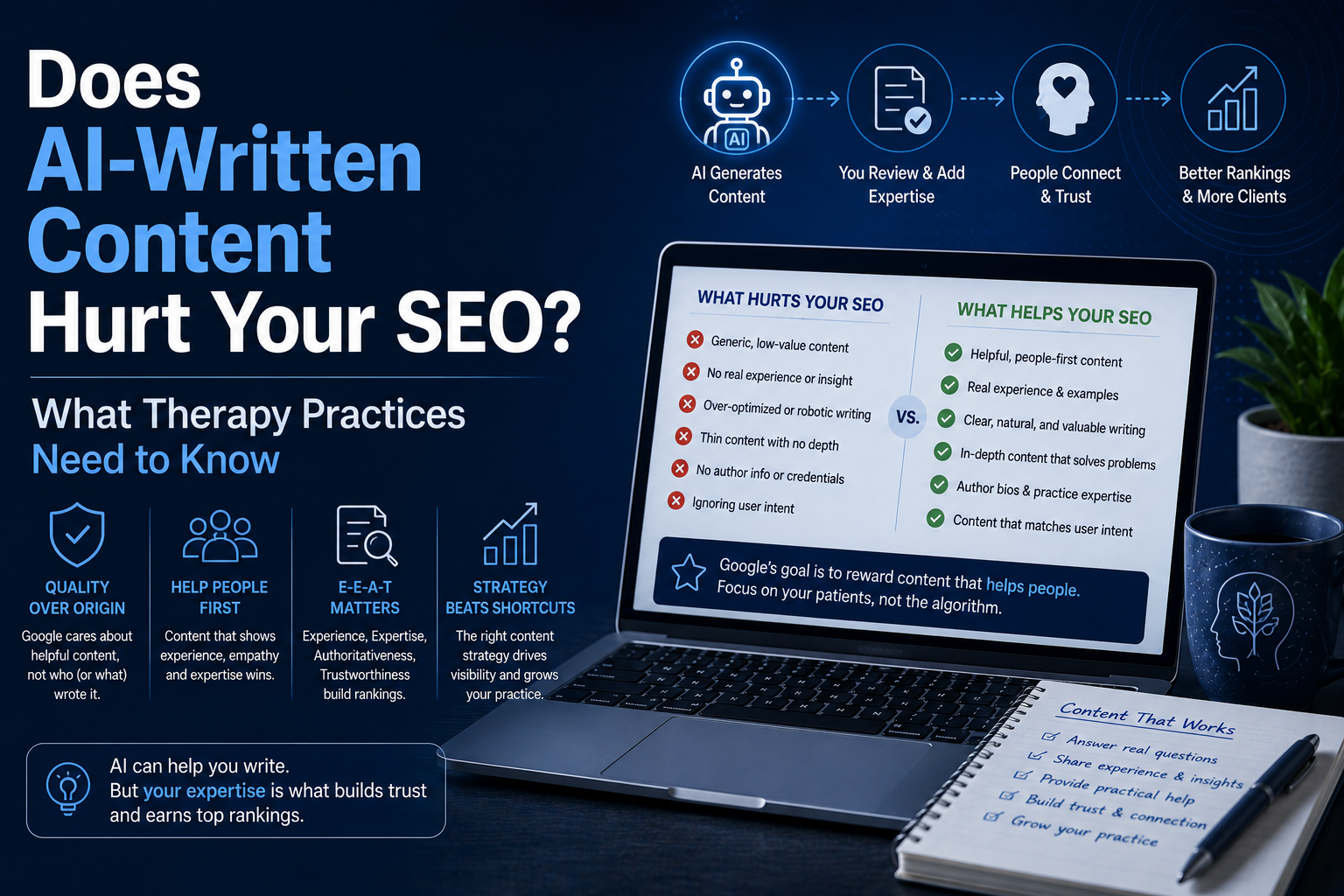
No, Google does not penalize content simply for being written with AI. Google’s stated position, unchanged for years, is that it focuses on the quality of content rather than how the content is produced. There is no separate AI penalty in Search. What Google does penalize is low-value content built to game rankings, whether a person or a machine wrote it. For therapy practices, the catch is that mental health content is held to a higher standard, so careless AI use carries more risk here than in most fields.
What Google Actually Says
Google has been consistent on this point. Generative AI is a useful tool for researching a topic and adding structure to original content. The problem begins when AI is used to mass-produce pages that add little value for users, which can violate Google’s scaled content abuse policy. In other words, the production method is not the signal. The quality is. Google also has no disclosure requirement, so there is no ranking penalty for not announcing that you used AI, though being transparent can build reader trust.
Two things follow, and they cut both ways. An AI-assisted article can rank perfectly well if it is useful, accurate, original, and written for people. An AI-generated article can sink your visibility if it is generic, thin, and produced for volume rather than value. The tool is neutral. How you use it decides everything.
What Actually Gets Penalized, And It Is Not AI
Google formally defined scaled content abuse in 2024 as generating many pages mainly to manipulate rankings, with little or no value added for users. The definition deliberately targets intent and outcome, not the method, which means thin human-written content is covered just as much as AI content. The March 2026 core update enforced this hard, and the patterns that got hit are worth studying because they are exactly the traps a busy practice can fall into.
- High volume with thin depth. Sites that published hundreds of shallow AI pages saw severe traffic losses, often in the range of 60 to 80 percent.
- No author credentials. Content with no named, qualified author was a recurring feature of penalized sites, especially in expertise-driven topics.
- Templated location pages. Near-identical pages differing only by city name, with no genuine local expertise, lost an estimated 30 to 60 percent of their traffic. This one matters enormously for multi-location practices.
- Generic, unoriginal information. Content that only repeats common knowledge or closely mirrors existing sources signals low effort. The algorithm detects sameness, not AI.
Why Therapy Practices Face Higher Stakes
Mental health sits squarely in what Google calls Your Money or Your Life content, the categories that can affect a person’s health, safety, or wellbeing. Google holds these topics to a stricter standard for Experience, Expertise, Authoritativeness, and Trustworthiness, often shortened to E-E-A-T. That higher bar is precisely where unreviewed AI content fails, because it tends to lack the two things a real clinician has in abundance: genuine expertise and first-hand experience.
Read positively, this is good news for you. A generic AI article about anxiety is exactly the kind of content Google is filtering out. A piece grounded in your clinical experience, your approach, and the real questions your clients ask is exactly what it wants to rank. Your expertise is the moat AI cannot cross on its own, which means you are positioned to win if you use AI as an assistant rather than a replacement.
The Danger Zone: Where AI Content Hurts Therapy Practices
These are the specific scenarios that turn AI from an asset into a liability for a practice website:
- Publishing raw AI output without editing, leaving generic phrasing and obvious AI patterns in place
- Mass-producing location or service pages that differ only by a swapped city or service name
- Posting clinically thin content with no real expertise, sourcing, or original insight
- Running content with no named author or no clinician credentials behind it
- Letting AI repeat widely available information without adding anything new
- Using AI to fabricate reviews or testimonials, which violates both Google policy and basic ethics
Notice the theme. None of these are wrong because AI was involved. They are wrong because they produce low-value, low-trust content, and in a YMYL field that failure is punished faster and harder.
How To Use AI For Content The Right Way
Used well, AI is a genuine advantage. The goal is to treat it as a starting point, never the finished product. Here is a workflow that keeps you safe and competitive.
| What Google penalizes | What Google rewards |
| Raw, unedited AI output | An AI draft refined and fact-checked by a human |
| Mass-produced, near-identical pages | Original pages with genuinely unique value |
| No named author or credentials | Content authored or reviewed by a credentialed clinician |
| Generic information copied from everywhere | First-hand experience and original insight |
| Volume produced to chase rankings | Quality that truly helps the reader |
In practice, that means letting AI help with research and structure, then adding what only you can provide. Bring in clinical experience, real examples, and the specific concerns your clients raise. Have a qualified person review every piece for accuracy, since a confident but wrong statement about mental health is a serious problem. Edit out generic AI phrasing so the writing sounds like your practice. Publish under a real, credentialed author. Match what people are actually searching, and update your content over time rather than treating the publish date as the finish line.
The Bonus: Good Content Wins In AI Search Too
There is an extra payoff for doing this well. The same qualities that satisfy Google, original insight, real expertise, and clear structure, are exactly what AI tools like ChatGPT and Google’s AI Overviews look for when they decide which practice to cite. Generic AI content does not get recommended by AI. Authoritative, genuinely useful content does. Investing in quality therefore pays off twice, in traditional rankings and in the AI answers a growing share of clients now rely on.
| Want content that ranks instead of risking a penalty? We produce AI-assisted, expert-reviewed content built for mental health practices and the E-E-A-T standard Google holds them to. Talk to us about content. |
How Mental Health IT Solutions Produces Content That Ranks
We pair the efficiency of AI with mental health expertise and real human review, so your content gets produced at a sustainable pace without slipping into the low-value patterns Google penalizes. That means original, well-sourced articles, credentialed authorship, genuinely unique location and service pages, and a strategy built for both search and AI visibility. It is the approach behind our mental health SEO services, and it builds on the fundamentals in our SEO guide for therapists. We do this for group practices, Therapists & Treatment Centers that need volume and quality at the same time.
| Scale your content without scaling your risk. Expert-reviewed, original content that ranks in Google and gets cited by AI. Explore our SEO services. |
Frequently Asked Questions
Does Google penalize AI-generated content?
No. Google does not penalize content for being created with AI. It judges content by quality and value, not by how it was produced. What gets penalized is low-value, mass-produced content, whether a human or AI wrote it.
Can AI content rank on Google?
Yes. AI-assisted content can rank well if it is useful, accurate, original, and genuinely helpful to the reader. The key is human review, real expertise, and added value, not the use of AI itself.
Can Google detect AI content?
Google does not target AI content directly. Its systems detect patterns of low effort and sameness, such as generic phrasing, thin depth, and near-identical pages. Those patterns get filtered out whether or not AI was involved.
Do I have to disclose that I used AI?
No. Google has no disclosure requirement, and there is no ranking penalty for not mentioning AI. Some practices choose to note human oversight as a trust signal, but it is optional.
Is AI content risky for a therapy website specifically?
It carries more risk than in many fields because mental health is treated as Your Money or Your Life content, held to a higher standard for expertise and trust. Unreviewed, generic AI content fails that standard, so clinician review and real expertise are essential.
Can I use AI to write my location or service pages?
You can use AI to help, but never publish near-identical pages that differ only by city or service name. Templated location pages were among the most heavily penalized content in recent updates. Each page needs genuinely unique, locally relevant content.
Should AI write my entire blog?
No. AI should assist with research and drafting, while a knowledgeable person adds clinical insight, checks accuracy, and shapes the voice. Fully automated, unreviewed content is exactly what tends to underperform and risk penalties.
The Bottom Line For Your Practice
AI-written content does not hurt your SEO because it is AI. It hurts your SEO when it is generic, thin, unreviewed, and mass-produced, the same way low-effort human content always has. For therapy practices, the higher bar of a Your Money or Your Life field means the difference between careless and careful AI use is sharper, but the path is clear. Use AI as an assistant, add your clinical expertise and real review, and publish content that genuinely helps the reader.
Do that, and AI becomes one of the most valuable tools your practice has, letting you produce more high-quality content than you ever could by hand, content that ranks in Google and gets recommended by AI alike. The practices that lose are the ones chasing volume. The ones that win pair AI’s speed with human expertise.
If you want content that captures both, that is what we do. Talk to our team about a content strategy built for your practice.
This article is for general information. SEO results depend on many factors and are never guaranteed, and search policies change frequently. The strategies above reflect current best practices in a fast-moving field.