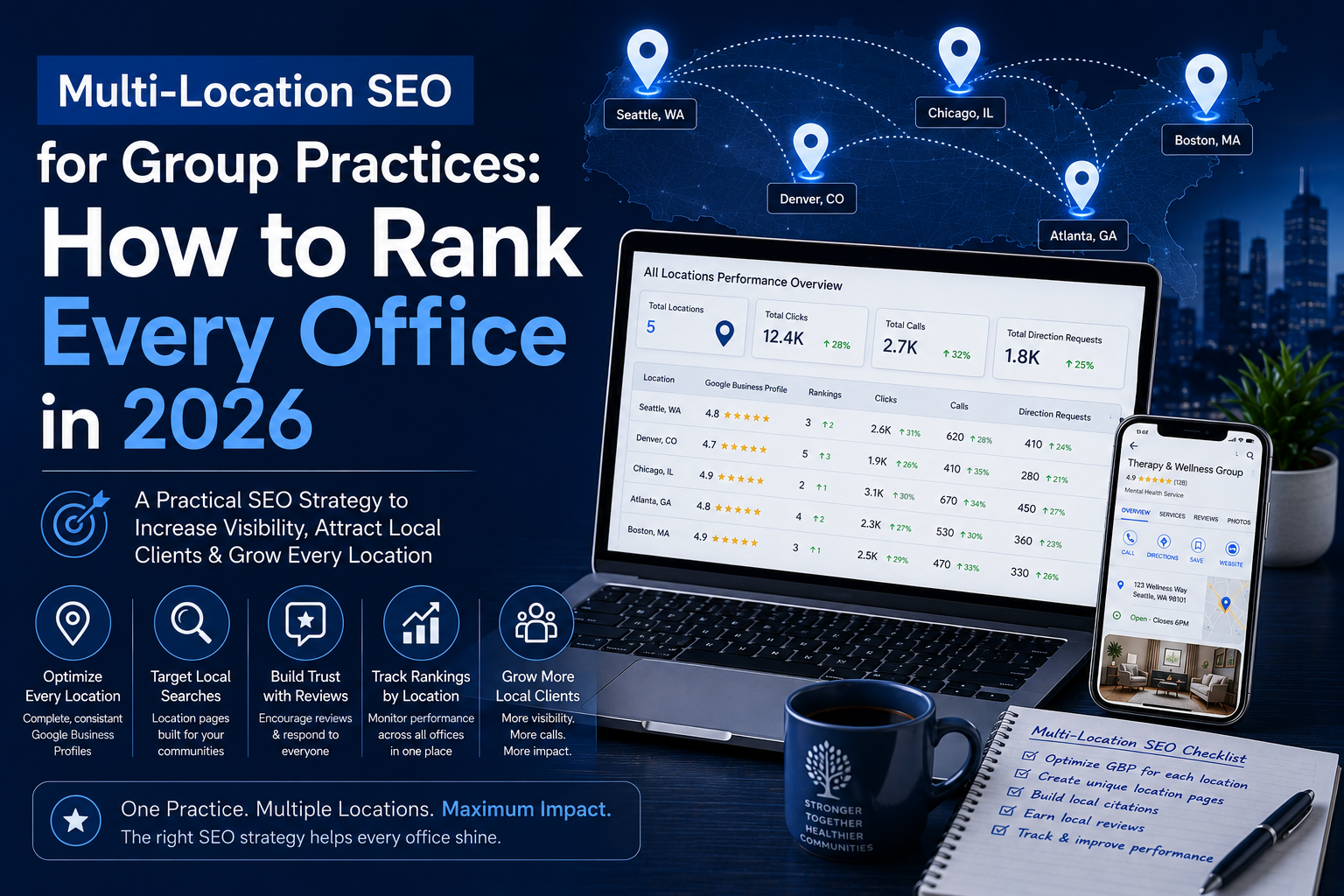
Multi-location SEO for group practices is the process of ranking each office, and in some cases each clinician, in its own local search results while preventing the practice from competing against itself. The first move is structural: every location earns one dedicated page and one verified Google Business Profile, supported by consistent local signals and tied back to a single authoritative practice website through deliberate internal linking.
Get this right and each location appears in the local map pack and organic results for searches in its own city, and the whole site compounds topical authority. Get it wrong and near-identical location pages cannibalize one another, split rankings, and trigger the quality demotions that Google’s helpful-content systems are built to catch.
This guide covers the full playbook: how to structure location pages without duplicate content, how to manage Google Business Profiles at scale, how to keep your name, address, and phone consistent across the web, and how to link it all together so authority flows to every office. It is written for group practice owners and the people who run their marketing, not for therapy clients.
In short: one page and one Google Business Profile per location, genuinely local content on each, consistent NAP everywhere, and internal links from every location page up to a central SEO pillar. A high location count is only an asset when each location is distinct.
This matters more in mental health than in most niches. According to 2026 local-search benchmarks for mental health practices, the listings that win the local map pack overwhelmingly share three traits: a verified Google Business Profile, consistent citations across the web, and a steady flow of recent reviews. Miss any one of the three and a location slips, and for a multi-location practice that gap multiplies across every office.
What is multi-location SEO for group practices?
Multi-location SEO for group practices is local SEO applied at scale. A solo practice optimizes for one city; a group practice has to do the same work for three, five, or fifteen locations at once, without the locations blurring into one another in Google’s eyes.
The goal is straightforward. When someone searches for care near one of your offices, that specific location should appear, with its own address, its own reviews, and its own page. The challenge is that the fastest way to create many location pages, copying one template and swapping the city name, is exactly the pattern Google treats as thin, duplicate content. Multi-location SEO is the discipline of getting the coverage without the cannibalization. The foundations are the same as any SEO for therapists program; the difference is governance across many pages.
Why do group practices struggle to rank multiple locations?
Most group practices run into the same wall: they publish a location page for every city they serve, each one built from the same boilerplate. The pages read almost identically apart from the place name. Google sees a cluster of near-duplicates competing for similar intent, cannot tell which one deserves to rank, and often ranks none of them well.
This is the single most common reason a multi-office practice underperforms in search. For multi-location specifically, three problems dominate: thin duplicate location pages, one Google Business Profile shared across offices, and inconsistent business information scattered across directories. The rest of this guide fixes each one.
How to structure location pages that rank (without duplicate content)
Every physical location gets one canonical page, and that page has to carry content a competitor could not produce by find-and-replace. If you could swap the city name and reuse the page for any other office, it is too thin to rank.
Genuinely local content means the things that are true only of that location: the neighborhoods and surrounding areas it serves, the clinicians who work there, the conditions and specialties most in demand locally, the insurance panels accepted at that office, an embedded map, and a short FAQ written for that community. The work that anchors the whole approach is your city-level local SEO for therapists foundation, applied office by office.
Use this checklist for every location page.
| Per-location element | Why it matters |
|---|---|
| One canonical URL per location | Prevents two pages competing for the same office and intent |
| City and neighborhood named in the H1, intro, and headings | Tells Google exactly where this location serves |
| Unique local content (team, specialties, local demand, insurance) | Defeats the duplicate-content problem that demotes templated pages |
| Embedded Google Map and full NAP | Reinforces location signals and matches the Business Profile |
| Location-specific reviews or testimonials (within HIPAA limits) | Builds trust and feeds local ranking |
| A short FAQ written for that community | Adds extractable, locally relevant content |
| Internal link up to the SEO pillar and to nearby locations | Passes authority and clarifies the structure |
If a location cannot support genuinely unique content, for example a market with no real demand, do not force a thin page. Fold it into a nearby office or a metro hub instead. Coverage without substance is a liability, not an asset.
Want this handled for you? MHIS builds and governs multi-location SEO systems for group practices, from location-page architecture to citation cleanup. See how our mental health SEO services work.
How do you set up Google Business Profiles for multiple locations?
Each physical office needs its own verified Google Business Profile, not one shared profile for the whole practice. The Business Profile is what places a location in the local map pack, and it is often the first thing a prospective client sees, ahead of your website.
Set the primary category accurately for each profile (psychotherapist, counselor, psychologist, or clinic, depending on the office), and add relevant secondary categories. Keep the practice name, address, and phone on each profile identical to the matching location page. Crucially, link each Business Profile to its own specific location page, not to the homepage, so the profile and the page reinforce each other. For offices that also serve clients remotely, set service areas appropriately. The same categories, verification, and service-area steps apply to every office, so complete them once per location.
For practices with many offices, manage profiles from a single dashboard so hours, photos, and posts stay current everywhere. Stale or conflicting profile information is a quiet ranking suppressor across a multi-location footprint.
Why does NAP consistency matter across every location?
NAP stands for name, address, and phone number, and Google cross-checks yours across your website, your Business Profiles, and third-party directories. For a group practice, every office multiplies the places that information can drift out of sync.
The most common trap is legacy data. A clinician leaves, an office moves, or a phone number changes, and the old details stay live on directories the practice forgot about. A single inconsistency erodes local authority; across a dozen offices, the errors compound fast. Audit your citations, correct the mismatches, and keep each location’s NAP identical everywhere it appears. This is unglamorous work, but it is one of the highest-return tasks in multi-location SEO.
How should you handle internal linking for a multi-location group practice?
Internal linking is the structural glue that turns a pile of location pages into a coherent, authoritative site. Without it, each location page floats alone and Google never understands how the pieces fit.
The rule is simple. Every location page links up to your central SEO pillar with descriptive anchor text, and sideways to nearby or related locations where it genuinely helps the reader, for example linking offices within the same metro to one another. Avoid linking every page to every other page; pick the two or three most relevant connections. This passes authority from your strongest pages down to individual locations, and it signals that the practice is a single, deep local authority rather than a scatter of disconnected pages. The same model underpins every cluster on a well-built site: one pillar, supporting pages, and deliberate links between them.
Citation cleanup, profile management, and internal-link architecture across many offices is exactly the work MHIS does for group practices. Talk to our SEO team about your locations.
What about reviews for each location?
Reviews accrue to individual Google Business Profiles, which means each location builds its own reputation. A practice cannot lean on the headquarters profile to carry every office; each location needs its own steady flow of recent reviews to compete locally.
Recency carries real weight here. In mental health, though, review generation comes with constraints that generic advice ignores: HIPAA and professional ethics codes limit how clinicians can solicit testimonials and prohibit confirming that a reviewer was a client, even in a positive reply. Build a compliant review process per location, and respond to reviews in a warm, general way that never confirms patient details. Reviews per office, gathered ethically, are one of the strongest local signals you control.
How do you measure multi-location SEO performance?
Track results location by location, not just for the practice as a whole. A practice-wide traffic number hides which offices are winning and which are invisible.
Watch four things per location: keyword rankings for that office’s city, map pack visibility for local searches, Google Business Profile insights (calls, direction requests, and website clicks), and the inquiries or bookings attributed to each office. When you can see performance per location, you can fix the underperforming offices instead of guessing.
The mistakes to avoid are the inverse of the playbook above: duplicate or near-identical location pages, one shared Business Profile, profiles pointed at the homepage instead of their own page, inconsistent NAP, ignoring reviews at the office level, and deleting underperforming pages instead of redirecting them. Each one quietly caps how well a multi-location practice can rank.
Frequently asked questions
How many location pages should a group practice have?
One per physical office where you have genuine local demand and can write unique local content. Do not create pages for markets with no real search demand; fold those into a nearby office or a metro hub instead.
Can a teletherapy group practice rank in multiple cities without offices there?
It is much harder. Google’s local results favor real, verifiable locations. A teletherapy practice can set service areas on its Business Profiles and compete on organic content, but it will not rank in the local map pack for a city where it has no physical presence.
Should each clinician have their own page, or just each office?
At minimum, each office needs a location page. Individual clinician pages add value because many people search by provider name, and those pages can rank for both branded and non-branded terms. Add them once your office-level pages are solid.
Will multiple location pages hurt my SEO?
Only if they are thin and near-identical. Unique, genuinely local pages help. Templated duplicates trigger the helpful-content demotions that pull down the whole site, which is the core problem this guide is built to prevent.
How long does multi-location SEO take to work?
Local SEO compounds rather than spikes. Expect early movement within a few months of fixing the architecture, citations, and Business Profiles, with rankings building through the following quarters as authority accrues to each location.
The bottom line
Multi-location SEO for group practices is won on structure, not volume. One dedicated page and one verified Google Business Profile per office, genuinely local content on each, consistent NAP across the web, deliberate internal links up to a central pillar, and reviews built ethically at the office level. Do that, and every location earns its place in local search and the whole practice grows more authoritative with each office you add.
If your group practice is adding locations or your existing offices are invisible in local search, MHIS builds the multi-location SEO architecture that ranks every office. Book a strategy call, and we will map the fastest path to local visibility across all your locations.