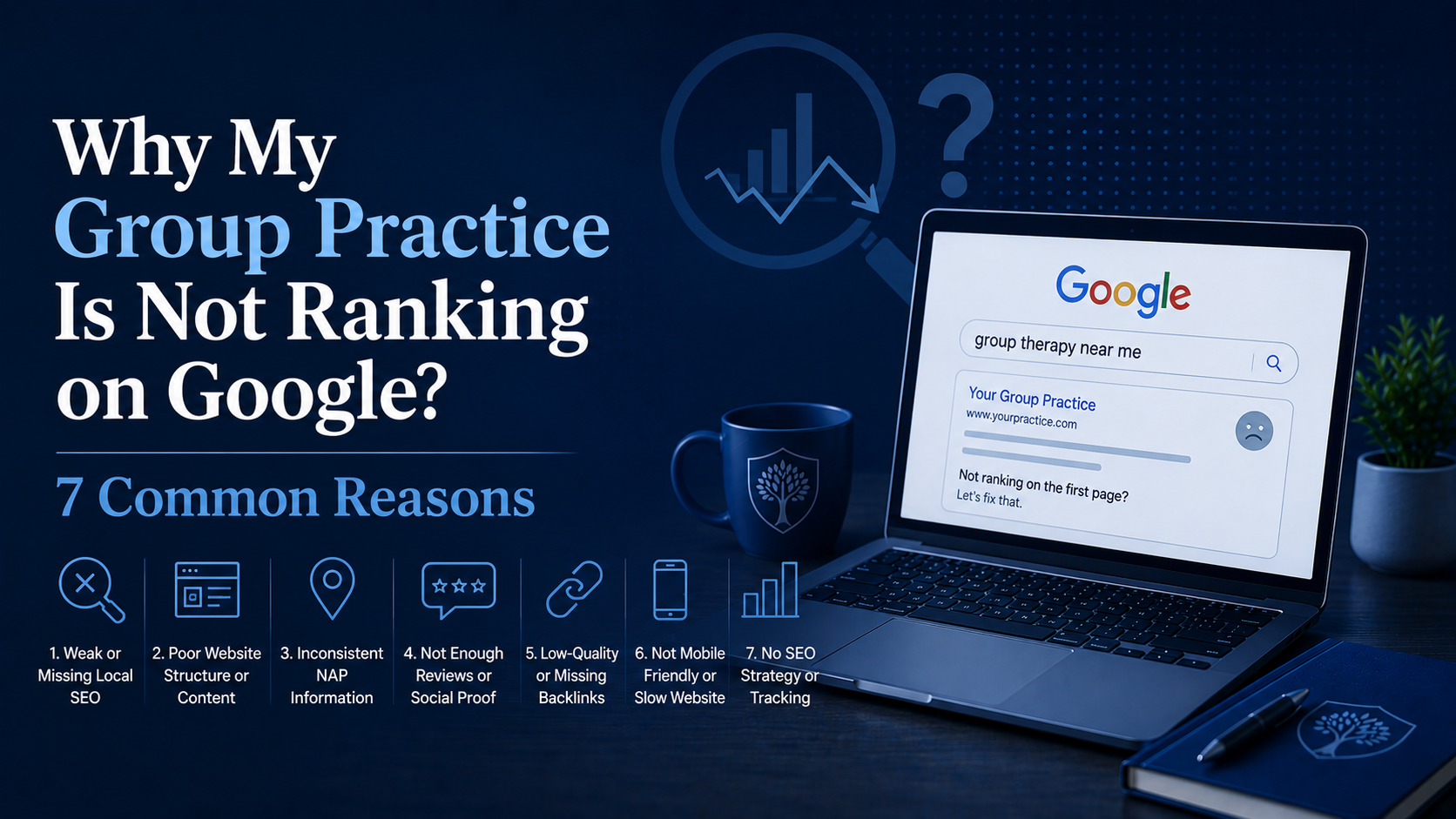
You have skilled clinicians, a thoughtful website, and a practice you are proud of. Yet when you search for the services you offer in your city, your competitors show up and you do not. It is one of the most frustrating problems a group practice owner can face, and you are far from alone in it.
The good news is that poor rankings almost always trace back to a handful of specific, fixable causes. This guide walks through the seven most common reasons a group practice fails to rank on Google, how to tell which ones apply to you, and what to do about each.
First, A quick Reality Check
Two things are worth setting straight before you diagnose anything. First, SEO is not instant. Rankings build over months, so a recently launched or recently changed site simply may not have had time. Second, the bar is higher in your field. Google treats health and mental health content as Your Money or Your Life material, which means it holds your site to a stricter standard for expertise, experience, authority, and trust. For a group practice, with many pages, locations, and clinicians, there is also more surface area where something can quietly go wrong. With that framing in place, here are the usual culprits.
Reason 1: Google Cannot Properly Crawl Or Index Your Site
If search engines cannot read your pages, nothing else matters. This is the silent ranking killer, and it is more common than most owners expect. A slow site, a layout that breaks on mobile, pages accidentally set to noindex, a missing sitemap, or content that only loads through heavy scripts can all keep your pages out of Google’s index entirely.
How to check: search Google for site:yourdomain.com and see how many of your pages actually appear. Open Google Search Console and look at coverage and indexing reports. If key pages are missing, or your site is slow and clunky on a phone, this is likely holding everything back, and it needs to be fixed before any other SEO effort pays off.
Reason 2: Your Content Is Thin, Generic, Or Written For The Wrong Reader
Search engines reward depth and relevance. Many practice sites have only a short paragraph on each service, no real blog, and pages that read like brochures rather than answers to what clients are searching. For a group practice, this often shows up as templated location and clinician pages that all say the same thing. Without genuine topical depth and clear author expertise, Google has little reason to rank you above a competitor who has covered the topic thoroughly. Building that depth is the foundation, and our guide to SEO for therapists walks through how to do it.
Reason 3: Your Google Business Profiles Are Missing Or Unoptimized
For local searches, your Google Business Profile is often more important than your website, because it powers the Map pack that sits at the top of local results. Common problems include not having a Profile at all, leaving it unverified, filling it out only partially, or, for group practices, running every office under a single shared Profile instead of one per location. Each physical office needs its own complete, verified, active Profile. Our How to Optimize Google Business Profile for Therapists covers exactly how to optimize.
Reason 4: You Do Not Have Enough Recent Reviews
Reviews are a powerful local ranking signal, a major trust factor for clients, and one of the clearest signals AI tools use to recommend a practice. A practice with few reviews, or reviews that are old, struggles to compete with one that has a steady, recent flow. For groups, reviews are also location-specific, so a strong review count at your flagship office does little for a newer location across town. If you have no system for requesting reviews at every location, this is a gap worth closing quickly.
Reason 5: Your site lacks authority and quality backlinks
Backlinks, meaning links to your site from other reputable websites, are one of the strongest authority signals in search. Think of them as Google’s version of word of mouth. A practice with few or no quality links from credible sources, such as health directories, local organizations, professional associations, or press, will struggle against competitors who have built that reputation. In a Your Money or Your Life field, this authority and trust layer matters even more, because Google wants confidence that your practice is established and credible before it sends clients your way.
Reason 6: You Are Targeting The Wrong Keywords
Sometimes the content is fine, but it is aimed at the wrong targets. Chasing a broad, fiercely competitive term like therapy or counseling is a losing battle for most practices. The wins come from specific, local, intent-driven phrases that combine a service, a condition, and a place, such as trauma therapy in your city or couples counseling near a specific neighborhood. If you have never mapped which keywords your ideal clients actually search and built pages around them, you may be ranking for nothing simply because you are aiming at the wrong words.
Reason 7: Your Local Signals Are Inconsistent And You Are Invisible In AI Search
Your name, address, and phone number need to match exactly across your website, Google, Psychology Today, and every other listing. Even small inconsistencies confuse search engines and weaken your local trust. On top of that, search itself is changing. A growing share of clients now ask ChatGPT, Perplexity, or Google’s AI Overviews for a recommendation, and if your practice is not structured to be cited there, you are missing a fast-growing source of new clients entirely. Clean, consistent local signals feed both traditional rankings and these AI answers at once.
How To Tell Which Reason Is Yours
Most struggling practices have two or three of these issues at once. Use the table below to match what you are seeing to the likely cause, then start with whichever applies to you.
| What you are seeing | Most likely reason |
| Your pages do not appear in a site:yourdomain.com search | Reason 1: crawling or indexing problems |
| You rank for your practice name but nothing else | Reason 2 or 6: thin content or wrong keywords |
| You are missing from the Google map results | Reason 3: Google Business Profile issues |
| Competitors with fewer services outrank you locally | Reason 4 or 5: too few reviews or weak authority |
| A newer location gets no traffic at all | Reason 3, 4, or 7: local signals for that office |
| AI tools never name your practice in your city | Reason 7: invisible in AI search |
A fast self-audit takes about fifteen minutes. Search your core service plus your city and see where you land. Run a site:yourdomain.com check. Open Google Search Console for indexing issues. Look at each location’s Profile and review count. Finally, ask ChatGPT to recommend a practice like yours in your city and see whether your name comes up.
| Want to know exactly why your practice is not ranking? We run a full audit across your site, your Profiles, your reviews, and your AI visibility, then hand you a clear plan. Request a free ranking audit. |
How Mental Health IT Solutions Fixes Group Practice Rankings
We diagnose and fix all seven of these issues for mental health group practices. That means cleaning up the technical foundation, building genuine content depth and topical authority, optimizing a Google Business Profile for every location, setting up review systems across offices, earning credible authority signals, targeting the keywords your clients actually search, and structuring everything for both Google and AI search. Our mental health SEO services are built for exactly this, and we focus on group practices because ranking many locations and clinicians is its own discipline.
| Stop losing clients to competitors who outrank you. We turn an invisible practice into one that ranks in search and gets recommended by AI. Explore our SEO services. |
Frequently Asked Questions
Why isn’t my group therapy website showing up on Google?
Usually, because of one or more of these issues: technical problems that block indexing, thin content, an unoptimized Google Business Profile, too few reviews, weak site authority, the wrong keyword targets, or inconsistent local listings. A quick audit will tell you which apply to your practice.
How long does it take to rank on Google?
SEO is a long-term effort. Meaningful movement often takes several months, and competitive local markets can take longer. Health and mental health sites are held to a higher standard, so building trust and authority takes time, but the results compound and last.
Why is my competitor ranking and I am not?
Competitors who outrank you usually have stronger signals in one or more areas: more in-depth content, better optimized Profiles, more recent reviews, more quality backlinks, or simply more time invested. Identify where they are ahead and close those specific gaps.
Does my group practice need a blog to rank?
You do not strictly need a blog, but you do need depth. Content that thoroughly covers your specialties builds the topical authority Google rewards, and a blog is the most practical way to create it. For most practices, regular, genuinely useful content is a major ranking advantage.
Why am I not showing up in the Google map results?
Map pack visibility is driven mainly by your Google Business Profile, your reviews, and consistent local listings. If your Profile is missing, unverified, incomplete, or shared across multiple offices, you will struggle to appear in local map results.
Can AI search affect whether my practice gets found?
Yes. More clients now ask AI tools to recommend a practice, and those answers draw on your reviews, listings, and content. If your practice is not structured to be cited, you can be invisible in AI search even while ranking acceptably in traditional results.
Should I hire an SEO agency or handle it myself?
A motivated owner can fix the basics, but multi-location SEO across many clinicians is time-consuming and technical, and most owners do not have spare hours each week to become specialists. An experienced agency usually moves faster and avoids costly mistakes, especially in a regulated field.
The Bottom Line For Your Practice
If your group practice is not ranking, it is almost never because your clinicians are not good enough. It is because one or more of these seven signals is missing or broken: indexing, content depth, Google Business Profiles, reviews, authority, keyword targeting, and consistent local and AI visibility. The encouraging part is that every one of them is fixable.
Start with a quick self-audit to find your biggest gaps, then work through them in order of impact. Get these foundations right and your practice stops being invisible. It starts showing up where clients are searching, in Google and in AI answers alike, across every market you serve.
If you would rather have experts diagnose and fix it for you, that is what we do. Talk to our team about getting your group practice ranking.
This article is for general information. SEO and AI visibility results depend on many factors and are never guaranteed. The strategies above reflect current best practices in a fast-moving field.