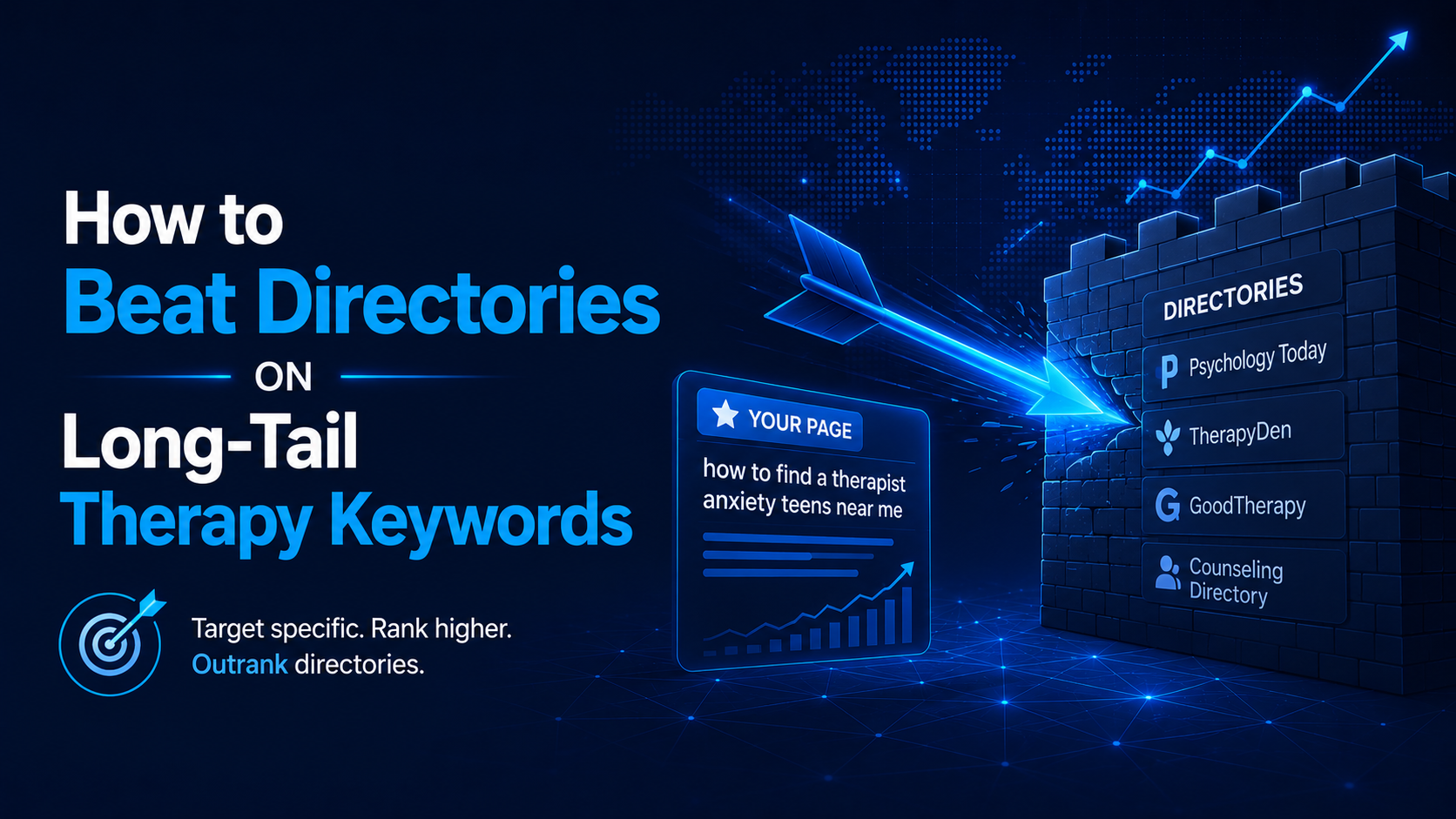
You cannot beat Psychology Today, BetterHelp, or Zocdoc on a broad term like “find a therapist,” and trying is a waste of budget. What you can beat them on is long-tail therapy keywords: specific, multi-word searches like “EMDR therapist for combat veterans” or “DBT group for teens in Denver,” where their generic profile pages cannot compete with a focused, expert page from your own site.
This is not a workaround. It is the realistic competitive reality of therapy SEO. Directories carry enormous domain authority built over years of traffic and links across thousands of listings. A practice website will not close that authority gap on broad terms in any reasonable timeframe. But authority is not the only ranking factor, and it matters less as a query gets more specific. On long-tail searches, relevance and depth beat raw authority, and that is the opening a practice can actually use.
This guide explains why directories dominate broad searches, why long-tail keywords are different, and the specific tactics that let a practice website outrank a directory listing where it counts. It is written for practice owners and the people who manage their marketing, not for therapy clients.
In short: stop competing with directories on broad terms. Target long-tail, condition-plus-approach, and local-plus-specialty keywords where directory profiles are generic and thin, build focused pages with real depth and credentials, and you will out-rank a page with ten times your domain authority.
The pattern is consistent across search data: directories dominate one-and-two-word therapy searches, but as a query grows more specific, and especially once it names a condition, an approach, or a neighborhood, the ranking results shift toward practice websites, clinic pages, and specialty content. Long-tail is where the competitive balance actually favors you.
Why do directories dominate broad therapy searches?
Directories like Psychology Today, BetterHelp, Zocdoc, and TherapyDen rank at the top of broad searches because of domain authority, not because their individual pages are better than yours. They have thousands of backlinks, years of consistent traffic, and enormous topical footprints across the entire mental health space.
Google’s ranking systems reward that scale for broad, competitive terms. A search for “therapist” or “find a therapist near me” has enormous demand and enormous competition, and the sites with the deepest authority usually win it. This is true in almost every YMYL niche, not just mental health: broad head terms go to the biggest, most established players. Fighting directories here, with limited budget and a much younger domain, is rarely a winnable fight and is not where SEO for therapists effort should concentrate first.
Why is long-tail different?
A long-tail keyword is a longer, more specific search phrase, and the more specific a query gets, the less domain authority alone determines the winner. Relevance, depth, and expertise start to matter more.
Here is the shift in practice.
| Query type | Example | Who tends to rank |
|---|---|---|
| Broad head term | therapist near me | Directories, aggregators, map pack |
| Mid-tail term | anxiety therapist | Mostly directories, some practice sites |
| Long-tail, condition-plus-approach | EMDR therapist for combat veterans | Practice sites with focused, expert pages |
| Long-tail, local-plus-specialty | DBT group for teens in Denver | Practice sites with genuinely local content |
| Long-tail, highly specific | somatic therapy for medical trauma survivors | Practice sites, specialty clinics |
A directory typically has one generic profile per clinician, built from a form, covering broad categories. It does not have a dedicated, in-depth page for “EMDR therapist for combat veterans.” A practice that builds exactly that page, with real expertise and real specificity, is often the most relevant result Google can find, and relevance wins on long-tail searches even against a far more authoritative domain.
What tactics actually beat a directory on long-tail keywords?
Five tactics consistently work. Use them together, not in isolation.
Go narrower than the directory can. Directory profiles are built to cover broad categories across thousands of clinicians. They cannot go deep on a single narrow specialty. Build a dedicated page for the specific niche a directory profile only mentions in passing, and you are competing in a space they structurally cannot fill.
Combine condition, approach, and location. The most winnable long-tail keywords stack two or three specific elements: a condition, a clinical approach, and often a place. “EMDR for PTSD” is good; “EMDR for PTSD in Austin” is better, because it adds a proximity signal a national directory profile rarely optimizes for at that level of specificity.
Out-depth the profile page. A directory listing is typically a few hundred words in a fixed template: a bio, a specialty list, a photo. A well-built service page can run far deeper: what the approach involves, who it helps, what to expect, credentials, and answers to real objections. Depth and genuine expertise are exactly what Google’s quality systems reward on YMYL content, and a thin directory template cannot match a thorough, expert page.
Win the trust signals. Visible clinician credentials, accurate and specific information, and clear authorship matter more in mental health than almost any other niche. A directory profile has minimal room for this. Your own page does not.
Build the internal link structure a directory cannot. A directory page stands alone. Your long-tail service page can sit inside a full cluster: linked up to a pillar, connected to sibling content, and reinforced by local SEO for therapists work across your site. That structural depth is a ranking advantage directories do not have at the individual listing level.
Building the long-tail pages and internal linking that outrank directory profiles is exactly the work our SEO team does for practices.
Should you still keep a directory profile?
Yes, but treat it as one channel, not your SEO strategy. A directory profile can bring referral traffic and fills a gap while your own site’s authority builds. What it should not be is the only place your practice’s expertise lives online.
The strategic shift matters here. Search behavior is moving toward original, first-party sources over aggregated ones, which means owning well-structured, expert content on your own site is a more durable long-term position than depending on a directory listing you do not control and whose own rankings can move without warning.
If you want a second opinion on your directory-versus-website balance, our mental health SEO services team can audit where your practice currently stands.
How do you find the long-tail keywords worth targeting?
Look for searches that combine specificity with real demand. The best candidates usually name a condition and an approach together, or a specialty and a location together, and the current top results are dominated by generic or thin pages rather than deep, expert content.
A practical starting point: list the specific populations, conditions, and approaches you genuinely specialize in, cross them with your service area, and check what currently ranks for each combination. Where the results are a mix of directory profiles and thin content, that is a winnable target. Where a well-established clinic already has a deep, expert page, that is a harder fight and worth deprioritizing.
What mistakes undercut this strategy?
The biggest mistake is competing on broad terms out of habit, chasing “therapist near me” while ignoring the long-tail keywords a practice can actually win. The second is building a long-tail page that is just as thin as the directory profile it is trying to beat, which defeats the entire point of out-depthing the competition. The third is neglecting internal linking, so a long-tail page sits isolated instead of gaining strength from a connected cluster. The fourth is abandoning directories entirely instead of treating them as one channel among several.
Frequently asked questions
Can a therapy practice ever outrank Psychology Today?
Rarely on broad terms like “find a therapist,” but regularly on long-tail, specific searches such as a condition paired with an approach, or a specialty paired with a location. Directory authority matters less as a query gets more specific.
What makes a keyword long-tail in therapy search?
A longer, more specific phrase, usually combining a condition, a clinical approach, a population, or a location, rather than a single broad word or two. Examples include “EMDR therapist for combat veterans” or “DBT group for teens in Denver.”
Should I stop keeping my directory profile?
No. Keep it as one referral channel, but do not rely on it as your SEO strategy. Owning deep, expert content on your own site is the more durable long-term position.
How long does it take to outrank a directory on a long-tail keyword?
It varies by competition, but long-tail keywords generally rank faster than broad ones because there is less established competition to overcome. A focused, deep page targeting a specific, low-competition long-tail term can gain traction within a few months.
Do I need many long-tail pages, or a few strong ones?
Depth wins over volume. A handful of genuinely deep, credentialed long-tail pages, well linked into your site structure, will outperform a large number of thin pages built the same way as a directory template.
The bottom line
Beating a directory is not about matching their authority; it is about refusing to fight where authority decides the outcome. Directories win broad terms because of scale you cannot replicate quickly. Long-tail therapy keywords, especially condition-plus-approach and local-plus-specialty combinations, reward relevance and depth instead, and that is ground a focused practice website can win. Go narrower than the directory can, build real depth, show real credentials, and link it all into a coherent site structure, and you will start outranking pages from domains many times your size.
If you want a long-tail keyword strategy built to outrank directories in your market, talk to our team and we will identify the exact terms your practice can win.