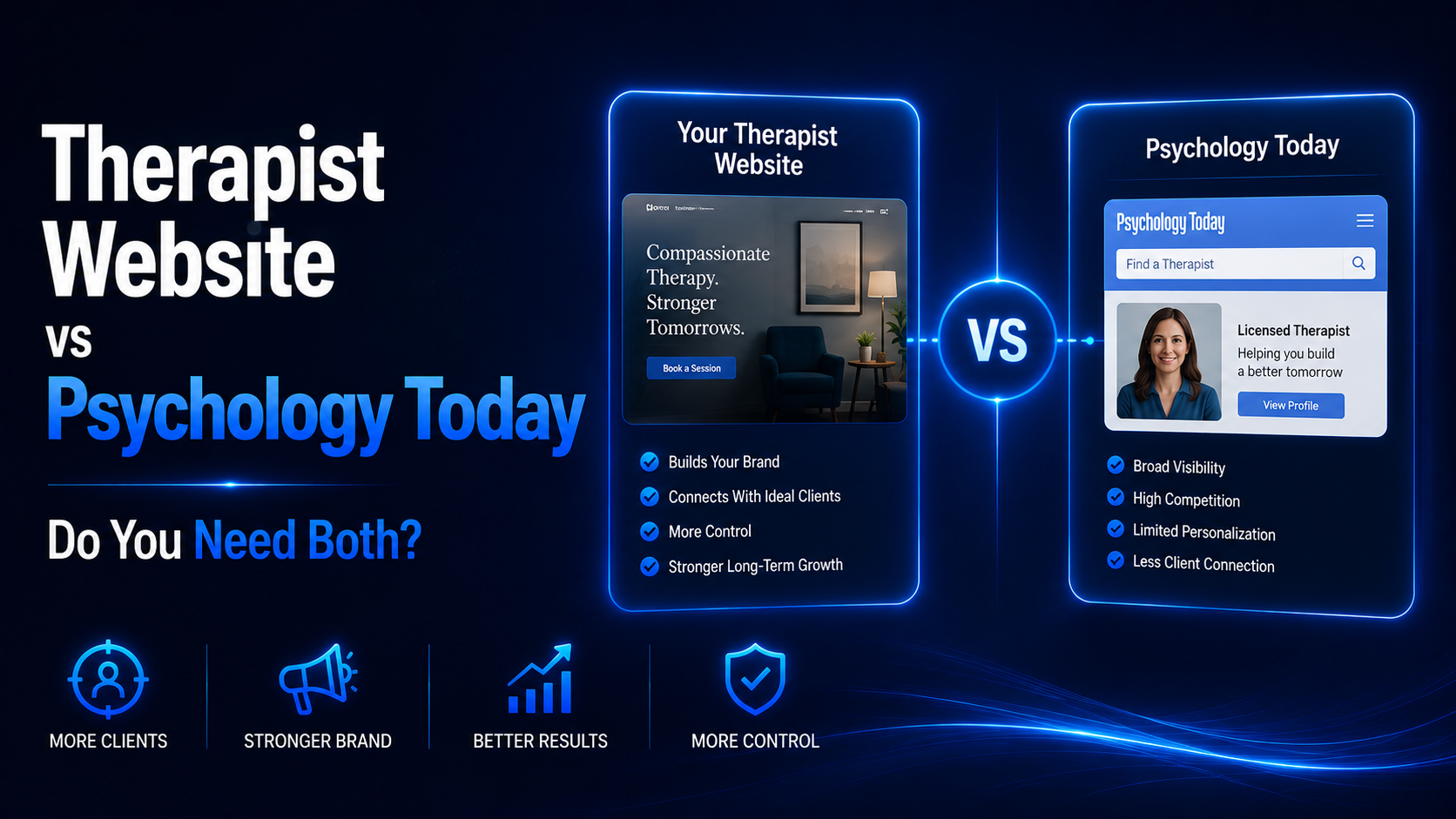
Should you have a therapist website if you already pay for Psychology Today? For most practices, the honest answer is both, not either. A Psychology Today profile puts you in front of people who are already searching for a therapist, which is genuine value that is hard to replicate on day one.
Your own website is the asset you own and control. It is where you differentiate from every other clinician, convert visitors on your terms, and build a search presence that compounds year after year. Used together, the directory feeds prospects toward you, and your website turns them into booked clients. This guide breaks down exactly what each one does, where each falls short, and the strategy that gets the most from both.
Is a Psychology Today profile enough to get clients?
A Psychology Today profile can absolutely bring clients in, and for many new practices it is the fastest way to get a first few inquiries. The problem is not whether it works. The problem is relying on it as your only online presence.
Referral volume from directories has changed. In 2020, a single listing often filled a caseload. By 2026, many therapists report far fewer inquiries per month from Psychology Today, and independent analyses describe a steep decline in referral volume as more clinicians compete for the same visibility. The listing is still inexpensive, so it can pay for itself if it sends even one client. But treating a directory profile as your whole strategy leaves your practice dependent on a channel you do not control and cannot improve much.
The deeper issue is ownership. When someone asks whether Psychology Today is enough, the real question is whether renting a spot on someone else’s platform should be the foundation of your practice’s growth. For most therapists, it should not be the foundation. It should be one input.
What does a Psychology Today listing do well?
A fair comparison starts by giving the directory real credit, because it has real strengths.
Psychology Today has enormous domain authority and consistently ranks at the top of Google for searches like find a therapist in a given city. Its own signup materials note that millions of people find a therapist through the platform, and it is often the first place a prospective client looks. That visibility is difficult for an individual website to match head on.
The listing is also low effort. You fill in a profile, choose your specialties and filters, and you are discoverable. It bundles useful extras such as a telehealth tool, secure messaging, and a protected phone number. As a directory citation, it also contributes to your local search presence by reinforcing your name, address, and phone details across the web. For a therapist who wants to be found quickly without building anything, that is a reasonable value at $29.95 per month, which is $359 per year, per Psychology Today’s current pricing.
Where a Psychology Today profile falls short
The limitations are structural, and they are the reason a directory listing cannot be your whole online presence.
You do not own the profile. You rent visibility, and that visibility ends the moment you stop paying. On the results page, you sit beside your direct competitors, so a prospect comparing three profiles at once may never reach yours. Every profile uses the same template, which means differentiation is minimal. Your unique approach, voice, and specialty depth get flattened into the same layout as everyone else.
You also have little control. You cannot meaningfully shape how the page ranks, how it converts, or what a visitor sees first. Front page placement within the directory is often rotated, so consistent visibility is not guaranteed. There is no room for genuine content marketing, no specialty pages, and no way to build the kind of authority that earns organic traffic on its own. Finally, the traffic and the relationship data belong to the platform, not to you. These directory profile limitations are not flaws you can fix. They are the nature of renting space.
What your own website gives you that a directory cannot
An owned website solves the exact things a directory cannot.
You own it outright. It is an asset that belongs to your practice for as long as you run it, not a subscription that disappears when canceled. You control the branding completely, so the site reflects your voice, your niche, and the specific clients you serve, which is the differentiation a template profile can never provide. You control conversion, from the words in your headline to where the booking button sits and how the whole page guides an anxious visitor toward reaching out.
A website is also a compounding search asset. Every specialty page and every well-written article adds to your authority and can rank on its own over time, which a static directory profile cannot do. You can integrate booking, intake, and the tools your practice already uses, turning the site into a working front desk rather than a brochure. And increasingly, your website is the destination that both Google and AI answer engines send people to when they research a specific therapist by name. It is where private practice website value actually accumulates. MHIS builds exactly this kind of owned asset through our website design and development service for therapists, designed from the first page to convert and to rank.
Therapist website vs Psychology Today: a side-by-side comparison
Here is the Psychology Today profile vs website question reduced to the factors that matter for a practice.
| Factor | Psychology Today profile | Your own website |
|---|---|---|
| Ownership | Rented space you do not own | Owned asset you control fully |
| Branding and differentiation | Template profile, looks like your peers | Fully custom to your practice and niche |
| SEO control | Limited, the platform controls the page | Full control, authority compounds over time |
| Conversion control | The platform’s layout and buttons | Your layout, your copy, your booking flow |
| Content marketing | Not really possible | Blog, specialty pages, and real authority |
| Cost structure | Ongoing rent at $29.95 per month | Investment in an appreciating asset |
| Who else appears | Your competitors sit on the same page | Only you |
| Data and leads | The platform holds the relationship data | You own the traffic and the leads |
| Longevity | Ends when you stop paying | Yours for the life of the practice |
Does Psychology Today rank better than my website?
For broad, generic searches, usually yes, and that is fine. Psychology Today’s domain authority is something a single practice website will not outrank head on for a term like therapist in your city. Trying to beat the directory at its own game is the wrong goal.
Your edge is specificity. A directory profile is generic by design, while your website can own a precise niche, a specific modality, and a defined local area, which is exactly what both search engines and AI answer engines reward. When someone searches for a narrow, high intent phrase, or asks an AI assistant for a particular kind of therapist, engines increasingly triangulate what they know about you from across the web and favor the source with clear, specific, credible depth. That source is your website, not a template listing. So the honest framing is not website versus directory for the same searches. It is the directory for broad discovery, and your website to win the specific, ready to book searches and to convert everyone who arrives.
The smart strategy: use both, with your website as the hub
The practices that grow fastest do not choose. They run both, and they make the website the center.
Keep your Psychology Today listing if it still sends inquiries, and treat it as a feeder. Then make your website the hub that everything points to and that turns interest into booked consultations. Keep your name, credentials, address, and phone identical across your website, your directory profiles, and your Google Business Profile, because consistency strengthens how every engine understands and trusts your practice. Link from your profiles toward your site so curious prospects can go deeper on your terms. The directory earns the first glance. Your website earns the appointment. That is how to complement Psychology Today rather than depend on it, and it is why nearly every therapist benefits from an owned website even while keeping a listing.
If you want that owned hub built to convert and to rank, talk to our team about your practice website. We build custom sites for therapists that do the job a directory profile cannot.
How much does each cost, and what is the real return?
A Psychology Today listing costs $29.95 per month, which is money spent on rented visibility that stops the moment you cancel. A website is a one time build plus modest upkeep, and unlike rent, it is an asset that keeps working and keeps appreciating in value as its authority grows. The return is not just leads this month. It is a practice presence you own outright, that differentiates you, and that compounds for years.
Reducing your dependence on any single channel is the goal, and the fastest way to do that is to make your own site rank for the searches your ideal clients use. Our SEO service for therapists is built for exactly that. For a full breakdown of what a professional build actually costs, see our guide to therapist website cost, and for what a strong site should include, see our guide to therapist website design.
One more reason the owned asset matters: credibility. Stanford Web Credibility Research found that a large majority of people judge an organization’s credibility based on its website design. A polished directory profile cannot deliver that impression the way a professional website can.
Frequently asked questions
Do I need a website if I have Psychology Today?
For most practices, yes. A Psychology Today profile brings discovery, but your website is the asset you own, where you differentiate, convert on your terms, and build search presence that compounds. The strongest approach uses both, with the website as the hub.
Is a Psychology Today profile enough to get clients?
It can generate inquiries, but relying on it alone is risky. Referral volume from directories has declined for many therapists since 2020, and you cannot control or improve a rented listing much. Pair it with an owned website and a Google Business Profile.
What does a website offer that a directory does not?
Ownership, full branding and differentiation, conversion control, content marketing, integrations like booking, and an SEO asset that compounds over time. A directory profile is a template you rent. A website is an asset you own.
Does Psychology Today rank better than my website?
For broad terms, usually yes, because of its domain authority. Your website’s advantage is specificity: a defined niche, modality, and local focus that wins high intent searches and AI recommendations, and converts the visitors a directory sends.
Should I have both a website and a directory profile?
Yes. Keep the listing if it still sends referrals, and make your website the hub everything points to. Keep your name, address, and phone consistent across both, and link from your profiles to your site.
Do I own my Psychology Today profile?
No. You rent the listing on the platform’s terms, and the visibility, the layout, and the relationship data stay with the platform. Your website is the only online presence you truly own.
Final thoughts
The therapist website vs Psychology Today debate is not really a competition. A directory profile is good at being found for broad searches. Your website is good at everything else: differentiation, conversion, authority, ownership, and being the destination that Google and AI engines send serious prospects to. Keep the listing while it earns its keep, and invest in the asset you own, because that is what carries your practice for the long run.
If you are ready to build the website your practice actually owns, one designed to convert visitors into consultations and to rank for the clients you want, see how MHIS builds therapy websites and book a strategy call.