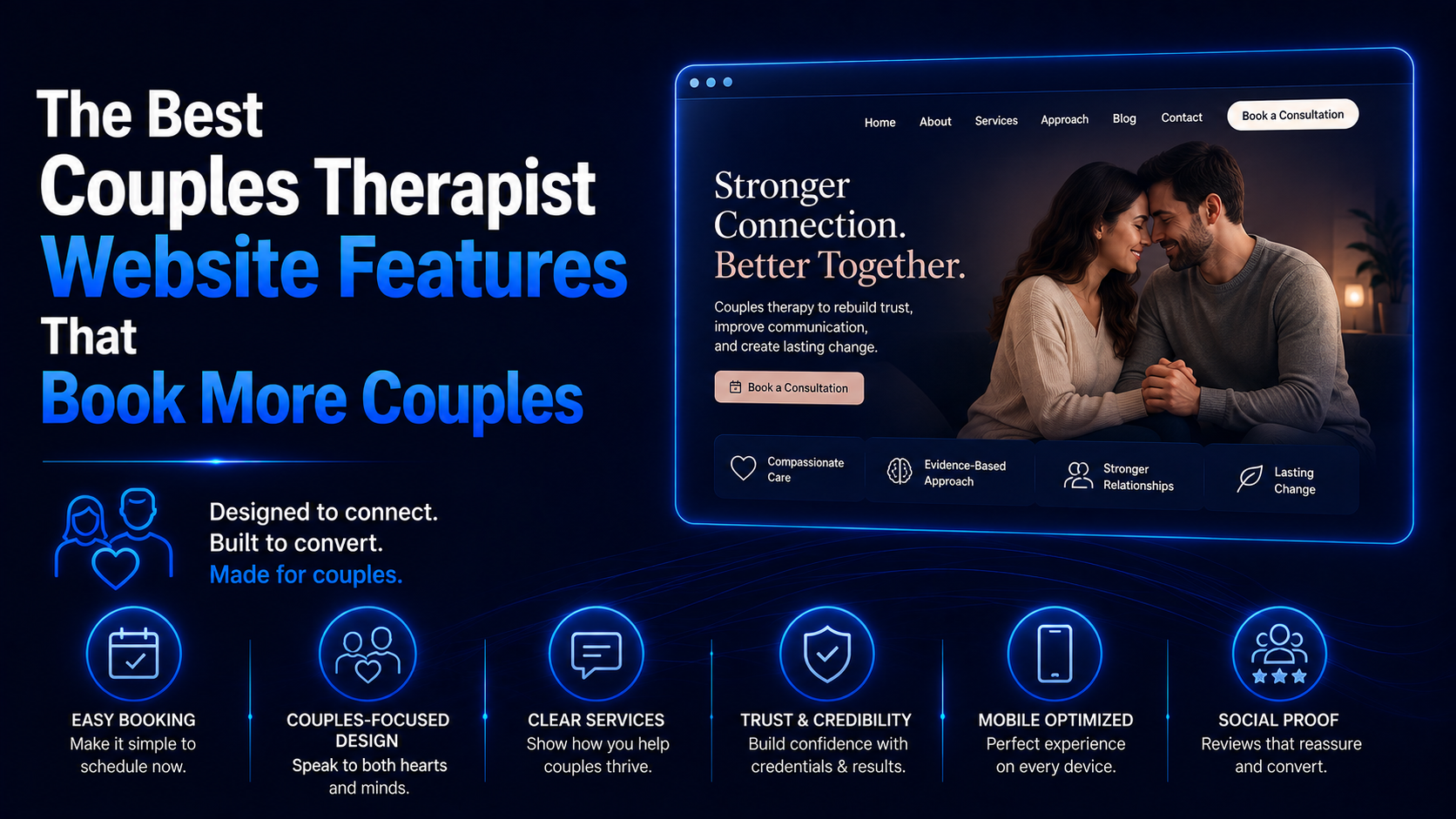
A couples therapist website has one job: turn a stressed, uncertain visitor into a booked consultation. Most therapy sites do not do this well. They read like a resume, bury the booking button, and speak to no one in particular. For couples work, that gap is expensive. The couples searching for you are often in the middle of a hard moment, deciding together, and comparing three or four practices in a single sitting. The site that loads fast, earns trust in seconds, and makes booking effortless is the one that gets the call.
The good news is that the features separating a high-performing couples therapist website from a forgettable one are known and repeatable. Get them right, and your site becomes your most reliable source of new couples.
Here are the ten features every high-performing couples therapist website needs:
- A couples-specific message above the fold
- Frictionless online scheduling
- Mobile-first, fast-loading design
- A trust-building bio with a real photo
- Dedicated pages for each couples service
- Local SEO built into the structure
- HIPAA-conscious contact and intake forms
- Clear fees and insurance information
- Ethical social proof
- Strong, repeated calls to action
1. A Couples-Specific Message Above the Fold
Couples do not want a generalist. When both partners land on your homepage, they need to know within a few seconds that you work with couples, understand their specific struggle, and can help. A headline that reads “Individual, Family, and Couples Therapy” tells them you are a jack of all trades. A headline that reads “Couples Therapy in Your City for Partners Who Want to Reconnect” tells them they are in the right place.
Lead with the couple, name the outcome they want (rebuild trust, stop the same fight, communicate without shutting down, or decide whether to stay), and put it at the very top where no scrolling is required. The first screen is where most couples decide whether to keep reading.
2. Frictionless Online Scheduling
The single biggest leak on most couples therapy websites is the booking step. Couples often decide together in a charged moment, and if booking requires a phone call during business hours, that moment passes and so does the client. Online scheduling that lets a visitor pick a consultation slot in under a minute captures intent while it is high.
Show real availability, keep the form short, and offer a free 15-minute consultation as the low-commitment first step. For couples specifically, make it clear that one partner can book on behalf of both, and that telehealth is available if you offer it. Every extra field and click between “I need help” and “I am booked” costs you clients.
3. Mobile-First, Fast-Loading Design
Most people searching for a couples therapist are doing it on a phone, often late at night after an argument. If your site is slow or awkward on mobile, you lose them before they read a word. A couples therapist website should load in under three seconds, resize cleanly to any screen, and keep the booking button within reach at all times.
Speed is also a ranking factor, so a fast site helps you get found and helps you convert once you are found. The usual fixes are compressing images, choosing reliable hosting, and avoiding bloated page builders that slow everything down.
4. A Trust-Building Bio With a Real Photo
Couples are handing you the most private part of their lives. They will not do that based on a stock photo and a list of degrees. Your bio should include a warm, professional headshot, your credentials and license, your approach to couples work, and a few sentences in your own voice about why you do this.
Photos of the actual office help too, since they make a first session feel less unknown. The goal is simple: a couple should finish reading and feel they already know you a little. That familiarity is what turns a browser into a booking.
5. Dedicated Pages for Each Couples Service
“Couples therapy” is not one thing, and a single catch-all page will never rank or convert as well as focused pages. Premarital counseling, affair recovery, discernment counseling, the Gottman Method, Emotionally Focused Therapy, and LGBTQ+ couples work are all separate searches with separate intent.
A dedicated page for each one lets you speak directly to that couple’s situation, and it gives search engines a clear, specific page to rank for each term. This is one of the highest-return structural decisions you can make, for both search visibility and conversion. A couple searching “affair recovery therapist near me” should land on a page about affair recovery, not a generic services list.
6. Local SEO Built Into the Structure
Most couples want someone nearby or licensed in their state, which means your site has to be built to rank locally. That includes naming your city and service area clearly on the page, adding a location page if you serve more than one area, keeping your name, address, and phone details consistent, and connecting a fully filled out Google Business Profile.
Local structured data (schema markup) helps both search engines and AI tools understand where you practice and what you offer. If local visibility is where you are losing couples, our guide to local marketing for therapists breaks down the moving parts in detail.
Want your site built to rank in your city? Our mental health SEO service handles the technical foundation, from schema and site structure to Google Business Profile optimization, so couples in your area find you first.
7. HIPAA-Conscious Contact and Intake Forms
A standard contact form that emails you a couple’s name and reason for reaching out is a privacy risk. For a couples therapist, forms should collect only what is necessary before the first call, use secure and encrypted submission, and avoid asking for sensitive clinical detail up front.
If you take intake information online, that flow should be handled with HIPAA-conscious tools, not a generic form plugin sending unencrypted data to your inbox. Getting this right protects your clients and protects your license, and it signals to careful couples that you take privacy as seriously as they do.
8. Clear Fees and Insurance Information
Couples counseling is usually private pay, since relationship issues are rarely a billable diagnosis and many couples therapists stay out of network to protect confidentiality. Hiding your fees does not help. It just filters out serious couples later and wastes consultation slots on mismatched inquiries.
State your session fee or a clear range, explain your private-pay rationale in a sentence (confidentiality and no diagnosis on record are genuine benefits to couples), and note whether you provide superbills for out-of-network reimbursement. Couples who are ready to invest will respect the transparency, and you will spend far less time on calls that go nowhere.
9. Ethical Social Proof
Trust sells couples therapy, but the way you build it matters. Most licensing boards and ethics codes, including those from the APA, ACA, NBCC, and NASW, restrict or prohibit soliciting testimonials from current clients, and couples work makes this even more sensitive.
Instead of client quotes, build credibility with your credentials and training, professional memberships, media or podcast features, association logos, and, where appropriate, unsolicited Google reviews that clients chose to leave on their own. The aim is to look established and trustworthy without crossing an ethical line. Always follow the specific rules of your licensing board.
10. Strong, Repeated Calls to Action
A visitor should never have to hunt for the next step. Every page should make it obvious how to book, with a clear button in the header, again partway down the page, and once more at the bottom. Use action language that fits couples work, such as “Book a Free Consultation” or “Schedule Your First Session Together,” rather than a vague “Contact Us.”
One primary action, repeated in the right places, will out-convert a page cluttered with five competing options. Decide the single most valuable thing a couple can do on each page, then make that the obvious choice everywhere.
Your Features Are Only as Good as Your Traffic
Even a perfectly built couples therapist website does nothing if no one sees it. SEO brings couples in over time by ranking you for local and service-specific searches. When you want clients faster, paid search puts you in front of couples the exact moment they search for help. Couples work is a strong fit for ads because it is high-intent and largely private pay, so you reach people prepared to pay your full fee.
Our Google Ads for couples counseling playbook covers the keywords, copy, and landing page approach that work for this niche. If you would rather not run campaigns yourself, our Google Ads management service handles them end to end.
Starting from scratch or fixing an outdated site? Our website design and development service builds couples therapy websites with every feature above already in place: fast, mobile-first, HIPAA-conscious, and built to convert.
Frequently Asked Questions
What features does a couples therapist website need?
The essentials are a couples-specific homepage message, easy online booking, a mobile-first and fast-loading design, a trust-building bio with a real photo, dedicated pages for each service (premarital, affair recovery, Gottman, and so on), local SEO structure, HIPAA-conscious forms, clear fees, ethical social proof, and strong, repeated calls to action. Together these help you rank on Google, build trust quickly, and turn visitors into booked consultations.
How much does a couples therapy website cost?
It depends on scope. A basic template site can run from a few hundred dollars, while a custom, SEO-ready couples therapy website built to convert typically runs from around one thousand to several thousand dollars or more. The right number depends on how many service pages you need, whether you are migrating from another platform, and how much SEO and copywriting is included in the build.
Should couples therapists use WordPress or Squarespace?
Both can work, but WordPress gives you more SEO flexibility, full ownership of your site, and room to grow as you add service pages and content. Squarespace is simpler to start with but more limited over the long term. For a couples practice that wants to rank and scale, WordPress is usually the stronger foundation, which is why most serious practice websites are built on it.
Do I need a separate page for each type of couples counseling?
Yes, if you want to rank and convert well. Premarital counseling, affair recovery, discernment counseling, and method-based work like the Gottman Method or Emotionally Focused Therapy are all distinct searches with distinct intent. A dedicated page for each one lets you match a couple’s exact situation and gives search engines a clear page to rank for each term.
How do I get my couples therapy website to rank on Google?
Ranking comes from a fast, mobile-first, well-structured site, dedicated service pages targeting the terms couples actually search, strong local SEO (city and service-area pages, a complete Google Business Profile, and local schema), and consistent, helpful content. You can accelerate traffic with Google Ads while your organic rankings build over the following months.
Can I put client testimonials on my couples therapy website?
Usually not from current clients. Most ethics codes and licensing boards restrict soliciting client testimonials, and couples therapy is especially sensitive because both partners are involved. Build trust instead with your credentials, training, professional memberships, media features, and unsolicited reviews that clients left on their own. Always follow your specific board’s rules.
Final Thoughts
Your website is the first impression most couples will ever have of your practice, and for many it is the deciding factor in whether they book with you or move on to the next name on the list. The features above are what separate a site that quietly loses couples from one that consistently turns visitors into booked consultations: a clear couples-focused message, effortless booking, fast mobile-first design, real trust signals, focused service pages, and a structure built to be found. Get these right and your website works for you around the clock, bringing in the couples you most want to help.
Ready to build a couples therapist website that books more clients? Get in touch with our team, and we will map out exactly what your site needs to attract, convince, and convert the couples you want to work with.