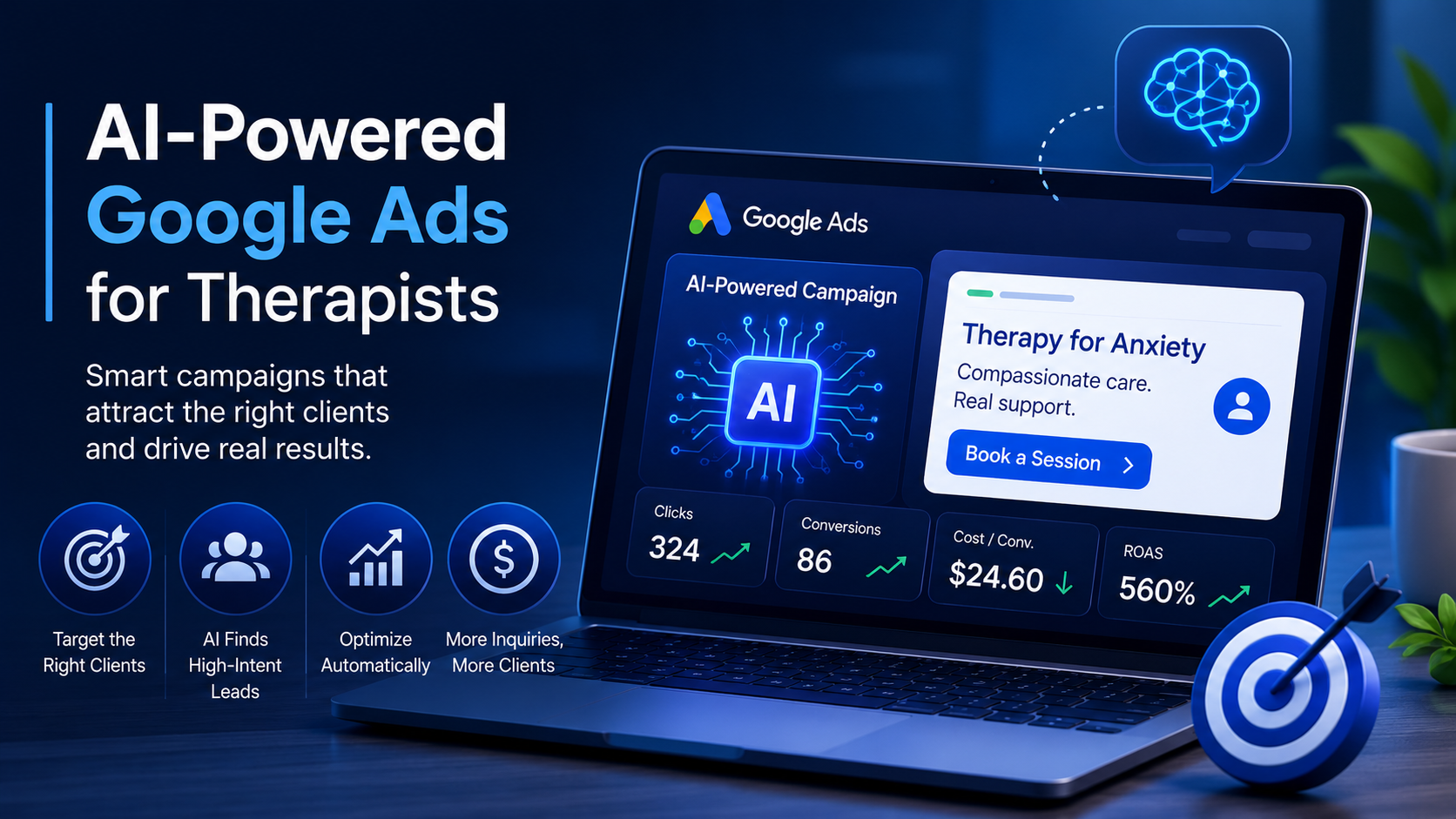
Most Therapists Running Google Ads Are Wasting Money
Not because Google Ads does not work for therapy practices. It does, and when set up correctly, it is one of the fastest ways to get qualified clients booked into your calendar.
The problem is set up. The vast majority of therapists either run campaigns with Google’s default settings, which are designed to maximize Google’s revenue rather than your return, or they hand the account to a generalist agency that has never worked with a mental health practice and does not understand HIPAA compliance, therapy-specific keyword behavior, or what a qualified lead actually looks like for a private practice.
The result is the same in both cases: money spent, clicks generated, phone silent.
Google Ads in 2026 is fundamentally AI-driven. Smart Bidding, AI Max, Performance Max, and automated asset generation have changed how campaigns work at a structural level. The therapists winning with paid search right now are not the ones with the biggest budgets. They are the ones who understand how to configure AI tools correctly, feed the algorithm clean data, and build campaigns around real conversion signals rather than vanity metrics.
This guide covers exactly how to do that.
Why Google Ads Works Differently for Therapy Practices
Before getting into setup, it helps to understand what makes therapy advertising distinct from other service businesses.
People searching for a therapist are typically in a vulnerable moment. They are not comparison shopping the way someone buying a laptop might be. When someone types “anxiety therapist near me” or “EMDR therapy for trauma in Chicago,” they are often ready to book. The intent is high and the window to convert them is short.
This creates both an opportunity and a responsibility. The opportunity is that high-intent search traffic converts at a much higher rate than display or social advertising. The responsibility is that your campaign, your landing page, and your intake process need to be designed for someone who may be in distress, not for someone casually browsing options.
It also creates a compliance consideration. Mental health advertising sits in a regulated space. Google has specific policies for healthcare advertisers. HIPAA creates constraints on what data you can collect and how you can track conversions. Any campaign built without accounting for these realities is likely to burn through budget on unqualified clicks, get disapproved, or create legal exposure.
For a deeper comparison of whether paid ads are the right move for your practice right now, read Google Ads vs SEO for Therapists.
The AI Shift in Google Ads: What Therapists Need to Know
Google Ads in 2026 is not the platform it was three years ago. Manual CPC bidding, exact match keyword control, and rigid campaign structures have been progressively replaced by machine learning. Understanding this shift is not optional. It determines whether you set campaigns up to succeed or set them up to fail while Google’s AI optimizes toward the wrong goals.
Smart Bidding is now the standard. Strategies like Maximize Conversions, Target CPA, and Target ROAS use real-time auction signals, including device, location, time of day, and search query context, to set bids for every individual auction. The AI adjusts thousands of variables simultaneously in ways manual bidding cannot replicate.
AI Max is the newest layer. Announced by Google in May 2025 and rolled out globally through late 2025 into 2026, AI Max applies artificial intelligence to three core elements of Search campaigns: search term targeting, ad copy creation, and landing page selection. Campaigns using AI Max with Smart Bidding Exploration have seen an average 18% increase in unique search query categories that convert and a 19% increase in overall conversions, according to Google’s internal data. For therapists in competitive markets, these gains are significant.
The algorithm needs quality data to perform. This is the most important thing to understand. Smart Bidding optimizes toward whatever you define as a conversion. If your conversion tracking is set up incorrectly or if you are tracking the wrong actions, the AI will learn to deliver more of the wrong outcomes. Clean, accurate conversion data is not a technical nicety. It is the foundation everything else depends on.
Step 1: Get Conversion Tracking Right Before You Spend a Dollar
This is where most therapy practice campaigns fail before they even start.
Conversion tracking is what tells Google’s AI which clicks are turning into real client inquiries. Without it, Smart Bidding has no signal to optimize toward. With incorrect tracking, Smart Bidding optimizes toward the wrong outcomes, and you end up paying for traffic that never converts.
What to track as a conversion for a therapy practice:
- Completed contact form submissions (not page views, not any form interaction)
- Phone call clicks from the ad or landing page (calls over 60 seconds are a strong indicator of genuine interest)
- Appointment booking completions through an online scheduler
- Live chat initiated inquiries
What not to track as a conversion:
- Homepage visits
- Any page views
- Bounce interactions
- Incomplete form starts
The critical rule: Google’s Smart Bidding in 2026 optimizes for whatever you tell it is a conversion. If you label any form interaction as equal to a completed booking request, the system learns to chase cheap, low-quality micro-interactions. Feed it clean signals, actual appointment requests, and qualified phone calls, and it optimizes toward real potential clients.
HIPAA considerations for conversion tracking: Standard Google Analytics and Google Ads pixels are designed to collect as much user data as possible. For a therapy practice, you cannot allow tracking pixels on pages where clients enter any health-related information. Keep PHI entirely out of your tracking setup. Use encrypted contact forms. Avoid retargeting pixels that follow users across the web after they visit mental health pages. HIPAA-aware call tracking tools exist specifically for healthcare, and they are worth using.
For a full walkthrough of campaign setup including conversion tracking, see How to Create a Google Ads Campaign for a Therapy Practice.
Step 2: Campaign Structure That Works for Private Practices
The right campaign structure for a therapy practice is simpler than most people think, and simpler than what most generalist agencies build.
Start with Search campaigns, not Performance Max. Performance Max runs ads across Search, Display, YouTube, Gmail, and Maps from a single campaign using full AI control. For a new therapy practice account without conversion history, Performance Max lacks the data it needs to perform efficiently. It will spend budget learning across too many channels at once. A focused Search campaign targeting high-intent keywords in your specific geography is the right starting point.
Build campaigns around intent, not services. The mistake most therapists make is building one campaign with every service keyword dumped into a single ad group. A better structure separates campaigns by intent category:
- General therapy and counseling searches (“therapist near me,” “find a therapist in [city]”)
- Specialty-specific searches (“EMDR therapy [city],” “trauma therapist near me”)
- Condition-specific searches (“anxiety therapy [city],” “depression therapist [city]”)
- Couples and relationship searches (“couples counseling [city],” “marriage therapist near me”)
Each intent category gets its own campaign with its own budget, its own ad copy matched to that intent, and its own landing page that speaks directly to what the person searched for.
Keep ad groups tight. Each ad group should contain a small cluster of closely related keywords, typically five to ten, all pointing to a single specific landing page. The goal is message match: the keyword, the ad headline, and the landing page headline should all address the same specific need.
Step 3: Keyword Strategy Built for How Clients Actually Search
People in emotional distress do not search using clinical terminology. They search the way they talk. Understanding this is the difference between a keyword list that converts and one that burns budget.
High-converting keyword patterns for therapists:
- Location plus service: “therapist in [city],” “counseling [neighborhood],” “EMDR [metro area]”
- Condition plus location: “anxiety therapist [city],” “depression counseling [city]”
- Ready-to-book intent: “book a therapist,” “schedule therapy appointment,” “accepting new therapy clients”
- Insurance-specific: “therapist accepting [insurance] [city],” “in-network therapist [city]”
Keywords to exclude with a robust negative keyword list. One of the most important and most overlooked parts of a therapy campaign is what you block. Without a strong negative keyword list, Google will match your ads to irrelevant queries and waste significant budget.
Common negative keywords for mental health campaigns include: free counseling, therapy jobs, therapist salary, psychology degree, therapy memes, DIY therapy, online therapy platform (if you are a private practice and not a platform), crisis hotline, emergency mental health, and research-intent terms like “what is CBT.”
Match type in 2026. Broad match keywords paired with Smart Bidding is now the best-performing combination in most well-managed accounts. The key requirement is that a broad match must always be paired with active, ongoing negative keyword management. Without that pairing, broad match will surface irrelevant queries and waste budget rapidly.
Step 4: Smart Bidding Strategy for Therapy Practices
The right bidding strategy depends on where your campaign is in its data-building lifecycle.
Phase 1: New campaign with no conversion history. Start with Maximize Conversions without a Target CPA set. This tells Google’s AI to generate as many conversions as possible within your daily budget. The goal in this phase is not efficiency. It is building the conversion data that the algorithm needs to learn your audience.
Phase 2: After 30 to 50 conversions per month Once you have consistent conversion volume, you can layer in a Target CPA. This tells the AI to maintain a specific cost per acquisition while continuing to maximize conversion volume. For therapy practices, a realistic target CPA varies significantly by market. Competitive cities like Los Angeles, San Francisco, New York, and Toronto will see higher CPAs than mid-size markets.
Phase 3: Scaled and optimized campaign. With strong conversion history, stable Target CPA performance, and a well-managed negative keyword list, you can consider testing AI Max to expand into additional relevant search queries that manual keyword targeting would miss.
The rule is straightforward: do not set a Target CPA before you have enough data. Google recommends a minimum of 30 to 50 conversions per month for Target CPA to optimize effectively. Setting a target too early, before the algorithm has learned, results in the campaign being unable to spend its budget efficiently or delivering inconsistent results.
Step 5: Ad Copy That Converts for Mental Health Audiences
Writing Google Ads for a therapy practice is different from writing ads for any other service business. The person reading your ad may be in genuine distress. Your copy needs to feel trustworthy, calm, and specific, not urgent or pushy.
What works in therapy ad headlines:
- Specificity about who you help: “Anxiety Therapy in [City]” converts better than “Therapy Services Available.”
- Credential signals: “Licensed Therapist” or “LMFT” in the headline builds instant credibility
- Availability signals: “Accepting New Clients,” “Same-Week Appointments Available.”
- Insurance clarity: “In-Network with [Insurance]” if applicable
What to avoid:
- Overly emotional or exploitative language that targets vulnerability
- Vague headlines that could apply to any service business
- Excessive punctuation or urgency language that feels salesy
Google has specific ad policies around mental health content. Certain phrasing around crisis services, suicide, and self-harm is restricted. Understanding these policies before writing copy prevents disapprovals and wasted setup time.
Responsive Search Ads (RSAs) are the standard ad format in 2026. You provide up to 15 headlines and four description lines, and Google’s AI tests combinations to find what performs. Provide the full 15 headlines and all four descriptions. The more asset variety you give the algorithm, the more it can optimize. Do not rely on Google’s auto-generated assets. Review what the system creates and replace anything that does not reflect your actual practice.
Step 6: Landing Pages Built for Conversion
Your landing page is where the conversion happens or does not happen. A well-structured Google Ads campaign sending traffic to a generic homepage or a cluttered website will underperform regardless of how well the campaign itself is set up.
What a high-converting therapy landing page needs:
- A headline that matches the search intent (if someone searched “anxiety therapist Chicago,” the landing page headline should reference anxiety therapy in Chicago)
- A clear, single call to action: book a consultation, schedule a call, or complete an intake form
- Credibility signals above the fold: your name, photo, credentials, and any relevant specialties
- A short, low-friction contact form: name, phone number, and preferred contact time is enough to start. Do not ask for health information in the intake form
- Mobile optimization: the majority of mental health searches happen on mobile devices
- Page speed: Slow pages kill conversions, particularly for users who may be in an anxious state
A strong landing page improves your Quality Score, which directly reduces your cost per click. Google rewards relevance: when the keyword, the ad, and the landing page are tightly aligned, your CPC drops and your ad rank improves. Message match is both a conversion tactic and a budget efficiency tactic.
Step 7: Ongoing Optimization That Keeps Campaigns Profitable
A Google Ads campaign for a therapy practice is not a set-and-forget system. The accounts that consistently generate qualified clients are the ones being actively managed.
Weekly actions:
- Review the Search Terms report to identify and add new negative keywords
- Check conversion tracking to ensure it is firing correctly on all intended actions
- Monitor for any ad disapprovals or policy flags
Monthly actions:
- Review campaign performance against your cost per lead targets
- Assess landing page conversion rate and identify any drop-off patterns
- Evaluate keyword performance and pause or reduce bids on consistently low-performing terms
- Review AI Max or Smart Bidding performance if enabled and assess whether targets need adjustment
Quarterly actions:
- Assess whether the campaign structure still matches your practice’s current service mix and geography
- Review audience signal performance if using AI Max
- Consider expanding to new intent categories if current campaigns are performing well, and you have capacity for new clients
For guidance on how much to budget and how to evaluate whether your spend is generating real return, read How Much Should Therapists Spend on Ads.
The HIPAA Compliance Layer You Cannot Skip
Every point in this guide has a HIPAA dimension that general Google Ads advice will not cover.
Data collection: Standard Google Ads retargeting and remarketing pixels collect and use browsing data in ways that can be problematic for mental health advertising. Someone who visited your anxiety therapy page should not be followed around the internet with banner ads. It erodes trust and may create compliance exposure. Build remarketing exclusions rather than remarketing lists.
Conversion tracking data: Conversion tracking should record that a form was submitted or a call was made. It should never record the content of that form or any health information the person included. Configure your conversion tracking to capture the action event only, not the data within it.
Call tracking: Standard call tracking tools record and store call audio. For a therapy practice, this requires careful evaluation. Use HIPAA-compliant call tracking tools that have signed Business Associate Agreements and handle call data in compliance with healthcare privacy standards.
Ad copy policies: Google prohibits certain targeting approaches in healthcare advertising, including interest-based targeting built around health conditions. Your campaigns should target by geography, search intent, and keywords rather than by health-related audience profiles.
For a broader look at the full Google Ads setup process with compliance built in, see Google Ads for Therapists.
What to Expect from a Well-Run Campaign
Realistic performance benchmarks help you evaluate whether your campaign is working or whether something needs to change.
Google Ads CPCs for therapy-related keywords typically range from $2 to $15 per click, depending on location, specialty, and competition level. High-cost markets like Los Angeles, San Francisco, New York, and Toronto sit at the higher end. Mid-size cities and less competitive specialties can see significantly lower CPCs.
A starting budget of $500 to $1,000 per month gives you enough click volume to generate meaningful data and test what is working. Below this level, your daily budget may be too thin to generate enough conversions for Smart Bidding to optimize effectively, especially in competitive markets.
A well-configured campaign in a mid-competition market should begin showing qualified inquiry volume within the first 30 to 60 days. The first 30 days are a learning period for Smart Bidding. Evaluate performance based on trends, not individual days.
The most important metric is not cost per click or even cost per lead in isolation. It is the cost per booked consultation relative to the lifetime value of a new client. If one new client stays for eight to twelve months at two to four sessions per month, your acceptable cost per acquisition is much higher than it might appear when looking at ad spend alone.
Summary: The AI-Powered Google Ads Setup Checklist for Therapists
Before Launch
- Set up conversion tracking for completed form submissions and qualified phone calls only
- Verify HIPAA compliance in your tracking setup and contact forms
- Build a robust negative keyword list before campaigns go live
- Create dedicated landing pages for each campaign intent category, not links to your homepage
Campaign Structure
- Start with Search campaigns, not Performance Max
- Separate campaigns by intent: general therapy, specialty, condition-specific, couples
- Keep ad groups tight with five to ten closely related keywords each
- Write the full 15 RSA headlines and four descriptions for every ad
Bidding Strategy
- New campaigns: start with Maximize Conversions, no Target CPA
- After 30 to 50 monthly conversions: layer in Target CPA
- Review AI Max only after Search campaigns have a stable conversion history
Ongoing Management
- Review Search Terms report weekly and add negatives consistently
- Monitor conversion tracking accuracy weekly
- Assess the landing page conversion rate monthly
- Evaluate campaign structure quarterly against your current practice capacity
Frequently Asked Questions
Do Google Ads actually work for therapy practices?
Yes, when set up correctly. The key requirements are proper conversion tracking, tight keyword targeting with strong negative keyword management, landing pages matched to search intent, and active ongoing management. Campaigns built on default Google settings or without HIPAA-conscious tracking frequently underperform.
What is the minimum budget for Google Ads as a therapist?
A starting budget of $500 per month is the practical minimum to generate enough data for Smart Bidding to learn. In high-competition markets like Los Angeles, San Francisco, or New York, $1,000 to $1,500 per month is a more realistic starting point. For a detailed breakdown by market and practice type, see How Much Should Therapists Spend on Ads.
What is AI Max and should therapists use it?
AI Max is Google’s newest Search campaign enhancement, launched in 2025, that uses AI to expand keyword targeting, generate ad copy variations, and select landing pages dynamically. It can increase conversions by 14% to 27% in mature campaigns. For therapy practices, AI Max is best tested after your base Search campaigns have stable conversion history and you have negative keyword lists in place to prevent irrelevant query expansion.
Is running Google Ads HIPAA-compliant for therapists?
Google Ads can be run in a HIPAA-conscious way, but it requires deliberate configuration. Standard remarketing, interest-based audience targeting built on health topics, and conversion tracking that captures health information are all problematic. The correct setup uses intent-based keyword targeting, encrypted contact forms, HIPAA-compliant call tracking, and conversion tracking that captures only the action event, not the data within it.
Should a therapy practice use Performance Max campaigns?
Performance Max is generally not the right starting point for a therapy practice. It works best for accounts with strong conversion history and requires high-quality creative assets across image, video, and text formats. New accounts without conversion data see poor efficiency from Performance Max. Start with focused Search campaigns, build conversion history, then evaluate Performance Max as an expansion option.
How long does it take for Google Ads to work for a therapist?
Smart Bidding requires a learning period of two to four weeks after launch. Expect the first 30 days to be data collection rather than peak performance. Most well-configured campaigns begin delivering consistent qualified inquiries within 30 to 60 days. The rate at which you build conversion data depends on budget, competition, and how tightly your campaign is built around high-intent searches.
Conclusion
Google Ads in 2026 is an AI-powered platform. That means the therapists who get results are not the ones who micromanage every keyword bid. They are the ones who understand how to configure the AI correctly: clean conversion signals, tight campaign structure, relevant landing pages, and consistent ongoing management.
The shift to Smart Bidding, AI Max, and automated asset testing is not something to resist. It is something to direct. When you feed Google’s algorithm the right inputs, define your conversions accurately, exclude irrelevant traffic aggressively, and match your ad copy and landing pages to real search intent, the AI becomes a genuine growth tool for your practice.
The practices that treat Google Ads as a system to configure and manage rather than a button to press are the ones filling their calendars. The ones that rely on defaults, ignore conversion tracking, or chase low budgets without strategic structure are the ones concluding that ads do not work for therapists.
They do. The setup is what makes the difference.
Mental Health IT Solutions manages Google Ads exclusively for therapists and private practices. Every campaign we build is HIPAA-conscious, structured around real conversion signals, and managed with the kind of ongoing attention that keeps cost per lead moving in the right direction over time.