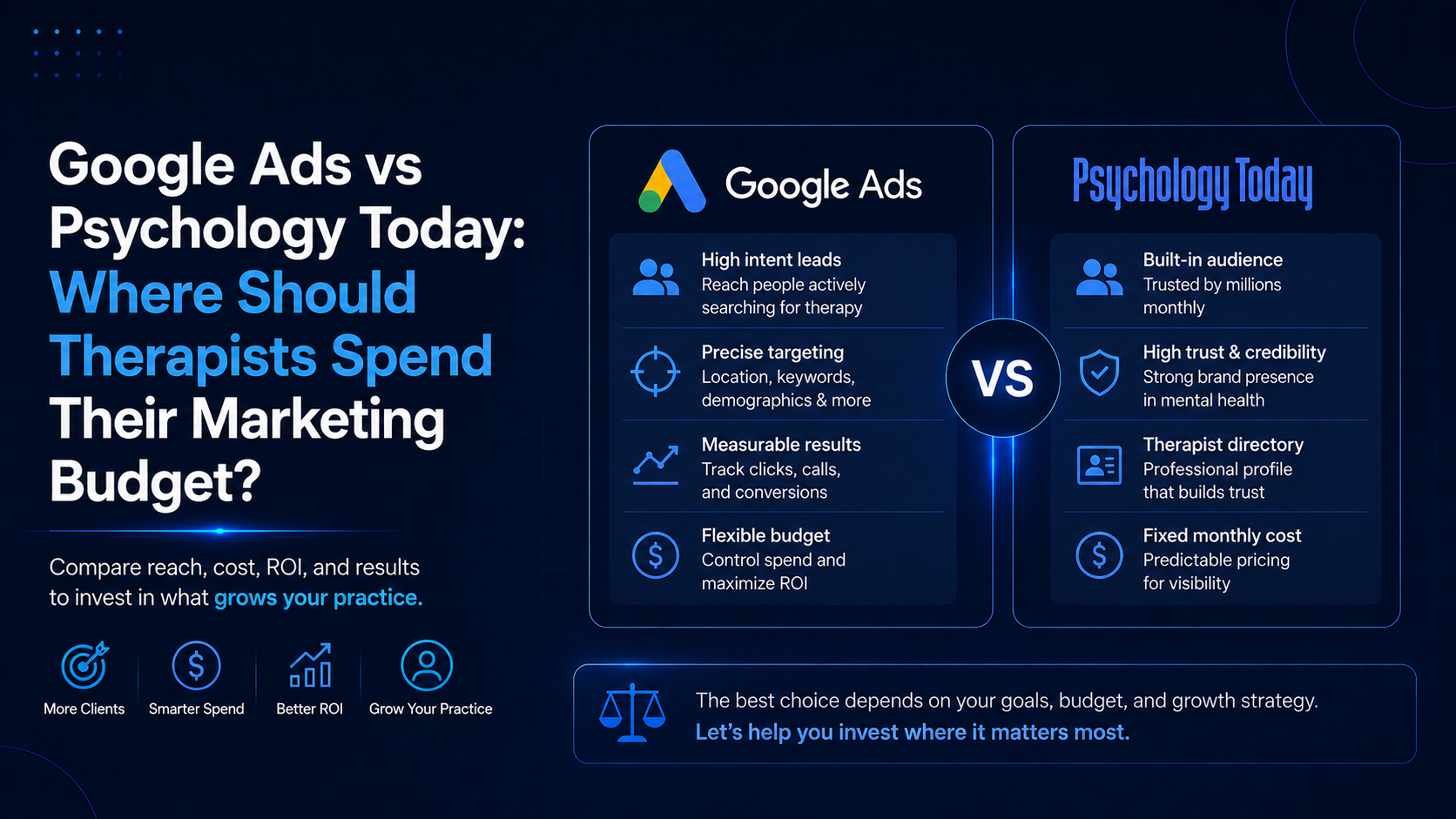
Most therapists do not begin with a marketing plan. They begin with a Psychology Today profile, because that is what a supervisor, a colleague, or a Facebook group told them to do. A year or two later, the inquiries slow down, the profile feels crowded, and a real question shows up: keep paying for the directory, or move that money into Google Ads?
This guide answers that question with current pricing, real cost math, and a clear decision framework, so you can put your budget where it will actually book clients for your practice.
Quick answer: Psychology Today is a low-cost directory listing that puts you in front of people browsing a list of therapists. Google Ads is paid search that puts you in front of people actively searching for help right now, on your own website. For most established practices, Google Ads offers more control and higher intent, while Psychology Today works best as an inexpensive baseline.
Key Takeaways
- Psychology Today costs $29.95 per month for a standard individual listing in 2026. Google Ads has no fixed price; most solo therapists spend between $500 and $1,500 per month on ad budget, plus management.
- Intent is the biggest difference. Directory visitors are comparing several therapists. Google searchers are often ready to book, which usually means higher-quality inquiries.
- Google Ads sends traffic to your own website, so you build an asset you control. Psychology Today keeps that traffic on its platform.
- Google Ads only works with a conversion-ready website. Sending paid clicks to a weak site is the single most common reason therapists conclude that “ads do not work.”
- For most practices, the answer is both. Keep Psychology Today as a low-cost baseline and add Google Ads to target specific niches, locations, and private-pay clients.
Not sure which channel fits your practice? MHIS offers a free growth consultation where we look at your current marketing and show you where your next clients are most likely to come from. No pitch, just a clear read on your situation. Book a free consultation with MHIS.
What Psychology Today Is for Therapists
Psychology Today is a paid online directory where therapists create a profile and appear in a searchable list. Prospective clients filter by location, insurance, specialty, gender, and other criteria, then browse profiles and reach out. You pay a flat monthly fee to stay listed, regardless of how many inquiries you receive.
How the directory works
You build a profile with your photo, a personal statement, your specialties, fees, and insurance accepted. When someone in your area searches the directory, your profile appears alongside other therapists who match the same filters. The client scans the results, reads a few profiles, and contacts the therapists who feel like a fit.
Psychology Today ranks well in Google for many “therapist near me” style searches, which is a large part of its value. Many people who think they are “searching Google for a therapist” actually land on a Psychology Today results page and pick from there.
What Psychology Today costs
A standard individual listing costs $29.95 per month, which is $359.40 per year. There are no premium tiers for solo practitioners. Group practices pay more because each clinician needs a separate profile. A listing also includes a few practical extras: a telehealth platform (Sessions), secure client messaging, a protected phone number, and basic call and email tracking.
Who Psychology Today is best for
- New practices that need visibility quickly on a small budget
- Therapists who accept insurance and want to be found by insurance filters
- Clinicians who want a set-and-forget listing with almost no ongoing management
- Providers in less saturated markets where the directory is not overcrowded
The limitation most therapists miss
Here is the part that rarely gets said out loud. On Psychology Today, you are renting visibility on someone else’s platform, and you share the page with your competitors. When a client views the search results, your profile sits directly beside a dozen other therapists offering similar services. You cannot control your position much, you cannot tailor a landing page to a specific type of client, and if you cancel, everything you built there disappears.
Reported inquiry volume has also softened. Many therapists now report roughly 2 to 5 inquiries per month from a Psychology Today listing, and that number varies widely by city and specialty. The directory is still cheap enough that a single retained client usually justifies the cost, but for a growing practice it is rarely enough on its own.
What Google Ads Is for Therapists
Google Ads is a pay-per-click advertising system that places your practice at the very top of Google search results when someone searches a keyword you choose. You bid on terms like “anxiety therapist Denver” or “couples counseling near me,” and you pay only when someone clicks your ad and lands on your website.
How Google Ads works for a therapy practice
You choose the keywords that represent the clients you want, write ad copy, set a daily budget, and target the specific cities or radius you serve. When someone searches one of your keywords, Google runs an instant auction. Your position depends on your bid, the quality of your ad, and the relevance of your landing page. Better, more relevant ads earn lower costs, so expertise directly lowers what you pay.
The searcher clicks your ad, arrives on your website, and (if the page is built well) books a consultation or calls you. Unlike a directory, the traffic goes to a page you own and control.
For a full walkthrough of the setup, see our guide on how to create a Google Ads campaign for a therapy practice.
What Google Ads costs
There is no flat fee. Your spend depends on your market, your keywords, and your goals. A few benchmarks to set expectations:
- The average cost per click across all Google Ads industries in 2026 is about $5.42, according to WordStream benchmark data.
- Therapy-related keywords typically run $3 to $15 per click, and higher in major metros like Los Angeles, New York, and San Francisco.
- High-value specialties cost more. EMDR, trauma therapy, and couples counseling keywords tend to sit at the upper end because demand and competition are higher.
- Most solo therapists start between $500 and $1,200 per month in ad spend. Below roughly $300 to $400 per month, campaigns rarely gather enough data to perform consistently.
On top of ad spend, most practices either invest their own time to manage the account or pay a specialist. For a deeper look at budgeting, read our breakdown of how much therapists should spend on ads.
Who Google Ads is best for
- Established practices that want more clients than referrals and directories provide
- Therapists who specialize in a specific, high-value niche
- Private-pay practices that want to attract clients willing to pay full fee
- Clinicians who want measurable results and control over targeting and budget
Why Google Ads needs a conversion-ready website
This point decides success or failure. Google Ads sends clicks to your website, so if your site is slow, confusing, or generic, you pay for traffic that never books. Many therapists run ads to their homepage, get poor results, and blame the ads. The real problem is usually the page.
A page built to convert therapy traffic loads fast, speaks directly to the client’s problem, shows credentials and a photo, and makes booking a call effortless. When the page is right, every advertising dollar works harder. When it is wrong, no amount of ad optimization will save the campaign. For newer campaigns, our overview of Google Ads for therapists covers the fundamentals in more depth.
Google Ads vs Psychology Today: Head-to-Head Comparison
In short, Psychology Today wins on cost and simplicity, while Google Ads wins on intent, control, targeting, and ownership. The table below lays out how the two channels compare across the factors that matter most to a private practice.
| Factor | Psychology Today | Google Ads |
|---|---|---|
| What it is | Paid directory listing | Paid search advertising (PPC) |
| Typical cost | $29.95 per month, flat | $500 to $2,000+ per month, plus management |
| Pricing model | Fixed monthly subscription | Pay per click, variable |
| Searcher intent | Browsing a list of therapists | Actively searching for help now |
| Controls your position | Psychology Today’s algorithm | You, through keywords and bids |
| Where the traffic goes | Your Psychology Today profile | Your own website or landing page |
| Asset you build | Presence on a platform you rent | Traffic, data, and audiences you own |
| Ability to differentiate | Low, you sit beside competitors | High, you control the message and offer |
| Speed to first inquiries | Days | Days |
| Ongoing effort | Low, mostly hands-off | Moderate to high, needs management |
| Scalability | Limited | High, raise budget to raise volume |
| Best for | New or budget-conscious practices | Practices ready to target and scale |
The Real Cost Comparison
Cost is where most therapists get stuck, because the two channels are priced in completely different ways. One is a fixed subscription. The other is a variable auction. Comparing them fairly means looking at cost per client, not just the sticker price.
Side-by-side monthly cost
| Channel | Monthly cost | What you get | Realistic monthly inquiries |
|---|---|---|---|
| Psychology Today | $29.95 | One profile, telehealth, messaging, call tracking | 2 to 5, varies by market |
| Google Ads, starter | $500 to $800 ad spend | Top-of-page visibility for your chosen keywords | Depends on CPC and landing page quality |
| Google Ads, growth | $1,000 to $2,000+ ad spend, plus management | Multiple campaigns, broader keyword coverage | Scales up with budget and conversion rate |
A note on those inquiry numbers: Google Ads volume swings widely because it depends on your cost per click and how well your website converts. Two practices spending the same amount can get very different results based on their landing pages alone. That is why the website matters as much as the budget.
Why the cheapest option is not always the best value
Psychology Today looks dramatically cheaper, and on a pure monthly-fee basis it is. But the real question is cost per booked client and the quality of those clients.
- Psychology Today math: at $29.95 per month, a single retained client easily covers the cost. The catch is ceiling. You cannot spend more to get more; you get whatever the directory sends you.
- Google Ads math: costs more per inquiry, but you can target high-fee, private-pay clients and scale the moment it works. A private-pay client at a full fee across several months represents far more revenue than the ad cost to acquire them.
The honest takeaway is that these tools are not really competitors on price. Psychology Today is a low, fixed cost with a low ceiling. Google Ads is a higher, flexible cost with a high ceiling. The right choice depends on whether you need to grow, not just be listed.
Running Google Ads well for a therapy practice is not a plug-and-play task. It takes the right keywords, tight negative keyword lists, conversion tracking, and a landing page built to turn clicks into booked calls. MHIS builds and manages Google Ads campaigns specifically for mental health practices, paired with conversion-focused therapist websites, local SEO, and HIPAA-aware development. See how our Google Ads management for therapists works.
Which One Gets You Better Clients?
Google Ads generally attracts higher-intent clients because searchers are actively looking, while Psychology Today attracts browsers who are still comparing options. Neither is inherently better; the right fit depends on the clients you want and how you get paid.
Browsing versus searching
A person scrolling a Psychology Today results page is in comparison mode. They are reading several profiles and weighing choices, so any single therapist competes for attention on a shared page. A person typing “trauma therapist in Austin” into Google has already decided they need help and are choosing where to go. That difference in mindset is why paid search clicks often convert into booked calls at a higher rate.
Insurance-seekers versus private-pay clients
This distinction is underrated. Psychology Today’s filters funnel many searchers by insurance, which is ideal if you are on panels, but it can shrink your pool if you are private-pay. Google Ads lets you write copy that speaks directly to private-pay clients, target the neighborhoods where they live, and set expectations about fees before they ever click. If your goal is a full caseload of full-fee clients, that control is valuable.
Targeting a specific specialty
A directory lists you under broad categories, so your EMDR or couples work sits in the same pile as general practitioners. With Google Ads, you can build a campaign around exactly one specialty, match the ad and landing page to that need, and capture searchers looking for that specific service. Practices using AI-assisted campaign management can refine this even further; see our guide on AI-powered Google Ads for therapists.
Pros and Cons
Psychology Today: pros and cons
Pros
- Very low, predictable monthly cost
- Fast to set up and get listed
- Strong domain authority, so profiles rank well in Google
- Built-in filters match clients to your specialties and insurance
- Almost no ongoing management required
- A profile link back to your site provides a modest SEO benefit
Cons
- You share the page with competing therapists
- Limited control over positioning and presentation
- No dedicated landing page to convert a specific client type
- Inquiry volume has declined in many saturated markets
- You cannot scale; you get what the directory sends
- The visibility disappears the moment you stop paying
Google Ads: pros and cons
Pros
- Reaches people actively searching for help
- Full control over keywords, targeting, budget, and messaging
- Traffic goes to your own website, an asset you own
- Scales up on demand by raising budget
- Fully measurable, so you can track cost per inquiry
- Lets you target high-value specialties and private-pay clients
Cons
- Higher cost per inquiry than a directory listing
- Requires expertise to set up and manage well
- Needs a strong, conversion-ready website to perform
- Subject to Google’s healthcare and sensitive-category ad rules
- Wasted budget is easy without negative keywords and tracking
- Ongoing time or management cost
Common Mistakes Therapists Make with Each Channel
Psychology Today mistakes
- A bare-bones profile. No photo, a two-line statement, and no specialties. Clients skip these fast.
- Sounding like everyone else. Generic language (“I provide a safe, non-judgmental space”) does not help a client choose you over the profile beside yours.
- Treating it as a complete strategy. A directory listing is a baseline, not a growth plan.
- Ignoring the numbers. Not tracking how many inquiries and booked clients the listing actually produces over six months.
Google Ads mistakes
- Sending traffic to the homepage. A general homepage rarely converts paid clicks. A focused landing page does.
- No negative keywords. Without them, you pay for clicks on “physical therapist,” “massage therapy,” and other irrelevant searches.
- No conversion tracking. If you cannot see which keywords produce calls and form fills, you are optimizing blind.
- Broad match with no oversight. Broad keywords with no monitoring drain budget on searches that will never book.
- Quitting too early. Campaigns need a few weeks of data and refinement. Most failures come from stopping before the account is dialed in, or from never fixing the website.
The Decision Framework: Which Should You Choose?
Choose Psychology Today if you need a low-cost presence fast. Choose Google Ads if you need control, higher intent, and room to grow. Choose both if you want a predictable baseline plus targeted scale. Use the matrix below to match your situation to a starting point.
| Your situation | Better starting point | Why |
|---|---|---|
| Brand new practice, tight budget | Psychology Today | Low fixed cost and fast visibility while you build |
| Established, want more control and volume | Google Ads | Target intent, scale spend, and own the traffic |
| Specialize in a high-value niche | Google Ads | A directory dilutes your niche; ads target it directly |
| Full calendar, want only private-pay clients | Google Ads | Tailored messaging attracts higher-fee inquiries |
| No conversion-ready website yet | Psychology Today for now | Fix the website first, or ads will underperform |
| Want maximum, predictable growth | Both, layered | Directory as a baseline, ads for targeted scale |
When to use both together
For most growing practices, this is the real answer. Keep the Psychology Today listing running as a cheap, passive baseline. Then add Google Ads to do what the directory cannot: target a specific specialty, reach private-pay clients, own the traffic, and scale when you have the capacity. The two channels cover different parts of how people find a therapist, and together they leave fewer gaps.
A Realistic Example
Consider a trauma therapist in Chicago who is private-pay and wants to fill four new client slots each month.
On Psychology Today alone, she pays $29.95 per month and receives about three inquiries. Some are insurance-seekers she cannot serve, and a couple are browsing several therapists at once. She books one to two clients in a good month, which is helpful but short of her goal, and she has no way to increase it.
Adding Google Ads, she invests $900 per month targeting “trauma therapist Chicago” and “EMDR therapist Chicago,” sends clicks to a focused landing page about her trauma work, and speaks directly to private-pay clients. Those searchers are actively looking for exactly her service. Even at a higher cost per inquiry, the clients are a better fit, pay full fee, and stay in treatment longer. Her cost to acquire one client is small compared to the revenue that client represents across several months of sessions.
The lesson is not that one channel beats the other. It is that the directory gave her a floor, and the ads gave her a way to reach her goal on purpose.
Frequently Asked Questions
Is Google Ads better than Psychology Today for therapists?
Neither is universally better; they solve different problems. Google Ads reaches people actively searching for help, gives you full control over targeting and messaging, and sends traffic to your own website, which makes it stronger for practices that want to grow or target a specific niche. Psychology Today is a low-cost directory listing that provides steady, passive visibility with almost no management. For a new practice on a tight budget, Psychology Today is a sensible start. For an established practice that wants more clients and more control, Google Ads usually delivers more. Most successful practices run both, using the directory as a baseline and ads for targeted growth.
How much does Psychology Today cost for therapists in 2026?
A standard individual Psychology Today listing costs $29.95 per month, which works out to $359.40 per year. There are no premium tiers for solo practitioners, so every individual therapist pays the same base rate. Group practices pay more because each clinician needs a separate profile. The listing includes a telehealth platform, secure client messaging, a protected phone number, and basic call and email tracking. Because the cost is fixed and low, a single retained client typically covers the fee for months. The main limitation is that you cannot spend more to receive more inquiries; you get whatever volume the directory sends you in your market.
How much do Google Ads cost for a therapy practice?
Google Ads has no fixed price because you pay per click in a live auction. Therapy-related keywords typically cost $3 to $15 per click, and more in large metros like Los Angeles, New York, and San Francisco. Most solo therapists start with $500 to $1,200 per month in ad spend, plus either their own time or a management fee. Below roughly $300 to $400 per month, campaigns often lack enough data to perform reliably. High-value specialties such as EMDR, trauma, and couples counseling sit at the higher end of the cost range because competition is stronger. Your true cost per client also depends heavily on how well your website converts the clicks you pay for.
Which gets better quality clients, Google Ads or Psychology Today?
Google Ads generally attracts higher-intent clients because searchers are actively looking for a therapist at that moment, rather than casually browsing a list. It also lets you target private-pay clients and specific specialties with tailored messaging, which improves fit. Psychology Today clients are often comparing several therapists at once and may be filtering by insurance, which is ideal if you are on panels but can shrink your pool if you are private-pay. Quality ultimately depends on your goals. If you want a full caseload of full-fee clients in a defined niche, Google Ads gives you more control over who reaches out. If you accept insurance and want steady, low-effort visibility, the directory performs well.
Can I use both Google Ads and Psychology Today together?
Yes, and for most growing practices this is the strongest approach. Keep your Psychology Today listing as a low-cost, passive baseline that captures directory browsers and provides a small SEO benefit through the profile link. Then layer Google Ads on top to do what the directory cannot: reach people actively searching, target a specific specialty or private-pay clients, and scale volume when you have capacity. The two channels cover different stages of how clients look for a therapist, so together they leave fewer gaps in your visibility. The only caution is that Google Ads needs a conversion-ready website to be worth the spend, so make sure your site is ready before you invest.
Why are my Psychology Today inquiries dropping?
Several factors can explain a decline. Many markets have become saturated, so more therapists now share the same results page, which reduces how often any single profile gets contacted. Reported inquiry volume has softened across the industry since 2020 as the directory filled up. Your profile itself matters too; a weak photo, a generic statement, or missing specialties will lower your response rate. Insurance and specialty filters also route searchers, so if your filters do not match local demand, you will see fewer inquiries. If the directory is underperforming, the fix is usually not to abandon it but to strengthen the profile and add a channel you control, such as Google Ads or local SEO, so you are not dependent on one platform.
Do I need a website to run Google Ads for my practice?
Yes, and it needs to be a good one. Google Ads sends paid clicks to a destination, and if that destination is slow, cluttered, or generic, you pay for visitors who leave without booking. This is the most common reason therapists conclude that ads do not work; the ads were fine, but the page failed to convert. An effective page loads quickly, speaks directly to the client’s specific problem, displays your credentials and photo, and makes booking a consultation simple. A dedicated landing page tied to your ad campaign almost always outperforms sending traffic to a general homepage. If your website is not ready to convert paid traffic, it is worth fixing the site before spending on ads.
Are Google Ads HIPAA compliant for therapists?
Google Ads can be run in a compliant way, but therapists must be careful. Google places mental health under sensitive categories and restricts certain kinds of personalized advertising and remarketing based on health-related data, so you cannot target ads in ways that reveal or rely on a person’s health conditions. You also must advertise only where you are licensed to practice and follow all applicable laws. On the tracking side, avoid passing protected health information into ad platforms, and configure conversion tracking carefully. Because the rules are nuanced and change over time, many practices work with a marketing partner that understands both Google’s policies and the compliance realities of a mental health practice, rather than setting everything up unaided.
How long until Google Ads or Psychology Today brings clients?
Both can produce inquiries within days, which is a key advantage over SEO. A Psychology Today profile goes live quickly and can start receiving contacts as soon as it appears in local results. Google Ads can show your practice at the top of search results shortly after the campaign is approved, so clicks and calls can begin the same week. The difference is in the ramp. A directory listing delivers whatever steady volume your market provides. Google Ads improves over the first few weeks as you gather data, add negative keywords, and refine your landing page, so early performance is usually not final performance. Practices that give ads time to optimize typically see cost per inquiry fall as the account matures.
Is Psychology Today worth it if I take insurance?
For insurance-based practices, Psychology Today is often one of the better-value channels. Its filters let clients narrow results by insurance accepted, which puts you in front of exactly the people who can use your services, and the low fixed cost means a single retained client covers many months of the subscription. The main drawback is competition; in busy markets you share the results page with many other in-network therapists, so a strong profile matters. If you rely heavily on insurance referrals, keep the listing, invest in a compelling profile, and consider adding local SEO so you also appear in Google’s map and organic results, giving you visibility beyond the directory alone.
What is a good monthly Google Ads budget for a solo therapist?
Most solo therapists see consistent results starting around $500 to $1,200 per month in ad spend, with the right number depending on your city, your keywords, and how many new clients you can take. Higher-cost markets and competitive specialties push the figure up, because clicks cost more there. Spending below roughly $300 to $400 per month usually gathers too little data to optimize, so campaigns underperform. A practical approach is to start at a level you are comfortable testing, run it for a few weeks with proper tracking, and measure your cost per inquiry before scaling. Remember that budget is only half the equation; a conversion-ready website determines how many of those paid clicks actually become booked clients.
Should a new private practice choose Google Ads or Psychology Today first?
For a brand-new practice with a limited budget and no website built to convert, Psychology Today is usually the smarter first move. It is inexpensive, fast to set up, and provides immediate visibility while you establish your practice. Once you have a conversion-ready website and some capacity to invest, adding Google Ads lets you target the specific clients you want and scale on your own terms. If you are launching with a clear high-value niche and a strong website already in place, you can start with Google Ads sooner to capture high-intent searchers directly. The general path for most new practices is directory first for a baseline, then ads for growth.
Final Key Takeaways
- Psychology Today is a low, fixed cost with a low ceiling. Google Ads is a higher, flexible cost with a high ceiling.
- Intent is the deciding factor: Google searchers are often ready to book, while directory visitors are still comparing.
- Google Ads sends traffic to a website you own; a weak site is the main reason ads underperform.
- For most practices, run both: the directory as a baseline, ads for targeted, scalable growth.
- Match the channel to your goal. Being listed and growing on purpose are two different objectives.
Action Checklist
- Confirm your Psychology Today profile has a strong photo, a specific personal statement, and accurate specialties.
- Track how many inquiries and booked clients your listing produces over the next six months.
- Audit your website: does it load fast, speak to a specific client, and make booking easy?
- Decide your primary goal: steady baseline visibility, or active growth.
- If growth is the goal, define one high-value specialty or client type to target with Google Ads.
- Set a test ad budget you are comfortable with, and require conversion tracking from day one.
- Build negative keyword lists so you do not pay for irrelevant searches.
- Reassess after 30 to 60 days and adjust based on cost per inquiry, not guesswork.
Conclusion
The choice between Google Ads and Psychology Today is not really about which platform is “better.” It is about what your practice needs right now. A directory listing gives you a low-cost floor and steady, passive visibility. Google Ads gives you control, higher-intent clients, and the ability to grow on purpose, provided your website is ready to convert the traffic you pay for.
Most therapists get the best result by combining the two: a Psychology Today profile as an inexpensive baseline, and a well-run Google Ads campaign to reach the specific clients they want at the scale they need. Get both working together, and you stop depending on any single source for your caseload.
Ready to stop guessing where your marketing budget should go? MHIS will review your current setup, build a custom growth strategy for your practice, and give you a clear plan, whether that means Google Ads, a stronger website, local SEO, or all three. Book your free consultation and website review with MHIS today.