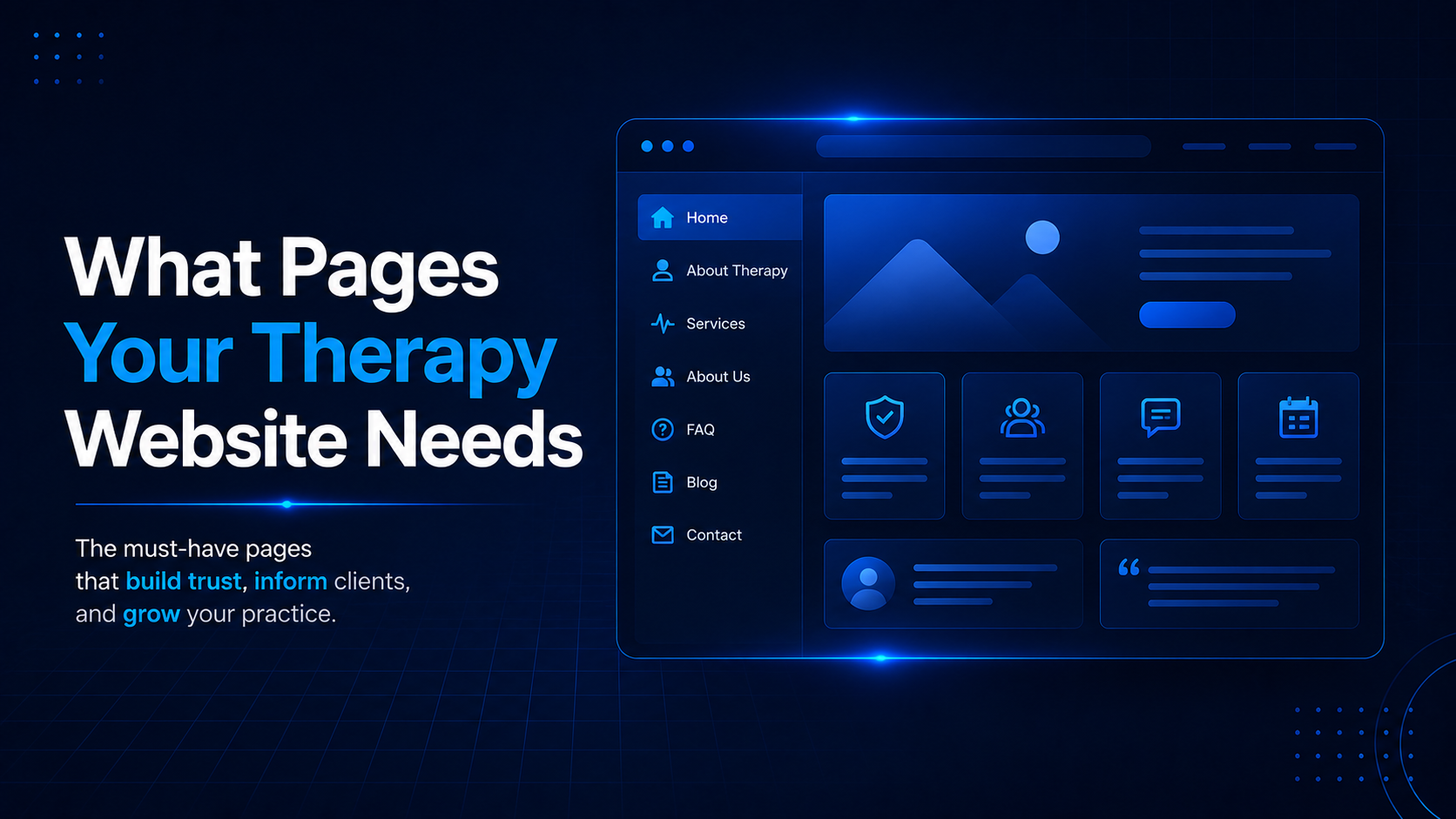
A therapy website needs four categories of pages to function as a real growth asset: foundation pages that establish who you are and what you offer, trust and compliance pages that satisfy both clients and Google’s higher trust bar for health content, conversion pages that turn a visitor into a booking, and growth pages that build search visibility over time. Most therapy websites have the first category and are missing meaningful pieces of the other three, which is why a site can look complete and still underperform.
This matters more in 2026 than it did even two years ago. Mental health is a Your Money or Your Life topic, so Google, and increasingly AI Overviews and tools like ChatGPT and Perplexity, weigh trust, structure, and specificity more heavily on a therapy site than on most other kinds of small business websites. A page list built only around what a visitor needs to see misses half of what actually determines whether the site gets found in the first place.
This guide breaks down every page a therapy website needs, organized by the job each one does, along with the SEO signal it should carry and where it fits in the site’s overall structure. It is written for practice owners and the people who manage their marketing.
In short: build a homepage and about page to establish trust, individual service pages for each condition or approach you treat, an FAQ and legal or compliance pages to satisfy trust requirements, a clear contact and booking path, and a blog to keep building visibility over time. Skipping any tier weakens the whole site, not just that one page.
Tier 1: Foundation pages
These establish who you are, what you offer, and whether a visitor is in the right place. Every therapy site needs them, and they are the pages most practices already have, though often built too thin.
Homepage. The homepage should state clearly, within the first screen, who you help, what you offer, and what a visitor should do next. It functions as a hub, not a summary of everything, and should route visitors toward the service and about pages rather than trying to say everything at once.
About page. This is where trust gets built, and in mental health it carries more weight than in almost any other industry, since clients are choosing someone to be vulnerable with. Cover your approach, your background, your credentials, and what working with you actually looks like, written in your own voice rather than a formal CV format.
Service pages, organized by what you actually treat. This is the single most under-built page type on most therapy sites. A generic “Services” page listing everything you offer in a paragraph will rarely rank for anything specific. Give each core condition-and-approach combination you treat, such as EMDR for trauma or CBT for anxiety, its own dedicated page: what it involves, who it helps, what to expect, and a clear path to book. This structure is what determines whether you show up for the specific searches your future clients actually run, and it is the foundation the rest of your SEO for therapists work builds on.
Tier 2: Trust and compliance pages
These pages do double duty: they answer the practical questions that stand between a visitor and a booking, and they carry the trust signals that a YMYL topic like mental health depends on for search visibility.
FAQ page. A well-built FAQ answers the real questions a prospective client has before reaching out, from clinical questions to logistics like insurance and session format. In 2026, this page has a second job: FAQ content, especially when marked up correctly, is some of the most reliably extracted content by AI Overviews and conversational AI tools, since it is already structured as a direct question and a direct answer.
Insurance and fees page. Cost and payment logistics are one of the most common reasons a prospective client hesitates to reach out. A dedicated page removes that friction, and it is a genuinely high-intent page: someone searching for a practice’s fee structure is close to a decision.
Legal and compliance pages. Every therapy website needs a privacy policy, terms of use, and a professional disclaimer at minimum, and healthcare providers should display a Good Faith Estimate notice consistent with current No Surprises Act requirements. These typically live in the footer rather than the main navigation, but they still need to exist, both for genuine legal protection and because their absence is a credibility gap on a site handling sensitive health information.
Structuring service pages and trust content correctly, so they carry real SEO weight instead of sitting as static boilerplate, is core to what our website design and development services team builds into every therapy site.
Tier 3: Conversion pages
These pages exist for one purpose: turning an interested visitor into a booked consultation. A site can rank perfectly and still underperform if this tier is weak.
Contact and booking page. Keep this simple and low-friction: a contact form with as few required fields as possible, a phone number, an email, and a scheduling link if you offer online booking. Every other page on the site should eventually lead here.
Team or meet-the-clinicians page (group practices). For a practice with more than one clinician, this page is essential and needs to do more than list names. It should route visitors to the right provider based on specialty, and each clinician should have their own dedicated page with real credentials and depth, not a shared, templated bio block.
Location page or pages. For any practice with a physical office, or multiple offices, a location page with a real address, embedded map, and locally specific content supports both the visitor’s decision and local search visibility. Multi-location practices need one genuinely distinct page per office rather than a single combined list.
Tier 4: Growth pages
These pages are not essential on day one, but they are what turns a functional website into a compounding search asset over time.
Blog. A blog built around real search intent, condition-and-approach topics, local-and-specialty topics, and the practical questions prospective clients ask, is one of the highest-leverage ways to keep growing organic visibility after the core site is built. A blog built around generic wellness topics, by contrast, rarely earns its place, since it competes directly with much larger health publishers.
Resources page. If you regularly recommend books, podcasts, or other materials, a dedicated resources page can support both client trust and search visibility for those specific recommendations, though it is genuinely optional rather than essential.
Testimonial and outcomes-focused content, handled carefully. Reviews and testimonials build trust quickly, but mental health has real ethical and HIPAA constraints on what can be published and how. Any testimonial content needs to be handled in a way that never confirms a specific person was a client, which shapes how this page type gets built far more than it does for most other small businesses.
If your site is missing full service pages, a real FAQ, or the trust signals a therapy site needs, our website design and development team can build the missing tiers.
The full structure at a glance
| Tier | Page type | Primary job |
|---|---|---|
| 1. Foundation | Homepage | Orient the visitor and route them to the right next page |
| 1. Foundation | About page | Build personal trust and connection |
| 1. Foundation | Service pages (per condition/approach) | Rank for specific, high-intent searches |
| 2. Trust and compliance | FAQ page | Answer objections; feed AI Overview and voice answers |
| 2. Trust and compliance | Insurance and fees page | Remove a common booking barrier |
| 2. Trust and compliance | Legal and compliance pages | Meet legal requirements and support credibility |
| 3. Conversion | Contact and booking page | Convert interest into a booked consultation |
| 3. Conversion | Team page (group practices) | Route visitors to the right clinician |
| 3. Conversion | Location page(s) | Support local decisions and local search |
| 4. Growth | Blog | Build compounding organic visibility over time |
| 4. Growth | Resources page | Optional; supports trust and niche visibility |
Do you need a page for every service and specialty?
Not necessarily every combination at once, but every core one. Start with dedicated pages for the conditions and approaches that make up the bulk of your caseload, since those carry the clearest search intent and the most direct path to a booking. Add narrower specialty pages over time as your content library grows, rather than trying to launch with every possible combination covered on day one.
How many pages does a therapy website actually need at minimum?
At minimum: a homepage, an about page, at least one service page, a contact page, and an FAQ page. That is enough to launch credibly. It is not enough to compete for meaningful search visibility over time, since a five-page site has very little surface area for Google or AI systems to find and trust. Treat the minimum as a starting point, not a destination.
Frequently asked questions
What is the most important page on a therapy website?
The service pages, more than the homepage, tend to carry the most SEO weight, because they target the specific searches prospective clients actually run. A strong homepage and about page build trust once someone arrives; service pages are often what brings them there in the first place.
Does a therapy website need a blog?
Not on day one, but it is one of the most effective ways to keep growing visibility over time. A blog built around real search intent, rather than generic wellness topics, compounds in value as it grows.
Do I need a separate page for every specialty I offer?
Start with your core specialties, the ones that make up most of your caseload, and expand from there. A handful of deep, well-built specialty pages outperform a large number of thin ones.
Is a one-page website enough for a therapy practice?
It can work for a referral-heavy practice that is not relying on search for new clients, but it significantly limits SEO potential, since Google and AI systems have far less content to evaluate and trust. Most practices growing through search need a multi-page structure.
What legal pages does a therapy website need?
At minimum, a privacy policy, terms of use, and a professional disclaimer, along with a Good Faith Estimate notice consistent with current No Surprises Act requirements. Requirements vary by state and by professional licensing body, so confirm current obligations with your relevant governing organization.
The bottom line
A therapy website needs more than the pages that feel obvious. Foundation pages establish who you are, trust and compliance pages meet the higher bar mental health content is held to, conversion pages turn interest into bookings, and growth pages compound your visibility over time. Build across all four tiers, with real depth on your service pages in particular, and the site becomes an asset that keeps earning visibility rather than a static brochure.
If your website is missing pages from any of these tiers, talk to our team and we will map the structure your practice actually needs.